The hunting swamp is everywhere: how FACE and the recreational hunting associations do politics
From Brussels to Bern, the recreational hunters' associations pursue the same goals: less species protection, more kill authorisations, more state funding. At the centre stands the European umbrella organisation FACE.

«The green network of favouritism»
On 21 September 2026, the German blog WolfsBlick published an extensive documentation with 73 sources.
The title: «The hunting swamp of power, money and killed animals». The author does not describe a secret society, but an open network whose building blocks can be traced in lobby registers, parliamentary papers and association communications. Anyone who reads the text and then looks across borders will find that this network is not a German phenomenon. In France, Italy, Austria and Switzerland it operates according to the same rules. And it has a common head.
The head of the fish: FACE in Brussels
The European Federation for Hunting and Conservation (FACE) represents, by its own account, around seven million recreational hunters. It consists of national associations from 37 countries, including all 27 EU member states, and has its secretariat in Brussels. The German Hunting Association (Deutscher Jagdverband), the French FNC, Jagd Österreich, the Italian associations and JagdSchweiz are affiliated with it.
How close the interconnections are is shown by the board list on the FACE website. Vice-president for Germany is Helmut Dammann-Tamke, who is also president of the DJV. For France, Nicolas Rivet sits on the board, general director of the FNC. Treasurer General is David Clavadetscher, managing director of JagdSchweiz. The people who set the course in Brussels lead the national associations back home. FACE is financed mainly through membership fees, though part of the budget, according to its own statements, comes from the EU Commission's LIFE programme.
Its most important lever is the direct line into the European Parliament. FACE is a member of the EU Transparency Register and has run the secretariat of the parliamentary intergroup «Biodiversity, Hunting, Countryside» since 1985, which by its own account is supported by more than 120 members of parliament. Today FACE shares this task with the European Landowners' Organization, the association of large landowners. The intergroup does not pass laws. However, it is a permanent platform on which members of parliament, the Commission and associations discuss nature and hunting policy, and its secretariat is provided by a lobby group.
Wild beim Wild already documented how FACE handles facts back in September, using three examples from a single week. From the Spanish national park Cabañeros, where red deer and wild boars are regulated using trapping facilities, the association concocted an alleged «management vacuum». A vaccination warning issued by the Latvian veterinary service to dog owners was turned into an argument for fox hunting, even though the official notice did not mention hunting at all. And FACE celebrated the dilution of the EU lead ban as a viable compromise. The expert committees of the EU Chemicals Agency had recommended a transition period of between 18 months and five years for lead shot, with the Commission proposing three years. The proposal approved in June now grants lead shot a transition period of seven years, while lead bullets have for now been dropped from the ban altogether. Yet the ECHA estimates that the ban over wetlands alone prevents the avoidable lead deaths of around one million water birds every year.
FACE has already named its next target: the «stress test» of the EU nature conservation directives, in which the association is chiefly focused on the procedure for amending the species annexes. The downgrading of the wolf was the blueprint. The same demands recur in the statements of national associations, from Berlin to Bern. Whether one sees this as a coordinated strategy or an ideological alignment is a matter of judgement. The connections themselves are publicly documented. In Switzerland this line runs particularly directly: JagdSchweiz managing director David Clavadetscher also serves as treasurer of FACE. Wild beim Wild has therefore previously described the Swiss umbrella association as a misinformation factory FACE is the same factory, just with European reach.
Germany: An association celebrates its law
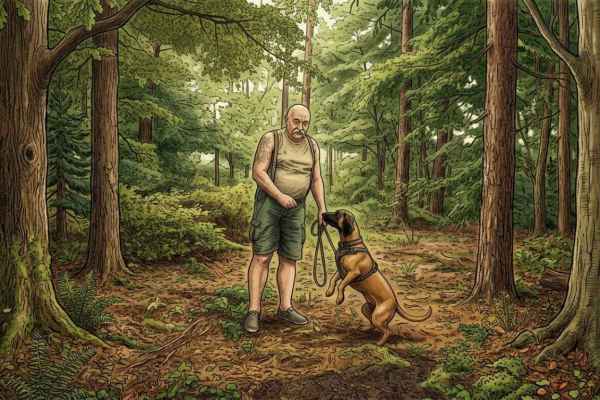
The starting point of WolfsBlick is Java, a three-year-old Czechoslovakian wolfdog who was shot dead near Nordhorn in January 2026 by a recreational hunter. According to his own explanation, he mistook her for a wolf and panicked. Even the local hunting community made clear that there was no legal basis for this shot.
From there, the article traces the structure: the German Hunting Association (DJV) itself describes the inclusion of the wolf under hunting law as its own «success story». It called for the killing of up to 40 percent of the annual wolf offspring and welcomed the proposal that legal challenges against kills should no longer have automatic suspensive effect. DJV president Helmut Dammann-Tamke previously sat for almost twenty years for the CDU in the Lower Saxony state parliament. The Lower Saxony State Hunting Association coordinates the state's wolf monitoring while simultaneously demanding that the same species be hunted. The Bavarian Hunting Association received around 4.9 million euros from the hunting levy between 2019 and 2023, used among other things for public relations work in nurseries and schools, and is calling for wolf monitoring to be placed in hunters' hands.
The DJV is a member of FACE, and its president sits on its board as vice-president. Its call for kill quotas for the wolf follows the same line that FACE pursued in Brussels for downgrading the species' protection status.
France: Willy Schraen, proud of killing and the president's «declarations of love»
In France, the hunting swamp has a face: Willy Schraen, president of the Fédération nationale des chasseurs (FNC). Unlike most officials, he does not hide the motive of recreational hunting behind wildlife management or service to nature. In August 2020, asked on the broadcaster CNews whether killing gave him pleasure, he replied: «The answer is yes. I enjoy killing animals as part of hunting.» Killing was «not violent at all». One doesn't need to hunt for food, he said, but it is «a great pleasure». Wild beim Wild has examined this self-disclosure in detail.
Part of their self-image is a claim of ownership over the landscape. Schraen advised walkers who feel uneasy among armed recreational hunters to go for a walk at home instead. His remark, "Nature does not belong to everyone," earned him the title "Trump at the trigger" from the director of the French Bird Protection League. At the opening of the 2026/27 season, he called on recreational hunters to be proud, announcing that they would not be intimidated and would relinquish neither territories, nor traditions, nor rights (Wild beim Wild reported).
The association responds to criticism with pressure. When Green MP Sandrine Rousseau called in August 2026 for people to head into forests and fields on the opening day of hunting season, the FNC announced it would file a criminal complaint and contacted the President of the National Assembly. Regional associations urged their members to sign a petition demanding Rousseau's resignation. Back in 2021, Schraen had personally won a court case against Brigitte Bardot, who had insulted him on her foundation's website with an unacceptable term tainted by Nazi associations. She was ordered to pay him 1,000 euros in damages.
Even natural disasters change nothing about this. When animal welfare organisations called for the hunting season to be postponed after the wildfires of summer 2026, since food sources and habitats had been destroyed over vast areas, Schraen called this "ridiculous" and an "ideology of eco-activists who understand nothing about it." Portugal, by contrast, had long since banned recreational hunting in burned areas by decree.
The fact that Schraen can act this way has to do with his access to power. Thierry Coste, the FNC's lobbyist and political adviser, summed up the balance sheet of Emmanuel Macron's first term to the "Journal du Dimanche" as follows: the president had delivered "proofs of love" to recreational hunters. After a meeting with the FNC, Macron announced that he would reduce the national hunting licence fee from 400 to 200 euros. Critics in the National Assembly calculated that this measure would cost 27 million euros and deprive the state wildlife agency ONCFS of 21 million euros in revenue. The reform also transferred kill quotas to the recreational hunting associations. Environment Minister Nicolas Hulot resigned.
New money was added on top. Since 2019, the so-called eco-levy has applied: every recreational hunter pays 5 euros, the state adds 10 euros, totalling almost 15 million euros per year for biodiversity. For delegated state tasks, the associations receive an additional 9 million euros annually, as the government confirmed in response to a parliamentary inquiry. The FNC published its annual accounts for 2017 to 2021 only after repeated demands, even though it is legally obliged to do so. An analysis by the platform Lanceurs d'Alerte found that public subsidies to the umbrella association rose from 27,000 euros in 2017 to 11.46 million euros in 2021 (Wild beim Wild reported). Schraen had called for Macron to be elected in the first round of the 2022 presidential election.
The French Court of Auditors reviewed the matter in 2023. Its finding: the associations only inadequately meet their statutory accountability obligations. The 2019 reform costs the state around 40 million euros in additional annual spending. Without any prior analysis of the financial situation, the state pledged a further 60 million euros over three years in March 2023. The FNC interpreted this as an acquittal, since no irregularities were found in the bookkeeping. The oversight gap nevertheless remains.
Schraen does not stop at lobbying. For the 2024 European elections, he stood on a list himself: the «Alliance rurale», backed by Coste and Schraen. The list aimed to have the wolf stripped of its protected species status. At the 2026 congress in Deauville, Schraen called for a change of course in wolf policy and for recreational hunters to get their money back from the state biodiversity agency OFB. The FNC belongs to FACE. What Schraen demands in Paris is the French version of what the umbrella association lobbies for in Brussels.
Uninvolved people also bear the consequences. In the 2024/25 season, the OFB recorded 11 deaths, the highest number since 2019/20, and 16 victims among people who were not even taking part in the hunt.
Italy: recreational hunting declared nature conservation by law
In Italy, the overhaul is proceeding through parliament. On 23 June 2026, the Senate passed bill 1552, tabled by Fratelli d'Italia group leader Lucio Malan, by 80 votes to 56. Agriculture Minister Francesco Lollobrigida had originally wanted to push the reform through as an emergency decree. The text is now before the Chamber of Deputies as bill C.2984 and has not yet entered into force.
At its core is a change in terminology with the force of law. The 1992 act is to state anew that recreational hunting contributes to protecting biodiversity and ecosystems. Recreational hunters become 'bioregulators'. The very claim that in Germany merely amounts to the association's self-praise would, in Italy, become statutory text.
According to the legal organisation Animal Law Italia, the bill includes, among other things, the following points: the assessment of the state environmental institute ISPRA is downgraded from binding to merely advisory, in favour of a politically appointed body; the hunting season is extended beyond February into the migration and breeding period; the downgrading of the wolf's protection status is adopted; and the suspension of hunting licences becomes optional instead of mandatory. The number of bird species that may be used as live decoys rises from 7 to 47.
The EU Commission has issued a warning. In a letter from the Directorate-General for Environment dated 18 December 2025 addressed to the Italian Ministry of the Environment, it stated that the changes raised several concerns. The recreational hunting associations reacted in a familiar pattern: the «Cabina di Regia», which brings together Federcaccia and the other recognised associations, described the criticism from animal welfare organisations as «falsehoods». The WWF, meanwhile, has counted eight separate legislative interventions since 2023 that have amended the hunting act in 23 places, often hidden within unrelated bills such as the budget act.
The downgrading of the wolf's protection status, which the Malan bill incorporates into Italian law, is precisely the change for which FACE has lobbied in Strasbourg and Brussels. The public sees it differently. According to a recent survey, only 3 percent of people in Italy want to promote recreational hunting.
Austria: An enclosure, a state master of the hunt and 35.6 million euros
In Austria, the hunting swamp reveals itself in its oldest form. Maximilian Mayr-Melnhof has led Salzburg's roughly 11,800 recreational hunters for ten years and intends to step down at the provincial hunters' assembly in April 2027. In 2024, he also chaired "Jagd Österreich", the umbrella association of the nine provincial hunting associations with around 132,000 members. Since then he has served as second vice-president. The president is now Franz Mayr-Melnhof-Saurau, the provincial master hunter of Styria.
What is missing from the friendly farewell announcements is the Antheringer Au. North of Salzburg, the family ran an enclosed hunting ground of around 500 hectares for decades, legally sanctioned since 1989. It was established under his father Friedrich, who at the time served as Salzburg's provincial councillor responsible for agriculture and the environment. According to research by the magazine "profil", around 600 wild boars lived within the fenced-in area, being fed, kept at high density, and driven towards the shooters with dogs during driven hunts. The magazine reported up to 200 wild boars killed on a single hunting day. Mayr-Melnhof himself admitted that when shooting at moving animals, grazing shots could not be entirely avoided. The enclosure lay within a Natura 2000 area.
When animal welfare activists filmed an enclosed hunt from outside in 2017, the conflict escalated. The Salzburg Provincial Administrative Court found that Mayr-Melnhof had unlawfully used force to seize an activist's camera, injuring him in the process. The province replaced the camera under official liability proceedings. He was not criminally charged over this; proceedings against him for false testimony ended in acquittal in 2021. Conversely, several animal welfare activists who had been charged following the incidents were acquitted. One judge described the witnesses called by Mayr-Melnhof as not credible.
The public bears the expensive ending. In 2022, the state of Salzburg bought the Au for around 35.6 million euros, more than two-thirds of which came from the federal government and the EU. The regional audit office judged the purchase to be neither economical, nor efficient, nor appropriate. The state then leased the hunting rights back to Mayr-Melnhof until the end of 2024 for 1,000 euros a year, even though a 2020 expert opinion had set a lease of 50 euros per hectare. The audit office explicitly called the sum incomprehensible. From 2027, the Salzburg hunting act will prohibit fully enclosed game enclosures. Recreational hunting behind fences will thus end by law, not by any insight on the association's part. Like the associations of the neighbouring countries, Jagd Österreich is a member of FACE.
Switzerland: smaller, but built to the same blueprint
Anyone who believes Switzerland is immune thanks to its direct democracy is mistaken. Here too, the association's leadership sits in parliament: Fabio Regazzi is a Centre Party Council of States member, president of the Swiss Trade Association, and vice-president of JagdSchweiz. Wild beim Wild has documented how his roles interlock in an analysis of 28 position papers issued by the umbrella association and in a portrait of his wolf policy . With Clavadetscher, the Swiss association's leadership also sits directly within FACE's financial responsibility. The path from Brussels to Bern is not a detour here, but a personal union.
The political direction mirrors that of Berlin and Rome. In the ongoing consultation on the hunting act , wolves are to be allowed to be shot in future also between February and May as well as in wildlife sanctuary areas. The explanatory report itself admits this will orphan young animals.
The data issue arises here too. In Zurich, the recreational hunter enters the reason for the kill into the game register themselves. Of the 21,846 foxes shot between 2015 and 2025, only 7.7 percent carry a note of disease, even though the canton justifies fox hunting on grounds of disease . In Ticino, the president of the recreational hunters' federation sells violations as «almost non-existent», while the cantonal hunting report counts 190 self-reports and 186 prosecution proceedings .
The media machine is likewise not missing. The fee-funded broadcaster RTR raffles off a hunting licence and crowns the «most beautiful» trophy photo , with critical voices on hunting absent from the portal. And in Switzerland too, pets die because a target was misidentified: Flims, Klosters, Sedrun, three dogs that recreational hunters in Grisons mistook for foxes. Anyone who shoots a protected female wolf gets off with 300 francs in Valais.
One head, five countries, seven building blocks
Placed side by side, the five countries show the same building blocks, and the first one explains the rest:
- The hub. FACE bundles the national associations in Brussels, provides the secretariat of the intergroup in the European Parliament, and represents the same demands that recur in all five countries.
- Personal union of association and politics. Dammann-Tamke in Lower Saxony, Schraen on a European list, Mayr-Melnhof as state master of the hunt with a father in the state government, Regazzi in the Council of States, Clavadetscher between Zofingen and Brussels. In Italy, the governing majority carries the associations' demands directly into law.
- Public money with little oversight. Hunting levy in Bavaria, eco-levy and 60 million euros in France, 35.6 million euros for the Antheringer Au and a lease of 1,000 euros in Salzburg. Courts of auditors and governments can barely quantify the effect, or they criticise it.
- Self-proclaimed nature conservation. “Hege” (wildlife management) in Germany, “biodiversity” as a label in France, “bio-regulators” in Italy, “regulation” in Switzerland, “conservation” in FACE's name. Killing is reinterpreted as a conservation service.
- The wolf as the enemy image. From the downgrading in Brussels to kills during the whelping season in Bern, it is everywhere the primary political target.
- Disempowerment of independent expert bodies. The ISPRA report is to become non-binding, monitoring is to move into the hunters' hands, and the ECHA recommendation on lead has been delayed by years.
- Discrediting of criticism. “So-called environmental associations” in Hesse, “falsehoods of animal welfare activists” in Italy, criminal complaints and resignation petitions in France.
The term “hunting swamp” is a value judgement, as is calling FACE a factory for misinformation. The facts underlying it are not: lobby registers, court of auditors' reports, parliamentary records, court rulings, official notices, and the associations' own statements. No conspiracy is needed anywhere. A well-networked minority with a European hub in Brussels suffices — one that declares its own activity to be nature conservation, reinterprets official notices, claims control over the data, and then sells political victories as scientific confirmation. The fish rots from the head down.
Biology did not vote on these laws. A fulfilled kill quota only proves that non-human animals were killed, not that harm was prevented. Those who claim lethal powers must endure more scrutiny than everyone else, not less. In all five countries, exactly the opposite is happening.
More on the subject of recreational hunting: In our dossiers on the criticism of recreational hunting gather fact-checks, analyses and background reports. What the research says about this is shown by Hunting fact-checked: the state of research.
The position of IG Wild beim Wild: IG Wild beim Wild rejects recreational hunting. Our model is the canton of Geneva, which has managed without recreational hunting since 1974: without hunting seasons, without hunting dogs, without driven hunts, without high seats, without the animal cruelty and crime that go hand in hand with hunting season elsewhere. What has worked there for over fifty years disproves every position paper by JagdSchweiz. An association that bases its policy on claims it refutes in its own documents is not a professional organisation, but a factory for misinformation.

All articles are written by IG Wild beim Wild as well as by external co-authors. Research, structuring and editorial processes may be supported by AI-assisted tools.
Support our work
With your donation you help protect animals and give their voice a hearing.
Donate now →