Ibex hybrids in Ticino: goats to be kept in the barn over winter
When feral domestic goats mate with ibex, fertile hybrids result. The canton of Ticino is now relying on prevention in the barn.
Ibex-goat hybrids
“Return”
The canton of Ticino is calling on goat keepers to keep their animals in the barn over the winter. The reason is hybrids between domestic goats and ibex. So far, only a handful of such animals have been counted in the canton, but according to SRF the real number is likely to be considerably higher, since only a genetic test provides certainty.
What the Ticino information sheet requires
The Office of Veterinary Affairs has set out the appeal in an information sheet. The problem begins in autumn: goats that are no longer milked regularly often remain unsupervised in the mountains for weeks, go feral and lose their familiarity with humans. They then encounter ibex, whose rut only begins late in the year. Anyone who fails to bring their animals back before the first snow risks offspring sired by an ibex. In rugged terrain, this sometimes requires a helicopter or the help of the wildlife wardens.
How to recognise hybrids
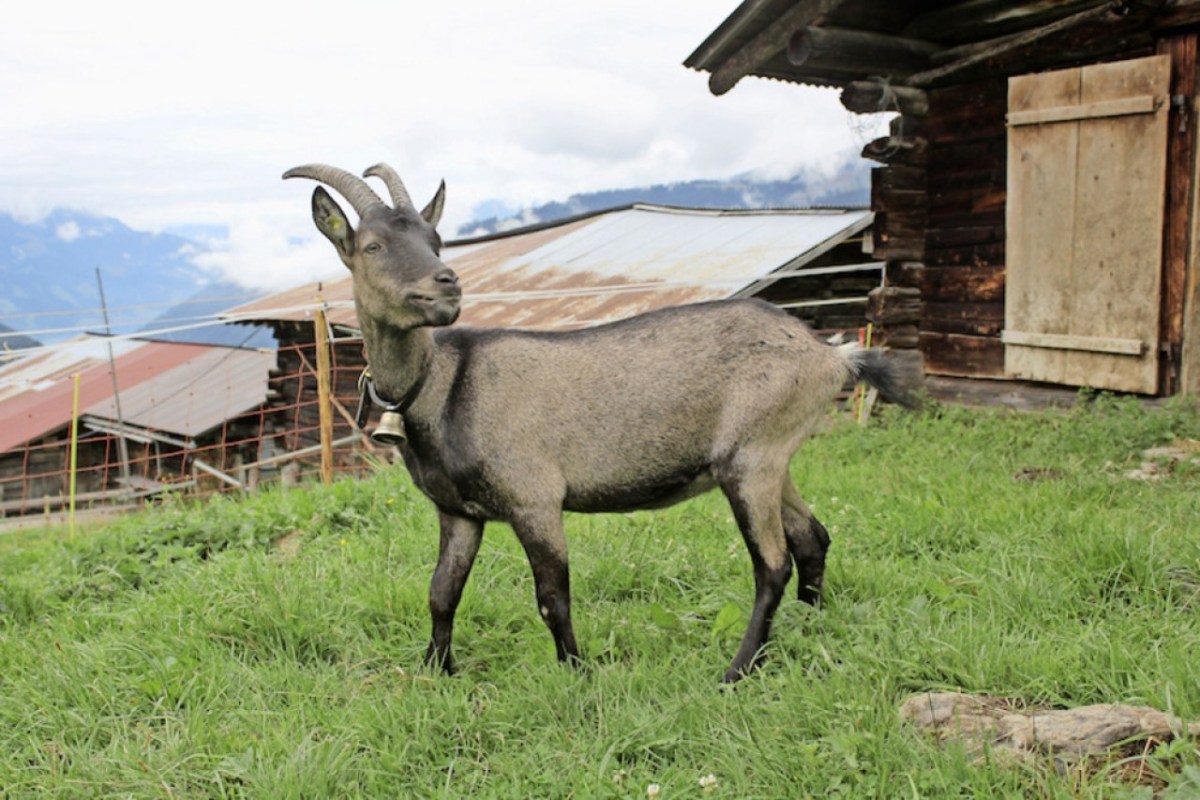
According to the Swiss Federal Institute for Forest, Snow and Landscape Research WSL, hybrids often stand out through dark or orange coat colours and a sturdier build. The horns, too, are frequently unusual, for instance with a triangular cross-section, longer annual segments or flattened knobs. Even animals that, after several generations, carry only around a quarter domestic goat can pass for an ibex at first glance.
Fertile, and therefore problematic
Unlike mules or hinnies, ibex hybrids are fertile. They go on mating with wild ibex, and in this way goat genes find their way into the colonies. The wildlife biologist Marco Giacometti was among the first to describe such crosses scientifically: his studies in Soglio from 1989 to 2001 showed that hybrids born in the wild survive and can even form entire herds.
The research paints a mixed picture. A study by the University of Zurich (Grossen et al. 2014) found that Alpine ibex carry only two variants at a gene locus important for immune defence, and that one of them originates from the domestic goat. The WSL, however, also warns of genetic defects and of adaptations typical of a domesticated species, such as the premature birth of young in the still wintry high mountains. As hybrids are reproducing very successfully in some areas and climate change could favour their survival, the WSL is currently investigating the consequences.
A home-made problem
Humans are responsible for the ibex's genetic vulnerability. Hunting had wiped it out in Switzerland, and all of today's animals descend from a few kids from Gran Paradiso. The story of this return is traced in our dossier «The ibex in Switzerland: smuggled, saved and degraded to a trophy once more»; more on its way of life can be found in the portrait «Everything about the mysterious Alpine ibex».
Hybrids arise where people leave goats to their own devices or deliberately bring about crossbreeding. Felix Widmer calls his alp in the Glarus Kärpf region a «goat laboratory» and has been breeding hybrids there for years. «I have a passion for goats,» he told the Wildlife. Breeders of pedigree goats would not be pleased about it at all, and many other keepers do not talk about it out of concern for legality. Hybrids are legally treated as wild animals and would require a keeping permit.
Hybridisation through domestic animals is not an isolated case, as the example of the wildcat shows: Domestic cat and wildcat: Hybridisation as a risk.
Prevention instead of shooting
Until now, the authorities' answer has often been the bullet. In 2014, a game warden spotted eight hybrids in the Val Roseg near Pontresina, five of which were shot, according to the Südostschweiz. The Ticino information sheet starts where the problem arises: with the responsibility of the keepers. IG Wild beim Wild expressly supports this approach.
It remains contradictory that the authorities fear for the genetic purity of the ibex while at the same time allowing recreational hunters to shoot the old males that are particularly important for reproduction. According to Valais wildlife warden statistics, around 36 per cent of all ibex over eleven years old are killed; the French researcher Jean-Michel Gaillard described this share as very high to Swissinfo (more on this in «Is trophy hunting in Valais for a good cause?»). In Fribourg, the recreational hunting lobby also wants to hunt the ibex, and Italy has, with its hunting reform, made it a huntable species. Anyone who wants to protect the ibex must tackle both: the goats in the barn and the rifles in the cabinet.
This article was first published on 17 September 2018 and was comprehensively revised on 1 November 2026.
More on the subject of recreational hunting: In the dossier The Role and Criticism of Recreational Hunters we shed light on the training, power and self-image of recreational hunters. The scientific evidence is presented in the overview Studies on the Effects of Recreational Hunting.
The position of IG Wild beim Wild: IG Wild beim Wild rejects recreational hunting. Our model is the canton of Geneva, which has managed without recreational hunting since 1974: without hunting seasons, without hunting dogs, without driven hunts, without high seats, without the animal cruelty and crime that go hand in hand with hunting season elsewhere. What has worked there for over fifty years disproves every position paper by JagdSchweiz. An association that bases its policy on claims it refutes in its own documents is not a professional organisation, but a factory for misinformation.
Wild animals need a voice
Once a week: research, petitions and background information on recreational hunting. Free of charge and can be unsubscribed from at any time.

All articles are written by IG Wild beim Wild as well as by external co-authors. Research, structuring and editorial processes may be supported by AI-assisted tools.
Support our work
With your donation you help protect animals and give their voice a hearing.
Donate now →