The Recreational Hunter in the 21st Century
Recreational hunting is not a scientific, wildlife-biologically sound, or professional wildlife management practice.


Hunting — an ancient craft, once essential for survival, and a passion passed down through generations. But how has hunting evolved in the 21st century?
Today’s recreational hunting destroys the normal social coexistence of wildlife, the ecological balance, natural behaviours, family structures and social groups, the use of dens and hiding places, the shift from daytime to nocturnal activity, increased reproduction in certain species, intensified migration into non-hunted residential areas, unnatural concentrations of animals in hotspots, ecological imbalance, and lifelong health-damaging psychological and physical stress for wildlife, unhealthy game meat, and much more that is harmful.
One also cannot help but notice that a militant minority determines what the majority of society gets to see — or take pleasure in — when it comes to wildlife. This may even be a reason for the high demand for animal viewings in undignified zoos. Hunting alone sustainably produces extremely fearful wildlife. It was hunting that made wild animals “wild” — that is, shy — not recreational activists. Wildlife does not like recreational hunters. Even wildlife can distinguish between good and bad people. The recreational hunter is the enemy figure from which wildlife flees in order to survive. Not infrequently, this flight ends on a road, leading to unnatural concentrations of animals in forests or in cities. There, wildlife is then blamed for causing “damage” — and this solely because wildlife has been driven there by recreational hunters.
Anyone who has ever been to a non-hunted national park — for example in the Engadin or in Africa — knows that animals no innate fear of humans. Neither prey animals nor predators. This is why it makes a significant difference whether a hobby-hunter or a jogger disturbs wildlife. The persistent hunting pressure makes animals shy and drives roe deer and red deer — originally inhabitants of grasslands — deep into the forests, which encourages so-called “wild browsing” on forestry land. Intensive hunting drastically reduces the life expectancy of wild animals. This results in early sexual maturity, which causes birth rates to rise. Not only do birth rates increase, but the natural selection process of nature is also undermined, particularly when it comes to maintaining healthy wildlife populations and consistently passing on the best traits, because recreational hunters intervene prematurely in natural processes.

The art of hunting is often compared to the art of war, with today's recreational hunter typically sitting like a tyrant — lazy, cowardly, and heavily equipped with technology — in a high seat or under cover. Yet the recreational hunter supposedly longs for nature. But what kind of surreal nature has the recreational hunter created? He must use binoculars and telescopic sights to search for animals — his own kin — in a landscape where, in non-hunted areas, they could be seen with the naked eye, entirely unafraid. It is not closeness to nature, but rather distance and hostility that the recreational hunter lives and creates. These are the character and essence of hunting in the 21st century.
Many people have the impression that foxes, roe deer, red deer, hares and the like no longer exist in the wild at all. How are today's children supposed to genuinely engage with nature in the future, if they can no longer experience it — distorted as it is by the hand of hunters into this state of unnaturalness? Nature is degraded by recreational hunters into a mere fabrication, which represents an enormous reduction in quality of life for ordinary people and animals alike. Recreational hunters and their shooting create a climate and energy field of unease for both humans and animals in natural recreation areas.
Precision technology
In the 21st century, recreational hunting has benefited from advanced technology. Modern recreational hunters use sophisticated equipment such as sound amplification devices, night vision devices, drones, binoculars, thermal imaging cameras, scent eliminators, GPS trackers, etc., to compensate for their inadequacies. These technologies enable recreational hunters to observe wildlife more effectively and hunt more efficiently, since hardly any recreational hunter would be capable of making a kill like a true hunter from an indigenous people. Recreational hunting in the 21st century has become increasingly unfair, with wildlife bearing the consequences.
Smart rifles, for example, are equipped with computer-controlled scopes that can calculate the perfect shot by taking into account factors such as distance, wind speed, and bullet type. Some even feature a “tracking” function that locks onto the target, thereby ensuring a precise kill.
Preservation of Biodiversity
The claim that recreational hunters promote biodiversity is almost audacious. At best, it may simply not be damaged. For instance, brown hares are still being hunted. The brown hare is listed on the Red List of threatened species. How this is supposed to constitute a service to the general public on the part of the hunting community defies common sense. The highest density of brown hares was scientifically recorded in 2016 at 17.7/100 ha in the hunting-free Canton of Geneva — where professional wildlife wardens are responsible for wildlife management. This is the first density exceeding 17 brown hares/100 ha since 2006 anywhere in Switzerland.
The preservation of biodiversity is not a central concern of modern hunters. Following the shocking UN report on species extinction in spring 2019, attention turns to Switzerland. No country in the world has a higher proportion of endangered species than Switzerland. Over a third of plant, animal and fungal species are considered threatened. Switzerland also ranks last in Europe when it comes to designating protected areas for biodiversity. It is always these circles of recreational hunters, through their lobbying work in politics, media and legislation, who have been responsible for this for decades. They are the ones who notoriously block contemporary, ethical improvements in animal welfare and sabotage serious wildlife and species protection. Recreational hunters regularly oppose more national parks in Switzerland, because their concern is not nature, biodiversity, species protection or animal welfare, but rather the pursuit of their perverse, bloody hobby.
Hunter slogans are pure window dressing. When one analyses the hunters' faction in politics, it quickly becomes clear that they rarely, if ever, engage on behalf of nature – what does become clear is that exploitation and self-interest are their true motivations. The experts put forward by recreational hunters are mostly nothing more than advocates for a self-serving lobby, seeking to preserve and whitewash a cultural aberration. In environmental rankings, recreational hunters occupy last place.
The contamination caused by the countless tonnes of lead and other highly toxic heavy metals in the ammunition that recreational hunters leave behind in nature is nothing short of ecological terrorism. Lead is an extremely toxic heavy metal and also a particularly cruel form of hunting. Injured animals suffer not only from their wounds but also from slow poisoning caused by the ammunition. Recreational hunters thereby potentially poison fellow humans, animals, soil and groundwater.
Recreational hunters also deliberately cause serious disturbances in the natural balance of species through small game hunting in order to hunt more successfully. Every autumn they stage an unnatural slaughter during the open hunting season. Habitats are deliberately manipulated and disturbed, to the detriment of all wildlife and society. Accordingly, every fox hunt is a clear violation of the Animal Protection Act, as there is no reasonable justification for it. There is also no culling plan for small game hunting. For more than 30 years, there have been at least 18 wildlife biology studies proving that fox hunting does not regulate populations and is also useless for disease control. On the contrary! Recreational hunters spread diseases:
In Europe, the focal point of the fox tapeworm's distribution — driven by recreational hunters and the senseless persecution of the fox — is primarily in Switzerland (concentrated in the Zurich region and eastern Switzerland). Recreational hunters negatively affect the health of the entire population, because the disease cannot run its natural course, which could otherwise allow resistant populations to develop. Amateur hunters already contributed significantly to the rapid spread of rabies during anti-rabies campaigns, as male foxes had to travel further to find a mate. The disease thus became a full-scale epidemic and was only eradicated in the early 1980s — not through merciless hunting of the fox, but through a vaccination campaign using chicken heads.
Every August, black-legged ticks capable of transmitting Lyme disease hatch. The number of people contracting Lyme disease and other tick-borne illnesses in Switzerland is rising. The Federal Office of Public Health estimates that approximately 6,000 to 12,000 people in Switzerland contract so-called Lyme borreliosis each year. For tick-borne encephalitis (TBE), the figure is between 100 and 250. The Federal Office of Public Health (FOPH) therefore classifies tick-borne diseases as a significant public health concern for Switzerland. This year, 7,000 acute cases of Lyme disease were reported by the end of September. According to the FOPH, this figure is considered relatively low in a multi-year comparison. During the same period, 214 cases of TBE were recorded, which is described as a high figure.
But this need not be the case. A study suggests that the absence of mouse-hunting predators, particularly the fox, is the cause of the rising number of tick-borne diseases.
In the past, mange and distemper would flare up locally time and again, then die out on their own. Especially in areas where mange spread most severely, foxes appear to be developing increasing resistance to reinfection. However, since recreational hunters' hunting negates the survival advantage that mange-resistant foxes would otherwise have (a recreational hunter cannot tell by looking at a fox whether it is mange-resistant), killing foxes is likely to be counterproductive in this respect as well. Incidentally, it has been found with distemper that wild animals have already developed antibodies, making the risk marginal.
Ethics and Responsibility
There are no associations with legal status whose members are as deeply rooted in criminal behaviour as in hunting. Modern hunting is characterised by a low level of ethical awareness and a high degree of irresponsibility. Recreational hunters do not take their role as guardians of nature seriously, nor do they advocate for the respectful treatment of wildlife.
Recreational hunters are invariably reluctant to embrace common-sense initiatives. Animal and species protection advocates have driven greater wildlife protection within the hunting world — the abolition of leg-hold traps, the ban on bird hunting with limed sticks, and so on. Common sense has been and remains the driving force behind restricting hunting seasons and reducing the number of huntable species. To prevent the extinction of animal species, animal welfare advocates have imposed on recreational hunters the moral obligation to care for and manage wildlife. The ethics of recreational hunters — to the extent that such a thing exists at all — have traditionally always lagged behind the spirit of the times.
Recreational hunters spread unspeakable suffering, terror and misery among both people and wildlife. Virtually everything that is cruel, unnecessary and heartless is promoted by hunting associations — as a court in Bellinzona recently confirmed. Because of recreational hunters, wild animals suffer. Recreational hunters not infrequently also turn their weapons on people as well.
The “responsible handling of hunting weapons” reads like a war report
In Switzerland, every year there are more human casualties and fatalities caused by the risk group of recreational hunters than by Islamic terrorists, cults, the mafia, wolves, and biker gangs combined.
In the years 2019–2020, a total of 1,484 injuries from hunting accidents were registered with accident insurers under the UVG. On average, there are 300 UVG accidents in recreational hunting per year. Most accidents occur in September, October, and November. The figures cover all employees working in Switzerland who are compulsorily insured under the Accident Insurance Act (UVG). All other persons residing in Switzerland (children, students, the self-employed, non-working homemakers, retirees, etc.) are not insured under the UVG but under the KVG, and are therefore not captured by the UVG accident statistics. The risk posed to third parties by recreational hunters cannot be determined from the data of accident insurers. The cost per case amounts to approximately CHF 10’000.–, or CHF 3.6 million annually.
The canton of Graubünden sees the highest number of hunting accidents, followed by hunting accidents abroad. The cantons of Ticino, Aargau, Valais, St. Gallen, and Bern follow. From the age of 45, the number of accidents rises dramatically. In addition, there are at least several fatalities each year — and this is only within the hunting community itself! Every year, there are additional violent crimes or suicides involving hunters' weapons.
More and more people feel harassed or threatened by recreational hunting in the 21st century.
Nutrition
Another trend in modern recreational hunting is the appreciation for what is perceived as superior nutrition. Many recreational hunters place great importance on harvesting and processing their own meat. Through hunting, they believe they can be certain of where their meat comes from and that it is free from additives.
However, the combined toxic cocktail of chemicals that farmers in industrial agriculture dispose of on their fields also takes a severe toll on wildlife — up to and including serious illness. Game meat is by no means as natural and organic as recreational hunters would have the public believe. Furthermore, “organic” is a protected label with specific guidelines and can never apply to game meat supplied by recreational hunters.
Game meat in particular is contaminated with residues of pesticides, spraying agents, liquid manure, antibiotics, etc. from feed and water from the fields, in addition to potential heavy metal contamination, such as lead from ammunition particles left by recreational hunters. Wild animals are in some cases also significantly contaminated with radioactive Cs-137, as a consequence of the Chernobyl reactor accident three decades ago.
What do the authorities say about game meat? Processed game meat is carcinogenic, like cigarettes, asbestos or arsenic, as stated in particular by the WHO.
Hunted game is fundamentally carrion and therefore not actually permissible for sale or consumption by ordinary people.
Added value:
- Game meat: Natural, healthy – or dangerous?
- Game meat from recreational hunters? – Carrion on the plate!
- According to studies, there are health risks in the context of consuming game meat
- Nutrition: The civilised palate
- Game meat from hunters is carrion
- Game meat cannot be organic
- Meat from wild animals is not organic game
- Dementia: How harmful is game meat?
- Game meat makes you ill
- Lead residues in game meat products
- Game meat: Risks, lead and hunting myths
- Caution: Warning about game meat from recreational hunters
- Hunters also lie when selling meat
The type of hunting also determines the quality of the meat. Driven hunts or beating hunts produce inferior and unhealthy meat, which may also be contaminated with ammunition residues. Wild animals live in constant fear because of recreational hunters. Particularly when they are actively being hunted, they produce vast quantities of toxic hormones, adrenaline, etc., which combine in the meat with the other toxins and waste products already present. Meat hygiene among recreational hunters does not meet normal standards. The game often lies around for hours without refrigeration – proper handling in accordance with the usual statutory regulations is nowhere to be seen.
Fair chase ethics
We are living in the most prosperous era in human history, and yet recreational hunters are listless, divided, misguided and unhappy. In their restlessness, they travel around the globe to destroy nature.
The «waidgerechtigkeit» (hunting ethics code) of recreational hunters has nothing — absolutely nothing — to do with nature and animal protection or professional wildlife management. Recreational hunters have been creating an ecological imbalance in the cultivated landscape for decades, with sometimes dramatic consequences (protective forests, diseases). For genetic balance, animals would need to be able to migrate in order to mate with animals from other areas. Only in this way can a healthy, ethical and genetic diversity of populations be achieved — not through intensive hunting.
A closer analysis also reveals that recreational hunters perform no obligatory service for the public, and certainly not for wildlife. Wild animals do not like recreational hunters. When entire tracts of land can be leased at a nominal price for a hobby — in order to kill and/or torment wild animals there, mostly pointlessly, through den hunting, driven hunts, and stalking hunts, etc. — one is inevitably compelled to use very different terms than ‘obligatory service’. Recreational hunters would not perform any “obligatory service” if they were not permitted to kill. This has absolutely nothing to do with the spirit of selfless public service. Moreover, recreational hunters can issue invoices for wildlife accidents or generate income through the sale of the unhealthy game meat, fur sales, trophy sales, etc.
In areas without recreational hunters within our cultivated landscape, one observes greater biodiversity, lower densities of huntable wildlife species, less damage, and fewer road accidents. On average, more than 20,000 wildlife accidents occur per year on Swiss roads and railways. According to estimates, the costs of these accidents amount to 40 to 50 million Swiss francs.
The wildlife populations of interest to recreational hunters have not been genuinely regulated for decades — rather, they have been decimated while birth rates are simultaneously stimulated. A consequence of current methods is that, for example, roe deer — grazing animals — become even more timid and shift their daytime activities entirely into the night. This leads to many traffic accidents. Populations of wild boar, red deer, and roe deer have literally exploded and are out of control. This is not wildlife understanding or wildlife management.
Sanitary and therapeutic culls carried out by wildlife wardens, such as those in the canton of Geneva, are not the same as regulatory hunting based on hunters' jargon or a misguided understanding of nature.
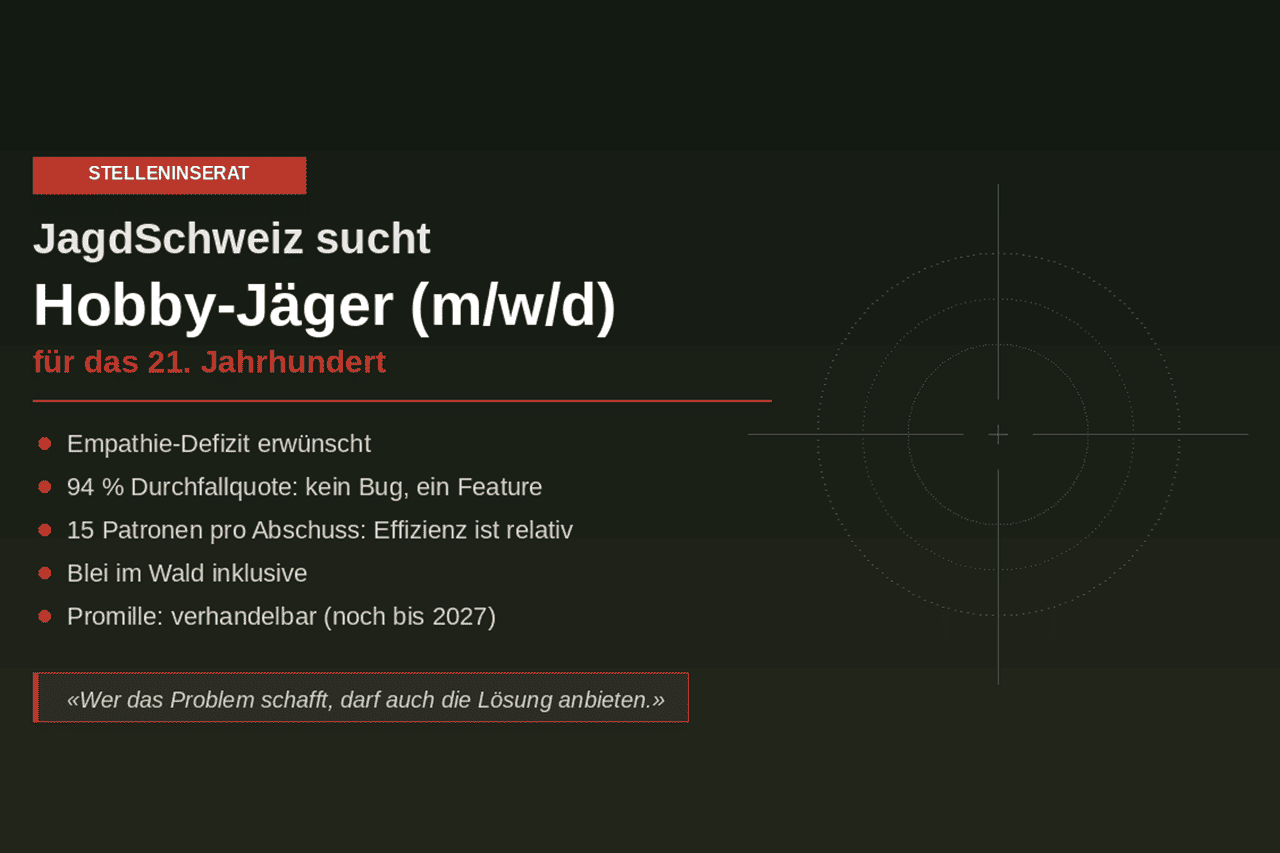
When intervention in the wild boar population is required in the canton of Geneva, for example, professional wildlife wardens accomplish this with ten times less time investment than recreational hunters in the surrounding areas. As a result, disturbances to wildlife and the local population in Geneva are significantly lower than those caused by hunters in the rest of Switzerland. A recreational hunter requires between 60 and 80 hours, according to Theo Anderes, head of the Elgger hunting territory Rappenstein (Landbote). A wildlife warden in the canton of Geneva spends only 8 hours on a necessary sanitary cull. Furthermore, wildlife wardens are also the better marksmen. A wildlife warden in Geneva uses a maximum of two cartridges for a wild boar. A recreational hunter, however, uses up to 15 cartridges! Added to this is the fact that wild animals are often wounded by recreational hunters and die in agony. In a driven and battue hunt, up to 10 times more shots are fired than the final “hunting bag” would suggest.
In the Swiss National Park in the Engadin, hunting has not taken place for 100 years, and there, for example, the chamois population has remained consistently around 1,350 animals since 1920. Foxes are also not hunted. Contrary to predictions from hunting circles, none of their prey species has become extinct. The transition from pasture for cows and sheep to deer grazing led to a completely new species composition of the vegetation and a doubling of biodiversity!
If there were fewer problem hunters harbouring a nature-exploitation mindset, more peace-loving people could once again dedicate themselves to the idea of nature conservation – people who care for flora and fauna with respect, decency and fairness.
More on the subject of recreational hunting: In our dossiers on the criticism of recreational hunting gather fact-checks, analyses and background reports. What the research says about this is shown by Hunting fact-checked: the state of research.
The position of IG Wild beim Wild: IG Wild beim Wild rejects recreational hunting. Our model is the canton of Geneva, which has managed without recreational hunting since 1974: without hunting seasons, without hunting dogs, without driven hunts, without high seats, without the animal cruelty and crime that go hand in hand with hunting season elsewhere. What has worked there for over fifty years disproves every position paper by JagdSchweiz. An association that bases its policy on claims it refutes in its own documents is not a professional organisation, but a factory for misinformation.