How Berlin and Bern release the wolf for shooting
From EU downgrading via the German Federal Hunting Act to Swiss puppy regulation: How species protection is being systematically undermined in both countries.

Germany is in a hurry to push the wolf from species protection into the rifle barrels of recreational hunters.
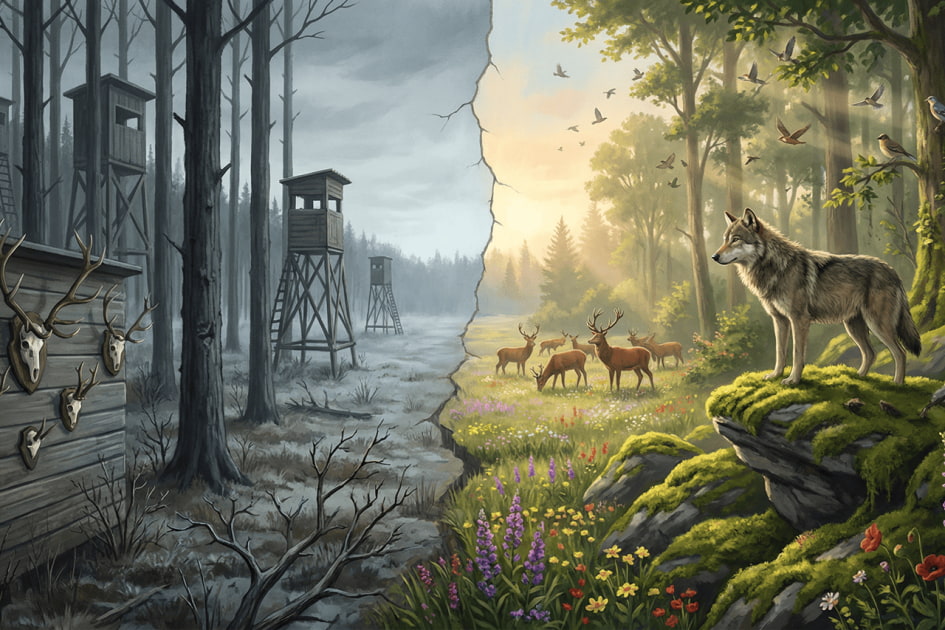
With the inclusion of the wolf in the Federal Hunting Act and a new hunting season from 1 July to 31 October, a predator that has just been downgraded at the European level is being degraded to a "regulatable stock" in record time – and the farming and hunting lobby rejoices. What is being sold as "reason-based population management" is in reality a political wish concert at the expense of a still vulnerable returnee to European fauna – and a blueprint for how to systematically undermine species protection.
Hunting season on the wolf: political wishful thinking instead of ecological necessity
The mechanism is simple: The federal government declares the wolf in large parts of Germany to have a "favourably conserved" status, has the states write management plans and thereby opens a regular hunting season from July 1 to October 31. Officially, this is supposed to apply only where 'high wolf numbers' allegedly cause problems; in reality, it means that states with dense lobby pressure get almost free rein to define shooting quotas. The wolf is thus still formally classified as protected, but practically pressed into the same logic as deer or stag: whoever disturbs gets 'regulated' – and who regulates is, as always, the recreational hunting community.
In Switzerland, precisely this logic was already introduced with the revision of hunting law, only without using the word 'hunting season': Preventive and reactive 'regulations' have allowed cantons since 2023/24 to shoot pack members and entire packs, as long as a politically defined minimum number of packs remains on paper. The label differs – 'regulation' instead of 'hunting season' – but the result is the same: the wolf transforms from a once strictly protected species into a remnant in the utilization regime of an industrialized cultural landscape.
Switzerland vs. Germany: two systems, one agenda
At first glance, the systems appear different: Germany introduces a classic hunting season, Switzerland speaks of preventive and reactive regulation. But the crucial question is not what the child is called, but who ultimately shoots it and according to what political logic.
Germany:
- Hunting season July 1 to October 31; hunting in regions with 'high populations' and 'favorable conservation status'. On March 5, 2026, the Bundestag decided to include the wolf in the Federal Hunting Act with votes from CDU/CSU, AfD and SPD. On March 27, 2026, the Bundesrat approved.
- States are to create cross-territory management plans with which populations are to be 'contained'. Lower Saxony, Mecklenburg-Western Pomerania and Schleswig-Holstein are already working on such plans.
- Additionally special rules for alpine and pasture areas, where livestock protection is declared 'unreasonable' and shooting is facilitated – even with unfavorable conservation status.
Switzerland:
- Preventive regulation from September 1 to January 31; reactive regulation from June 1 to August 31 at defined damage thresholds.
- FOEN approves cantonal applications; entire packs or large parts of them can be approved for removal. In the period 2024/25 FOEN approved the shooting of around 125 wolves, of which 92 were killed preventively.
- It is marketed as a success that the 'rapid growth' of the wolf population has been slowed – with a pack count of 36 packs and around 320 confirmed wolves.
Both systems follow the same agenda: No longer the reestablishment of a once-exterminated species is at the center, but the cementing of a livestock system that is based on free ecosystem services from nature and treats every predator as a disruptive factor. Where the hunting lobby speaks of 'wildlife biological management', it is really about maintaining power in a hobby that kills hundreds of thousands of wild animals in forests and fields every year without real necessity.
Further reading: Dossier 'Wolf in Switzerland: Facts, Politics and the Limits of Hunting'
Politics allows targeted shooting of wolf pups
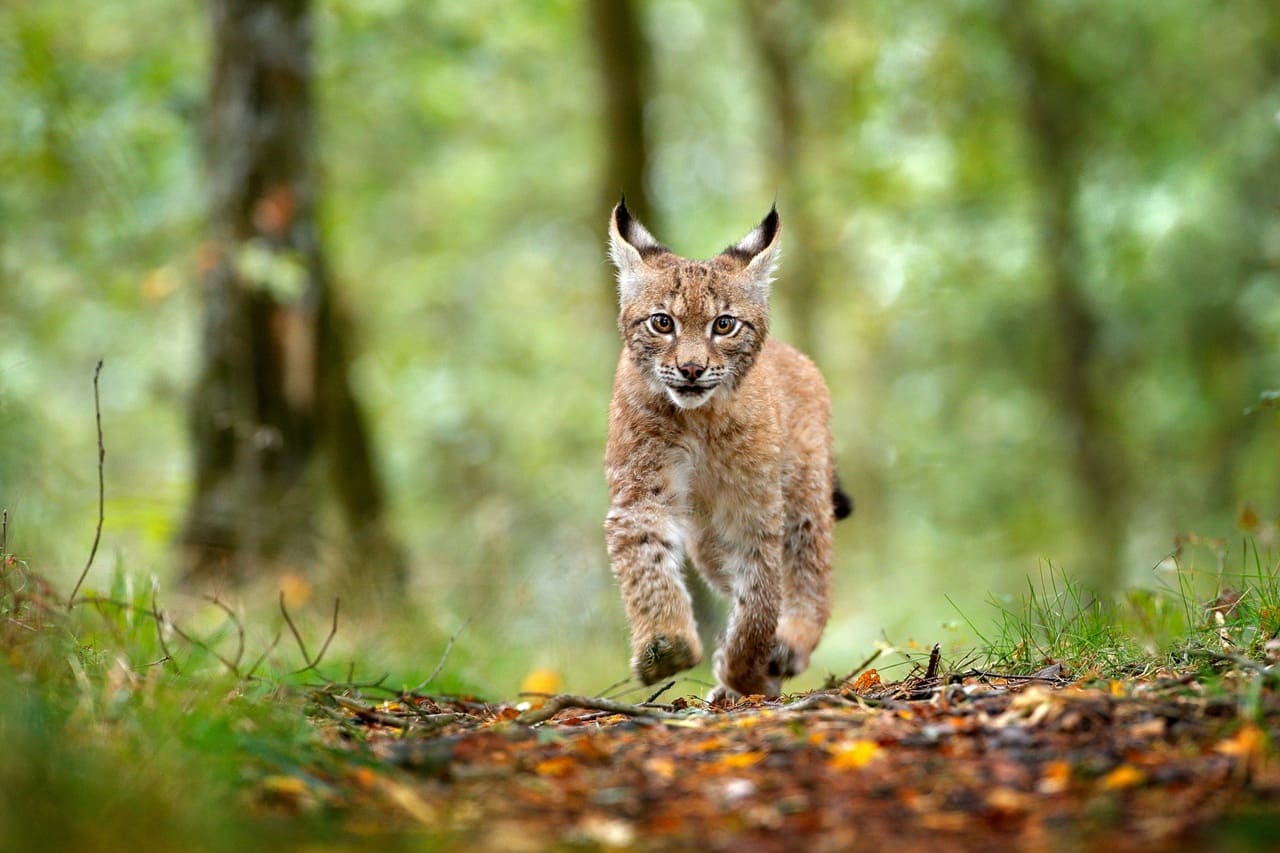
While the lobby talks publicly about 'reason-guided population management', the precision strike by lawmakers is actually directed against wolf pups, i.e., the youngest and most vulnerable animals in the packs. In Switzerland, this is cynically called 'preventive regulation': FOEN authorizes cantons to shoot up to half or even two-thirds of this year's pups in a pack, officially to prevent conflicts from the outset. The regulation periods are timed so that mainly young animals are hit, although FOEN itself notes that the distinction between young and parent animals in the field is difficult – with the result that in the period 2024/25 two parent animals and three lynx, in the previous period one livestock guardian dog were killed 'accidentally'.
Germany is now copying this pattern almost textbook-style: The new hunting season from 1 July to 31 October falls precisely into the phase when wolf pups are still being fed and socially imprinted by their parents. The German Animal Welfare Association explicitly warns that this puts 'wolf pups and parent animals in the crosshairs from summer onwards' and enables blanket culling of the juvenile class as soon as the politically manipulated 'favourable conservation status' is declared.
The German Hunting Association (DJV) openly celebrates: This regulation enables 'classic population management based on interventions in the juvenile class' – 40 percent of the annual offspring are to be culled. In an official statement before the Bundestag the DJV explicitly demands to shoot 'up to 40% of the young wolves of a year class' – exactly what Swiss regulatory practice already demonstrates. Behind the facade of 'coexistence' and 'safety', both states are thus pursuing a policy that systematically attacks packs at their roots and degrades the wolf to an arbitrarily regulable remnant population in the recreational hunting system.
Further reading: 'Germany: Wolf pups in the crosshairs of politics'
The 'favourable conservation status' as political elastic term
The central lever for legally legitimising culls is called 'favourable conservation status' in both countries. What sounds like a strict technical category functions in practice as a political elastic term: Governments report to Brussels that the wolf is doing 'well', while simultaneously introducing new culling instruments.
At EU level, the wolf was downgraded in the Bern Convention on 6 December 2024 from 'strictly protected' to 'protected' – the amendment came into force on 7 March 2025. In June 2025 followed Directive (EU) 2025/1237, which moved the wolf in the Habitats Directive from Annex IV (strictly protected) to Annex V (taking and use possible). Germany uses this as justification for including the wolf in the Federal Hunting Act and introducing hunting seasons. Switzerland notes with satisfaction in its BAFU report that the rapid growth of the population has been slowed, thus indicating that further regulation is politically desired and will be consolidated.
Instead of transparently saying: 'We want to keep the wolf small in the interest of the agricultural lobby', politics and authorities hide behind technocratic terms. The WWF warns that the conservation status of the wolf under the FFH criteria is still not to be assessed as 'favourable' and yet it is being degraded step by step to a negotiable target, whose right to exist is 'defined' anew each year through shot and bullet.
Further reading: 'One year after the downgrading: The wolf loses its protection'
Figures from Switzerland: Livestock protection works – not the finger on the trigger
The BAFU report on the regulatory periods 2023/24 and 2024/25 delivers an uncomfortable truth for the hunting lobby: The number of livestock kills has fallen again after a peak in 2022, even though the number of packs has continued to increase or stabilised. In the two periods, nevertheless around 147 wolves were culled in total (55 in the period 2023/24, 92 in the period 2024/25), several entire packs were eradicated – and yet the BAFU cautiously speaks only of slowed growth dynamics, not of a country 'overrun' with wolves.
The crucial statement of the report reads: 'Good livestock protection is an important pillar in wolf management and helps prevent damage to livestock.' In other words: Fences, livestock guardian dogs, adapted management – all of this has measurable effects. The WWF pointed out, that shooting lead animals can lead to unstable packs, causing young animals to increasingly turn to more easily available livestock – recreational hunting therefore exacerbates precisely the problems it claims to solve. Also in Germany the number of attacks on livestock decreased by 25 percent in 2024, even though the wolf population continued to grow – clear evidence that livestock protection works.
Anyone claiming today that wolves must be hunted so that livestock farmers can 'sleep again' deliberately ignores their own data and serves an enemy narrative that markets better politically than fair prices, working conditions and subsidy policy reforms in the livestock sector. As NABU NRW aptly puts it: 'Blanket hunting of wolves is pure symbolic politics and creates no security for livestock farmers.' Over 151,000 people have already signed the NABU petition 'Livestock protection instead of wolf hunting'.
Further reading: Dossier 'Wolf in Switzerland: Facts, Politics and the Limits of Hunting'
What remains: Recreational hunting as a disruptive factor in coexistence
In the end, the comparison between Germany and Switzerland leads to an uncomfortable result: The wolf is not the problem, but rather a politically protected system of recreational hunting and extensive livestock farming that views any form of predator as an attack on old privileges. In both countries, hunting and farming lobbies are courted by promising them to reduce 'wolf pressure' through lead – even though their own expert agencies show that livestock protection and management planning are the actual keys.
Anyone seriously wanting to speak of coexistence must have the courage to name precisely these power structures: the hunting control over wildlife that has been politically declared sacred, and an agricultural model that cannot survive long-term without radical changes. As long as wolf policy in Berlin, Bern and Brussels means opening new shooting windows instead of securing habitats, livestock protection and fair economics, the word 'species protection' remains a fig leaf – and the wolf the projection surface of a crisis that is in truth a crisis of the human-nature relationship and lobbyism.
Further reading: 'When the wolf is limited, but recreational hunting grows' | Dossier 'The Wolf in Europe'
Support our work
With your donation you help protect animals and give voice to their concerns.
Donate now →