
Wolf Switzerland: Facts, politics and limits of hunting
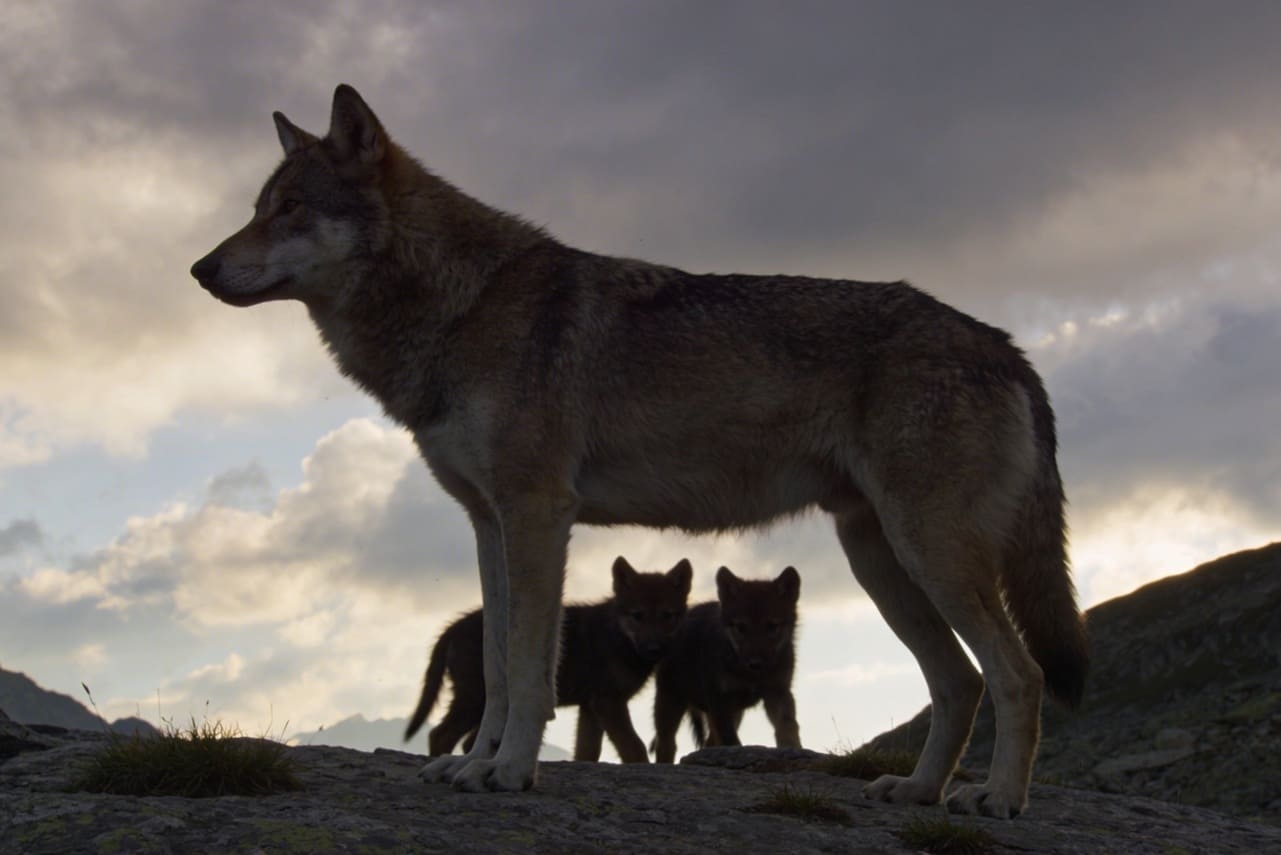
The wolf has returned to Switzerland and with it a heated debate in which facts, emotions and lobbying interests intertwine. While part of the political establishment would prefer to return to widespread hunting, researchers and animal protection organizations point to international obligations, functioning livestock protection models and the central ecological role of the wolf.
This dossier compiles analyses, studies and research from wildbeimwild.com and places them in the context of Swiss hunting politics, the Bern Convention and European wolf policy.
What to expect here
- Return of the wolf: Population and distribution: Around 30 packs and 300 wolves in 2023 in the Alps, pre-Alps and Jura, Calanda pack as success model, behavioral studies on shyness towards humans.
- Political front lines: Who hunts the wolf? Valais wolf balance 2025/2026, over 200 scientists against hunting law classification, cantonal initiative 'Wolf finished, cheerful!', Darbellay and Regazzi as political actors.
- Livestock protection: What really works: Calanda model, costs of culling vs. livestock protection, 4’000 sheep annually through disease/falls vs. 336 wolf kills, international models.
- Legal framework: Bern Convention and hunting law: Wolf Concept Switzerland 2008, JSG revision 2020, Bern Convention Oct 2024, Council of Europe investigation procedure Dec 2024, EU downgrading 2025.
- Misidentified kills, young animals and ethics: Marchairuz/Moesola misidentified kills 2022, basic regulation as systematic killing of young animals.
- Mountain agriculture and structural conflicts: Wolf as scapegoat for unresolved structural problems, direct payments, location policy.
- Hunting lobby and lack of transparency: Valais as case study: DJFW criticism 2016, merger of recreational hunting and sovereign mandate, psychology of hunting culture.
- International perspective: Europe in the wolf war: Sweden license hunt stopped, research wolf 'Andrea' Carinthia, poaching Poschiavo.
- Arguments: Responses to the most common objections of culling policy.
- Quick links: All relevant articles, dossiers and external sources.
Return of the wolf: Population and distribution
Since the mid-1990s, wolves have been returning to Switzerland naturally – mainly via Italy and France. Monitoring data shows that the population initially spread slowly, then significantly faster. In 2023, around 30 packs and a total of approximately 300 wolves were registered, predominantly in the Alps, pre-Alps and Jura.
The spread varies greatly by region. In the canton of Graubünden, the Calanda pack is considered the first established pack of modern times. Despite around 1,500 sheep in the territory, the pack killed only 37 livestock in five years – a direct result of consistent herd protection. The culling programs instead focus particularly on Valais, where political pressure and the hunting lobby are especially strong. In the Jura, only two packs are established – Marchairuz and Risoux – whose alpha wolves were killed in 2022 through erroneous or cross-border culls, acutely endangering the regional wolf population.
Wolves avoid humans – the research is clear
Behavioral studies prove that wolves consistently avoid humans. Experiments with recordings of human voices show pronounced flight reactions – significantly stronger than with dog barking or bird calls. This persistent shyness contrasts sharply with public rhetoric about 'problem wolves' and makes clear: conflicts arise mainly where livestock farming without protection, hunting interests and political pressure converge.
More on this: Wolf: Ecological function and political reality and Special hunt in Graubünden
Political frontlines: Who hunts the wolf?
In several cantons, politics and the hunting lobby are attempting to remove the wolf from strict protection regimes and transfer it into regular hunting logic. The Valais wolf balance 2025/2026 exemplifies this: under the label 'proactive regulation', entire packs and numerous juveniles were approved for culling within a few months – which factually amounts to systematic weakening of the Swiss population. In the regulation period 2025/2026 alone, the canton of Valais had 27 wolves killed: three through individual culling orders, 24 through so-called population regulation of entire packs.
Science against hunting law
Over 200 scientists criticize in an open letter that endangered species like the wolf do not belong in hunting law, because hunting intensifies conflicts rather than solving them. In the article 'Why endangered species do not belong in hunting law' wildbeimwild.com explores exactly this conflict line. The central criticism: culls destroy social structures, leading to increased reproduction, immigration and unstable behavior – exactly the opposite of what is marketed as 'regulation'.
Cantonal initiative 'Wolf finished, cheerful!'
Already in 2016, the canton of Valais demanded with the cantonal initiative 'Wolf finished, cheerful!' to revoke the wolf's protection status and renegotiate the Bern Convention. The Environment Committee of the National Council (UREK) approved the proposal with a narrow majority – Pro Natura called this an 'extermination proposal'. The Federal Council had already created possibilities in 2012 and 2013 to cull individual wolves in cases of significant damage, without affecting the fundamental protection regime.
Christophe Darbellay and Fabio Regazzi
At the center of political wolf hunting are center politicians like Christophe Darbellay (CVP Valais) and Fabio Regazzi (CVP Ticino). Both come from a party that presents itself as guardian of Christian values, yet pursue uncompromising interest politics in wolf policy favoring the hunting lobby and livestock industry. Darbellay is not only politically responsible for the Valais culling programs, but is himself a recreational hunter. In the article «Christophe Darbellay's Wolf War: Polemics Against Facts» wildbeimwild.com shows how deliberately emotionalized individual incidents are inflated and scientific assessments suppressed to create an atmosphere of permanent threat.
Regazzi, former hunting president in the canton of Ticino, propagates the Swedish wolf model as an example – precisely that model which was stopped by courts for violations of rule-of-law requirements and species protection. The article «Fabio Regazzi and the Wolf Politics of Quick Shots» documents how Regazzi's initiatives consistently shift wildlife policy from protection to minimization.
Two Logics Collide
At federal and cantonal levels, two logics thus collide: a hunting-centered politics that treats the wolf as a 'population figure', and a nature conservation-oriented perspective that places social pack structures, herd protection and international species protection obligations at the center.
More on this: Valais Wolf Assessment: Numbers of a Massacre and Hunter Lobby in Switzerland: How Influence Works
Herd Protection: What Really Works
Switzerland has a broad spectrum of proven herd protection measures: electric fences, night enclosures, livestock guardian dogs, herding and adapted grazing forms. The Calanda pack in Graubünden proves that these measures work even in a wolf-rich area with around 1500 sheep.
In the political debate, herd protection is frequently dismissed as 'too expensive', 'impractical' or 'impossible in steep alpine areas'. Reality shows however: It's not herd protection that fails, but the consistent implementation and financing. In Valais, 3.2 full-time positions were created to support the department, yet the majority of the 13,390 work hours in 2025 flowed into wolf management and regulation – not into herd protection consulting. Calculating with conservative full costs of 60 to 80 francs per hour, the wolf massacre in Valais alone consumes between 0.8 and well over 1 million francs in tax money in 2025. The shooting of a single wolf costs the taxpayer in Switzerland around 35,000 francs.
Wolf Kills in Perspective
Pro Natura provides an important figure on this: According to studies, around 4000 sheep die annually in the Swiss mountains from diseases, falls or severe weather, not least due to lack of care. The 336 livestock kills by wolves in 2022 (the second highest number since 1998) appear modest in comparison. Particularly revealing: 174 kills occurred in Valais, 54 in the canton of Uri, there largely attributable to a single animal (wolf M58) that has since migrated to Austria.
Livestock Guardian Dogs: Benefits and Side Effects
Livestock guardian dogs are a central element of non-lethal wolf management, but also bring conflicts: occasional encounters with hikers occur, which the hunting lobby regularly instrumentalizes as an argument against herd protection. Through professional training, clear signage and adapted grazing strategies, these problems can be significantly minimized however.
International Examples
In other European countries, projects demonstrate that coexistence with predators is possible when political will, funding and participatory approaches come together. In Italy, livestock protection measures have been promoted for decades, in Spain there are successful conflict prevention programs. Switzerland could learn from these experiences instead of relying on a hunting logic that is scientifically considered ineffective.
More on this: Livestock protection in Switzerland and Alternatives to hunting: What really helps without killing animals
Legal framework: Bern Convention and Hunting Law
The wolf is protected in Switzerland under the Bern Convention (1979). This international legal obligation generally prohibits the intentional killing of wolves and allows exceptions only under strict conditions: when no other satisfactory solution exists, public safety is endangered, or significant damage to livestock occurs. Furthermore, it must be ensured in all cases that the conservation status of the species is not impaired.
The Bern Convention explicitly confirmed in October 2024: 'proactive' shootings – i.e., preventive culling without concrete damage – are illegal. In December 2024, the Bern Convention Committee opened an investigation procedure against Switzerland because the current regulatory system is deemed non-compliant with the Convention.
Swiss Hunting Law and Wolf Concept
The Swiss Hunting Law (JSG) classifies the wolf as a protected species, but has allowed individual culls under certain conditions since 2012. The Wolf Concept Switzerland from 2008 regulates the damage threshold: 25 killed livestock in one month or 35 livestock in four months entitle authorities to issue a culling order, but only if all technically possible, practical and financially viable protection measures have been taken.
With the revision of the Hunting Law in 2020, culling possibilities were further expanded: young wolves of a pack may be shot under certain conditions even if they regularly stay near settlements. This 'proactive regulation' is under criticism because it no longer targets concrete damage but preventively intervenes in pack structures – and thus directly contradicts the Bern Convention.
European dimension
At EU level, the wolf is protected by the Fauna-Flora-Habitat Directive (FFH Directive). Member states must ensure a favorable conservation status and may only permit removals under strict conditions. Several ECJ rulings have confirmed that cullings are only lawful when alternative measures are exhausted and the population is not endangered.
Downgrading of protection status: What it means – and what it doesn't
In 2025, the wolf's protection status in the EU was downgraded from 'strictly protected' to 'protected'. Conservation organizations like the Large Carnivore Initiative for Europe called the downgrading 'premature and flawed', over 700 scientists expressed their concerns in open letters. What is crucial: The obligation to ensure favorable conservation status remains even after the downgrading. Those who interpret the downgrading as a free pass for widespread wolf hunting misunderstand the law – or do so deliberately.
More on this: Wolf in Europe: Protection status, conflicts and political pressure and Illegal wolf hunting in Switzerland
Misfire killings: System, not malfunction
In 2022, at least three wolves were incorrectly shot in Switzerland. In the canton of Vaud, the alpha wolf of the Marchairuz pack was mistakenly shot in late November, although a juvenile should have been killed. In October, in the canton of Grisons, the alpha male of the Moesola pack was killed instead of a young wolf. In March, a wolf not authorized for shooting was killed in Valais.
The Group Wolf Switzerland (GWS) described these shootings as unlawful: animals other than those authorized for shooting were killed. Shootings of alpha animals are far more consequential than shootings of juveniles, as they can lead to the dissolution of entire packs. For the two wolf packs in the Jura arc – Marchairuz and Risoux – this meant acute endangerment of the entire regional wolf population, as alpha animals were killed in both packs in 2022.
These erroneous shootings are no coincidence, but rather an expression of a system that prioritizes quantity over quality: when shooting quotas must be met, visibility conditions are poor, and political pressure is high, wrong animals are also killed. The responsibility for this lies not only with individual shooters, but with the political and administrative structures that enable and legitimize this practice.
More on this: Hunting laws and control: Why self-supervision is not enough and Hunting accidents in Switzerland
Juveniles in the crosshairs: Ethics turned upside down
Particularly disturbing is that juveniles are killed not only in problematic packs with repeated livestock kills, but also as part of a 'basic regulation' in packs that have not caused significant damage. This means young wolves are killed before they had the chance to learn how their pack interacts with livestock and landscape. Yet precisely these learning processes are crucial for conflicts to decrease in the long term.
An ethics worthy of the name would define juveniles as a red line: whoever targets them violates not only the individual, but the future of the entire population. The Valais practice reverses this principle: juveniles become the preferred target group because they are easiest to hit and statistically deliver quick 'success'. To speak of regulation here obscures that the foundation of all moral responsibility – protection of the most vulnerable – is deliberately ignored.
The Valais wolf assessment 2025/2026 reveals how the logic of hunting seeps into state handling of wildlife: wild animals become stocks, conflicts become dossiers, regulation becomes shooting plans.
More on this: Hunting and animal welfare: What the practice does to wild animals and Wild animals, mortal fear and lack of anesthesia
Wolf and mountain agriculture: structural conflicts
The conflicts between wolf and mountain agriculture are real, but their causes lie deeper than the mere presence of predators. Swiss mountain agriculture has been under structural pressure for decades: farm closures, dependence on direct payments, steep topography and international competition shape the daily reality of many operations. In this context, the wolf becomes a projection surface for unresolved structural problems and a target of hunting policy that undermines scientific and ethical minimum standards.
Neither the role of direct payments and location policy nor the responsibility of management practices for conflicts with predators are seriously discussed. The wolf takes on the role of scapegoat, which is calculated out of the system with technical vocabulary – 'basic regulation', 'complete implementation'. Instead of consistently investing in livestock protection, grazing management, consulting and structural adaptations, the wolf is made into the problem bear that must be kept 'under control' with administratively precisely planned shots.
The real questions of what kind of agriculture we want to promote in steep mountain regions, how livestock husbandry can be adapted to predators, and how much recreational hunting has a place in a modern constitutional state remain unanswered.
More on this: Cultural landscape as myth and Hunting myths: 12 claims you should critically examine
Hunting lobby and lack of transparency: Valais as a case study
Swiss hunting policy is significantly shaped by hunting associations that have direct access to cantonal governments, commissions and parliamentary groups. In Valais, the entanglement between hunting affairs, politics and administration is particularly close: The Department for Hunting, Fishing and Wildlife (DJFW) was massively criticized by the Management Audit Commission in 2016 for weak leadership, alcohol problems among individual game wardens and outdated administration.
With professional game wardens and recreational hunting groups, the canton creates a hunting-centered infrastructure whose main task is not protection, but efficient shooting. When sovereign mandate and recreational hunting merge into an alliance with a common goal, that goal is: kill as many wolves as possible, as smoothly as possible, as quietly as possible.
The article «Psychology of hunting in the Canton of Valais» analyzes how deeply rooted patterns of dominance, identity and community shape hunting culture. The wolf's return is perceived as a threat to this order because it calls into question control over one's 'own' territory. Emotionalized campaigns that inflate individual wolf kills into 'attacks' serve archaic fear narratives and divert attention from structural problems.
More on this: How hunting associations influence politics and the public and Psychology of hunting
International perspective: Europe in the wolf war
Swiss wolf policy is not an isolated case, but part of a European pattern in which hunting associations, agricultural lobby and populist politicians jointly attempt to undermine species protection. In Austria, the hunting lobby is reorganizing under new president Anton Larcher and propagates 'science instead of emotion' as a slogan, while wolf, bear and weapons law are pressed into a hunting control regime. The research wolf 'Andrea', which had been equipped with a GPS collar by the University of Udine, was shot in the night of February 3, 2026 in Carinthia. A 250,000-euro project ended with a single shot.
Sweden: Model or warning?
Fabio Regazzi has been praising the Swedish wolf model as an example for Switzerland for years. Yet it is precisely this model, where licensed hunts with politically fixed population targets are now being stopped by courts because they violate constitutional requirements and species protection. In the article «Wolf hunt 2026 stopped: How courts protect wolves better than politics» wildbeimwild.com shows what this means for Europe's wolf policy: Sweden does not show how wolf management works, but how hunting politics fails against the constitutional state.
Poaching as a symptom
The case of an illegally killed wolf in Puschlav (Graubünden, September 2025) is not an isolated incident, but part of a pattern across the Alpine region. The article «Criminal charges: Recreational hunter kills wolf» documents how lenient criminal law and political climate favor illegal wolf hunting.
More on this: Hunting crisis in Europe: FACE fights for shots, Switzerland remains in the shadows and Trophy hunting: When killing becomes a status symbol
Not nature management – a political massacre
In the end, we face a finding that cannot be glossed over: When entire packs are wiped out, young animals are systematically killed, and culling numbers are presented as success stories, this is not proactive regulation but a politically sanctioned massacre. The wolf becomes a projection screen for unresolved structural problems in mountain agriculture and a target for hunting politics that undermines scientific and ethical minimum standards.
A truly contemporary approach to predators would have to rely consistently on non-lethal measures: maximum protection for young animals, promotion of stable pack structures, investments in livestock protection, pasture management and advisory services, clear limitations on hunting power, and transparency in culling decisions. Anything else is not ethics, but the legitimization of violence against the most vulnerable.
More on this: Introduction to Hunting Criticism and Hunting Ban Switzerland: Possibilities, Models and Limitations
What would need to change
- Immediate protection of young animals: A culling ban for young wolves under 12 months as an ethical and biological minimum requirement. The basic regulation that makes young animals the preferred target group must be abolished.
- Consistent livestock protection as a prerequisite for culling permits: No culling without documented proof that all reasonable livestock protection measures have been implemented and evaluated over at least one grazing season.
- Independent wolf monitoring: Population surveys and damage analyses must be conducted by independent scientific institutions, without participation from hunting associations or cantonal hunting-affiliated departments.
- Establishing legal conformity with the Bern Convention: Preventive culling of entire packs must be removed from the revised hunting ordinance (JSV), regardless of the outcome of the ongoing investigation procedure.
- Transparency in culling decisions: Every culling order must be publicly accessible with complete damage history, livestock protection documentation, and scientific justification.
- Structural mountain agriculture reform: The question of which forms of livestock keeping in steep mountain areas are compatible with predators must be addressed politically with adapted direct payments and advisory structures.
- Model initiatives: Template texts for hunting-critical initiatives and Template letter: Appeal for change in Switzerland
Arguments
«The wolf threatens the mountain population.» Statistically zero wolf attacks on humans in Switzerland. Mountain agriculture faces structural challenges (farm deaths, dependence on direct payments, topography) that no wolf culling will solve. Those who make the wolf the cause of structural problems are conducting politics with the wrong scapegoat.
«Proactive regulation prevents damage before it occurs.» The Bern Convention stated in October 2024: Preventive culling without concrete, significant, and repeated damage is not covered by the convention and therefore illegal. The unanimously adopted investigation procedure by the Council of Europe is the consequence.
«Livestock protection doesn't work in steep alpine areas.» The Calanda pack proves the opposite: 1,500 sheep, 37 kills in five years thanks to consistent livestock protection. It's not livestock protection that fails, but its consistent implementation and financing. In Valais, between 0.8 and 1 million francs flowed into culling programs in 2025 instead of livestock protection advisory services.
«The EU has downgraded the wolf's protection status – so hunting is now allowed.» The downgrading from «strictly protected» to «protected» changes nothing about the obligation to ensure favorable conservation status. Over 700 scientists called the downgrading premature. Those who interpret it as a free pass for widespread wolf hunting misunderstand the law.
«Mistaken cullings are regrettable isolated cases.» In 2022, at least three wolves were shot wrongly: Marchairuz pack leader, Moesola alpha male, VS non-authorized wolf. When shooting quotas must be met under time pressure and poor visibility conditions, misshots are systemic, not accidental.
Quick links
Posts on Wild beim Wild:
- Valais Wolf Report 2025/2026: Numbers of a Massacre
- Christophe Darbellay's Wolf War: Polemics Against Facts
- Fabio Regazzi and the Politics of Wolf Quick-Shooting
- Why Endangered Species Don't Belong in Hunting Laws
- Wolf Hunt 2026 Stopped: How Courts Protect Wolves
- Psychology of Hunting in Canton Valais
- Criminal Charges: Recreational Hunter Kills Wolf (Poschiavo)
- Problem Politicians Instead of Problem Wolves
Related Dossiers:
- Golden Jackal in Switzerland: Natural Immigrant Under Political Pressure
- The Otter in Switzerland: Exterminated, Returned and Politically Threatened
- The Brown Bear in Switzerland: Exterminated, Returned and Still Unwanted
- The Wildcat in Switzerland: Back from Extinction, Threatened by Indifference
- The Lynx in Switzerland: Predator, Keystone Species and Political Object of Dispute
- The Fox in Switzerland: Most Hunted Predator Without Lobby
- Wolf: Ecological Function and Political Reality
- The Wolf in Europe: How Politics and Recreational Hunting Undermine Species Protection
- Wolf in Switzerland: Facts, Politics and the Limits of Hunting
- Valais Wolf Report: Numbers of a Massacre
- Fox Hunting Without Facts: How JagdSchweiz Invents Problems
- Livestock Protection in Switzerland: What Works, What Fails and Why Shootings Are No Solution
Our Mission
The wolf in Switzerland is not a management problem. It is a political litmus test for whether a modern constitutional state is capable of enforcing species protection obligations against lobby interests. This dossier compiles the analyses, investigations and studies by IG Wild beim Wild on Swiss wolf politics, because a society that proclaims biodiversity and animal welfare as values must know what is being done in its name: systematic pack killings, systematic juvenile shootings and hunting policies that ignore international legal standards.
Anyone who knows of tips, documents or current cases that belong in this dossier should write to us. Good information is the foundation of any effective criticism.
More on recreational hunting: In our Hunting Dossier we compile fact-checks, analyses and background reports.