
Wolf: Ecological Function and Political Reality
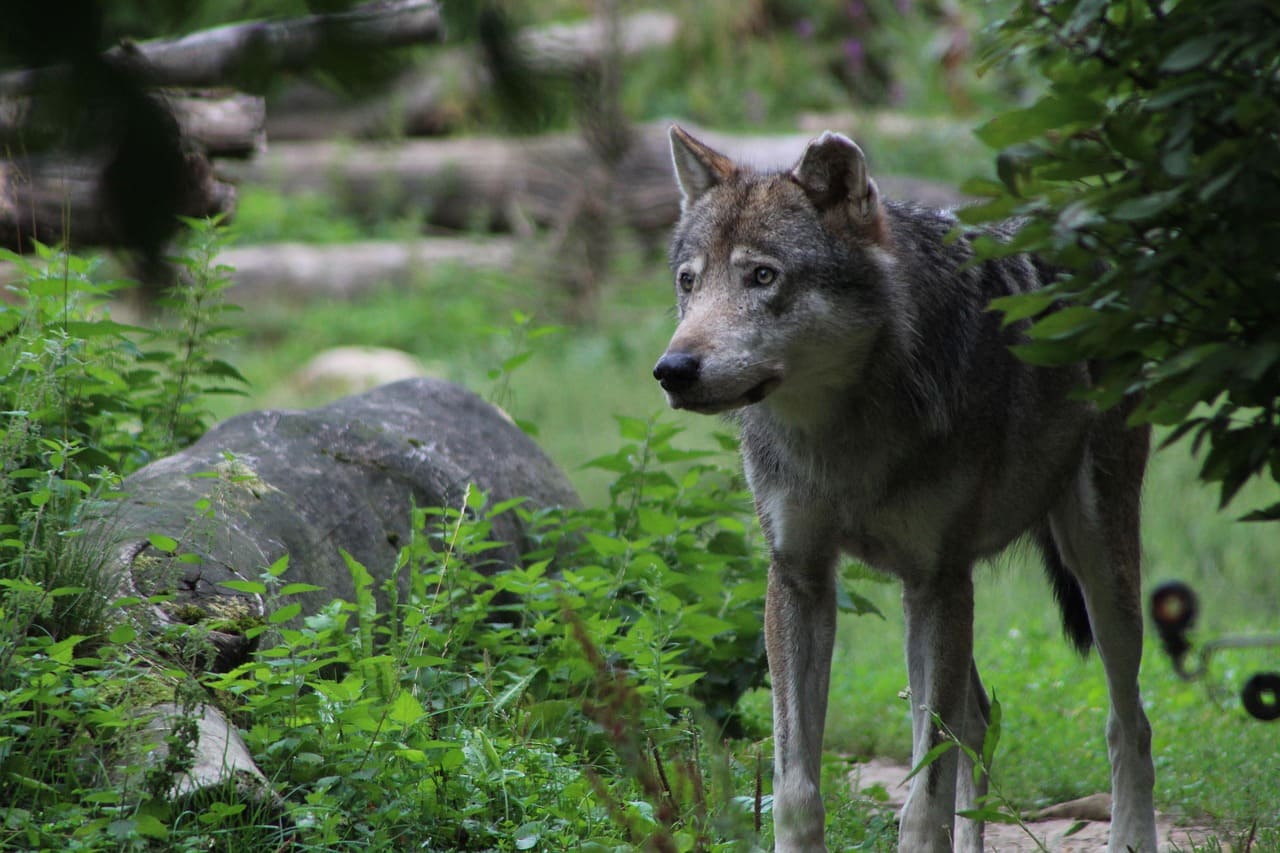
The wolf is not a problem animal, but an ecosystem architect. As an apex predator, it regulates ungulate populations, alters the behavior of its prey animals, and triggers ecological cascade effects that range from forest regeneration through riparian vegetation to the species diversity of entire habitats. These connections are scientifically documented, internationally recognized, and largely politically irrelevant in Switzerland. For Swiss wolf policy is not guided by ecology, but by the interests of a recreational hunting lobby that sees primarily one thing in the wolf: a competitor.
This dossier compiles ecological research on wolves, from trophic cascades through carrion ecology to forest regeneration, and confronts it with the political reality in Switzerland. It shows why the wolf's return is a gain for biodiversity and why the culling policy is based not on science, but on fear-mongering and conflicts of interest. All evidence is prepared so that it can be used in political initiatives, media discussions, and public debates.
What awaits you here
- Trophic Cascades: How the wolf as an apex predator shapes entire ecosystems from top to bottom. Yellowstone as reference, European research, and the question of what this means for Switzerland.
- Selective Predation: Why the wolf strengthens the fitness of prey populations by preferentially hunting sick, old, and weak individuals, and how this differs from recreational hunting.
- Carrion Ecology: How wolf kills create a food source for scavengers, insects, fungi, and plants, and expand the food web.
- Forest Regeneration and Browse Reduction: Why the wolf is more relevant for Swiss protection forests than any culling regime and what research on the Landscape of Fear shows.
- Self-Regulation: Why wolves regulate their own population density through territorial behavior, pack structure, and food supply, and politically set 'target sizes' have no ecological basis.
- Human Avoidance: What research says about wolf behavior toward humans and why the risk is statistically negligible.
- Political reality in Switzerland: How the ecological function of the wolf is systematically ignored in political debate and what interests lie behind this.
- The competitive narratives of hobby hunting: Why hobby hunters perceive the wolf as a threat and how this narrative distorts wildlife policy.
- What needs to change: 6 demands for a wildlife policy that takes ecological evidence seriously.
- Arguments: Responses to the most common objections to the ecological role of the wolf.
- Quick links: All relevant articles, studies and dossiers.
Trophic cascades: The wolf as ecosystem architect
Trophic cascades describe an ecological process in which changes at the top of the food chain have effects on all underlying levels. The wolf is the most well-known example of this top-down effect: As an apex predator, it influences not only the population size of its prey animals, but also their behavior, which has cascading effects on vegetation, soils, watercourses and other animal species.
The most prominent case study is Yellowstone National Park. After the extermination of the last wolf in 1926, elk populations exploded uncontrollably, leading to massive browsing and destruction of riparian vegetation. After the reintroduction of 31 wolves in 1995, researchers around William J. Ripple (Oregon State University) documented a remarkable recovery: willows, aspens, alders and berry-bearing shrubs grew back, riparian shading increased, aquatic organisms recovered, erosion decreased and even river morphology changed. Ripple's comparative study (Global Ecology and Conservation, 2025) shows that Yellowstone exceeds 82 percent of the world's quantified trophic cascades.
The research is not uncritical: Ecologists like Arthur Middleton (Yale) and Oswald Schmitz point out that not all areas in Yellowstone show the same recovery and that factors like climate change, bear density and historic soil damage overlay the effects. David Mech, one of the world's leading wolf experts, warns against a 'canonization' of the wolf as the sole ecosystem savior. This differentiation is important: trophic cascades are real and proven, but their strength varies by ecosystem, and no single predator can reverse decades of human landscape destruction.
For Switzerland, this means: The return of the wolf has the potential to reduce browsing pressure on forests, promote forest regeneration and strengthen biodiversity in mountain ecosystems. However, this potential will only be realized if the wolf is not systematically decimated before it can become ecologically effective.
More on this: Hunting and biodiversity: Does hunting really protect nature? and Cultural landscape as myth
Selective predation: Why the wolf strengthens prey populations
One of the best-documented characteristics of wolf predation is its selectivity. Wolves 'test' their prey by briefly driving them and observing their reaction. Flight speed, condition and behavioral patterns reveal to the pack whether an individual is healthy or weakened. The result: wolves prey disproportionately on young, old, sick and weakened animals.
This selective mechanism has far-reaching consequences. In the short term, the average fitness of prey populations increases because the least viable individuals are removed. In the long term, natural selection operates: animals that escape wolf predation pass on their flight ability, vigilance and condition to their offspring.
Hobby hunting works in reverse. Hobby hunters do not select the weakest individuals, but the most visible, largest and often genetically most valuable: the trophy stag with the large antlers, the chamois on the rocky outcrop, the roe buck in its prime. Studies like Darimont et al. (2009, Science) show that human 'predation' decimates prey populations on average significantly more than natural predators while selectively removing the strongest individuals. The result is evolutionary reversal: instead of promoting fitness, hobby hunting selects for inconspicuousness and small stature.
In Switzerland, this difference is particularly relevant: in cantons with high hunting and trophy orientation, the genetically most valuable individuals are systematically shot. The wolf would do the opposite. That the hobby hunting lobby does not acknowledge precisely this ecological function has a simple reason: a wolf that preys on weak animals competes directly with hobby hunters who claim the strong animals.
More on this: High hunting in Switzerland: Traditional ritual, violence zone and stress test for wildlife and Hunting myths: 12 claims you should examine critically
Carrion ecology: How wolf kills expand the food web
Wolves rarely consume their prey completely. The remains—bones, organs, fur and meat scraps—become the food base for a variety of other species. Carrion ecology is a research field of its own that shows how profound the effects of a single wolf kill can be on the surrounding ecosystem.
In Yellowstone, researchers documented that wolf kills are regularly used by scavengers like ravens, bald eagles, magpies, coyotes and even grizzly bears. Raven populations alone benefited significantly from wolf reintroduction. But the cascade continues: insects colonize the carcasses, bacteria and fungi decompose the organic material, the released nutrients enrich the soil and promote plant growth in the immediate vicinity.
In Switzerland, this function is particularly relevant for alpine ecosystems where carrion is naturally rare. Since the extermination of predators in the 19th century, alpine scavenger communities—golden eagles, bearded vultures, ravens, red foxes—have lacked a regular food source outside of human waste. The wolf brings back this food source. This is not a side effect, but an ecological function that directly strengthens biodiversity.
By comparison: an animal shot by hobby hunters is transported away, gutted and processed. The entire biomass is removed from the ecosystem. An animal killed by the wolf remains on site and feeds the local food web. The ecological difference between hobby hunting and wolf predation is fundamental at this level too.
More on this: Hunting and wildlife diseases and Wildlife corridors and habitat connectivity
Forest regeneration, browsing and the landscape of fear
In Switzerland, forest regeneration is a central political issue. Particularly in protection forests that shield settlements, roads and railway lines from avalanches, rockfall and debris flows, excessive ungulate browsing has led to serious problems for decades: young trees are eaten before they can grow, and natural forest regeneration fails. The costs for artificial reforestation and browsing protection amount to millions annually.
Research on the 'Landscape of Fear' shows why the wolf can make a decisive contribution to solving this problem. In the presence of wolves, deer, roe deer and chamois change their spatial behavior: they avoid areas where predation risk is high (dense vegetation, streams, steep slopes) and spend less time at individual feeding sites. This effect, 'ecological fear,' reduces browsing pressure without a single animal being killed.
Studies from Yellowstone, the Polish Carpathians and the Swiss National Park show that this behavioral effect is often stronger than the pure population effect: even if the total number of deer remains constant, browsing pressure decreases because the animals distribute themselves differently and feed less intensively at individual locations.
For Swiss protection forest policy, this would be a paradigm shift: instead of shooting 40,000 deer and 80,000 roe deer every year and still having browsing problems, the presence of wolf packs in protection forest perimeters could reduce browsing pressure without tax money and without recreational violence. That this connection hardly appears in political debate is not due to lack of evidence, but to lack of willingness to draw the consequences: if the wolf protects the forest better than hobby hunting, hobby hunting loses its last ecological legitimation.
More on this: Special hunt in Graubünden and Alternatives to hobby hunting
Self-regulation: Why wolves need no political target numbers
Wolves regulate their population density through a complex system of territorial behavior, pack structure and reproductive adaptation. A wolf pack claims a territory of 100 to 300 square kilometers that it defends against other packs. Within the pack, usually only the alpha pair reproduces, the remaining members help with rearing or migrate to establish their own territories.
When available territory and food supply are exhausted, population growth stagnates: young wolves find no free territories, the reproduction rate drops, natural mortality (territorial fights, diseases, road traffic, food shortage) balances the birth rate. This mechanism is documented worldwide in wolves and functions without human intervention.
Switzerland has around 300 wolves in approximately 30 packs (as of 2023). The politically set 'target size' in Valais (reduction from 11 to 3 packs, Darbellay) has no ecological basis. It does not serve wildlife management, but rather acceptance politics towards the hobby hunting and agricultural lobby. The wolf regulates itself when allowed to. What it does not regulate are political fears and economic interests, but for that there is livestock protection, not culling.
The 2020 JSG revision enables 'proactive regulation' of young wolves, the so-called basic regulation. Ecologically, this is counterproductive: Removing young wolves destabilizes pack structure, leads to the dissolution of family units and increases the probability that surviving individuals will migrate and cause conflicts in new areas. Sweden has had this experience and stopped licensed hunting of wolves after court rulings in 2026.
More on this: Wolf in Switzerland: Facts, Politics and the Limits of Hunting and Valais Wolf Balance: Numbers of a Massacre
Shyness towards humans: What research actually shows
In the last 50 years there have been no fatal wolf attacks on humans in Western Europe. The risk of being killed by a dog, cow, horse or lightning strike is many times higher. Studies on wolf shyness towards humans show that wolves have a deeply ingrained avoidance reaction to humans.
Behavioral studies document that wolves react to human voice recordings with stronger flight reactions than to dog barking. Telemetry data shows that wolves systematically avoid human settlements and heavily frequented paths, especially during the day. The research wolf 'Andrea' in Carinthia (GPS collar, University of Udine, project worth 250,000 euros, documented from February 2026) provides further data on space use in human-dominated landscapes.
The political narrative of the 'problem wolf' that approaches humans and threatens settlements contradicts this data. What is classified as 'conspicuous behavior' is usually the presence of a wolf in an area that is also used by humans. In a densely populated cultural landscape like Switzerland, sightings are inevitable, and inevitable does not mean dangerous.
The Wolf Concept Switzerland 2008 defines damage thresholds (25 kills per month or 35 kills over four months) above which culling can be authorized. These thresholds refer to livestock damage, not dangers to humans. The mixing of livestock protection and human protection in political rhetoric is a deliberate strategy of fear management.
More on this: Livestock Protection in Switzerland and Media and Hunting Topics
Political reality vs. ecological evidence
Swiss wolf policy is not based on ecology, but on a political compromise between the agricultural lobby, hobby hunting associations and an administration that weighs conflict avoidance higher than scientific evidence. The ecological function of the wolf, trophic cascades, browsing reduction, carrion ecology, population strengthening, appears in no Federal Council message, no consultation response from JagdSchweiz and no cantonal culling order.
In Valais alone, 27 wolves were killed in 2025, the Simplon and Chablais packs were completely removed, 7 young wolves were shot through basic regulation. 13,390 working hours and around one million francs flowed into regulation. At the same time, not a single franc was invested in researching the ecological impact of the wolf on Valais protection forests. The canton of Graubünden shot 35 wolves in 2025. According to CHWOLF, 92 wolves were killed nationwide in the second regulation period.
The Bern Convention explicitly stated in October 2024 that preventive culling without concrete proof of damage is illegal. The Council of Europe unanimously opened an investigation procedure against Switzerland in December 2024. The EU's downgrading of wolf protection in 2025 was criticized by over 700 scientists as 'premature and flawed', the Large Carnivore Initiative for Europe (LCIE) called the measure scientifically unjustified.
Political reality shows a clear pattern: Ecological evidence is systematically ignored when it contradicts the culling narrative. The question is not whether the wolf is ecologically valuable, research has answered this question. The question is whether Swiss politics is prepared to place evidence above lobby interests.
More on this: How Hunting Associations Influence Politics and the Public and Hunter Lobby in Switzerland: How Influence Works
The competitive narratives of hobby hunting
Why does the hobby hunting lobby react so vehemently to the wolf's return? The ecological answer is simple: The wolf is a natural competitor of the hobby hunter. Both claim the same prey animals, deer, roe deer, chamois, wild boar, but with opposite selection patterns and opposite ecological effects.
Hobby hunters shoot the strongest and most visible animals, the wolf preys on the weakest. Hobby hunters remove biomass from the ecosystem, the wolf leaves it on site. Hobby hunters hunt seasonally and territory-bound, the wolf hunts year-round and territorially. In areas where wolf packs establish themselves, hobby hunters' hunting bags typically decrease because ungulates become more cautious, retreat to less accessible areas and shift their activity times.
For hobby hunters, whose self-understanding depends on kill numbers, trophies and the narrative of the 'necessary regulator', this is an existential threat. If the wolf takes over regulation, the core legitimation of hobby hunting disappears. That's why the wolf is not framed as an ecosystem actor in JagdSchweiz communication, but as a 'damage causer' and 'problem animal', and that's why the lobby invests more in political opposition to the wolf than in ecological research into its function.
The cantonal initiative 'Wolf finished, happy!' from 2016, which was approved by UREK and described by Pro Natura as an 'extermination initiative', illustrates this dynamic: It was never about livestock kills (for which there would be livestock protection), but about control over habitat.
More on this: Psychology of Hunting and Fox Hunting Without Facts: How JagdSchweiz Invents Problems
What would need to change
- Scientific monitoring of ecological impacts: In no Swiss canton are the ecological effects of wolf presence systematically researched. Long-term monitoring financed by FOEN is needed that documents browsing development, vegetation structure, scavenger populations and biodiversity in wolf areas and compares them with control areas without wolf packs.
- Ecological expertise in wolf policy: Culling orders are issued by cantonal hunting administrations that have neither ecologists nor population biologists. Every regulation decision must be based on an independent ecological assessment that evaluates the impacts on pack structure and the ecological function of the wolf.
- Abolition of political target sizes: Setting a 'desired' number of wolf packs (Darbellay: 11→3) has no ecological basis. Population targets must be oriented towards conservation status and ecological carrying capacity, not the political acceptance of the hobby hunting lobby.
- Integration of the wolf into protection forest strategy: The wolf must be recognized in cantonal and federal protection forest concepts as an ecological browsing reducer. As long as protection forests cost millions for artificial reforestation and at the same time the natural regulator is shot, politics is ecologically inconsistent.
- Livestock protection before culling: No culling without documented proof that all reasonable livestock protection measures have been exhausted. The Wolf Concept Switzerland 2008 provides for this, practice systematically ignores it.
- Transparency in mistaken culling and pack impacts: The mistaken cullings of 2022 (Marchairuz alpha male, Moesola alpha female, Valais non-authorized wolf) must be fully investigated. Every culling must be documented with a post-analysis of pack stability and ecological impacts.
Model initiatives: Template texts for hunting-critical initiatives and Template letter: Appeal for change in Switzerland
Argumentarium
«The wolf has no place in densely populated Switzerland.» The wolf lived for millennia in Europe, including in densely populated regions. France, Italy, Germany and Spain prove that wolves can exist in cultural landscapes. Switzerland is no more densely populated than parts of Northern Italy or Southern Germany, where packs are established. The question is not whether space is available, but whether the political will for coexistence exists.
«Wolves do not regulate themselves, they multiply uncontrollably.» Wolf populations demonstrably regulate themselves through territorial behavior, reproductive adaptation and natural mortality. No European country has documented 'uncontrolled multiplication'. What is portrayed as 'increase' is the natural expansion of a species that was previously exterminated into available habitats. When territories are occupied, the population stabilizes.
«The wolf endangers wildlife populations and recreational hunting.» The wolf changes the population structure and behavior of ungulates, it does not exterminate them. In areas with wolf packs, hunting yields decline because animals become more cautious, not because they disappear. That recreational hunting perceives this as a threat only confirms the competitive motive: this is not about ecology, but about leisure interests.
«The Yellowstone results cannot be transferred to Europe.» Trophic cascades are not limited to Yellowstone. Studies from the Polish Carpathians, the Italian Apennines, the Scandinavian boreal forest and the Swiss National Park document comparable effects. The intensity varies, the principle is universal: apex predators shape ecosystems from top to bottom, and their absence leaves gaps that no recreational hunting can fill.
«The wolf is not endangered, it must be regulated.» The favorable conservation status of a species is a legal prerequisite for any regulatory measure. In Switzerland, this status has not been achieved for the wolf. The Bern Convention and the Council of Europe have classified Swiss regulatory practice as legally problematic. Over 700 scientists have criticized the EU downgrading. Those who say 'regulate' and mean 'decimate' should know the difference.
Quicklinks
Articles on Wild beim Wild:
- The wolf helps the forest ecosystem
- Wolves are important for the ecosystem
- Problem politicians instead of problem wolves
- Battle for the wolf: Downgrading of protection status
- Wolf hunt 2026 stopped: How courts protect the wolf
- Wolf as huntable game: Austria pushes ahead
- Illegal wolf hunting in Switzerland
- St. Gallen hunting administration: Wolf management without science
Related dossiers:
- Golden jackal in Switzerland: Natural immigrant under political pressure
- The otter in Switzerland: Exterminated, returned and politically threatened
- The brown bear in Switzerland: Exterminated, returned and still unwanted
- The wildcat in Switzerland: Back from extermination, threatened by indifference
- The lynx in Switzerland: Predator, keystone species and political object of dispute
- The fox in Switzerland: Most hunted predator without lobby
- Wolf: Ecological function and political reality
- The wolf in Europe: How politics and recreational hunting undermine species protection
- Wolf in Switzerland: Facts, politics and the limits of hunting
- Valais wolf balance: Numbers of a massacre
- Fox hunting without facts: How JagdSchweiz invents problems
- Livestock protection in Switzerland: What works, what fails and why culling is no solution
Our standard
This dossier does not aim to romanticize the wolf as a miracle animal. What it aims to do: summarize the ecological research that shows why the wolf is valuable for Swiss biodiversity, the forest and ecological balance, and contrast this research with the political reality that systematically ignores these findings. The Yellowstone research is no fairy tale and trophic cascades no wishful thinking. But they are also no automatism: for the wolf to fulfill its ecological function, it must be allowed to live. A policy that kills 92 wolves in a single regulatory period while simultaneously claiming to practice species protection is scientifically incredible.
Anyone who knows studies, data or observations on the ecological function of the wolf in Switzerland should write to us. Particularly sought: documentation on browsing development in wolf areas, sightings of scavengers at wolf kills and long-term data on ungulate distribution.
More on the topic of recreational hunting: In our hunting dossier we bundle fact-checks, analyses and background reports.