
Cultural landscape as myth
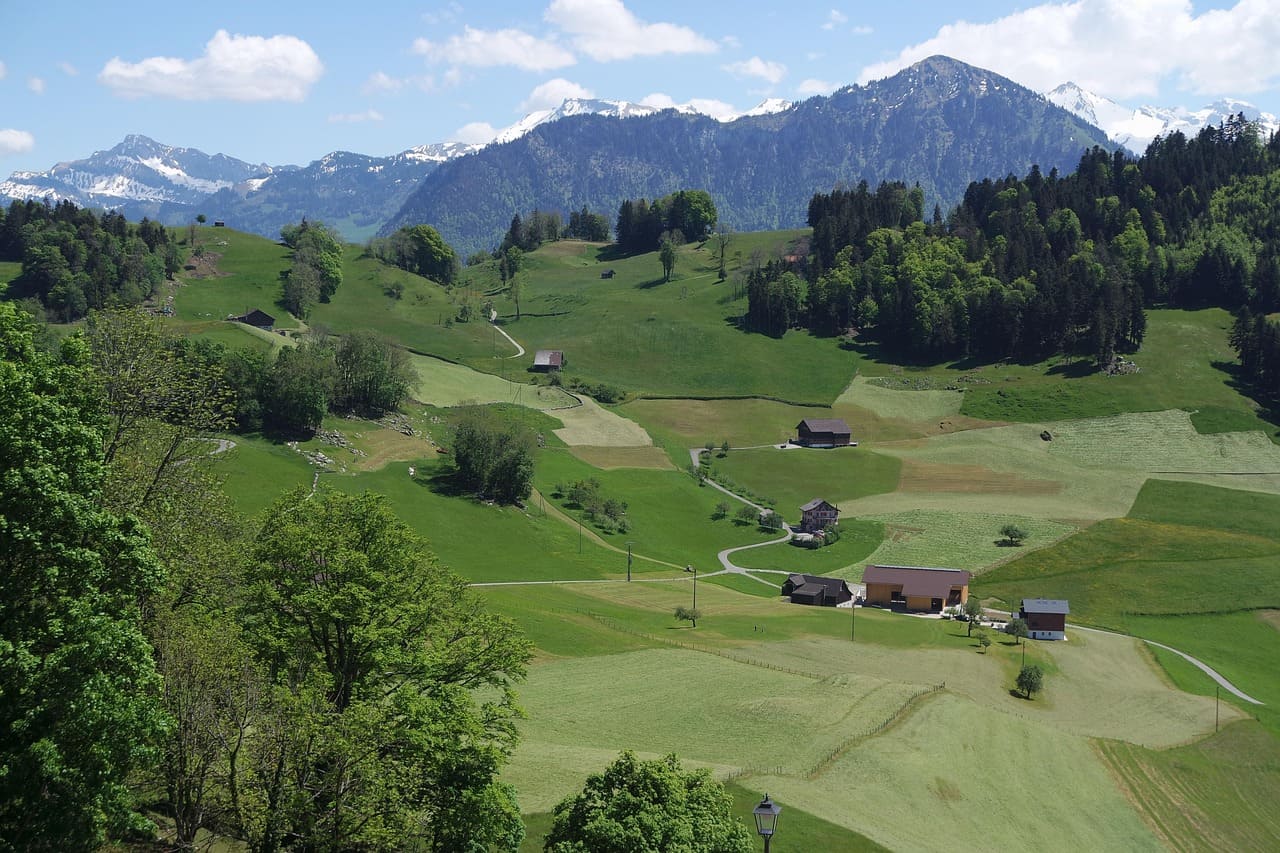
The notion that European cultural landscapes are 'natural heritage' to be preserved is scientifically untenable. They are the result of deforestation, drainage, river straightening, agriculture and settlement – that is, permanent, often massive human interventions over centuries. This dossier systematically questions the cultural landscape narrative. The focus is not on moral judgements, but on verifiable facts: origin history, ecological impact and scientific alternatives.
What to expect here
- Cultural landscape: not natural heritage, but human-made: Why no Central European cultural landscape arose naturally, what the concept of 'evolved landscape' obscures and what research says about the ecological origins of these landscape types.
- Ecologically impoverished stabilisation systems: Why cultural landscapes only exist through constant human intervention, how they systematically suppress natural ecosystem services and what the Krefeld study reveals about the condition of these landscapes.
- Rewilding as scientific response: What process-oriented nature conservation means, how the Helmholtz Centre UFZ investigates rewilding projects in Germany and why natural dynamics create more resilient ecosystems than maintenance-intensive conservation.
- European practice and Swiss examples: Where large rewilding areas are emerging in Europe, what the reintroduction of bison in the Jura shows and what the European Environment Agency recommends for ecosystem restoration.
- Critical opposing positions: Which objections classical nature conservation raises, what the Dutch project Oostvaardersplassen teaches about the limits of rewilding, and where the ethical and political tensions lie.
- What would need to change: Concrete political demands: process protection instead of conservation maintenance, enhancement of natural dynamics, space for wilderness in landscape policy.
- Arguments: Responses to the most common objections against rewilding and natural processes.
- Quick links: All relevant articles, studies and dossiers at a glance.
Cultural landscape: not natural heritage, but human creation
When nature conservation organizations, agricultural lobbyists or hunting associations speak of 'evolved cultural landscapes,' it sounds like tradition, depth, ecological legitimacy. What the concept actually describes is a landscape state that was never natural at any point. Central European cultural landscapes – flower meadows, heathlands, floodplain forests in channelized river valleys, vineyards, alpine pastures – are the product of deforestation, drainage, river channelization, fertilization, grazing and settlement. None of these forms arose spontaneously.
The term 'evolved' suggests biological origin and historical depth. In reality, it only means: old enough to be perceived as self-evident. A channelized Töss river has not 'evolved.' A drained wetland is not 'natural.' A mountain meadow that would be replaced by forest within a few years without annual mowing is not an independent ecosystem – it is a state dependent on human labor. The concept of cultural landscape as natural heritage serves a political function: it legitimizes maintaining a human-made status quo by reference to supposed naturalness.
The consequence for the nature conservation debate is far-reaching. Those who treat cultural landscapes as 'ancient' and 'natural' draw the conclusion that their change constitutes destruction – whether through beavers, floodplain revitalization, forest succession or rewilding projects. This logic inverts ecological reality: it is not the restoration of natural processes that is destruction. Destruction is the suppression of natural dynamics over centuries, which has caused the decline of 76 percent of insect biomass, the disappearance of floodplain landscapes and the collapse of waterfowl populations.
More on this: Hunting and biodiversity: Does recreational hunting really protect nature? and Recreational hunting and climate change
Ecologically impoverished stabilization systems
Cultural landscapes are not stable ecosystems. They are artificially stabilized states that require constant human intervention: mowing, channelizing, fertilizing, draining, felling. As soon as these interventions cease, ecological succession begins – the natural process of recolonization by pioneer woody plants, shrubs, eventually forest. What conservationists then lament as 'going wild' is actually the ecosystem repairing itself.
The Institute for Social-Ecological Research (ISOE) notes that landscapes in many regions have been adapted to human needs over centuries to such an extent that natural ecosystem services – self-purification of waters, natural flood protection, soil formation, pollination – have been systematically pushed into the background. This is taking its revenge: landscapes optimized for a single use objective are highly vulnerable to climate fluctuations, pest pressure and societal change.
The 2017 Krefeld study made headlines in this context: Within 27 years, insect biomass in Germany declined by 76 percent – even in designated nature reserves surrounded by intensively used cultural landscapes. The finding is unambiguous: it is not sufficient to maintain isolated protection islands in an ecologically impoverished matrix. The matrix itself – the cultural landscape – is the problem.
More on this: Wildlife corridors and habitat connectivity and Wildlife corridors: Migrating animals face difficulties
Rewilding as scientific response
Rewilding is not a romantic back-to-nature concept, but a scientifically grounded approach of modern restoration ecology. The core principle: humans create the conditions for natural processes – through removing barriers, reintroducing key species, or abandoning intensive use – and then withdraw. The ecosystem develops itself. Instead of maintenance-intensive conservation of a historical state, a self-regulating system with its own dynamics emerges.
The Helmholtz Centre for Environmental Research (UFZ) examines in the research project REWILD_DE how river restoration, natural grazing by large animals, and coexistence with wildlife contribute to biodiversity recovery. Research results show: restored river sections develop within a few years a species diversity that managed banks do not achieve in decades. Deadwood, bank erosion, fluctuating water levels – everything that cultural landscape management combats as disorder is the foundation of productive ecosystems.
Rewilding is not the end of human responsibility, but its reformulation. Instead of 'What state do we preserve?' the question becomes: 'What processes do we allow?' This means in practice letting beavers perform their ecological engineering, allowing floodplains their natural flooding cycles, tolerating deadwood in forests, and accepting wolves and lynx as regulators instead of replacing them with hunting quotas.
More on this: Alternatives to hunting: What really helps without killing animals and Wolf: Ecological function and political reality
European practice and Swiss examples
In Europe, large rewilding areas are increasingly emerging. In the Polish and Belarusian parts of the Białowieża Forest – the last lowland primeval forest in Europe – what natural dynamics can achieve is evident: a species diversity that managed forests do not even approach. In Romania, large-scale wilderness areas with bison, wolf, bear and lynx are developing in the Carpathians. In the Netherlands, the Kraansvlak project experiments with free-living wisent in dune landscapes. In Portugal, new wilderness zones are emerging in the Côa region, converting former agricultural land into near-natural habitats.
In Switzerland, the reintroduction of wisent in Canton Jura (Thal, SO) is the most prominent practical example. These animals perform natural landscape management functions: they open forests through bark stripping and rubbing, create clearings and structural diversity that benefit numerous other species. What conservationists perceive as 'browsing damage' is from an ecological perspective a service: the creation of transition zones, clearings and deadwood. The European Environment Agency (EEA) states in its recommendations for the Biodiversity Strategy 2030 that restoring functional ecosystems is a central response to global biodiversity loss – and that this restoration must include natural processes, not just species lists.
More on this: Geneva and the hunting ban and Wildlife management in Geneva: Contraception instead of culling
Critical opposing positions
The rewilding concept is not without contradiction, and this contradiction deserves serious engagement. Classical nature conservation – particularly organizations specialized in maintaining species-rich cultural landscapes – fears that natural succession will displace those open-land species dependent on extensive management. Butterfly species of nutrient-poor meadows, ground-nesting birds of agricultural land, or certain orchid communities evolved co-evolutionally with human use. Simply abandoning them to succession would destroy their habitat.
The Dutch project Oostvaardersplassen has shown how difficult it is to consistently implement the principle of 'leaving nature to itself.' When large herbivores starved en masse in the enclosed area, the project came under massive societal pressure. The question of when visible animal suffering requires human intervention is ethically non-trivial. Rewilding presupposes functioning ecosystems with sufficient space and complete food webs. Enclosed small projects without predators and without escape routes for overpopulated herbivores are not rewilding, but a semi-open zoo.
These tensions are not resolved through principle, but through context. In large-scale wilderness areas, in floodplains, along watercourses, and in mountain regions with sufficient space, rewilding is scientifically well-founded. In small-scale, fragmented cultural landscapes with high settlement pressure, more differentiated approaches are needed: targeted management for highly specialized open-land species, combined with maximum space for natural processes where possible. The error lies not in rewilding as a concept, but in application without context.
More on this: Hunting Myths: 12 Claims You Should Critically Examine and Hunting in Switzerland: Numbers, Systems and the End of a Narrative
What would need to change
- Recognize process protection on equal footing with management conservation: Swiss nature conservation policy is oriented toward maintaining states. Ecological processes must be anchored as independent protection goals in federal law. What happens naturally may no longer automatically be considered a threat.
- Remove beaver, wolf and floodplain dynamics from problem logic: Beavers are Europe's most effective aquatic ecosystem restorers. Wolves regulate ungulate populations in a way that hunting quotas structurally cannot. These animals and processes need space instead of displacement. Model initiative: Model texts for hunting-critical initiatives
- Remove public funds from cultural landscape management where it is not ecologically justified: Millions flow into maintaining landscape forms that only exist because they were historically used. Funding should be oriented toward ecological goals, not toward conserving historical usage patterns.
- Rewilding pilot areas in Switzerland: The canton of Jura has taken a first step with the bison project. More such projects are needed with scientific accompaniment, transparent communication and clear evaluation criteria.
- Societal debate about the concept of 'nature': What counts as 'natural' is politically defined in Switzerland, usually in favor of the status quo. An honest engagement with the developmental history of cultural landscapes would place the debate about wilderness, rewilding and ecological recovery on a more factual foundation.
Arguments
'Cultural landscapes are historically evolved and ecologically valuable.'
Historical is not synonymous with natural. Cultural landscapes are the result of massive human interventions – deforestation, drainage, straightening. Some of them harbor specialized species that co-evolved with extensive management. This justifies targeted care for highly specialized open-land species. It does not justify treating the entire cultural landscape status quo as an untouchable natural heritage.
«Rewilding destroys what has developed over centuries.»
What has developed over centuries are interventions in natural systems. Succession, flooding and deadwood are not destruction, but recovery. What happens in an abandoned meadow – woody growth, silting up, insect abundance – is not ecological loss, but structural enrichment. The term 'destruction' functions here as a rhetorical instrument, not as an ecological finding.
«Without management interventions, rare species disappear.»
This is true for certain highly specialized open-land species that are indeed dependent on extensive management. These groups deserve targeted care programs. It does not follow that cultural landscape management as an overall concept is ecologically necessary. The error lies in generalization: Not every managed landscape is worth protecting, and not every succession is a loss.
«Rewilding is too expensive and politically unfeasible.»
The costs of the status quo are seldom fully accounted for: subsidies for cultural landscape management, costs for flood protection on straightened rivers, damage from pollinator decline, costs of water treatment in pesticide-contaminated catchment areas. Renaturalized floodplains are demonstrably more cost-efficient in flood protection than technical structures. Rewilding is not an expensive ideal, but often the cheaper solution.
«Beavers and wolves only cause damage.»
Beavers create wetlands, raise groundwater levels, filter nutrients and measurably increase biodiversity at watercourses. Their 'damage' is local and compensable. Wolves regulate ungulate populations, reduce browsing pressure on forests and stabilize social structures in cervids. Both species perform ecosystem functions that humans can only replace with considerable effort and never completely.
Quick links
Articles on wildbeimwild.com:
- Killing as recreational entertainment: What the Ticino hunting law really reveals
- Wildlife corridors: Migrating animals have it tough
- Wildlife receives corridor over the A3
- Wildlife management in Geneva: Contraception instead of culling
- Switzerland hunts, but why actually?
- Why recreational hunting fails as population control
Related dossiers
- Wildlife corridors and habitat connectivity: Why wildlife bridges and spatial planning are more effective than culling
- Cultural landscape as myth
- Hunting laws and control: Why self-regulation is not enough
- Alternatives to recreational hunting
- Geneva and the hunting ban
- The wildlife warden model – professional wildlife management with code of honor
Our mission
Cultural landscapes are not nature. They are human creation, historically developed, ecologically impoverished and stable only through permanent interventions. Those who treat this condition as untouchable natural heritage are not pursuing nature conservation policy, but status preservation. Modern ecology is clear here: Self-regulating ecosystems are more resilient, more species-rich and in the long term also more valuable for humans than landscapes frozen at a historical usage level.
This does not mean the end of cultural landscape management. It means its revaluation: targeted care where highly specialized species need it, and maximum space for natural processes where space is available. This dossier will be continuously updated when new research results, political developments or Swiss practical examples require it.
More on the topic: In our Hunting Dossier we compile fact-checks, analyses and background reports.