
Wildlife corridors: Wildlife bridges more effective than culling
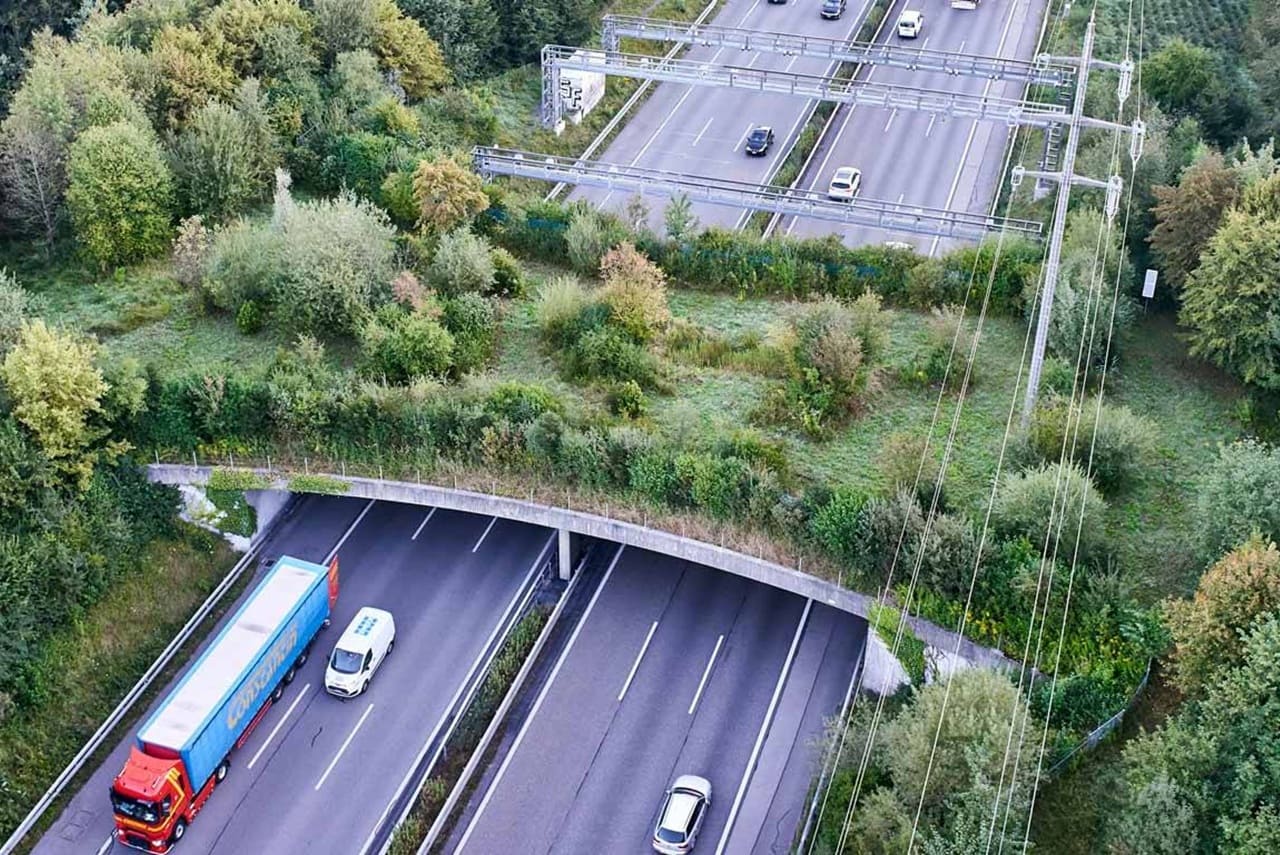
In Switzerland there are 303 supra-regional wildlife corridors. Of these, 47 – around 16 percent – are now largely interrupted and no longer usable for wildlife. Over half of the remaining corridors have significantly to severely impaired functionality. Each year, nearly 21,000 medium to large wild animals die on Swiss roads and railways, including over 8,000 roe deer – statistically one roe deer every hour. Over 100,000 amphibians are run over annually. More than 100 people are injured each year, and property damage runs into tens of millions.
What the recreational hunting community makes of this is remarkable: They declare themselves the solution to the problem. Culling, they argue, reduces wildlife populations and thus wildlife accidents. Wildlife damage prevention on roads serves as a legitimation formula for recreational hunting, particularly where other justifications no longer hold. Yet science, practice and experience from Switzerland and Europe clearly show: The effective responses to habitat fragmentation and wildlife accidents are wildlife bridges, wildlife passages, scent barriers, wildlife warning systems and consistent spatial planning – not culling.
This dossier shows why habitat fragmentation is a structural problem that requires structural solutions, why recreational hunting does not solve the problem but sometimes exacerbates it, and why Switzerland, despite a good legal foundation, lags decades behind what is needed.
More background on lobby arguments from recreational hunting can be found in the Dossier Hunting Myths: 12 Claims You Should Critically Examine.
What to expect here
- Habitat fragmentation: What it means and why it is the central wildlife problem of our time. How roads, settlements and railway lines fragment animal habitats into ever smaller islands, what this means for populations, genetics and survival chances, and which species are particularly affected.
- 303 corridors, 47 interrupted: The state of Swiss wildlife corridors. What the FOEN inventory shows, where the biggest gaps lie, why national highways form the greatest barrier and how far remediation has progressed.
- Wildlife bridges and wildlife passages: What they can do – and what research says. Why green bridges are effective for all terrestrial animal groups, what 2’300 wild animals per bridge per year means and which factors determine success or failure.
- Wildlife accidents: 21,000 deaths per year and the dark figure. What Swiss wildlife accident statistics show: which groups of people are harmed, what costs arise and why official figures are systematically too low.
- The hunting argument: «Culling prevents wildlife accidents.» Why this claim does not hold up scientifically, how driven hunts and night hunting causally increase wildlife accidents and what studies on population dynamics and traffic safety show.
- Alternatives that work: Scent fences, reflectors, wildlife warning systems, speed reductions: Which non-lethal measures show up to 80 percent fewer wildlife accidents in studies, how technical wildlife warning systems function and why 60 km/h speed limits on critical stretches save lives.
- Spatial planning as a solution: What consistent habitat connectivity means: how Pro Natura, FOEN and cantons secure corridors, what the Biodiversity Action Plan provides for and why the restoration of Swiss wildlife corridors will take decades.
- What would need to change: Concrete political demands: mandatory restoration with deadlines, mandatory wildlife warning systems, speed reductions, spatial planning reservations.
- Arguments: Answers to the most common justifications from the recreational hunting lobby.
- Quick links: All relevant articles, studies and dossiers at a glance.
Habitat fragmentation: The central wildlife problem of our time
Wildlife needs connected habitats. They migrate daily between feeding and resting areas, seasonally between summer and winter ranges, and across generations so that young animals can disperse, populations can exchange and species can colonize new areas. What was once natural is today no longer possible for many species in Switzerland and Central Europe: roads, railway lines, settlements, channelized waterways and intensively used agricultural areas have fragmented the landscape into ever smaller islands.
The consequences are severe. Isolated populations lose genetic diversity because no exchange with neighboring populations takes place. Local events – a harsh winter, a disease, an extreme event – can wipe out entire populations if no immigration from neighboring areas is possible. Species that require large-scale habitats or depend on seasonal migrations lose further options with every new road and every new settlement area. Road traffic is today the most common cause of death for wild mammals in Switzerland, killing around half of those wild animals that do not die through recreational hunting.
This is not a niche problem of nature conservation. It is the structural fundamental problem of wildlife ecology in Switzerland, and it is not solved by a single shot. Anyone who wants to seriously discuss wildlife protection, species conservation and traffic safety must start here – not with hunting licenses.
More on this: Switzerland hunts, but why actually? and Hunting and Animal Welfare: What Practice Does to Wild Animals
303 Corridors, 47 Interrupted: The State of Swiss Wildlife Corridors
The FOEN has inventoried 303 interregional wildlife corridors for Switzerland. These corridors connect forest areas, waterways and near-natural areas and form the backbone of wildlife mobility in Switzerland. The results of the current assessment are sobering: Only around 28 percent of the corridors function largely without restriction. 47 corridors – 16 percent – are completely interrupted and no longer usable for wildlife. More than half, namely 171 corridors, have significantly to severely impaired functionality.
The greatest barrier is formed by the national highways. The Federal Roads Office (FEDRO) has been working since 2003 together with FOEN and cantons on the restoration of those wildlife corridors that cross national highways – a total of 41 corridors of interregional importance. Progress is slow: In 2021 there were 44 wildlife bridges in Switzerland; the first were built in 1992 in the canton of Thurgau over the new A7. Additional passages, underpasses and specialized small animal crossings are being added, but the restoration extends over decades, not years. In the canton of Zurich, the current restoration program encompasses 50 wildlife corridors and is designed in three phases over 24 years, from 2024 to 2044.
No wildlife population caused this condition, and no culling will remedy it. It is the result of decades of spatial planning failures and it demands spatial planning corrections.
More on this: FOEN: Wildlife Corridors and Wildlife Passages and Pro Natura: Free Passage for Wildlife
Wildlife Bridges and Wildlife Passages: What They Can Do – and What Research Says
Wildlife bridges and wildlife passages work. This is not the opinion of nature conservation organizations, but the result of decades of research. A meta-analysis that evaluated green bridges in Germany, the Netherlands, France and Switzerland concludes: Green bridges are suitable for all terrestrial animal groups to at least locally compensate for fragmentation effects of transport infrastructure. They are most effective when they serve not only as narrow crossing corridors, but are integrated into the activity areas of the respective species.
The numbers are impressive: On a green bridge over the A11 highway in Brandenburg, almost 2,300 wild animals were registered between May 2005 and April 2006. The passage was used not only by larger wild animals, but also by invertebrates such as butterflies, spiders and beetles. Monitoring by the Forest Research Station of Baden-Württemberg at 66 wildlife passages – from large overpasses to small animal underpasses – documents that bridges are suitable as crossing aids and habitat for various species groups and make a significant contribution to connectivity. For the European wildcat in Luxembourg, DNA analysis could prove that at least 9 different individuals used a single wildlife bridge as a migration corridor.
Decisive for success: width. The wider a bridge is, the better it is accepted. Narrow bridges without cover are avoided by shy species. A bridge of at least 50 meters width with near-natural vegetation achieves significantly higher usage numbers than narrow "economy models". This has consequences for planning: Those who economize on wildlife bridges economize on effectiveness.
More on this: Canton of Zurich: Wildlife Corridors and FOEN Functional Control of Wildlife Passages (PDF)
Wildlife Accidents: 21,000 Deaths per Year and the Dark Figure
According to official statistics, nearly 21,000 medium to large wild animals die annually in road traffic in Switzerland – including over 8,000 roe deer, plus foxes, badgers, hares, wild boar and occasionally red deer. Over 100,000 amphibians – primarily frogs and toads – are run over each year. Around 90 percent of accidents occur on roads, the remainder on railways. Additionally, over 100 people are injured annually, and property damage for reported insurance cases alone reaches double-digit millions: Insurers like AXA and Helvetia report thousands of claims annually.
These figures must be read with a crucial caveat: They are underestimations. Only those accidents reported to a hunting warden or authority are recorded. Smaller animals, nocturnal species and accidents on secondary roads are frequently omitted. In Canton Zurich alone, around 2,800 wild animals died in road traffic in 2023 – and this only includes reported cases. The dark figure is likely considerably higher nationwide than the official 20,000. Particularly accident-prone regions are Jura, Fribourg and Graubünden, as well as the Weinland and lakeside communities in Zurich.
What these figures also reveal: The problem does not primarily affect wild populations as abstract stocks, but concrete individual animals that die on a road at night – often after a prolonged agony process, far from any veterinarian, unnoticed by authorities and the public. Around half of the animals found on roads show bite wounds or other prior injuries from hunting, indicating that flight reactions due to hunting pressure and driven hunts contribute causally to road deaths.
More on this: Hunting and Animal Welfare Dossier and Wild Animals, Mortal Fear and Absent Anesthesia
The hunting argument: «Culls prevent wildlife accidents»
The argument is old and persistently repeated: Fewer wild animals mean fewer wildlife accidents. Therefore, culls are a means of traffic safety. At first glance, this sounds plausible. Upon closer examination, it does not hold up empirically and ecologically.
First, population ecology studies show that intensive hunting can decimate wildlife populations short-term, but cannot permanently reduce them, because losses are compensated by increased reproduction rates. This applies particularly to roe deer and wild boar: The population self-regulates through the resource capacity of the habitat, not through culling numbers. Hunting creates short-term space for young animals – and thereby increases the reproduction rate. Second, research shows that driven hunts and beating actively startle wild animals and cause panic. Hunted animals cross roads in mortal fear that they would otherwise avoid. PETA states: «Hunters are co-responsible for many wildlife accidents. During hunting, especially large driven hunts, animals are startled. They flee and run in mortal fear across roads and into settlements.»
Third, the culling argument is most clearly refuted where Canton Geneva has operated without any recreational hunting since 1974: Wildlife accident numbers in Canton Geneva are not higher than in hunted cantons. What makes the difference are structural measures: speed reductions, wildlife warning systems, habitat planning. This shows: Traffic safety and wildlife protection are planning tasks, not hunting tasks.
More on this: Hunting Myths: 12 Claims You Should Examine Critically and Hunting and Animal Cruelty
Alternatives that work: Scent barriers, reflectors, warning systems, speed reductions
Between the extreme pole of «doing nothing» and «shooting wild animals» lies a broad spectrum of scientifically tested, non-lethal measures for reducing wildlife accidents, which in their overall effect are far more efficient than culls.
Scent fences and wildlife reflectors showed in a long-term study conducted jointly by ADAC and the German Hunting Association a reduction of wildlife accidents by up to 80 percent on well-secured test sections. The effectiveness is focused on specific road types and animal species and requires regular maintenance – but the effect is measurable and reproducible. Acoustic wildlife warning systems that react to vehicle movements and emit ultrasonic signals have proven effective at critical hotspots. In Canton Zurich, an improved warning system is being tested at Lake Zurich, specifically targeted at the most accident-prone road sections.
Speed limits on critical road sections – particularly 60 km/h at night on known wildlife crossing routes – are easy to implement and significantly reduce both collision probability and accident severity: a 20-kilogram roe deer has an impact weight of around one tonne at 100 km/h. Wildlife protection fences along national roads do prevent crossings, but simultaneously increase habitat fragmentation – they therefore only make sense in combination with wildlife passages, never as a standalone measure. Acoustic deterrent methods like the 'wild boar deterrent' tested by ZHAW show promising results in agriculture and could sustainably influence road-adjacent wildlife behavior without injuring a single animal.
More on this: Alternatives to hunting: What really helps without killing animals and Initiative demands 'Wildlife wardens instead of hunters'
Spatial planning as solution: What comprehensive habitat connectivity means
Wildlife corridors are anchored in Swiss law: The corridor network is a legal mandate, their restoration is part of the federal biodiversity strategy action plan. FOEN, FEDRO and the cantons work together. The foundations are solid.
The problem is the pace. The restoration of the 51 interrupted corridors along national roads has been running since 2003 – for over 20 years – and is still not completed. In Canton Zurich, the restoration program for 50 corridors is designed for 24 years. Pro Natura has been demanding for years that impaired or interrupted corridors be made passable again, and that the movement needs of wildlife be bindingly considered from the outset when planning new infrastructure. The Federal Office for the Environment is accelerating restoration programs within the framework of the biodiversity strategy – a step in the right direction, but one that must not obscure the fact that for every restored passage, new fragmentations arise as long as spatial planning and construction law do not anchor a consistent corridor protection principle.
What a truly comprehensive approach would mean: a federally binding corridor reservation for all spatially relevant projects, an accelerated restoration program with clear deadlines instead of decade-long plans, mandatory wildlife warning systems on all statistically accident-critical sections, and consistent strengthening of near-natural land use in corridor zones to ensure the continuity of migration routes also between bridges and passages.
More on this: FOEN: Wildlife corridors and Canton Lucerne: Wildlife corridors and wildlife passages
What would need to change
- Federally binding corridor reservation for infrastructure projects: Today, wildlife corridors must be considered in new road, rail and settlement projects – but the binding nature is incomplete. A clear legal foundation is needed that fundamentally prevents new fragmentations of existing or planned corridors and ties exceptions to strict compensation obligations.
- Accelerated restoration program with deadlines: The ongoing restoration of the 51 interrupted national corridor sites must receive binding completion deadlines. A 24-year plan is not a restoration program, but a stalling tactic. At the current pace, interrupted corridors will be restored decades too late.
- Mandatory wildlife warning systems on accident-prone road sections: The cantons maintain wildlife accident statistics. This data must be systematically evaluated and used as grounds for mandatory wildlife warning systems, scent barriers or speed reductions on accident-prone road sections. A wildlife accident hotspot without measures is an avoidable decision.
- Speed reductions on wildlife crossing routes: On road sections that cross known wildlife crossings, particularly during twilight and nighttime hours, 60 km/h must apply as the standard speed. Reducing impact weight decreases accident severity for both animals and humans.
- Integrated wildlife management instead of kill quotas: Cantonal hunting authorities and spatial planning authorities must work more closely together. Wildlife management must no longer mean setting kill numbers. It must mean connecting habitats, creating buffer zones and systematically prioritizing non-lethal conflict solutions.
- Publicly accessible, complete wildlife accident statistics: Not all cantons publish comparable wildlife accident figures. A uniform, publicly accessible monitoring system with binding reporting requirements creates the data foundation needed for evidence-based measures.
- Model motions: Template texts for hunting-critical motions and Protecting protective forests from recreational hunting
Arguments
«Fewer wildlife through culling means fewer wildlife accidents.» This is true short-term and locally in individual situations. Long-term, wildlife populations compensate for losses through increased reproduction rates; populations recover quickly. Moreover, driven hunts and battue hunts show causal connections to increased wildlife accident numbers: Startled animals cross roads in mortal fear that they would otherwise avoid. Canton Geneva has had no recreational hunting since 1974 and no comparatively higher wildlife accident numbers. This is the clearest empirical refutation of the argument.pronatura+1
«Wildlife bridges are too expensive – hunting is much cheaper.» A wildlife bridge costs several million francs depending on width and location. But it lasts decades, improves biodiversity, permanently reduces accidents and creates no new problems. Culling is periodic, generates follow-up costs through increased reproduction and doesn't solve the fundamental problem – habitat fragmentation – at all. Those who call wildlife bridges too expensive must ask themselves why they don't offset hunting costs, wildlife accident damages in the double-digit millions and long-term biodiversity losses against them.watson+1
«Wildlife corridors are useless if animals don't use them.» Research shows the opposite: wildlife bridges are used by all terrestrial animal groups, from large mammals to invertebrates. Width, vegetation and connection to near-natural areas on both sides of the passage are crucial. Narrow or poorly designed bridges indeed function less well – this is an argument for better planning, not against wildlife bridges per se.wikipedia+1
«Hunting regulates wildlife populations that would otherwise get out of hand.» No wildlife population «gets out of hand» without humans having altered their habitat, their enemies or their food sources. Where wildlife populations actually cause problems, non-lethal measures – scent barriers, deterrent systems, habitat modifications – are often more effective and lasting than culling, which doesn't address the fundamental problem.peta+1
«Pro Natura and other nature conservation organizations support hunting as an instrument.» Pro Natura consistently advocates for wildlife corridors, green bridges and spatial planning. Where conservation organizations do not fundamentally reject individual hunting measures, this is not support for recreational hunting, but the result of pragmatic compromises in a system that offers no better alternative. As soon as non-lethal alternatives are available, the hunting argument in nature conservation loses its foundation.
«Switzerland has one of the best wildlife corridor systems in the world.» Switzerland has a good inventory and a good legal foundation. But 47 completely interrupted and 171 severely impaired corridors out of 303 supra-regional connections is not a success. The remediation program has been running since 2003 and is planned for decades. It needs more speed, more resources and more political will – not self-congratulation.bafu.admin+1
Quicklinks
Articles on Wild beim Wild:
- Hunting and animal welfare: What practice does to wildlife
- Alternatives to hunting: What really helps without killing animals
- Switzerland hunts, but why actually?
- Initiative demands «Wildlife wardens instead of hunters»
- Hunting accelerates poaching – Study refutes old superstition
- Hunting in Switzerland: Fact check, hunting types, criticism
Related dossiers
- Wildlife corridors and habitat connectivity: Why wildlife bridges and spatial planning are more effective than culling
- Cultural landscape as myth
- Hunting laws and control: Why self-supervision is not enough
- Alternatives to recreational hunting
- Geneva and the hunting ban
- The wildlife warden model – professional wildlife management with code of honor
Our claim
Wildlife corridors, wildlife bridges and consistent spatial planning are not romantic nature conservation ideas – they are the only answers that actually address the fundamental problem of habitat fragmentation. Culling does not solve this problem. At best, it temporarily conceals it and creates new problems: increased reproduction rates, stress-induced misbehavior, panic flight across roads, and – as the Canton of Geneva has shown since 1974 – no measurable advantages over a hunting-free, spatially consistent alternative.
A wildlife policy that takes biodiversity and traffic safety seriously invests in wildlife bridges, accelerates the remediation of interrupted corridors, mandates wildlife warning systems at accident hotspots and stops offering culling as a universal tool for problems that demand structural solutions. Switzerland has the legal foundation and scientific knowledge for this. What is missing is political will and speed. This dossier will be continuously updated when new studies, planning reports or political decisions require it.
More on the topic of recreational hunting: In our hunting dossier we bundle fact checks, analyses and background reports.