Why Recreational Hunting Fails as Population Control
Recreational hunting can reduce numbers locally, but cannot curb them across the board, because animals continually migrate in from neighbouring areas and, due to the pressure from recreational hunters, simply increase their birth rate.


High kill numbers are often an indicator of a growing population — recreational hunters can simply shoot more because density is increasing.
The notion that recreational hunting can keep populations “under control” is biologically unfounded.
In some regions, predators benefit from the presence of certain species, yet these are senselessly hunted within the hunting community itself in the face of its own obsessions, despite scientific counterarguments. With species such as wild boar or fox, the killing of lead animals can destabilise social groups, causing more females to become pregnant or mating to occur earlier.
The creation of “vacant territories” or less-defended ranges triggers migratory movements and also spreads disease. For mobile species this means: hunting essentially targets only transient individuals — not the resident population.
Many “problem species” such as nutria in Germany, wild boar or rabbits have extremely high reproductive rates.
Even if a large proportion of the population is shot, the remaining animals can replenish the gap within a few months through reproduction or immigration.
In wildlife species, females can become pregnant again just a few months after giving birth, often producing multiple litters per year. Recreational hunting frequently does not randomly affect all age and sex classes. When hunters target primarily large or conspicuous animals, younger individuals with higher reproductive potential are spared. In some cases, this actually promotes population growth, because more resources (food, space) remain available for survivors.
Many wildlife species respond to lower population density with higher birth rates or improved juvenile survival rates. This means: less competition = more offspring per animal. When animals are heavily hunted locally, individuals from unhunted or less-hunted regions frequently migrate in. This negates hunting success in open landscapes or along rivers.
Recreational hunting is, and has never been, wildlife management — rather, it has the character of a funfair for psychologically disturbed individuals operating blindly.
Recreational hunting is a perversion of the concept of harvesting surplus, but rarely a reliable means of achieving lasting population reduction — particularly in adaptable, fast-reproducing, or mobile species.
During the 1980s through the 2000s, the hunting bag (animals killed) for wild boar increased sharply, yet the population continued to grow. Intensive hunting primarily removed adult animals, which relieved pressure on the remaining population: more food, higher fertility (sows reached sexual maturity earlier and produced more piglets). In addition: mild winters and maize cultivation provided abundant food. Hunting pressure was unable to curb population growth.
Recreational hunters kill ever-increasing numbers of various wildlife species each year (the hunting bag has multiplied within just a few years), yet populations are also growing. More offspring per year, better survival of juvenile animals, and new individuals arriving from less-hunted areas.
In some regions of Germany, recreational hunters now view nutria as attractive quarry, effectively making a “remnant population” desirable. This species of rodent is regarded as a delicacy within recreational hunting circles.
Step-by-step dynamics
- Recreational hunting reduces the population
- A proportion of animals is removed (e.g. 30% of individuals).
- Result: fewer mouths competing for food and habitat.
- Less competition = better conditions
- More food per animal.
- More favourable body condition (better health, less stress).
- Juvenile animals have higher survival rates.
- Biological response: higher reproduction rate
- Females reach sexual maturity earlier (e.g. wild boar sows as young as 7–8 months instead of 18).
- More litters per year possible.
- More offspring per litter.
- Higher proportion of surviving young.
- Immigration fills the gaps
- Vacant territories attract animals from neighbouring areas.
- The effect is amplified particularly in mobile species.
- Population reaches or exceeds its original level again
- Sometimes even faster than before recreational hunting.
- In the long term, the population is stable or continues to grow.
This is known as compensatory or over-compensatory population dynamics – nature does not respond passively to losses, but “overreacts” with increased reproduction.
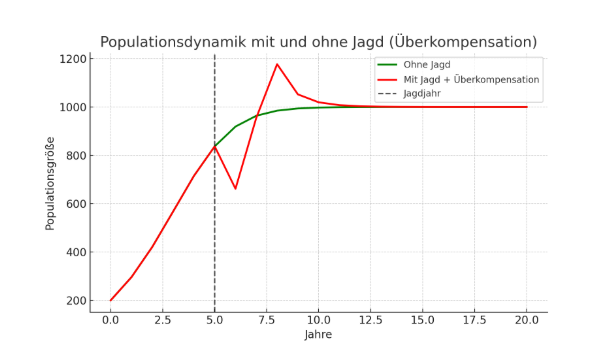
This is a key point that many recreational hunters, due to their lack of training, and parts of the political establishment fail to understand: hunting pressure does not act as a permanent ‘population ceiling’, but rather as a reset button, after which the population responds with increased reproduction – often even more strongly than before.
When primarily large, conspicuous animals are shot, the age and sex structure shifts.
Given the disorder in which nature finds itself after decades of unscientific stewardship by recreational hunters, it is hardly surprising that more and more stakeholders are raising concerns.
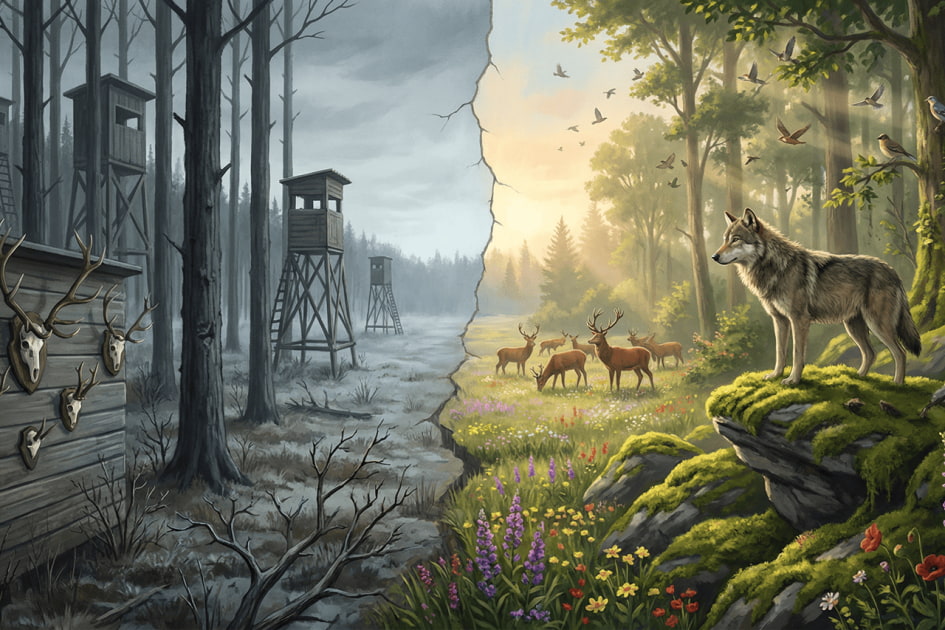
Recreational hunting in its current form is not an effective instrument for population regulation, but a periodic ‘wildlife harvest’ that frequently stabilises or even increases population numbers. The cause lies in the biological counter-response of many wildlife species. Viewed soberly, recreational hunting in its present form is more a kind of utilitarian wildlife harvesting – with the side effect that recreational hunters never run out of game – than effective wildlife management.
Furthermore, every area cleared by shooting in permeable landscapes attracts animals from neighbouring territories – an effect that, particularly in mobile species, negates the hunting outcome entirely. In social species, the killing of lead animals destroys stable group structures, which paradoxically can lead to even greater reproduction.
Effective wildlife management requires scientifically grounded, precisely implemented strategies – not the opportunistic exploitation of a perpetually self-replenishing population by recreational hunters.
Further articles
- Are recreational hunters psychopaths?
- Recreational hunters on the psychological pendulum
- Aggression: understanding recreational hunters better
- Sadism: Understanding Recreational Hunters Better
- Trophies: The Pleasure Hunt
- Alcohol: Recreational Hunters and the Drinking Problem
- Hunting and Hunters: Psychoanalysis
- Recreational Hunters and Violence in Our Society