Bern protects research red deer, releases research roe deer for shooting
The hunting information 2025/26 of Canton Bern exemplifies how selectively the protection of research animals is handled during ongoing recreational hunting: Radio-collared red deer are off-limits canton-wide, while marked roe deer may be shot.

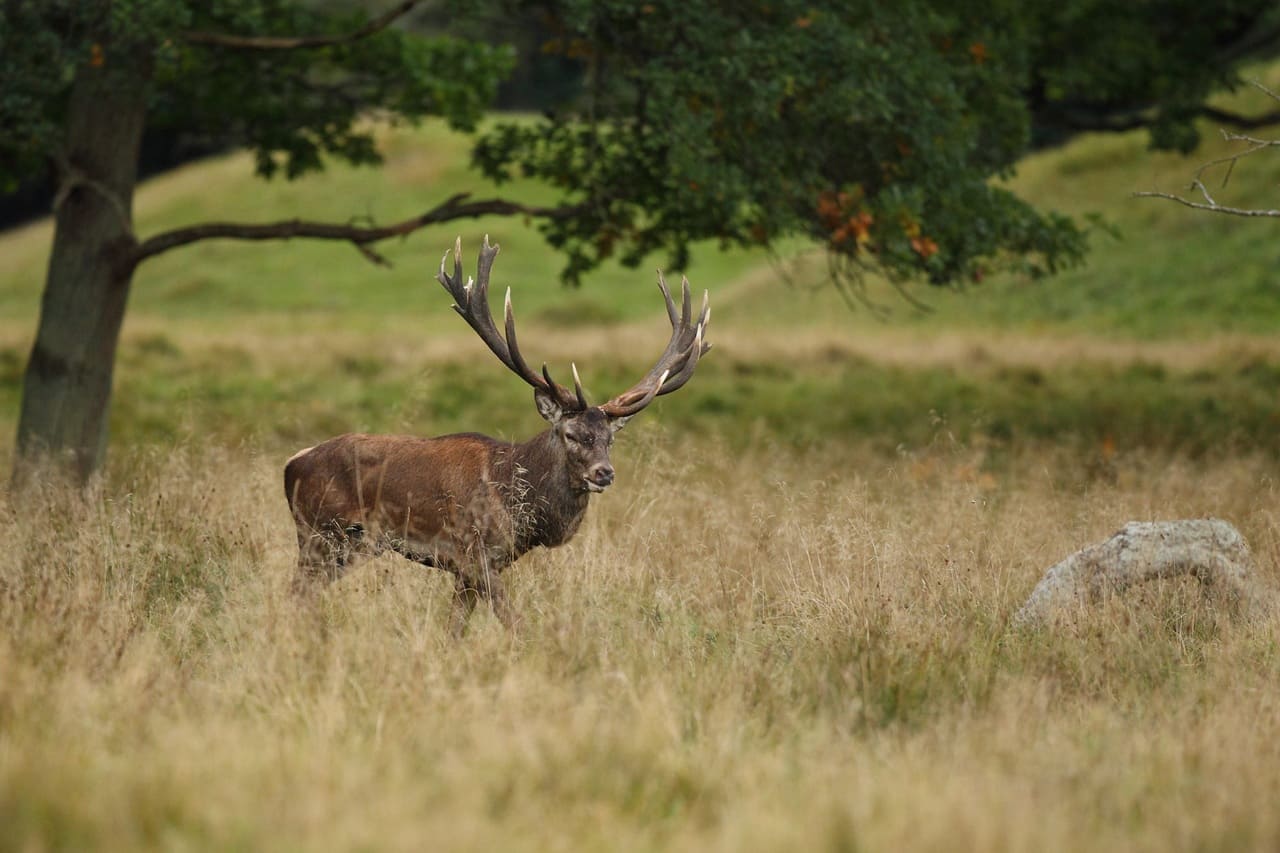
It is a sentence that barely stands out in its bureaucratic matter-of-factness, yet reveals a fundamental contradiction in the Swiss recreational hunting system: "Red deer wearing transmitter collars are not huntable throughout Canton Bern," states the official hunting information 2025/26 of Canton Bern, published via the Bernese Hunters' Association (bejagd.ch).
A few lines below it states: "Marked roe deer may be shot, but must be reported immediately with the necessary information to the responsible game warden."
What does this mean in concrete terms? A red deer equipped with a GPS collar as part of a scientific project is protected throughout the entire canton of Bern. A roe deer that was likewise fitted with ear tags for research purposes may, however, be killed by recreational hunters. The only requirement: reporting to the game warden. The protection status of a research animal thus depends not on its scientific value, but on the animal species and the type of marking.
The legal framework: fines yes, protection no
In principle, the Bernese Law on Hunting and Wildlife Protection (JWG) criminalizes the intentional killing of marked research animals. Article 31 Section I Letter d JWG provides for fines of up to 20,000 francs for persons who "intentionally kill an animal marked for wildlife research projects." However, the hunting information for 2025/26 immediately relativizes this principle with species-specific exceptions. The result is a patchwork that defines different protection standards depending on the wildlife species:
Radio-collared red deer enjoy full protection. Red deer with ear tags but without transmitter collars may be killed. Marked roe deer may be killed but are subject to reporting requirements. For wild boar with "transmitter collars" in hunting areas 3, 7, 8 and 12, a hunting ban also applies, while animals "with ear tags only" remain huntable – thus the same logic as with red deer, only extended even more consistently to two ear types.
This graduated logic reveals more about the system's priorities than about the actual research value of individual animals. It shows: protection applies not to the animal as a research subject, but to expensive transmitters and the politically more sensitive large game species.
Million-dollar project on a collar
The background to the protection regulation for radio-collared red deer is the research program "Red Deer in the Swiss Midlands," a joint project of the Federal Office for the Environment (FOEN), Bern University of Applied Sciences (BFH/HAFL), ZHAW and HEPIA Geneva. Under the direction of wildlife biologist Christian Willisch, free-ranging red deer in the cantons of Bern, Solothurn and Aargau have been equipped with GPS collar transmitters since 2013. According to the 2024 ZHAW final report, the project delivered over 450,000 GPS positions and developed foundations for habitat use, migration corridors and population connectivity.
A single GPS transmitter collar costs several thousand francs depending on the model. Capturing and anesthetizing the animals is complex, data analysis extends over years. It stands to reason that the canton does not want to jeopardize these investments through an errant shot. But this is precisely where the argumentation becomes questionable: protection of the research animal follows an economic logic, not an ethical one. The marked roe deer is scientifically no less valuable, but its marking cost significantly less. Therefore it is huntable.
Patent hunting without territory responsibility
The canton of Bern practices patent hunting, like 15 other Swiss cantons. Hobby hunters acquire a personal patent and may hunt throughout the entire cantonal territory, outside wildlife protection areas and within established times and quotas. For the hunting period 2025/26, 299 red deer were released for shooting in hunting area 11 of the Bernese Oberland alone, with another 106 in hunting area 12, 63 in hunting area 10 and 39 more in hunting area 8. The cantonal total was over 1,000 animals. Of these, the majority were female animals – hinds and calves. In the main hunt from September 1-7, 2025, initially only female deer could be killed.
This system knows no individual territory responsibility, as would be customary in a territory hunting system. The recreational hunters have no long-term connection to a specific area and thus no systematic incentive to know the condition of the local population over years. In such a system, the canton must protect research animals through explicit regulations because it cannot rely on the local knowledge and overview of individuals.
In the canton of Geneva, where recreational hunting has been banned since 1974 and professional game wardens handle population regulation, this problem does not arise in this form. There, trained professionals decide on every intervention in the population. The Geneva model shows that wildlife management and research do not have to endanger each other.
What the case reveals about recreational hunting
The differentiated regulations of the canton of Bern are by no means an expression of particular care. They are the symptom of a system that is supposed to fulfill two incompatible functions simultaneously: enable research on wild animals while organizing their killing by thousands of permit holders.
This reveals a fundamental problem: wildlife research and recreational hunting exist in a structural field of tension. Research needs long-term, undisturbed observation series. Recreational hunting produces disturbances, changes population structures and sometimes kills precisely those individuals that would be scientifically most valuable. The fact that the canton of Bern protects radio-collared red deer is an implicit admission that recreational hunting would endanger research results without such interventions.
The research results of the HAFL project ironically show that red deer were able to successfully return to the Mittelland primarily because they were initially not hunted in some cantons. Wildlife biologist Willisch himself documented how the cantons of Solothurn, Bern and Aargau have resumed deer hunting in the Mittelland in recent years, even though populations there remain small and mortality from traffic accidents is already high.
Protection by market value instead of principle
The 2025/26 hunting information from the canton of Bern is a textbook example of the internal contradictions of the Swiss recreational hunting system. Research animals are not protected on principle, but graded according to investment volume and species status. What wears an expensive radio collar is taboo. What has only an ear tag is fair game with reporting obligation. The roe deer, which can equally be part of a research project, is out of luck: its data value does not exceed the hunting impulse.
Anyone who seriously understands wildlife management as a science-based task must ask whether a system that must protect research animals from its own actors is still contemporary. The Geneva model has proven for over 50 years that it can be done differently. More on this in the dossier Why recreational hunting fails as population control.
Sources:
- Hunting information 2025/2026, canton of Bern, published via bejagd.ch (bejagd.ch/informationen-zur-jagd-2025-2026)
- C permits red deer 2025/26, canton of Bern (bejagd.ch/patente-c-rothirsch-2025-26)
- Art. 31 para. I let. d, Law on Hunting and Wildlife Protection of the canton of Bern (JWG)
- Fischer, C. et al. (2024): Red deer research program in the Swiss Mittelland, final report. BFH/HAFL, ZHAW, HEPIA, BAFU.
- Sigrist, B. et al. (2025): Red deer in the Mittelland: population development and space use in the Albiskette-Reusstal region. ZHAW final report.
- Willisch, C. et al. (2019): Exchange of red deer between the pre-Alps and the Mittelland. Final report commissioned by the Bern hunting inspectorate.
- Annual report hunting inspectorate 2024, canton of Bern (weu.be.ch)
- Pro Natura: Red deer in motion (pronatura.ch)
- SRF News, 12.4.2024: Deer in the Mittelland – They are back and feel at home
Related dossiers on wildbeimwild.com:
- Red Deer Dossier
- Hunting Myths
- Hunting and Biodiversity
- Animal Welfare Problem: Recreational Hunting
- Studies
Support our work
With your donation you help protect animals and give voice to their concerns.
Donate now →