
Swiss ibex: Smuggled, saved, trophy
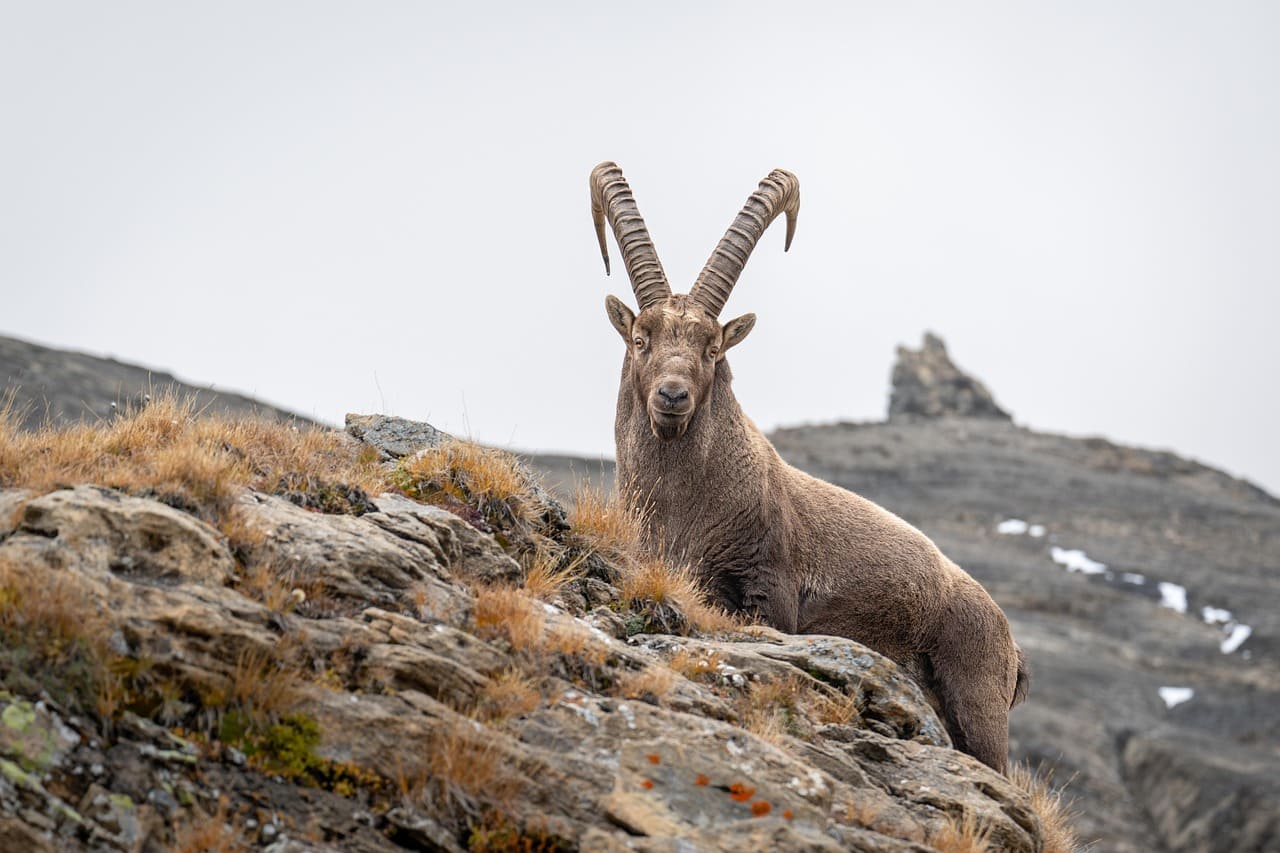
The Alpine ibex was completely extinct in Switzerland by 1820. Its survival is thanks to one of Europe's most adventurous conservation stories: From 1906, poachers commissioned by Swiss conservationists smuggled ibex kids from the royal hunting grounds at Gran Paradiso in Italy across the border. The Federal Council covered the illegal operation and let the customs officers turn a blind eye. 59 smuggled kids, raised in the Peter and Paul Wildlife Park in St. Gallen, form the foundation of all approximately 17,000 ibex in Switzerland today and around 40,000 in the entire Alps (National Museum, 2022; Swiss National Park, 2020). This success story has been undermined since 1977 by hunting of the species and since 2025 by the reintroduction of trophy hunting in Canton Valais. For up to 25,000 francs, foreign recreational hunters may again shoot the 'king of the Alps'. In 2024, 7,000 ibex were counted in Valais, more than ever before. 624 are cleared for shooting, including 34 bucks over 11 years old, those with the mightiest horns (SRF, 2024; 20 Minutes, 2025). IG Wild beim Wild states: 'Trophy hunting is cowardly and a testament to character poverty' (wildbeimwild.com, 2025).
Profile
The Alpine ibex (Capra ibex) is a species of goat and belongs to the family of bovids (Bovidae). It is the heraldic animal of the canton of Graubünden and a symbol of the Swiss Alps. The ibex lives at altitudes between 1’600 and 3’200 meters, above the tree line, on steep rock faces and ridges. It is perfectly adapted to life in high mountains: Its hard, flexible hooves give it grip on the steepest rocks.
The buck reaches a weight of 75 to 120 kilograms and a shoulder height of 85 to 92 centimeters. The female ibex is significantly smaller and lighter (40 to 55 kilograms). The most impressive feature of the buck are the mighty, backward-curved horns, which can reach up to one meter in length and weigh up to 15 kilograms. The horns grow throughout life and bear annual rings, by which age can be determined. Female ibex also carry horns, but they are significantly shorter (15 to 30 centimeters).
Biology and Lifestyle
The ibex is diurnal and lives in separate gender groups: bucks form bachelor groups, females live with their kids in mother-child herds. Only during the rut in December and January do the sexes come together. Old bucks with large horns play a central role in reproduction and herd cohesion. Biologist and Green cantonal councilor Brigitte Wolf (Valais) emphasizes: «The shooting of old bucks is very delicate, because they are important for reproduction and herd cohesion» (SRF, 2024). The gestation period is around 170 days. In June, typically a single kid is born. The ibex eats grasses, herbs, lichens and in winter also dwarf shrubs and bark. It is strictly vegetarian. Its life expectancy is 15 to 20 years.
Genetic Bottleneck
All ibex in the Alps descend from a single remaining population at Gran Paradiso. The Swiss National Park documents: Today's animals have gone through several genetic bottlenecks (remaining population, removal by poachers, breeding in wildlife parks, reintroduction into various areas). The consequences of this high inbreeding rate are lower body weight, reduced horn length and increased risk of parasite infestation (Swiss National Park, 2020). The targeted trophy hunting of the largest and genetically most valuable bucks additionally exacerbates this problem.
History: From Extinction to Smuggling Drama
The Extinction
The ibex served for centuries as a «walking pharmacy»: Almost every body part was attributed healing properties. The horns were supposed to help with stomach and intestinal cramps, the bezoar stones (stomach stones) were to work against poisoning, and the so-called heart cross (a hardened cartilage of the heart valves) was supposed to make its bearer invulnerable. Even ibex droppings were considered a remedy for sciatica (Surselva Hausbuch; National Museum, 2022). As early as 1550, the last ibex was killed in Glarnerland. Although the Three Leagues imposed a hunting ban in 1612 under threat of death penalty, the ibex was extinct in Graubünden by 1640. In 1809 and 1820 respectively, the last ibex fell in Valais. In 1875, the ibex was placed under federal protection, half a century after it had already become extinct in Switzerland.
The Smuggling Drama
At Gran Paradiso in northern Italy, the last 100 to 200 Alpine ibex survived, protected by King Vittorio Emanuele II, who reserved exclusive hunting rights for himself and employed 50 game wardens. Official Swiss requests for breeding pairs remained unanswered. On June 6, 1906, St. Gallen hotelier Robert Mader and Aosta Valley poacher Joseph Berard met in Martigny for a strictly secret meeting. Berard delivered the first two smuggled ibex kids, 800 francs per animal (approximately 30,000 francs today). The kids were raised with baby bottles in the Peter and Paul Wildlife Park in St. Gallen (Beobachter, 2017; National Museum, 2022). By 1933, 59 smuggled kids had reached Switzerland. The Federal Council financed the purchases and instructed customs officers to let the smugglers pass (Beobachter, 2017). From 1911, the first offspring were released into the wild. In 1920, seven ibex arrived at the Swiss National Park, accompanied by a brass band and a large crowd (Swiss National Park, 2020).
The Success Story
The reintroduction became the greatest species conservation success in Swiss history. Today, around 17,000 ibex live in Switzerland and 40,000 throughout the Alps (Waldwissen.net, Hunting Statistics; Swiss National Park, 2020). Annually, over 1,000 ibex are shot (Waldwissen.net, 2023). The population is slightly increasing according to Federal Hunting Statistics. In Valais, over 7,000 animals were counted for the first time in 2024 (SRF, 2024).
More on this: Dossier: Hunting and Biodiversity
Hunting: From Protection Back to Trophy
Legal Situation
The ibex is a protected species under the Federal Law on Hunting (JSG). Since 1977, individual cantons may regulate populations under strict conditions. In 1988, the federal government allowed regulation nationwide, with FOEN approval required for each shooting plan. Each canton needs consent from the Federal Office for the Environment before releasing ibex for shooting. The FOEN defines the number of kills and composition by age and sex (NZZ, 2017).
The Valais 'Ibex Safari'
As the only canton, Valais allowed foreign and out-of-canton recreational hunters to shoot ibex for payment starting in 1991. The longer the horns, the higher the price: up to 20,500 francs (Watson, 2025). Private hunting agencies like 'K&Premium Jagd' (Germany) marketed the 'experience,' sometimes including helicopter flights over the Alps (NZZ, 2017). In 2016, US hunting influencer Olivia Opre shot a Valais ibex for her trophy collection. Television stations SRF Rundschau and RTS exposed the conditions. 70,000 people signed a petition to ban ibex safaris. In 2021, canton Valais implemented a ban (Watson, 2025; SRF, 2024).
The Reintroduction 2025
By the end of 2024, canton Valais lifted the ban again. From 2025, foreign and out-of-canton recreational hunters may again shoot ibex. The cost: 25,000 francs for foreigners, around 12,500 francs for Swiss citizens from other cantons. In 2025, 16 foreign and 13 out-of-canton individuals have registered, with demand exceeding supply (20 Minuten, 2025). The canton expects revenue of 460,000 francs, 60 percent from foreign clientele (20 Minuten, 2025). The canton emphasizes that past 'malfunctions' have been resolved: no more hunting agencies, pricing by age instead of horn length, accompaniment by game wardens. Watson notes: 'Nevertheless, the whole thing resembles trophy hunting: Non-Valais residents may only shoot male animals over eleven years old, meaning those with the most imposing horns' (Watson, 2025).
What Other Cantons Do Differently
In the Canton of Bern, a recreational hunter may only shoot one ibex and one female ibex once in their lifetime. The shooting costs a maximum of 850 francs including the basic fee. Foreign recreational hunters are not permitted (NZZ, 2017). JagdSchweiz, the umbrella organization of recreational hunters, observes the issuance of permits to foreign clients in Valais with 'mixed feelings' and considers hunting tourism a 'misguided strategy' (NZZ, 2017).
More on this: Animal welfare problem: Wildlife dies agonizingly due to recreational hunters
The problem of trophy hunting: Why old bucks must not be shot
Genetic erosion
Trophy hunting systematically targets the largest, oldest and genetically most valuable bucks. These animals carry the best genes for size, survival ability and reproductive success. The Swiss National Park already warns of the consequences of genetic bottlenecks: lower body weight, reduced horn length, increased risk of parasite infestation (Swiss National Park, 2020). The selective removal of the best bucks by trophy hunters reinforces precisely these negative tendencies.
Social structure of herds
Old bucks play a central role in the social structure and reproduction of ibex herds. Biologist Brigitte Wolf (Greens Valais) emphasizes that their shooting disrupts herd dynamics (SRF, 2024). When the most experienced bucks are missing, reproductive success and the social stability of the group decline. IG Wild beim Wild documents: 'As researchers have now discovered, old bucks with large horns are central to the survival and health of the population' (wildbeimwild.com, 2025).
Ethics: Killing as luxury entertainment
Trophy hunting of ibex is not wildlife management, but luxury entertainment for affluent clientele. The ibex has 'no hunting pressure and little flight instinct, they can be killed relatively easily,' admits former hunting tour operator Eric von Schulthess (Blick, 2025). The killing of a trusting, barely shy animal for 25,000 francs has nothing to do with hunting in the traditional sense. It is a service by the Canton of Valais to an international trophy collecting scene.
Ecological significance
High mountain ecosystem
The ibex is a keystone species of alpine ecosystems. Through its grazing activity it keeps alpine pastures open, promotes plant diversity and prevents the overgrowth of steep grasslands above the tree line. Its dung fertilizes nutrient-poor high mountain soils and serves as a food source for insects.
Food chain
The ibex is prey for golden eagles (kids and young ibex) and wolves. The return of the wolf to the Swiss Alps represents a natural regulation of ibex populations that functions without human intervention and strengthens the genetic fitness of the population through the selection of weak and sick animals, in contrast to trophy hunting, which removes the strongest animals.
Indicator species and symbolic animal
The ibex is an indicator of intact alpine habitats and the heraldic animal of the Canton of Graubünden. It is the most photographed wild animal in the Swiss Alps and a tourism magnet whose living value exceeds the proceeds from its shooting by multiples.
What needs to change
- Immediate ban on trophy hunting for foreign and out-of-canton clients in Valais: The marketing of a protected wild animal to affluent trophy collectors is ethically unjustifiable, harmful from a wildlife biology perspective and damages Switzerland's reputation. The 70,000 signatures of the 2019 petition have unambiguously expressed the popular will.
- Ban on selective shooting of old bucks: If regulation of ibex populations is necessary, it must not target the genetically most valuable animals. The removal of old bucks with large horns is counterproductive from a wildlife biology perspective and serves exclusively for trophy production.
- Professional wildlife management instead of recreational hunting: The regulation of ibex populations should, where demonstrably necessary, be carried out exclusively by professional game wardens, not by recreational hunters who pay for the 'experience'. The Geneva model, where wildlife management has been conducted by professional game wardens since 1974, demonstrates that this works.
- Promote natural regulation through predators: The return of the wolf offers the opportunity for natural regulation of ibex populations that strengthens the genetic fitness of the population instead of weakening it. The coexistence of ibex and wolf is the most sensible solution from a wildlife biology perspective.
- Genetic monitoring and exchange: The low genetic diversity of Swiss ibex must be monitored through national monitoring and improved through targeted exchange between colonies and, where possible, through imports from the original population at Gran Paradiso.
Arguments
'There are too many ibex, they must be regulated.' The necessity of regulation is often claimed broadly but rarely proven with differentiated evidence. 7,000 ibex in Valais sounds like many, but it is fewer animals than in the 19th century before extermination. The carrying capacity of habitats is regulated by natural mechanisms (food availability, winter, diseases, predators). If removal is necessary, it must be carried out by professional game wardens according to wildlife biology criteria, not by paying trophy clients who specifically target the largest bucks.
'It makes no difference who carries out the shooting, whether Valaisans or foreigners.' If it makes no difference, why does the shooting cost 25,000 francs for foreigners and a fraction of that for Valaisans? The price difference shows that this is not about regulation but about revenue. Demand exceeds supply, and a lottery decides who may shoot an old buck. This is not population regulation, this is a business model.
'The rules have been tightened, there is no more safari.' The cosmetic changes (price according to age instead of horn length, no more agencies) change nothing about the core issue: Non-Valaisans may only shoot male animals over 11 years old, precisely those animals that carry the largest horns. Anyone who pays 25,000 francs for an ibex wants a trophy. This is not regulation, this is trophy hunting in new clothes.
'The ibex is not endangered, therefore it can be hunted.' The ibex is not endangered because it has been under protection since 1875 and because poachers illegally smuggled it from Italy. Using this success story as an argument for resuming trophy hunting is the same perverse logic as with the beaver: One protects a species until it recovers, then degrades it to a trophy object.
'Trophy hunting brings important revenue to the canton.' 460,000 francs in revenue stands against reputational damage that cannot be measured in francs. The ibex is the heraldic animal of Graubünden and a symbol of the Swiss Alps. Selling it for 25,000 francs to wealthy foreigners for shooting damages Switzerland's image as a nature conservation country and undermines the moral authority with which Switzerland appears in international species protection negotiations. A living ibex as a tourism magnet is worth more in the long term than a dead ibex as a wall trophy.
Quick links
Posts on Wild beim Wild:
- Controversial ibex hunting in Valais
- Studies on the impact of recreational hunting on wildlife
- Why recreational hunting fails as population control
- Animal welfare problem: Wildlife dies agonizing deaths due to recreational hunters
Related dossiers
- The Alpine ptarmigan in Switzerland: Ice Age relic between climate crisis, tourism and gunfire
- The ibex in Switzerland: Smuggled, saved and degraded back to trophy
- The beaver in Switzerland: Exterminated, reintroduced and newly released for shooting
- The woodcock in Switzerland: Endangered, hunted and politically ignored
- Waterfowl in Switzerland: Winter guests in the line of fire
- Pigeons in Switzerland: Between peace symbol, mass shooting and official starvation
- Corvids in Switzerland: The most intelligent animals in the crosshairs
- The Eurasian jay in Switzerland: Forest gardener in the crosshairs of small game hunting
- The marmot in Switzerland: Ice Age relic under climate stress, tourist attraction and mass shooting
- The wild rabbit in Switzerland: severely endangered, yet huntable
- The mountain hare in Switzerland: Ice Age relic between climate crisis and gunfire
- The raccoon in Switzerland: Released for shooting because it has the wrong origin
- The stone marten in Switzerland: Urban adapter between attic and gunfire
- The pine marten in Switzerland: Shy forest dweller under hunting pressure
- The badger in Switzerland: Ecosystem engineer in the crosshairs of small game hunting
- The red deer in Switzerland: Exterminated, returned and degraded to shooting object
- The roe deer in Switzerland: most shot game animal and victim of misguided hunting policy
- The wild boar in Switzerland: Why recreational hunting exacerbates the problem instead of solving it
- The chamois in Switzerland: Between high hunting, climate stress and the myth of overpopulation
- The brown hare in Switzerland: Endangered, hunted and politically ignored
Source references
- Federal hunting statistics, FOEN/Wildlife Switzerland: http://www.jagdstatistik.ch (population over 19,000, annually around 1,000 kills)
- Swiss National Park (2020): How the ibex returned to the National Park, 100 years of reintroduction (nationalpark.ch)
- Swiss National Museum (2022): Wildlife smuggling, ibex in boxes (blog.nationalmuseum.ch)
- SAC (2011): 100 years of ibex in the Swiss Alps, A successful reintroduction (sac-cas.ch)
- Beobachter (2017): Stolen and saved (beobachter.ch)
- Watson (2025): Ibex safari Valais allowed again from 2025: What this means (watson.ch, 31.3.2025)
- SRF (2024): Controversial trophy hunting: Foreigners allowed to hunt ibex in Valais again (srf.ch, 12.12.2024)
- 20 Minuten (2025): Valais: Foreigners allowed to shoot an ibex for 25,000 Fr. (20min.ch, 3.7.2025)
- Blick (2025): 25,000 francs for a buck: How hunting works in Valais (blick.ch)
- SWI swissinfo.ch (2024): Foreigners allowed to hunt ibex in Valais again (swissinfo.ch, 17.12.2024)
- SRF (2021): Valais hunting chief with explosive statement on ibex hunting (srf.ch, 25.10.2021)
- NZZ (2017): The most expensive trophies go abroad (nzz.ch)
- Walliser Zeitung (2025): Controversial ibex hunting in Valais (walliser-zeitung.ch)
- IG Wild beim Wild (2025): Controversial ibex hunting in Valais (wildbeimwild.com)
- Waldwissen.net / WSL (2023): Federal hunting statistics (population slightly increasing, over 19,000)
- Giacometti, M. (Ed., 2006): Of Kings and Poachers. Salm-Verlag
- Federal Act on Hunting and the Protection of Wild Mammals and Birds (HPA, SR 922.0)
- Animal Welfare Act (AWA, SR 455)
Our standards
The history of the ibex in Switzerland is a mirror of our relationship with nature. We exterminated it because we attributed magical healing powers to its body. We brought it back because private individuals broke the laws of a foreign country and smuggled kids across the border. The Federal Council financed this illegal operation and let the customs officers turn a blind eye. It was a story of courage, passion and the insight that Switzerland is poorer without the king of the Alps.
Today there are 17,000 ibex in Switzerland, a triumph of species conservation. And what do we do with this triumph? We sell it. For 25,000 francs, wealthy foreigners are allowed to shoot the most powerful buck of a herd in Valais, that animal that is genetically most valuable, that is central to reproduction and group cohesion. Demand exceeds supply. The canton expects 460,000 francs in revenue. This is the price that the canton of Valais demands for the dignity of the heraldic animal of Graubünden.
The petition from 2019 collected 70,000 signatures. The ban was enforced. And then it was lifted because it left a hole in the cantonal budget. The Valais government calls it 'regulation'. Watson calls it 'trophy hunting in new clothes'. The IG Wild beim Wild calls it 'cowardly and a character testimony of poverty'.
The consequence is clear: trophy hunting of ibex must be banned throughout Switzerland. Where regulation is necessary, it should be carried out by professional wildlife wardens, according to wildlife biological criteria, without trophy production and without price lists. The ibex is not a consumer good. It is an animal that we almost lost and whose return we must not thank with a price tag. This dossier will be continuously updated when new figures, studies or political developments require it.
More on recreational hunting: In our hunting dossier we compile fact-checks, analyses and background reports.