
Corvids Switzerland: Most intelligent animals in the crosshairs
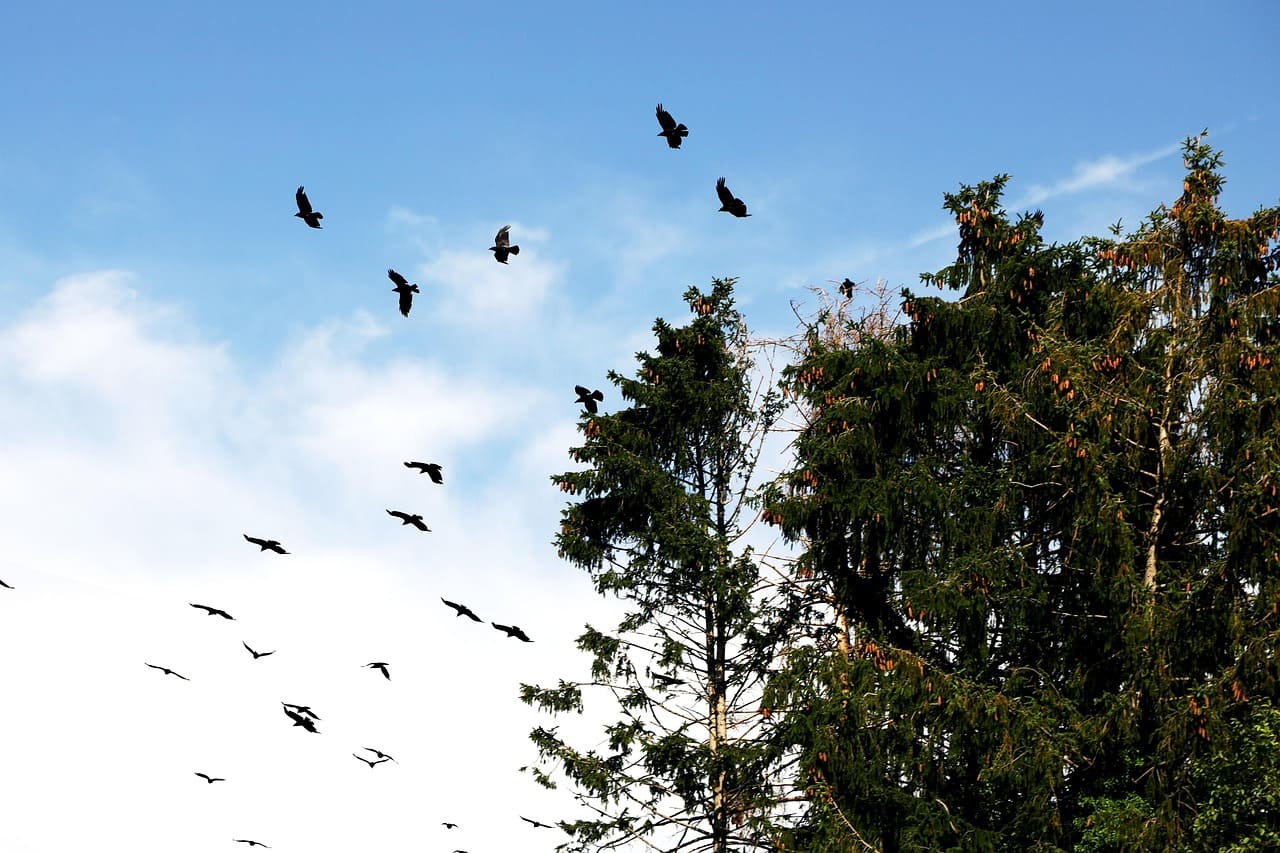
Corvids belong to the most intelligent animals on Earth. Studies from the University of Vienna, the University of Osnabrück and the Max Planck Institute demonstrate that young ravens possess cognitive abilities at the level of adult great apes. Crows can count, manufacture tools, recognise faces and empathise with fellow species. Research has proven that they possess subjective experience and conscious perception. In Switzerland, these animals are shot by the thousands. Carrion crow, hooded crow, magpie, Eurasian jay and common raven are huntable. The rook is protected, yet its history shows how close persecution and extinction lie together. The NABU states: «The hunting of corvids contradicts both the principles of sustainable use and all serious scientific findings.»
The five species overview
Carrion crow (Corvus corone)
The hooded crow is the most common corvid in Switzerland north of the Alps. It has completely black plumage, measures around 47 centimetres in length and weighs 450 to 600 grams. It lives in pairs or small family groups and inhabits forests, agricultural land, parks and residential areas. Its diet is extremely diverse: insects, worms, mice, carrion, grain, fruit, waste and occasionally eggs and young birds. As an omnivore and health police, it removes carrion and regulates insect and rodent populations. It is huntable in Switzerland. The BUWAL determined in 1998 that half of all shot birds were hooded crows and Eurasian jays.
Hooded crow (Corvus cornix)
The hooded crow is the south-alpine and eastern sister species of the carrion crow, from which it differs by its grey body plumage with black head, throat, wings and tail. In Switzerland it occurs mainly in Ticino, the Engadin and parts of Valais. In the hybrid zone, where the distribution areas overlap, carrion crows and hooded crows interbreed and produce fertile offspring. Biologically and ecologically, the two species are equivalent. A study by Lomonosov University Moscow and the University of Bristol (Animal Cognition, 2024) has demonstrated that hooded crows can use 'mental templates', a cognitive ability previously considered unique to humans. The hooded crow is huntable in Switzerland.
Rook (Corvus frugilegus)
The rook is a colonial breeder that differs from the carrion crow by its featherless, greyish-white face at the base of the bill. In Switzerland it had long disappeared due to persecution and habitat loss and has only re-established and spread thanks to international protection. The Swiss Ornithological Institute Sempach confirms: 'The establishment and spread of cormorant and rook are a result of better international protection' (Vogelwarte Sempach, Atlas). The rook is protected in most cantons in Switzerland, but is still hunted in individual cantons such as Basel-Country (hunting seasons Canton BL, 2024/25). Its colonies near settlements lead to conflicts due to noise and pollution, which can be solved through prevention and visitor guidance.
Common raven (Corvus corax)
The common raven is the largest songbird in the world. It reaches a wingspan of over one metre and weighs up to 1.5 kilograms. Its deep, guttural 'krock-krock' is unmistakable. It was severely decimated in Switzerland through intensive persecution, but has recovered after hunting restrictions were introduced. The Swiss Ornithological Institute Sempach explicitly lists the common raven among the species that were severely decimated by historical hunting (Vogelwarte Sempach, Atlas). It is huntable in Switzerland, with cantons setting hunting seasons. In Graubünden, 51 grey herons and common ravens were shot together in a single year (IG Wild beim Wild, hunting statistics 2022). The common raven is perhaps the best-researched bird species in terms of cognition: it can count, understand relationships, cooperates only with honest partners, uses pointing gestures and can put itself in the perspective of conspecifics (Bugnyar, University of Vienna).
Eurasian magpie (Pica pica)
The magpie is unmistakable with its black-and-white plumage and long, metallic green and blue shimmering tail. It is approximately 46 centimeters long and weighs 200 to 250 grams. It lives in open and semi-open landscapes, often near settlements, and builds large, spherical nests in trees and hedges. In Switzerland, the magpie was exterminated in Ticino through persecution and only resettled after protective regulations were established (Vogelwarte Sempach, Atlas). It is huntable in Switzerland. The magpie is one of the few non-mammals that pass the mirror test: It recognizes itself in a mirror, which is considered an indicator of self-awareness.
Intelligence: Why corvids must not be shot
Cognitive abilities at great ape level
Research over the past two decades has revolutionized our understanding of corvids. A study by the University of Osnabrück and the Max Planck Institute for Ornithology (Scientific Reports, 2020) showed that young ravens at just four months of age already possess cognitive abilities comparable to those of adult chimpanzees and orangutans. The birds mastered tests on understanding quantities, causal chains, social learning and communication at the level of great apes.
Professor Thomas Bugnyar from the University of Vienna, one of the world's leading corvid researchers, has demonstrated through decades of research that ravens possess a 'Theory of Mind': They can put themselves in the perspective of others and predict their actions (Proceedings of the Royal Society B). They only cooperate with honest conspecifics, feign food caches, manipulate social relationships and use pointing gestures that are extraordinarily rare in the animal world.
Consciousness in crows
Researchers at the University of Tübingen were able to provide the first neuroscientific proof in 2020 that crows possess subjective experience, meaning they consciously perceive sensory impressions. Previously, this type of consciousness had only been demonstrated in humans and other primates. The avian brain has no neocortex (cerebral cortex), which is responsible for higher cognitive performance in mammals. Nevertheless, corvids achieve comparable or even superior performance because their pallium (an analogous brain region) contains significantly more neurons per unit volume than primate brains.
What hunting means
Shooting animals that can count, manufacture tools, recognize faces, empathize with others and possess conscious experience is ethically indefensible. The hunting of corvids is not wildlife management, but the routine killing of highly intelligent, sentient beings without reasonable justification.
More on this: Dossier: Hunting and biodiversity
The hunting: Thousands of killings without purpose
Legal situation
Under the Federal Act on Hunting (JSG, Art. 5 Para. 3), carrion crow, hooded crow, raven, magpie and Eurasian jay are huntable bird species. The rook is also hunted in individual cantons (Canton BL: hunting season August 1 to February 15). Closed seasons vary greatly between cantons. In Canton Bern, carrion crows, magpies and Eurasian jays are even killed during closed season through 'special shoots', as a reward system for recreational hunters who 'engage in game management' (IG Wild beim Wild, Fox massacre in Switzerland).
The scale of the killings
BUWAL determined in 1998 that half of all birds shot in Switzerland, around 25,000 animals, were carrion crows and Eurasian jays (BUWAL press release, 1998). Today, thousands of corvids are still shot annually. IG Wild beim Wild documents that alongside official kills during the general hunting season, 'crows, jays, magpies' are among the regularly killed species (IG Wild beim Wild, hunting statistics 2022). In Grisons, the number of Eurasian jays shot during an invasion year rose from 192 to 770 (Südostschweiz, 2018). BirdLife Switzerland comments: 'Ecologically completely unnecessary is not only the hunting of hares, but also that of birds' (BirdLife Switzerland, hunting statistics).
The Methods
Corvid hunting in Switzerland is mainly conducted as ambush hunting and increasingly as decoy hunting. In decoy hunting, crow decoys are set up in fields to attract additional crows, which are then shot from a camouflaged blind. Wildtierschutz Deutschland describes this method as 'particularly perfidious' and compares the equipment (camouflage tent, camouflage suit, gloves, war paint) to war games (Wildtierschutz Deutschland, 2021). Shot carrion crows and magpies are generally not utilized but 'disposed of like garbage' (Wildtierschutz Deutschland, 2021).
More on this: Animal welfare problem: Wildlife dies agonizingly because of recreational hunters
The 'pest' narrative: Scientifically refuted
'Corvids decimate songbirds'
The most widespread argument for hunting corvids is that they are 'nest robbers' that decimate populations of songbirds and small game. NABU has refuted this claim based on extensive scientific literature. Expert opinions from independent institutes, including the work of Dr. Wolfgang Epple, Dr. Ulrich Mäck and Dr. Hans-Wolfgang Helb (corvid expert of the state of Rhineland-Palatinate), unanimously conclude: There is no scientifically reproducible evidence that corvids pose a widespread threat to songbird or small game populations (NABU, hunting of corvids; Wildtierschutz Deutschland, 2021).
The actual causes for the decline of songbirds and small game are habitat loss through agricultural intensification, pesticide use (which destroys insect food), land consolidation (which eliminates hedges and fallow land), glass facades, domestic cats and road traffic. Corvids have lived in the same ecosystems as songbirds and small game for millennia without endangering their populations. The decline of these species does not correlate with corvid population development, but with the intensification of land use.
'Corvids cause damage in agriculture'
Carrion crows can cause local damage to silo films, corn crops and fruit. These damages are real, but limited and manageable with deterrent measures (scarecrows, diversionary feeding, nets). Monitoring results from Upper Austria show that shooting 19,000 carrion crows per year led to no reduction in the population (OÖ Landesjagdverband, 2015). Hunting is ineffective as a damage prevention measure.
'Ravens kill lambs and calves'
The raven is vilified by the recreational hunting lobby as a 'lamb killer' and 'calf killer'. In reality, ravens preferentially eat carrion. Attacks on living livestock occur rarely and almost exclusively affect already weakened or dying animals. The claim that ravens kill healthy lambs in pastures is not scientifically substantiated and belongs to the realm of hunters' tales (Wildtierschutz Deutschland, 2021).
Ecological significance: Health police, regulators, seed dispersers
Carrion removal
Carrion crows and common ravens are the most important carrion removers in Switzerland's cultural landscape. They dispose of dead animals on roads, fields and pastures, thereby preventing the spread of pathogens. Without corvids, disease hygiene in open countryside would deteriorate massively.
Regulation of pests
All five species consume considerable quantities of mice, snails, grubs and other agricultural pests. The carrion crow alone eliminates thousands of insects and mice per territory per year. This benefit to agriculture far exceeds damage to crops, but is not considered in any damage calculations.
Seed dispersal
Magpies and Eurasian jays (as part of the corvid family) contribute significantly to the dispersal of plant seeds. Jay seeding is recognized in forestry (see Dossier: The Eurasian Jay in Switzerland).
Indicator species
Corvids are indicators of landscape quality. Where corvids are absent, there is a lack of food diversity and structural richness. To propagate their persecution while simultaneously lamenting the decline of biodiversity is a contradiction that the recreational hunting lobby cannot resolve.
What would need to change
- Switzerland-wide protection of all corvids: The hunting of carrion crows, hooded crows, common ravens and magpies has no reasonable justification under animal protection law. It contradicts scientific knowledge about the intelligence and sentience of these animals. All corvids must be removed from the catalogue of huntable species.
- Immediate abolition of 'special culls' during closed season: The practice of individual cantons releasing corvids for shooting as a 'reward' for committed recreational hunters even during closed season is a scandal and must be ended immediately.
- Ban on decoy hunting of corvids: Decoy hunting with decoys and camouflage tents is a particularly perfidious hunting method that lures animals to their death by exploiting their social behaviour (curiosity, solidarity with conspecifics). It must be banned.
- Prevention instead of shooting in agricultural conflicts: Where carrion crows cause local damage to crops, deterrent measures, diversionary feeding and technical protective devices must be employed. Shooting is demonstrably ineffective, as experiences from Upper Austria show.
- Public outreach for corvid rehabilitation: The 'vermin' narrative that defames corvids as pests must be replaced by factual information about their intelligence, their ecological significance and their need for protection.
Arguments
'Corvids decimate songbird populations and must therefore be hunted.' Expert opinions from independent institutes and the position of NABU clearly refute this claim. The decline of songbirds does not correlate with corvid population development, but with the intensification of agriculture, pesticide use and habitat loss. Corvids have lived in the same ecosystems as songbirds for millennia without endangering their populations. Recreational hunters want to eliminate an unwelcome prey competitor in order to shoot more small game.
'The carrion crow is a mass species and hunting it does not harm the population.' If hunting has no influence on the population, it also has no purpose. Experience from Upper Austria proves that shooting 19,000 carrion crows per year led to no population reduction. Shooting without effect and without utilization is senseless killing. It contradicts animal protection law, which requires a reasonable justification for killing an animal.
'Corvids are 'pests' that cause problems in agriculture.' The classification of animals into 'useful' and 'harmful' is an outdated concept from the 19th century. In Germany, the term 'Raubzeug' (vermin) was removed from the Federal Hunting Act in 1976 as a 'vilifying and unnecessary expression'. Corvids remove carrion, regulate mice and insects, and disperse plant seeds. Their ecological benefit far exceeds local damage to crops.
'The raven kills lambs and must therefore be hunted.' The raven preferentially feeds on carrion. Attacks on living livestock are not scientifically documented. The defamation of the raven as a 'lamb killer' is hunters' folklore that serves to legitimize the hunting of a species that was historically almost exterminated in Switzerland and has only recovered through protective measures.
'Hunting corvids is traditional and belongs to small game hunting.' The persecution of corvids has a long history permeated with superstition, prejudice, and pseudo-biological concepts. In the past, bearded vultures, ospreys, golden eagles, and ravens were almost exterminated because they were considered 'harmful'. Science has long since corrected this assessment. Tradition is no argument for continuing a demonstrably senseless and ethically questionable practice.
Quick links
Articles on Wild beim Wild:
- Studies on the impact of recreational hunting on wildlife
- Why recreational hunting fails as population control
- Animal welfare problem: Wildlife suffers agonizing deaths due to recreational hunters
- Animal cruelty: Fox massacres in Switzerland
Related dossiers
- The Alpine ptarmigan in Switzerland: Ice age relic between climate crisis, tourism and gunshot
- The ibex in Switzerland: Smuggled, rescued and again degraded to trophy
- The beaver in Switzerland: Exterminated, reintroduced and newly released for shooting
- The woodcock in Switzerland: Endangered, hunted and politically ignored
- Waterfowl in Switzerland: Winter guests in the line of fire
- Pigeons in Switzerland: Between peace symbol, mass shooting and official starvation
- Corvids in Switzerland: The most intelligent animals in the crosshairs
- The Eurasian jay in Switzerland: Forest gardener in the crosshairs of small game hunting
- The marmot in Switzerland: Ice age relic under climate stress, tourist attraction and mass shooting
- The European rabbit in Switzerland: severely endangered, yet huntable
- The mountain hare in Switzerland: Ice age relic between climate crisis and gunshot
- The raccoon in Switzerland: Released for shooting because it has the wrong origin
- The stone marten in Switzerland: Synanthropic species between attic and gunshot
- The pine marten in Switzerland: Shy forest dweller under hunting pressure
- The badger in Switzerland: Ecosystem engineer in the crosshairs of small game hunting
- The red deer in Switzerland: Exterminated, returned and degraded to shooting object
- The roe deer in Switzerland: Most shot wildlife and victim of misguided hunting policy
- The wild boar in Switzerland: Why recreational hunting aggravates the problem instead of solving it
- The chamois in Switzerland: Between high hunting, climate stress and the myth of overpopulation
- The brown hare in Switzerland: Endangered, hunted and politically ignored
Source references
- Federal hunting statistics, FOEN/Wildtier Schweiz: http://www.jagdstatistik.ch
- BUWAL press release (1998): Federal hunting statistics 1997 (Half of the birds killed were carrion crows and Eurasian jays)
- Swiss Ornithological Institute Sempach: Atlas of Swiss breeding birds, Hunting and persecution by humans (vogelwarte.ch)
- BirdLife Switzerland: Current hunting statistics and the revised hunting law (birdlife.ch)
- NABU Germany: Hunting of corvids (nabu.de)
- Wildtierschutz Deutschland (2021): Hunting of corvids, No reasonable justification (wildtierschutz-deutschland.de)
- Pika, S. et al. (2020): Ravens parallel great apes in physical and social cognitive skills. Scientific Reports, University of Osnabrück/Max Planck Institute
- Bugnyar, T. (various): Research on corvid cognition, Theory of Mind in ravens. University of Vienna, Proceedings of the Royal Society B
- Nieder, A. et al. (2020): Consciousness in crows, University of Tübingen
- Smirnova, A. A. and Jelbert, S. (2024): Mental templates in hooded crows. Animal Cognition
- OÖ Regional Hunting Association (2015): Monitoring of carrion crow population Upper Austria (19’000 kills without population reduction)
- Canton Basel-Landschaft: Hunting seasons 2024/25 (carrion crow, rook, hooded crow, raven, magpie, Eurasian jay)
- Südostschweiz (2018): Hunters set a new record (770 Eurasian jays in Graubünden)
- IG Wild beim Wild (2020/2022/2025): Hunting statistics 2022, fox massacre in Switzerland (wildbeimwild.com)
- taz (2022): Hunt for crows, cleared for shooting
- Federal Act on Hunting and the Protection of Wild Mammals and Birds (JSG, SR 922.0)
- Animal Welfare Act (TSchG, SR 455)
Our mission
Corvids are the primates among birds. They possess cognitive abilities that astound science and have only been approximately understood in the last two decades. They can count, manufacture and use tools, adopt the perspective of others, manipulate social relationships, recognize faces and hold grudges for years. They mourn dead conspecifics. They demonstrably possess conscious experience. And they are shot by the thousands in Switzerland, not because they pose a threat, but because they have been considered 'vermin' since the 19th century and because recreational hunters view them as competitors for prey. The persecution of corvids in Switzerland has led to the near-complete extermination of the raven, the extinction of the magpie in Ticino, and severe decimation of the carrion crow. Only legal protection has enabled recovery. That the same species whose survival is owed to protection are now being hunted again represents a historical regression. The consequence is clear: all corvids must be protected throughout Switzerland. The hunting is scientifically unfounded, ecologically harmful and ethically indefensible. This dossier is continuously updated when new figures, studies or political developments require it.
More on the topic of recreational hunting: In our hunting dossier we compile fact-checks, analyses and background reports.