
Red deer Switzerland: Returned and degraded to shooting targets
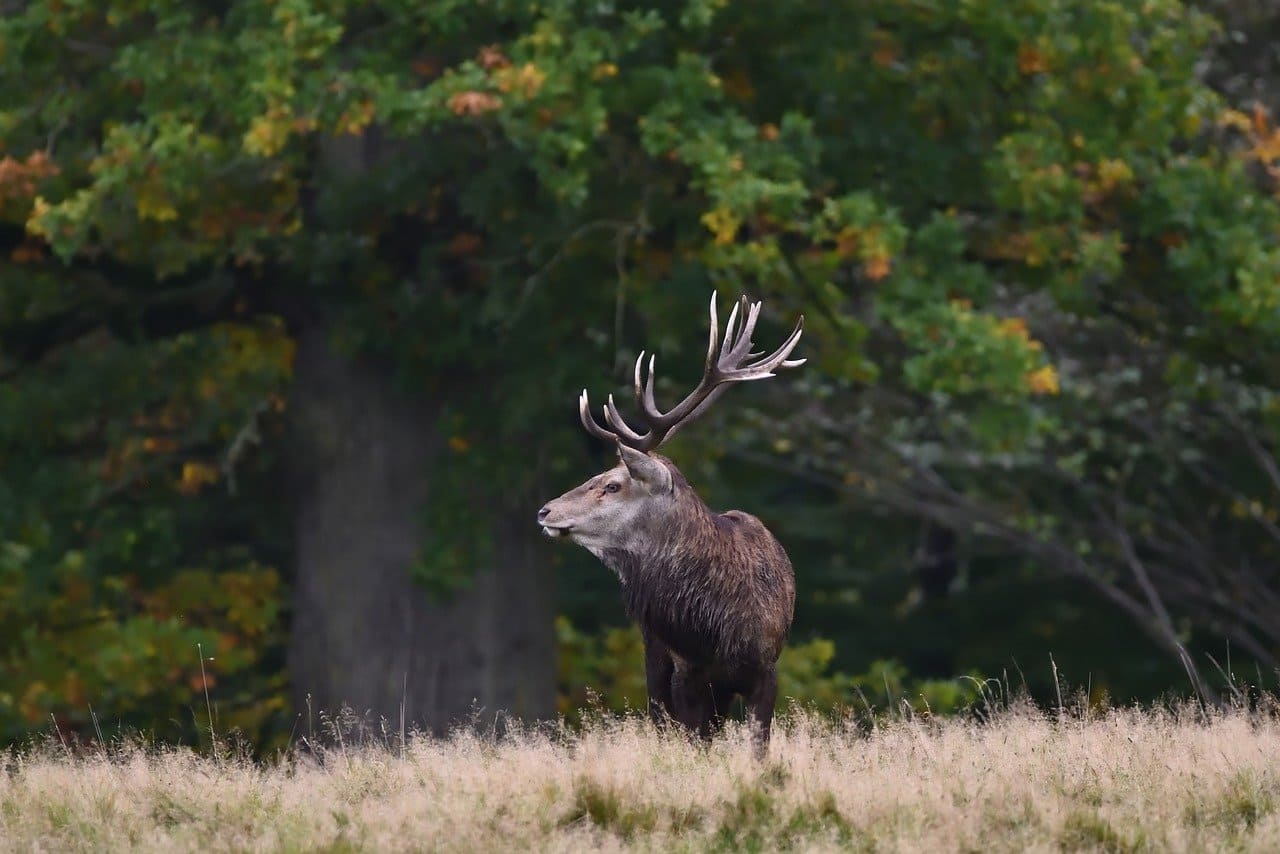
The red deer is Switzerland's largest wild animal. After its extermination around 1850, it fought its way back on its own. Yet instead of celebrating its comeback as a conservation success story, recreational hunters view it primarily as a problem that needs to be 'regulated'. Around 8,000 red deer are shot annually, while their habitat is systematically restricted.
Profile
The red deer (Cervus elaphus) is Switzerland's largest free-living mammal. A mature stag reaches a shoulder height of 1.20 to 1.50 metres and weighs between 170 and 220 kilograms. The hind is significantly smaller and weighs 90 to 130 kilograms. The animal is thus roughly eight times heavier than a roe deer. In summer, the red deer sports a reddish-brown coat, in winter it changes to a greyish-brown coat. Only the male animals develop antlers annually, which can grow up to 1.50 metres high and weigh around six kilograms.
Biology and lifestyle
The red deer is a typical long-distance migrant. Between summer and winter ranges, it covers distances of dozens of kilometers. Hinds live in family groups that join together to form larger herds in winter. Stags form their own bachelor groups outside the rutting season. The rut takes place between mid-September and mid-October. The roaring of the stags can be heard far and wide during this time. After a gestation period of around 34 weeks, the hind usually gives birth to a single calf in June.
Originally, the red deer was an inhabitant of open and semi-open landscapes. In Switzerland, however, it has largely retreated into the forest due to pressure from hobby hunters and increasing human disturbances. Researchers from ZHAW and HAFL have proven that Mittelland red deer are now almost completely nocturnal (Red Deer Mittelland Research Project, HAFL/FOEN, 2024). During the day they hide in the thicket, only emerging at dusk to feed. This forced nocturnal activity is not a natural characteristic, but a direct consequence of persecution and disturbance by hobby hunters.
Diet
The red deer is a mixed feeder. Its diet includes grasses and herbs (around two-thirds), supplemented by bark, needles, leaves and tree fruits. In winter, when snow cover prevents grass feeding, it turns to bark, lichens, mosses and coniferous shoots. A single animal needs 8 to 20 kilograms of food daily. The fact that red deer increasingly strip bark and browse young trees in winter is not a characteristic of the species, but a consequence of habitat restriction: hobby hunters have displaced it into the forest, where the natural food supply is insufficient for an open-land dweller.
Extirpation and Return: A Story of Human Failure
Around 1850, the red deer was completely extirpated in Switzerland. The causes were unregulated popular hunting, which had been declared a people's right with the French Revolution, combined with large-scale deforestation that robbed the deer of its habitat. Poverty and famines drove the population to massive overexploitation of wildlife populations. Effective protection laws were lacking. It was hobby hunting in its historical original form that wiped out the red deer from Switzerland.
The Return
Only the federal hunting law of 1875, which restricted hunting seasons and protected female animals, created the foundation for recovery. From 1870, the first red deer migrated from the Austrian Montafon into the canton of Graubünden. In 1926, two stags and three hinds were established in Val Ferret in Valais. Since then, the red deer has spread through its own efforts across large parts of the Swiss Alps and pre-Alps. Since the 1990s, it has also colonized parts of the Jura from France, and since around 2005, local populations have been establishing themselves in the Mittelland (Red Deer Mittelland Research Project, FOEN/Cantons, since 2011).
Today, according to the Federal Hunting Statistics, around 40,000 red deer live in Switzerland, most of them in the Alpine cantons of Graubünden, Valais and Ticino. The population continues to grow. The canton of Ticino alone estimates its population at around 7,250 animals (cantonal data, 2026).
This return is not an achievement of the hobby hunters. It is the result of legal protection provisions, natural immigration and forest recovery. The red deer has earned its comeback itself.
More on this: Dossier: Hunting and Biodiversity
The Hunting: From Protected Species to Target for Shooting
The red deer is a huntable species under the Federal Act on Hunting and the Protection of Wild Mammals and Birds (JSG, Art. 5 Para. 1 lit. a). The cantons set hunting seasons, shooting plans and hunting methods. In most cantons, the hunting year runs from April 1st to March 31st of the following year. Hunting seasons vary significantly between cantons. The red deer is not on the Red List of endangered species. This distinguishes it from the brown hare, which is hunted despite its Red List status.
Patent hunting vs. territorial hunting
As with all wild species in Switzerland, two different hunting systems apply to red deer. In around 65 percent of cantons, patent hunting prevails: hobby hunters obtain a cantonal license and hunt independently, without being bound to a specific territory and without assuming territorial responsibility. In the remaining cantons, including St. Gallen, Thurgau and both Appenzells, territorial hunting is practiced: hunting associations lease a territory and thereby formally assume conservation obligations. Both systems lead to increasing shooting numbers for red deer, as the cantons continuously raise their shooting plans.
The scale of the cull
In 2023, around 76,000 wild ungulates were killed in Switzerland, including an estimated over 8,000 red deer (Federal Hunting Statistics, Wildtier Schweiz/FOEN). The shooting numbers have been rising for years. In the canton of St. Gallen alone, over 800 red deer were shot in 2023, with the shooting plan 97 percent fulfilled (Hunting Statistics Canton St. Gallen, 2024). In the canton of Graubünden, the main canton for red deer, the culls are significantly higher still. The cantons regularly state the goal of shooting 15 to 20 percent of the estimated population annually to 'stabilize' the population. The fact that these shooting quotas have been rising for years while the population continues to increase raises questions that recreational hunters refuse to answer.
The trophy cult
The red deer has been a coveted trophy animal for centuries due to its imposing antlers. In Switzerland, so-called conservation shows are held in many cantons after recreational hunting, where the killed antlers are publicly displayed and examined. In the canton of St. Gallen, up to 800 hobby hunters participate in these events (Office for Nature, Hunting and Fisheries St. Gallen, 2022). The trophy cult makes it clear that red deer hunting is not wildlife management for a considerable portion of recreational hunters, but entertainment.
More on this: Dossier: Hunting myths
The forest damage narrative: Why the red deer is made a scapegoat
The central argument of the recreational hunting lobby for intensive hunting of red deer is: the deer destroys the forest. Browsing on young trees and bark peeling can indeed cause considerable local damage, particularly to silver fir, oak, maple and yew (WSL, Waldwissen.net). In the canton of Zurich, bark damage by red deer threatens internationally significant yew populations on the Albis (Odermatt/Wasem, WSL, 2018). The Forest Report 2025 by FOEN and WSL states that regionally excessive wildlife populations impair natural regeneration and the forest's adaptation potential to climate change.
What the narrative conceals
The forest-wildlife debate in Switzerland is conducted almost exclusively from the perspective of forestry and recreational hunting. In doing so, central connections are systematically ignored.
First: The red deer is an open-land dweller that has been forced into forests by human disturbance, hunting pressure, and habitat destruction. Research by WSL and ZHAW shows that red deer prefer open pastures between 2,000 and 2,700 meters when given sufficient tranquility and are visible there even during the day. In Switzerland, however, the red deer has been forced into forests by recreational use, settlement pressure, and recreational hunting, where it must feed on bark and young trees because its natural food sources are absent. Forest damage is not the cause, but the symptom of misguided land use.
Second: Field studies by WSL in the Bern-Solothurn region have found that most browsing damage in many areas is not caused by red deer, but by roe deer (SRF Wissen, 2026). The blanket attribution of forest damage to red deer serves to legitimize high culling quotas.
Third: Recreational hunting itself is a significant stress factor for red deer. Studies from the red deer research project in eastern Switzerland (ZHAW/Cantons SG, AI, AR, 2014–2017) show that red deer massively reduce their basic metabolic rate, heart rate, and body temperature in winter to conserve energy. Every disturbance during this phase, whether from hobby hunters, winter sports enthusiasts, or dogs, forces the animals to flee and drastically increases their energy consumption. The consequence: The animals must eat more, which increases browsing pressure on the forest. Recreational hunting thus exacerbates precisely the problem it claims to solve.
Fourth: The Swiss Forestry Association shows in a report based on cantonal data from 2020 to 2024 that 46 to 50 percent of assessed forest areas are in the best category, showing no impairment of natural regeneration. In 2015, this figure was still 68 percent. The situation is thus deteriorating despite annual increases in culling numbers. This proves that recreational hunting does not solve the forest-wildlife problem but perpetuates it.
More on this: Why recreational hunting fails as population control
The suppressed natural regulator: predators instead of hobby hunters
The red deer evolved over millions of years alongside its natural predators: wolf, lynx, and brown bear. In Switzerland, all three were exterminated in the 19th century. The lynx was reintroduced from 1971 and primarily preys on roe deer and chamois. The wolf has been naturally returning from Italy and France since the 1990s and has now established itself with several packs in Switzerland.
Research shows that wolves change the behavior and spatial use of red deer. A study by WSL (Kupferschmid et al., Swiss Journal of Forestry, 2016) demonstrates that wolves as predators have both direct effects on populations and indirect effects on ungulate behavior: In the presence of wolves, red deer migrate more frequently, stay shorter periods in one location, and distribute grazing pressure more evenly across the landscape. Forest regeneration benefits from this.
The Swiss Animal Protection STS notes that wolves as natural regulators preferentially prey on sick, old, or weakened animals, leading to healthier wild populations and protecting forests from browsing damage (STS Position Paper, 2025). Gruppe Wolf Schweiz puts it pointedly: 'Those who sow deer will reap wolves' (GWS Press Release, 2021). The high ungulate density in Switzerland, which in Canton Graubünden is more than three times higher than in Yellowstone National Park, is the main reason for the growing wolf population.
Instead of recognizing predators as part of the solution, Swiss politics has been conducting a preventive regulation of wolf populations since 2023 under pressure from the recreational hunting lobby. The revised Hunting Act enables cantons to have entire wolf packs shot. This policy is ecologically counterproductive: it fights the natural regulator that could take over precisely the task at which recreational hunting has failed for decades.
More on this: Studies on the impact of recreational hunting on wildlife
Red deer and wildlife corridors: An animal without freedom of movement
The red deer is a long-distance migrant that depends on connected, permeable landscapes for its seasonal migrations between summer and winter habitats. However, the Swiss landscape is massively fragmented by highways, railway lines, settlements and fenced agricultural areas. The Federal Office for the Environment (FOEN) has defined connectivity axes for wildlife, but nearly 50 wildlife corridors are still interrupted. In particular, the A1 highway, which crosses the Central Plateau from east to west, forms an almost insurmountable barrier between the Jura and the Pre-Alps.
The Red Deer Central Plateau research project (HAFL/FOEN, 2024) has shown that red deer can move surprisingly well in the Central Plateau, as long as there are no highways in the way. But the A1 still prevents the connectivity of populations. The planned green bridges and wildlife underpasses are progressing only slowly.
The consequence
As long as wildlife corridors do not function, red deer populations can become genetically impoverished and locally extinct. Habitat fragmentation is a structural problem that cannot be solved by culling. The federal government invests millions in wildlife corridors while simultaneously allowing recreational hunters to shoot thousands of red deer that should be using these corridors.
What would need to change
- Professional wildlife management by state wildlife wardens: The regulation of red deer must not be left to recreational hunters, whose motivation is primarily recreational pleasure and trophy acquisition. Professional wildlife wardens, as the Canton of Geneva has successfully employed since 1974, are the only guarantee for science-based, animal welfare-compliant wildlife management.
- Promoting predators instead of combating them: Wolf and lynx are the natural regulators of red deer. Instead of decimating predators under pressure from the recreational hunting lobby, Switzerland must protect and promote their populations. WSL studies show that predators reduce browsing pressure on forests.
- Habitat enhancement and rest areas: Red deer must be able to return from the forest to their natural habitats. This requires large-scale wildlife rest areas where human disturbances are prohibited, as well as the consistent maintenance of forest clearings and alpine meadows that serve as natural feeding areas for red deer.
- Accelerated implementation of wildlife corridors: The nearly 50 interrupted wildlife corridors must be restored as a priority. Without connectivity of populations between the Jura, Central Plateau and Pre-Alps, red deer management remains patchwork.
- Restriction of recreational use in sensitive areas: Winter sports off-piste, mountain bike trails in wildlife habitats and drone flights over wildlife rest areas massively increase red deer energy consumption in winter and exacerbate browsing pressure. Binding regulations for visitor guidance must be enforced.
- Scientifically based monitoring instead of cantonal estimates: According to Wildtier Schweiz, red deer population numbers are partly based on rough estimates. A national, standardized monitoring system is a prerequisite for evidence-based wildlife policy.
Arguments
«Red deer destroys the forest and must therefore be intensively hunted.» Red deer is naturally an open-land inhabitant. That it causes damage in forests is because recreational hunting, recreational use, and settlement pressure have displaced it into the forest. Anyone who wants to solve the problem must eliminate the causes, not the symptom: create quiet zones, promote predators, and free red deer from its forced forest existence. Recreational hunting itself is part of the problem, not the solution.
«Without recreational hunting, red deer populations would explode.» In ecosystems with intact predator chains, red deer populations regulate themselves. The wolf is the most important natural regulator. An international study (van Beeck Calkoen et al., Journal of Applied Ecology, 2024) shows that only the simultaneous presence of wolf, lynx, and bear statistically significantly reduces red deer density. The Geneva model, where professional wildlife rangers instead of hobby hunters have been responsible for wildlife management since 1974, shows that recreational hunting is not necessary.
«Recreational hunting is the only way to prevent forest damage.» Culling numbers have been rising for years, yet the situation of forest regeneration continues to deteriorate according to the Swiss Forestry Association. Recreational hunting is failing at its own task. At the same time, research shows that recreational hunting actually increases browsing pressure through disturbance and stress generation, because disturbed animals consume more energy and must eat more. A paradigm shift toward quiet zones, predators, and professional management is overdue.
«Red deer no longer has natural enemies and must therefore be regulated by humans.» Red deer no longer has natural enemies because humans exterminated them. Wolf and lynx are returning, but the recreational hunting lobby fights their return politically. Those who eliminate natural regulators and then argue that one must take over their role operate a self-referential system that serves only one purpose: maintaining hunting privilege.
«Recreational hunting of red deer is sustainable and law-compliant.» Recreational hunting may be law-compliant, but it is 'sustainable' only in the sense of the recreational hunting lobby: it maintains populations at a level that allows continued hunting without solving the structural problems—habitat fragmentation, disturbance, missing predators. A wildlife policy that controls populations through culling while ignoring the causes of conflicts is not sustainable use, but institutionalized failure.
Quicklinks
Articles on Wild beim Wild:
- Studies on the impact of recreational hunting on wildlife
- Why recreational hunting fails as population control
- Animal welfare problem: Wild animals suffer agonizing deaths due to hobby hunters
Related dossiers
- The alpine ptarmigan in Switzerland: Ice age relic between climate crisis, tourism, and shotgun blast
- The ibex in Switzerland: Smuggled, saved, and again degraded to trophy
- The beaver in Switzerland: Exterminated, reintroduced, and newly cleared for shooting
- The woodcock in Switzerland: Endangered, hunted, and politically ignored
- Waterfowl in Switzerland: Winter guests in the line of fire
- Pigeons in Switzerland: Between peace symbol, mass shooting, and official starvation
- Corvids in Switzerland: The most intelligent animals in the crosshairs
- The jay in Switzerland: Forest gardener in the crosshairs of low hunting
- The marmot in Switzerland: Ice age relic under climate stress, tourist attraction, and mass shooting
- The wild rabbit in Switzerland: Severely endangered, yet huntable
- The mountain hare in Switzerland: Ice age relic between climate crisis and shotgun blast
- The raccoon in Switzerland: Cleared for shooting because it has the wrong origin
- The Stone Marten in Switzerland: Cultural Follower Between Attic and Gunshot
- The Pine Marten in Switzerland: Shy Forest Dweller Under Hunting Pressure
- The Badger in Switzerland: Ecosystem Engineer in the Crosshairs of Ground Hunting
- The Red Deer in Switzerland: Exterminated, Returned and Degraded to Shooting Target
- The Roe Deer in Switzerland: Most Shot Wild Animal and Victim of Misguided Hunting Policy
- Wild Boar in Switzerland: Why Hobby Hunting Exacerbates the Problem Instead of Solving It
- The Chamois in Switzerland: Between High Hunting, Climate Stress and the Myth of Overpopulation
- The Brown Hare in Switzerland: Endangered, Hunted and Politically Ignored
Sources
- Federal Hunting Statistics, FOEN/Wildlife Switzerland: http://www.jagdstatistik.ch (Population and Shooting Data)
- Pro Natura: Animal of the Year 2017, The Red Deer (pronatura.ch)
- Red Deer Research Project in Eastern Switzerland, Cantons SG/AI/AR in cooperation with ZHAW, 2014–2017 (waldwissen.net)
- Red Deer Mittelland Research Project, HAFL/FOEN/Cantons BE/SO/AG, since 2011 (SRF Wissen, 2024)
- Kupferschmid, A. D. et al. (2016): Direct, indirect and combined effects of wolves on forest regeneration. Swiss Journal of Forestry, 167(1): 3–12
- van Beeck Calkoen, S. T. S. et al. (2024): Influence of predators on red deer densities in Europe. Journal of Applied Ecology
- Forest Report 2025, FOEN/WSL
- Swiss Forest Association: Report on Wildlife Impact at Cantonal Level, 2020–2024
- Odermatt, O.; Wasem, U. (2018): Yew stands massively bark-stripped by red deer. Forest Protection News 1/2018, WSL
- Gruppe Wolf Schweiz: Press release «Who sows deer will reap wolves», 2021
- Swiss Animal Protection STS: Position paper Wolf in Switzerland, 2025
- Cervo Volante: The Swiss Red Deer (cervovolante.com)
- Federal Act on Hunting and the Protection of Wild Mammals and Birds (JSG, SR 922.0)
Our Claim
The red deer is the symbol of a failed wildlife policy. It survived its extermination, fought its way back into Switzerland through its own strength and today recolonizes large parts of the country. Yet instead of honoring its return as an ecological success story, it is branded as a damage-causer by recreational hunters, coveted as a trophy and instrumentalized as justification for increasing shooting quotas. The forest damage attributed to it is largely the result of a policy that forces it into the forest, combats its natural predators and fragments its habitat. The consequence is clear: Switzerland does not need more intensive shooting, but a fundamentally different understanding of wildlife. Professional management by game wardens instead of hobby hunting. Predators instead of lead shot. Quiet zones instead of hunting stands. The Geneva model has shown for over 50 years that this is possible. This dossier is continuously updated when new figures, studies or political developments require it.
More on hobby hunting: In our Hunting Dossier we compile fact-checks, analyses and background reports.