
Chamois Switzerland: High hunting, climate stress and overpopulation myth
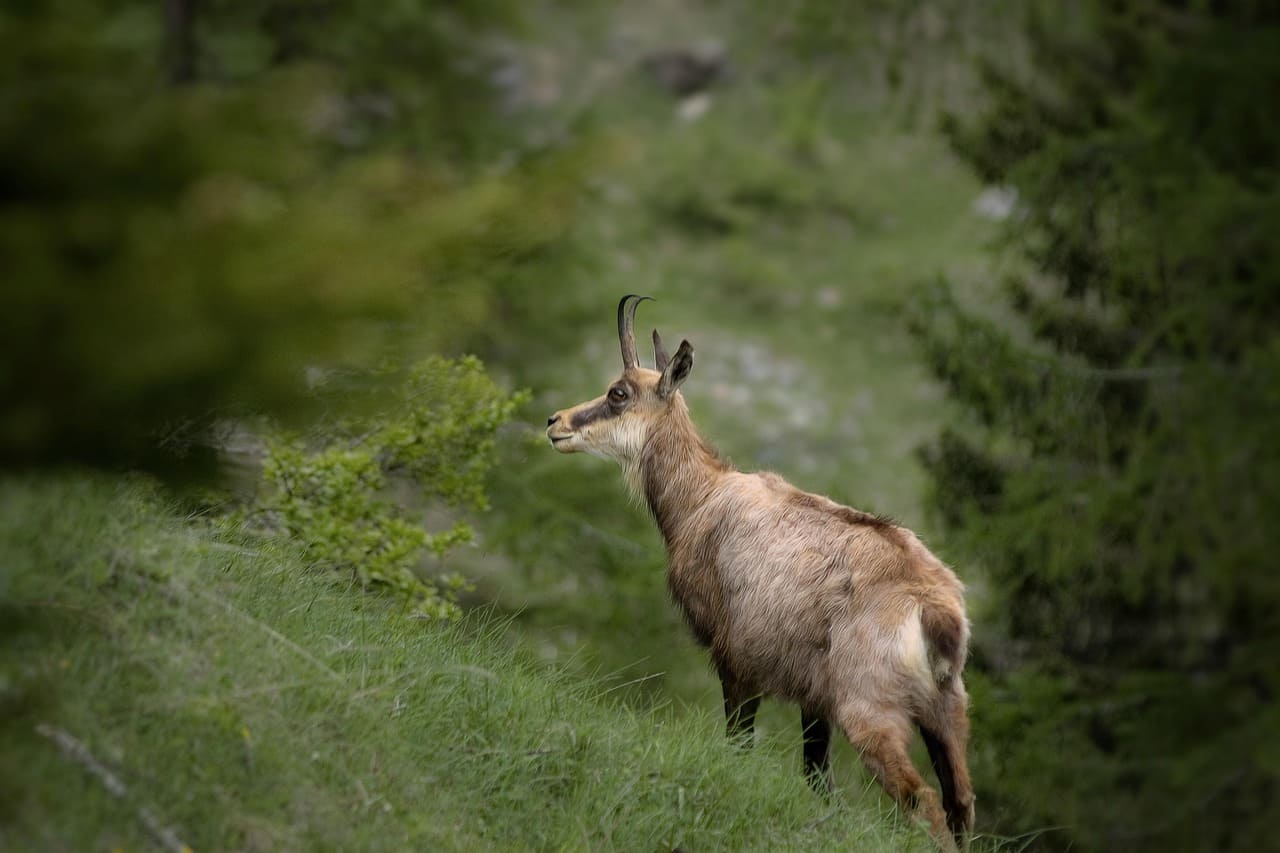
Around 86,000 chamois live in Switzerland, around 12,000 are shot annually by recreational hunters. While populations in many regions are stagnating or declining, recreational hunting maintains the same shooting pressure. This dossier shows why chamois are caught between high hunting, climate change and predator debates.
Profile
The chamois (Rupicapra rupicapra) belongs to the bovid family (Bovidae) and is one of the iconic wildlife species of the Alpine region. It inhabits steep mountain areas between the tree line and rocky regions, but also occurs in forested mid-mountain areas. In Switzerland, chamois are distributed throughout the Alps, Pre-Alps and Jura.
Biology and social behavior
Chamois live in matriarchal groups led by experienced females. Outside the rutting season (November/December), males often live alone or in loose bachelor groups. Females typically give birth to one kid in May or June, rarely twins. Kids follow their mothers within hours of birth and become independent after about six months.
Chamois are excellent climbers and can navigate slopes with up to 80-degree inclines. Their hard, rubber-like hooves provide optimal grip on rock and snow. In winter, chamois lower their metabolism and use snow-free, wind-exposed areas to conserve energy. Disturbances during winter months, whether from ski tourers, off-piste skiers or recreational hunting, can be life-threatening because every escape costs valuable energy reserves.
Population numbers
According to the Federal Hunting Statistics, approximately 86,000 chamois live in Switzerland (as of 2022). Populations have been declining for years in many regions of the Northwestern Alps, while they are considered stable in individual areas of the Central and Eastern Alps. Population estimates are based on counts that are relatively reliable in open terrain above the tree line, but show considerable uncertainties in forests.
Chamois in the crosshairs of high hunting
Hunting pressure
The chamois is the third most frequent target of Swiss recreational hunting after roe deer and red deer. Around 12,000 chamois are shot annually throughout Switzerland, with harvests varying significantly by region. In patent hunting cantons like Graubünden, Valais and Ticino, chamois hunting forms a central component of high hunting, which is staged as a cultural tradition with high emotional value.
Hunting of chamois occurs predominantly in autumn during high hunting season. In Graubünden, yearlings and does are released alongside bucks, with quota systems varying by region and year. Harvest planning is based on count results and fallen game numbers, which are often inaccurate and do not correctly reflect the actual population trend.
The problem of trophy hunting
Trophies play a considerable role in chamois hunting. The curved horns of chamois bucks (hooks) are considered coveted hunting trophies. Although official hunting planning emphasizes that harvests are not trophy-oriented, practice shows a different picture: In many regions, disproportionately many bucks in their prime are shot, which distorts the age structure of the population and reduces genetic diversity. The selective removal of the strongest bucks contradicts the principle of natural selection, in which the fittest animals reproduce most frequently.
More on this: Dossier: High hunting in Switzerland
Declining populations: causes and ignorance
Climate change
Climate change hits mountain species like chamois particularly hard. Rising temperatures, increasing heat periods and changing snow conditions affect multiple levels. Chamois are adapted to cold temperatures. Heat stress in summer forces them to retreat to higher, shady elevations during the day, which reduces feeding time and strains energy balance. The upward shift of vegetation zones changes the food supply. Chamois above the tree line find less suitable forage, while increasing forest competes for their habitat. Earlier snowmelt and altered precipitation patterns can disrupt synchronization between kid birth and optimal food availability.
Recreational pressure
Chamois in the Alpine region face increasing pressure from recreational activities: ski touring, snowshoeing, paragliding and mountain biking penetrate previously undisturbed retreat areas. Disturbances affect all seasons but are particularly severe in winter. A chamois forced to flee multiple times in winter cannot balance its energy budget and perishes.
Diseases
Chamois blindness (infectious keratoconjunctivitis) and chamois mange are recurring diseases that can lead to massive population collapses locally. Chamois mange, caused by mites, can decimate entire populations by 80 percent. The spread of such diseases is facilitated by the stress of recreational hunting and high animal density in the remaining retreat areas.
Chamois and predators: The lynx as natural regulator
The facts
The lynx regularly preys on chamois, especially in forested mountain areas. In areas with stable lynx populations, predation pressure on chamois can be locally noticeable. The recreational hunting lobby uses this fact to portray the lynx as a threat to chamois populations and demand its regulation or removal.
The classification
Scientific evidence paints a more nuanced picture. KORA, the Swiss coordination center for carnivore ecology, has documented predator-prey dynamics for years. The lynx influences chamois populations locally but is not responsible for the large-scale decline. The main causes lie in climate change, habitat deterioration, and cumulative pressure from recreational hunting and recreational disturbance. The lynx primarily takes weakened, sick, or old chamois and kids, thus fulfilling a sanitary function that strengthens the population overall. In areas where the lynx regulates chamois and deer, protection forests benefit from reduced browsing damage, which corresponds exactly to the goal that recreational hunting claims for itself.
The demand to regulate the lynx to protect chamois populations is therefore ecologically untenable. It primarily serves the interests of recreational hunters who see the lynx as a competitor for 'their' prey, not the protection of chamois.
More on this: Dossier: The Lynx in Switzerland and Dossier: Hunting Myths
Chamois in the Forest-Wildlife Conflict
As with deer, chamois are also accused of causing browsing damage in protection forests. In areas where chamois are pushed into forests because they lose open high-altitude areas due to disturbance or climate change, browsing damage on young trees can increase. But here too the argument falls short: the chamois is not the problem, but rather the fact that their natural habitat above the tree line is shrinking due to recreational pressure and climate change. Recreational hunting itself contributes to driving chamois into forests by displacing the animals from open areas where they would naturally graze. The solution lies not in higher culls but in reducing disturbances, protecting quiet zones, and promoting natural predators.
More on this: Dossier: Hunting and Biodiversity
Animal Suffering in Alpine Hunting
Hunting Conditions in the Mountains
Chamois hunting in the mountains is particularly problematic from an animal welfare perspective. Shot distances are often extremely long, lighting conditions changeable, and wind conditions unpredictable. All of this increases the probability of missed shots and wounding shots. Retrieving and tracking a wounded animal in steep terrain is laborious and frequently impossible. Chamois that are wounded and flee into rock faces die there over hours or days.
Disturbance and Stress
Alpine hunting lasts several weeks and creates permanent hunting pressure in affected areas. Chamois that are disturbed daily by recreational hunters leave their traditional resting places, reduce their feeding times, and consume energy reserves they would need for the approaching winter. The disturbance effect affects not only the hunted animals but the entire mountain fauna, including golden eagles, ibex, and ptarmigan.
More on this: Dossier: Hunting and Animal Welfare and Dossier: Alpine Hunting in Switzerland
What Would Need to Change
- Adapting cull numbers to actual population development: In regions with declining chamois populations, recreational hunting must be stopped immediately. Cull quotas based on inaccurate counts and political compromises are not regulation but population endangerment
- Large-scale wildlife quiet zones: Chamois need undisturbed winter habitats where they can balance their energy budget. Establishing binding wildlife quiet zones – including vis-à-vis recreational users – is the most effective measure against cumulative stress from recreational hunting, tourism, and climate change.
- Promoting the lynx as a natural chamois regulator: The lynx regulates chamois populations in the forest more effectively and sustainably than any hunting quota. Instead of fighting it as a competitor for 'their own prey', its role as a keystone species must be recognized and its expansion promoted.
- Ending trophy-oriented buck hunting: The selective removal of the strongest bucks contradicts the principle of natural selection and distorts the age structure and genetic diversity of the population. Recreational hunting must abandon trophy thinking.
- Professional wildlife management instead of mountain hunting: Chamois regulation must be transferred to professional game wardens who intervene in a targeted, planned manner with professional expertise. Mountain hunting in its current form – a week-long traditional ritual with massive disturbance effects – must be replaced by targeted individual removals.
Arguments
'Without recreational hunting, chamois populations would endanger the protection forest.' Recreational hunting itself drives chamois into the forest through constant disturbance, where they concentrate their browsing. In undisturbed areas, chamois predominantly stay above the tree line, where they naturally graze. The solution lies in reducing disturbances, not in higher shooting quotas. The lynx regulates chamois in the forest more effectively than recreational hunting.
'The lynx endangers chamois populations – it must be regulated.' KORA has documented for years that the lynx predominantly preys on weakened, sick or old chamois and kids, thus fulfilling a sanitary function. The main causes of chamois decline are climate change, habitat deterioration and cumulative pressure from recreational hunting and recreational disturbance. The demand to regulate the lynx for the 'protection' of chamois populations serves the interests of recreational hunters, not the protection of chamois.
'Mountain hunting is tradition and part of Alpine culture.' Tradition is no argument against scientific evidence. Mountain hunting causes week-long constant disturbance in the most sensitive habitats of the Alps, with high shooting inaccuracy in steep terrain, considerable animal suffering due to wounding, and negative impacts on the entire mountain fauna. Professional wildlife management is not cultural destruction, but an adaptation to the state of science and ethics.
'Chamois populations are stable – there is no reason for concern.' Population estimates are based on counts in open terrain that do not capture chamois in the forest. In the northwestern Alps, populations have been declining for years. The claim of stability ignores regional differences and the cumulative effect of climate change, recreational pressure and recreational hunting.
Quick links
Articles on Wild beim Wild:
- Studies on the impact of recreational hunting on wildlife
- Why recreational hunting fails as population control
- Animal welfare problem: Wild animals die agonizing deaths because of recreational hunters
Related dossiers
- The Alpine ptarmigan in Switzerland: Ice age relic between climate crisis, tourism and gunshot
- The ibex in Switzerland: Smuggled, saved and again degraded to a trophy
- The beaver in Switzerland: Exterminated, reintroduced and newly released for shooting
- The woodcock in Switzerland: Endangered, hunted and politically ignored
- Waterfowl in Switzerland: Winter guests in the line of fire
- Pigeons in Switzerland: Between peace symbol, mass shooting and official starvation
- Corvids in Switzerland: The most intelligent animals in the crosshairs
- The jay in Switzerland: Forester of the forest in the crosshairs of low hunting
- The marmot in Switzerland: Ice age relic under climate stress, tourist attraction and mass shooting
- The wild rabbit in Switzerland: severely endangered, yet huntable
- The mountain hare in Switzerland: Ice age relic between climate crisis and gunshot
- The raccoon in Switzerland: Released for shooting because it has the wrong origin
- The stone marten in Switzerland: Cultural follower between attic and shotgun blast
- The pine marten in Switzerland: Shy forest dweller under hunting pressure
- The badger in Switzerland: Ecosystem engineer in the crosshairs of small game hunting
- The red deer in Switzerland: Exterminated, returned and degraded to a shooting target
- The roe deer in Switzerland: most shot game animal and victim of misguided hunting policy
- The wild boar in Switzerland: Why recreational hunting exacerbates the problem instead of solving it
- The chamois in Switzerland: Between high hunting, climate stress and the myth of overpopulation
- The brown hare in Switzerland: Endangered, hunted and politically ignored
Our standards
The chamois is an emblematic animal of the Alps and belongs to the symbols of the Swiss mountain world. That it continues to be massively hunted despite declining populations shows how strongly the interests of recreational hunters dominate wildlife policy. Research shows that the lynx regulates chamois in the forest more effectively than recreational hunting, that climate change is shrinking chamois habitat from above and that high hunting causes weeks of continuous disturbance in the most sensitive mountain habitats. A system change towards professional wildlife management, wildlife refuge zones and natural predators is not radicalism, but an adaptation to the state of science. This dossier is continuously updated when new figures, studies or political developments require it.
More on the topic of recreational hunting: In our hunting dossier we bundle fact-checks, analyses and background reports.