
Badger Switzerland: Ecosystem engineer in the crosshairs
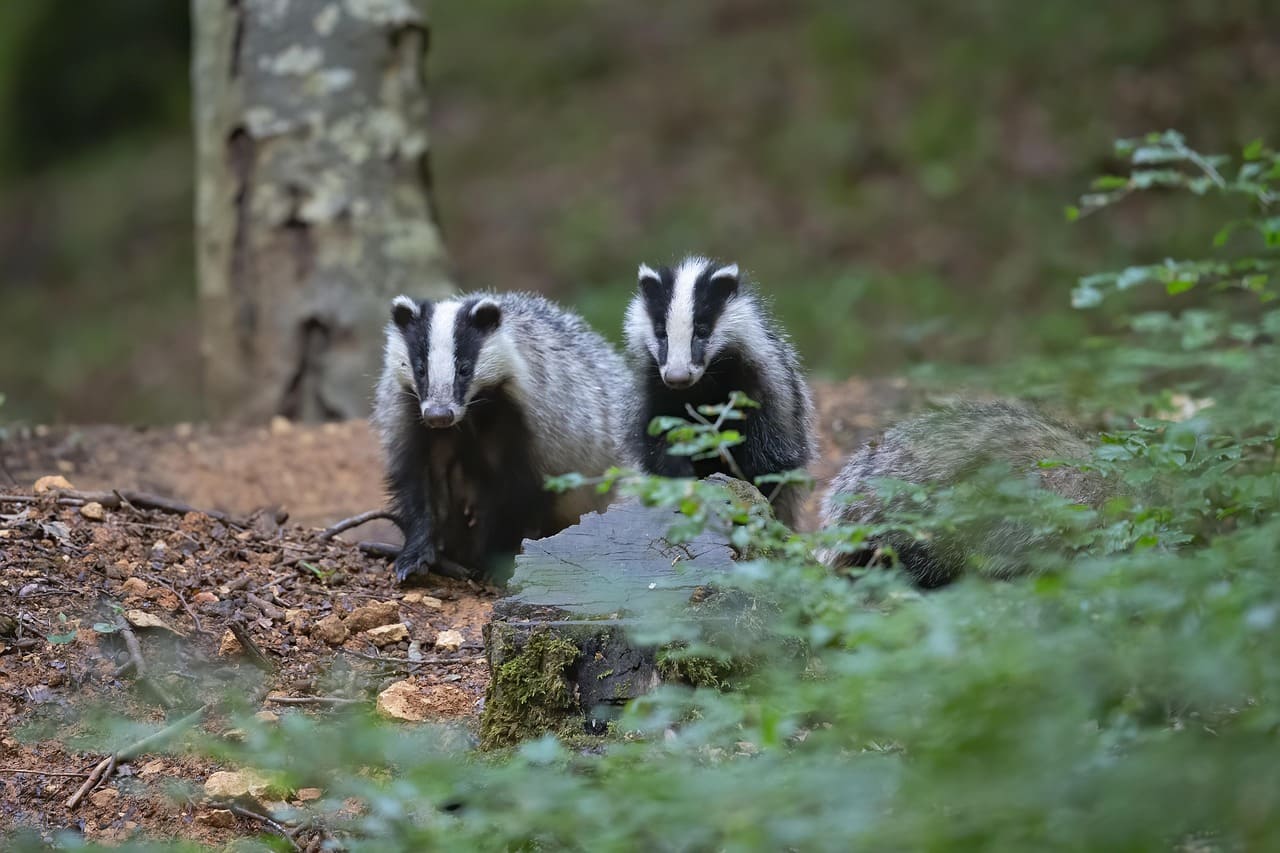
The badger is the largest mustelid in Switzerland. It lives in family groups, digs complex burrow systems, aerates the forest floor and regulates insect populations. Nevertheless, around 3,000 badgers are shot by recreational hunters every year and over 3,500 more end up as roadkill on Swiss roads. An animal that nobody wants to utilize and that recreational hunters themselves describe as 'not a coveted trophy' continues to be killed out of habit.
Profile
The European badger (Meles meles) belongs to the weasel family (Mustelidae) and is its largest representative in Central Europe. It reaches a body length of up to 90 centimeters (of which around 15 centimeters is tail) and weighs between 10 and 18 kilograms depending on the season. In autumn, badgers feed themselves a fat layer weighing several kilograms, which they live off during winter dormancy. Its most distinctive feature is the black and white facial markings: two broad, black stripes extend from the nose over the eyes to the ears. The upper side of the body is silver-gray, the underside black. Its stocky body structure with short, powerful legs and long claws on the front paws reveals its lifestyle as a builder.
Biology and social structure
The badger is one of the most social among the mustelids. It lives in family groups, so-called clans, which can consist of 2 to 20 animals and jointly inhabit a sett (Stadtwildtiere Schweiz). Badger pairs remain together for life. In early spring, the sow (the female) usually gives birth to 2 to 3 young, rarely up to 6. The young are born blind and white. The black facial stripes only develop in the later months of life. A special feature of badger biology is delayed implantation: the fertilized egg only implants in the uterus after a delay of several months, so that birth always occurs in spring.
The population grows slowly. After population crashes, for instance due to diseases, the badger needs many years to recover. In the wild, badgers rarely live longer than 10 years; in captivity they can live up to 15 years.
The badger sett: A generational project
The badger's sett constructions are among the most impressive animal structures in Swiss fauna. A badger sett can be used for decades, in some cases for centuries, and be extended by each generation. A sett investigated in England comprised 50 chambers and 178 entrances, connected by a total of 879 meters of tunnels (Wikipedia, European Badger). The setts reach up to 5 meters deep. Unlike the fox, the badger lines its sleeping chamber with dry leaves, moss or ferns and establishes separate latrines at some distance to keep the sett clean (Waldwissen.net, Dachs im Kanton Luzern).
These sett constructions are not only significant for badgers. Foxes, rabbits and numerous insect species use abandoned or side chambers of badger setts as shelter. The badger is thus an ecosystem engineer whose construction activity benefits other species.
Diet and ecological function
The badger is an opportunistic omnivore with a strong preference for earthworms. It also eats insects, larvae (particularly grubs), snails, mice, fruits, berries, nuts and field crops (Waldwissen.net, Kanton Aargau). It is not an active hunter, but a forager that searches for food by rooting and digging through the soil. Around three-quarters of its total diet consists of plant matter (Umweltberatung Luzern).
The ecological function of the badger is systematically ignored in public debate. Through its digging activity it aerates the forest floor, promotes the mixing of soil layers and contributes to the dispersal of plant seeds. As a destroyer of grubs, mice and snails, it acts as a natural pest regulator in agriculture and forestry. Its benefit to the ecosystem is considerable, but is never included in the cost-benefit calculation of recreational hunting.
The hunt: Tradition without justification
Legal situation
The badger is a huntable species under the Federal Act on Hunting (JSG, Art. 5 Para. 2). It is classified as so-called small game, together with the red fox, the stone marten and the pine marten. The hunting season is set by the cantons and varies greatly. In some cantons, the badger is hunted for up to 6 months per year (Eidgenössische Jagdstatistik). The closed season during rearing of young usually lasts from January 16 to June 15, but here too there are cantonal variations.
The scale of the kill
According to the Federal Hunting Statistics, around 3,000 badgers are shot annually in Switzerland. In addition, over 3,500 badgers are registered as casualties, mainly traffic victims (Jagdstatistik, Wildtier Schweiz/BAFU). Total mortality due to human impact is thus over 6,500 animals per year. Recreational hunting is therefore the second most common cause of death for badgers in Switzerland after road traffic.
Particularly striking: In individual cantons, shooting numbers explode periodically. In Basel-Country canton, the culls increased in a short time from a long-term average of 80 to 200 animals to over 350 animals per year (BZ Basel, 2017). The cantonal hunting administrator explained: «How many badgers are killed depends on the engagement of the hunters», and admitted that badgers were «not a coveted trophy» and «could not be utilized». They ended up «normally completely at the carcass collection point» (BZ Basel, 2017). In Graubünden canton, the municipality of Laax paid a bounty of 40 francs for every killed badger (IG Wild beim Wild, 2020).
In Geneva canton, where recreational hunting has been abolished since 1974, only 4 badgers were killed by professional game wardens in the 2022/23 hunting year (IG Wild beim Wild, Hunting Statistics 2022). In Schaffhausen canton with its 805 recreational hunters, it was 109 badgers in the same period. This ratio demonstrates exemplarily: The badger is not shot because it is necessary, but because it happens to be in the hunting ground and recreational hunters are seeking targets.
Hunting methods and animal welfare
Badger hunting in Switzerland is predominantly conducted as ambush hunting at the sett during late twilight and at night. In some cantons, night hunting of badgers is also permitted. Zurich canton has introduced night hunting for foxes and badgers. In some territories, badgers are still hunted with earth dogs (dachshunds, terriers) that are sent into the sett to drive the animals out. The Swiss Animal Protection STS demands a nationwide ban on earth hunting, as it involves extreme fear for both animal species involved and constitutes animal cruelty (STS, Hunting in Switzerland).
The sett is a refuge for the badger, into which no enemies would penetrate under natural conditions. Earth hunting destroys this elementary security need. That recreational hunters send dogs into the sett of a defensive animal weighing up to 18 kilograms is ethically unjustifiable and regularly leads to severe bite injuries in the deployed dogs.
More on this: Animal welfare problem: Wild animals die agonizingly because of recreational hunters
The rabies story: How the badger became collateral damage
Gassing and population collapse
In the 1970s and 1980s, the badger population in Switzerland was massively decimated, not because it was itself infected with rabies, but because it lived in the same setts as the red fox, which was considered the main transmitter of rabies. As part of rabies control, fox setts were treated with gas. Since badgers and foxes frequently use shared sett systems, badgers died as collateral damage in large numbers (Aargau canton, Lucerne Environmental Advisory).
Rabies has been considered eradicated in Switzerland since 1999. It was not defeated by gassing and not by recreational hunting, but by animal-friendly vaccine baits that were deployed over large areas. The Swiss rabies center has explicitly stated that hunting reduction of fox populations for rabies control is not possible and even counterproductive (IG Wild beim Wild, 2020). The badger thus paid a high price for a control strategy that proved to be wrong.
The recovery
After the collapse due to rabies control, the badger population has slowly recovered in recent decades. The rising hunting bag and the increasing number of badgers killed in traffic accidents indicate a population increase (Aargau canton). An exact population count is not possible for badgers due to their nocturnal lifestyle. That recreational hunters now use the population increase as justification for rising culls is cynical: They first decimated it through gassing and now want to hunt it again as it has recovered.
The Damage Argument: Inflated and Disproportionate
Agricultural Damage
The main argument for badger hunting is: The badger causes damage to agricultural crops, particularly to corn, grapes and berry crops. It also digs in gardens and can destabilize embankments or slopes through its digging activity. This damage is real, but modest in extent and locally limited.
The Canton of Aargau states that the badger can cause wildlife damage "similar to wild boar". But the comparison with wild boar is misleading: While wild boar can plow up fields over large areas, badger damage is limited to small-scale digging and selective feeding. A badger rarely ventures more than 1,600 meters from its burrow during its nocturnal foraging trips (Waldwissen.net, Badger in Canton Lucerne). Its damage is thus clearly locally limited and can be prevented with simple, animal-friendly means.
Animal-Friendly Alternatives
Ground-level, two-wire electric fences around corn or berry fields reliably keep badgers away. This protective measure is cost-effective, immediately effective and makes shooting unnecessary. Other deterrents such as scent substances, light flashes or motion sensors can be used in residential areas. That recreational hunters nonetheless promote shooting as the first and often only measure is not due to a lack of alternatives, but to the self-understanding of a hunting culture that sees the killing of animals as the standard solution to every problem.
What the Damage Argument Conceals
The economic damage caused by badgers is in no proportion to the costs and suffering that hunting causes. The ecological benefit of the badger as a soil aerator, seed disperser and natural pest controller is not considered in any cantonal damage calculation. When a badger devours grubs and mice, it saves agriculture costs for pesticides. When it digs through and aerates forest soil, forest regeneration benefits. These positive services are never accounted for because they would undermine the narrative of the "damage-causer".
More on this: Why Recreational Hunting Fails as Population Control
The Badger and Its Predators: Natural Enemies Instead of Gunshots
The only natural enemies of the badger are wolf, lynx, brown bear and humans (Environmental Consulting Lucerne). In large parts of Switzerland, the first three are still missing. The return of the wolf could in the long term also naturally co-regulate badger populations, but the badger is not a focus of wolf prey. Its main enemy is and remains road traffic: Over 3,500 badgers die annually on Swiss roads.
The fragmentation of the landscape by roads and settlements is a greater threat to the badger than any agricultural conflict. Young animals that cross roads while searching for their own territory are particularly endangered. Wildlife corridors and underpasses, as planned for red deer, also benefit the badger, but are rarely considered for smaller species in wildlife management concepts.
More on this: Studies on the Impact of Recreational Hunting on Wildlife
What Would Need to Change
- Abolition of small game hunting of the badger: An animal that provides no trophy, is not utilized and ends up at the carcass collection point must not be hunted. Badger hunting has no reasonable justification within the meaning of the Animal Welfare Act (TSchG, Art. 4). What works in the Canton of Geneva with 4 professional culls per year must serve as the standard.
- Switzerland-wide ban on den hunting: The hunting of badgers and foxes in burrows with dogs is an archaic form of hunting that constitutes animal cruelty. The Swiss Animal Protection STS demands a ban. This demand must be implemented by law.
- Protection of badger setts: Badger setts are used across generations and constitute ecologically valuable structures. They must be recognized as habitats worthy of protection and safeguarded against destruction, filling, and disturbance, analogous to caves or nesting trees.
- Promotion of animal-friendly damage prevention: Electric fences around sensitive crops are the only proportionate measure against badger damage. Cantons must support farmers in procurement and installation instead of issuing shooting permits.
- Reduction of road mortality: Over 3,500 badgers die annually on Swiss roads. Small wildlife passages, warning signs and speed restrictions at known badger crossings must be systematically implemented.
- Research and monitoring: There are no reliable population figures for badgers in Switzerland. National monitoring using standardized methodology, such as counting occupied setts, is a prerequisite for an evidence-based protection strategy.
Arguments
«Badgers cause damage to agricultural crops and must therefore be hunted.» The damage is real but locally limited and reliably preventable with electric fences. Hunting is not a proportionate measure, especially since it does not control the population but only removes individual animals whose territories are immediately taken over by neighboring animals. In Canton Geneva, badger damage is managed through professional wildlife management and prevention, not with recreational hunters.
«The badger population has recovered and must be regulated.» The population has recovered after collapsing due to senseless gassing during rabies control efforts. That a species increases again after a human-caused catastrophe is not an argument for renewed hunting, but a sign of functioning ecosystems. Badger populations regulate themselves through food availability and territorial structures.
«The badger belongs to small game hunting and its hunting is tradition.» Tradition is not an argument for animal cruelty. Small game hunting of fox, badger, stone marten and pine marten is not scientifically justified and serves primarily the recreational pleasure of recreational hunters. The Swiss Animal Protection STS rightfully demands that the sense and purpose of hunting these species be critically examined and that all animals have a right to closed seasons.
«Without hunting, badgers will become a problem in residential areas.» Badgers penetrate residential areas because they find food there, not because they are not hunted enough. The solution lies in eliminating food sources (open compost heaps, accessible garbage bins, fallen fruit), not in shooting. Hunting in residential areas is hardly possible anyway, as cantonal authorities themselves admit. That badgers seek proximity to settlements is an expression of their adaptability, not of overpopulation.
«Badgers cannot be utilized, shooting is nevertheless necessary.» When an animal serves neither as food nor as trophy and is completely disposed of at the carcass collection site, the reasonable justification for killing under animal protection law is lacking. The statement by the cantonal hunting administrator of Baselland that badgers 'cannot be utilized' and end up 'normally completely at the carcass collection site' exposes badger hunting for what it is: senseless killing without purpose.
Quick links
Articles on Wild beim Wild:
- Studies on the impact of recreational hunting on wildlife
- Why recreational hunting fails as population control
- Animal welfare problem: Wildlife dies agonizingly because of recreational hunters
- Animal cruelty: Fox massacre in Switzerland
Related Dossiers
- The Alpine Ptarmigan in Switzerland: Ice Age Relic Between Climate Crisis, Tourism and Gunfire
- The Ibex in Switzerland: Smuggled, Saved and Once Again Degraded to a Trophy
- The Beaver in Switzerland: Exterminated, Reintroduced and Newly Released for Shooting
- The Woodcock in Switzerland: Endangered, Hunted and Politically Ignored
- Waterfowl in Switzerland: Winter Guests in the Line of Fire
- Pigeons in Switzerland: Between Peace Symbol, Mass Shooting and Official Starvation
- Corvids in Switzerland: The Most Intelligent Animals in the Crosshairs
- The Eurasian Jay in Switzerland: Forest Gardener in the Crosshairs of Small Game Hunting
- The Marmot in Switzerland: Ice Age Relic Under Climate Stress, Tourist Attraction and Mass Shooting
- The Wild Rabbit in Switzerland: Severely Endangered, Yet Still Huntable
- The Mountain Hare in Switzerland: Ice Age Relic Between Climate Crisis and Gunfire
- The Raccoon in Switzerland: Released for Shooting Because It Has the Wrong Origin
- The Stone Marten in Switzerland: Cultural Follower Between Attic and Gunfire
- The Pine Marten in Switzerland: Shy Forest Dweller Under Hunting Pressure
- The Badger in Switzerland: Ecosystem Engineer in the Crosshairs of Small Game Hunting
- The Red Deer in Switzerland: Exterminated, Returned and Degraded to a Shooting Target
- The Roe Deer in Switzerland: Most Shot Wild Animal and Victim of Misguided Hunting Policy
- The Wild Boar in Switzerland: Why Recreational Hunting Exacerbates the Problem Instead of Solving It
- The Chamois in Switzerland: Between High Hunting, Climate Stress and the Myth of Overpopulation
- The Brown Hare in Switzerland: Endangered, Hunted and Politically Ignored
Sources
- Federal Hunting Statistics, FOEN/Wildlife Switzerland: http://www.jagdstatistik.ch (Shooting and Roadkill Data)
- Canton Aargau, Department of Construction, Transport and Environment: Badger Portrait (ag.ch)
- Waldwissen.net/WSL: The Badger in Canton Lucerne (Holzgang/Muggli, 2005, updated)
- Urban Wildlife Switzerland/Wild Neighbors: Badger Species Portrait (stadtwildtiere.ch)
- Environmental Consulting Lucerne: Badger, from Forest to City (umweltberatung-luzern.ch)
- BZ Basel (2017): Hunting Statistics, Badgers in the Sights of Local Hunters
- IG Wild beim Wild (2020/2022/2025): Fox Massacre in Switzerland, Hunting Statistics 2022 (wildbeimwild.com)
- Swiss Animal Protection STS: Hunting in Switzerland, Protection of Wild Animals and Habitats (tierschutz.com)
- Hunters' Association: The Badger (jvdt.ch)
- Wikipedia: European Badger (Meles meles)
- Federal Act on Hunting and the Protection of Wild Mammals and Birds (HPA, SR 922.0)
- Animal Welfare Act (AWA, SR 455)
Our Standards
The badger is an animal that lives in secret and dies in secret. Its burrow systems, grown over generations and ecologically valuable, are misused by recreational hunters as hunting opportunities. Its ecological performance as soil aerator, pest regulator and seed disperser is not accounted for in any hunting statistics. Instead, it is branded as a 'damage causer', although its damage is locally limited and preventable with simple means. The fact that the badger ends up completely in the carcass collection site after being shot, because it is not usable, makes the senselessness of hunting it particularly clear. Killing an animal just because you can is not wildlife management. It is the bankruptcy declaration of a hunting culture that operates shooting as an end in itself. Small game hunting of badgers must be abolished. What the Canton of Geneva has been demonstrating for over 50 years is the standard. This dossier is continuously updated when new figures, studies or political developments require it.
More on the topic of recreational hunting: In our Hunting Dossier we bundle fact-checks, analyses and background reports.