Hobby hunters as false wildlife experts
Pascal Wolf has submitted petitions for a fox hunting ban in more than 12 cantons. The reaction of the Lucerne newspaper exemplifies how media uncritically adopt hunting lobby narratives – despite the petition text providing watertight science.


A Lucerne lawyer named Pascal Wolf has submitted petitions for an end to red fox hunting in more than 12 cantons, including Zug, Basel-Landschaft and Lucerne.
In Bern, cantonal councillor von Arx has already submitted a motion based on this foundation. Cantonal councillor Sabine Hesselhaus is active in the Lucerne parliament. And the cantons of Zug and Basel-Landschaft have initiated scientific investigations.
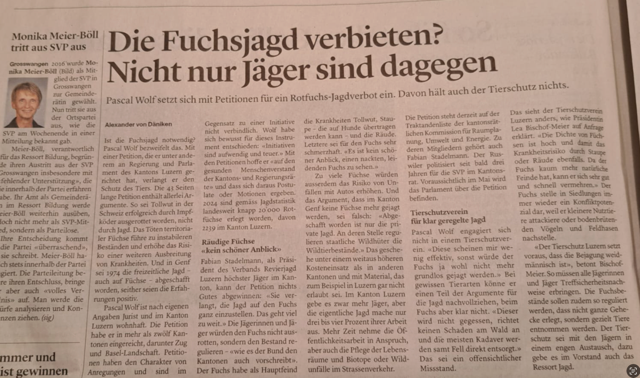
This is a remarkable success for a lone fighter without organizational backing. And yet the headlines read: 'Ban fox hunting? Not only hunters oppose it' (Luzerner Zeitung) and 'Baselland addresses fox hunting petition, office promises review' (Oberbaselbieter Zeitung). The tone: skeptical. The voices: recreational hunters and administration. The science: marginal.
What Wolf actually demands
Wolf's petition does not call for the immediate abolition of fox hunting. It demands something more modest and legally unavoidable: that the government council examines and reports whether there is any scientific basis for fox hunting at all.
The petition lists six concrete review tasks, supported by studies from wildlife biology, parasitology and epidemiology. The key findings: Rabies was eliminated in Switzerland through bait vaccination, not through hobby hunting (BAG). Fox tapeworm can only be effectively reduced through deworming baits; hobby hunting is ineffective (König et al. 2019, Comte et al. 2013, Takahashi et al. 2013). Distemper and mange: hobby hunting is counterproductive because killing territorial animals leads to increased immigration and faster disease spread (Prentice 2012). Fox populations remain stable despite intensive hobby hunting; immigration and increased reproduction quickly compensate for culling (Kämmerle et al. 2019, Baker et al. 2002). The decline of ground-nesting birds and hares is scientifically attributed to habitat loss and intensive agriculture, not to foxes (Knauer et al. 2010, Spaar et al. 2012). And hobby hunting destabilizes territories and increases roaming behavior, which rather increases the traffic accident rate.
This is not activism. This is documented science. And Wolf provided the journalist with all sources including direct hyperlinks.
The newspaper article: What's missing
Chief reporter Alexander von Däniken from Luzerner Zeitung had the complete petition, all scientific sources and Wolf's written responses. Wolf explicitly requested to review the presentation of statements before publication. Von Däniken declined, noting that written responses do not need to be authorized.
What appeared in the article: a quote from hunting association official Fabian Stadelmann, positioned as an objective counterpoint. The science: barely present. The example of Geneva (50 years without fox hunting, no significant problems): marginal. Luxembourg: not mentioned.
This is not an isolated case. It is a structural problem.
Sometimes it's better to provide no information at all than information that, despite scientific facts, casts one in a bad light and ultimately only promotes crude recreational hunter propaganda. When CH Media hides the article behind their paywall and even Pascal Wolf, who provided the editorial team with the entire scientific foundation, only receives access for payment, the question arises why one should cooperate at all.
We know this pattern all too well, also from CH Media: As a source, one invests time, energy and resources, delivers carefully researched material and is thanked by being asked to purchase a subscription for an article that reproduces the delivered facts half-heartedly at best. wildbeimwild.com remains the only platform that shows the complete picture. This is no coincidence, but policy.
We draw a consequence from this: In future media contacts, we will establish in writing from the beginning that as information providers, we expect in return to review the finished article before publication and at least receive the PDF. This is not legally enforceable, but it creates clear expectations and makes the asymmetry visible when it nevertheless occurs.
The wrong expert
Local press, animal welfare organizations and politics still believe today that expertise is available under the hunting hat. On nature topics of all kinds (wolf, fox, deer, forest condition, wild boar populations), local recreational hunters are reflexively consulted and presented as an "expert group" without identifying their vested interests. The "Media and Hunting Topics" dossier from wildbeimwild.com analyzes this mechanism in detail.
The problem begins with training. Courses for the hunting exam are conducted by persons who require no regular qualification certificate and derive their knowledge primarily from hunting literature and club tradition, not from independent wildlife research. "I completed hunter training in Canton Bern a year ago, the training is a disgrace," writes a newly certified hobby hunter to IG Wild beim Wild. After training, recreational hunters move within the echo chamber of hunting press. In hunting clubs, they confirm each other mutually. This creates an insular group that is barely accessible to new information, but presents itself externally as "nature experts." Because this group is well-organized and quickly reachable, editorial teams structurally turn to them repeatedly. Not from intention, but from habit.
The newspaper report on Wolf's petitions follows this pattern exactly. The president of a district hunting association is positioned as an objective voice against the ban. Scientific counter-evidence (Luxembourg, Canton Geneva, National Park, population biology) does not appear. The position paper from JagdSchweiz that declares fox hunting "sensible and useful" is not questioned. The 12 most common hunting myths are systematically refuted on wildbeimwild.com.
Yet the factual situation is clear: Luxembourg abolished fox hunting in 2015 without the prophesied catastrophes occurring. According to official figures from the Luxembourg veterinary administration, the fox tapeworm infection rate in foxes fell from 40 percent (2014) to 17.6 percent (2020), thus more than halved. Not a single case of alveolar echinococcosis in humans has been reported since. The Luxembourg government sees no reason to lift the hunting ban (Luxemburger Wort, 2022). In Canton Geneva, wildlife management has functioned for 50 years without recreational hunting. In the National Park, no one hunts and there are neither fox plagues nor ecological collapses.
The Animal Protection Association Lucerne: When PR communication replaces substantive policy
Particularly revealing is the position of Lea Bischof-Meier, president of the Animal Protection Association Lucerne. According to newspaper reports, she advocates for "clearly regulated hunting," thus for maintaining fox hunting, which annually costs up to 25,000 animals their lives senselessly and without reason. This is not an animal protection position. This is hunting lobby communication with an animal protection logo.
Her professional profile identifies her as a politician and PR entrepreneur, co-owner of a company for "PR, advertising and communication." Wildlife biology, ecology or veterinary medicine: none. What she does bring are twenty years in local politics and a pronounced sense for consensus-capable formulations. When an animal protection organization does not base its position on fox hunting on scientific evidence, but on what sounds politically viable, it has abandoned its mission.
Pascal Wolf put it succinctly himself: "These seem to me little effective, otherwise the fox would no longer be hunted without reason." An organization whose president stands on the side of recreational hunters on the most obvious animal protection issue in the canton impressively confirms this judgment.
Lucerne also practices den hunting, and nobody protests
While Pascal Wolf questions the scientific basis of fox hunting with his petition, the Canton of Lucerne simultaneously practices an even more brutal hunting method: den hunting. Hunting dogs are sent into fox and badger dens to corner the animals underground. They are harassed, injured, or suffocated in the den before being shot outside. The Swiss Animal Protection (STS) states in its official position paper: 'From an animal welfare perspective, den hunting and waterfowl hunting should be rejected. The use of terriers cannot be justified from an animal welfare standpoint.' The cantons of Thurgau, Zurich, Bern, and Vaud have already banned den hunting. Lucerne has not.
Motion 23.3303 'Ban on cruel den hunting' is pending in the Federal Parliament. wildbeimwild.com also documents this method extensively in the Den Hunting Dossier. The fact that the Animal Protection Association of Lucerne under President Lea Bischof-Meier remains silent on both issues — the senseless fox hunting and den hunting — completes the failure of organized animal protection in the canton.
Basel too: Same media logic, same gaps
Not only the Luzerner Zeitung, but also the Oberbaselbieter Zeitung, another CH-Media title, reports on Wolf's petition. The article correctly summarizes the petition content, but here too the crucial element is missing: The Veterinary and Health Directorate of Basel announces a statement only for June 2026 — not a substantive engagement with the science, but a reference to administrative jurisdiction.
This is telling. The cantonal bureaucracy protects fox hunting not with arguments, but with procedures. Wolf's petition has achieved exactly what it should: It forces cantonal governments to position themselves in writing, revealing that 'tradition' and 'jurisdiction' must serve as answers to studies and case examples.
What Wolf himself says
In email correspondence with the Luzerner Zeitung, Wolf formulates his position precisely:
'If one wants to kill around 20,000 animals annually, the moral burden of proof for justifying this clearly lies with those who intend to do so.'
And on the question of how to explain fox hunting to one's own population: 'How do you want to explain to your children why 20,000 foxes are killed annually in Switzerland? I find that difficult to imagine and believe in the population's reason. Life should not be taken without cause.'
What is needed now
Pascal Wolf's petitions in over 12 cantons are a rare opportunity: A lawyer, not an NGO, not an 'animal rights activist,' poses a fundamental constitutional question. Cantonal governments are obligated to respond on a scientific basis. This is the right leverage. The Template texts for hunting-critical initiatives on wildbeimwild.com provide concrete templates for petitions, motions, and popular initiatives in every canton.
What's missing is reinforcement: from animal protection associations, from independent wildlife biologists, from media professionals who are ready to introduce hobby hunters next time not as an expert group, but as what they are: an interest party.
wildbeimwild.com will continue to follow and report on further developments in the cantons.
Further sources
SRF DOK: Everything for the foxes · Tagesanzeiger: Zurich hobby hunter refuses to shoot healthy foxes · Media and Hunting Topics Dossier · No to fox hunting · Hobby hunters spread diseases · Recreational hunting promotes diseases · FAQ: Psychology of hobby hunters · Hunting Myths Dossier · Template texts for cantonal initiatives · All dossiers
Support our work
With your donation, you help protect animals and give voice to their concerns.
Donate now →