
Wild rabbits Switzerland: Severely threatened, yet still huntable
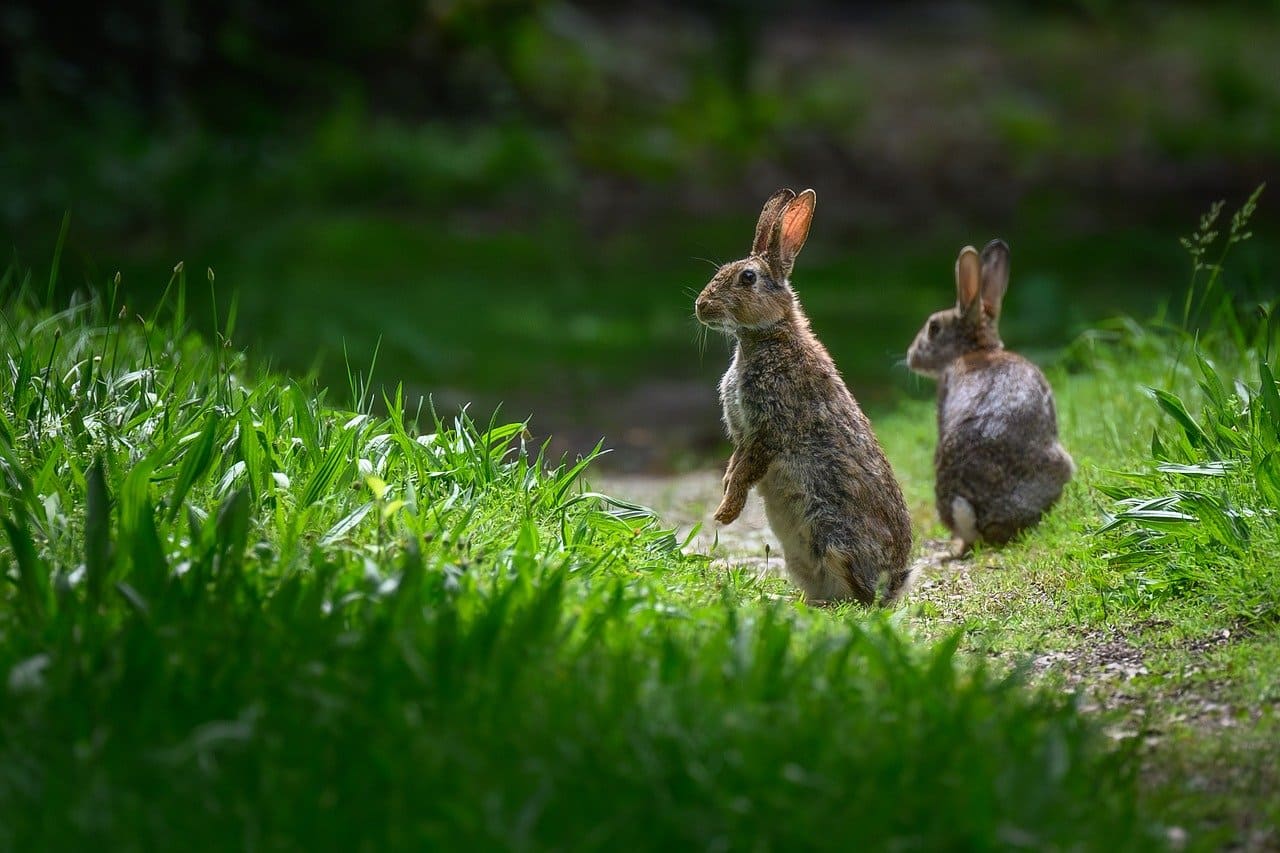
The wild rabbit is among the most severely threatened mammals in Switzerland. On the Red List it is classified as 'severely threatened' (EN, Endangered). Its population is tiny: In the early 1980s the species was still well represented in Ticino, but an epidemic virtually wiped out the population at the end of the 20th century. Today there are only scattered, isolated occurrences in Switzerland. Nevertheless, the wild rabbit is listed as a huntable species in the Federal Act on Hunting. It is the most absurd case in the Swiss hunting system: A species on the brink of disappearance that may legally continue to be shot.
Profile
The European wild rabbit (Oryctolagus cuniculus) belongs to the hare family (Leporidae) and is the only species of the genus Oryctolagus. It is the ancestral animal of all domestic rabbits. With a body length of 40 to 50 centimeters and a weight of 1.5 to 2 kilograms, it is significantly smaller and more compact than the brown hare. The ears are shorter, the hind legs less long. The fur is greyish-brown on top, the neck rust-brown, the belly and underside of the short tail (the 'scut') are white.
Biology and social structure
In contrast to the European hare, which lives as a solitary animal in open landscapes, the wild rabbit is a distinctly social animal. It lives in colonies and digs complex, underground burrows that are expanded and used over generations. Within the colony, there is a fixed hierarchy. Wild rabbits are primarily active at dusk and night and rarely venture more than a few hundred meters from their burrow when foraging. This close bond to the burrow fundamentally distinguishes them from the European hare, which as a precocial species rests in open forms.
Wild rabbits prefer open landscapes with lower vegetation, shrub islands and loose soils suitable for digging. Forest edges, hedge landscapes, dunes and embankments are ideal habitats. In intensively farmed agricultural areas, they can hardly find suitable habitats anymore. Climatically, the wild rabbit depends on milder locations; it is absent in higher mountain regions.
Reproduction
The wild rabbit has one of the highest reproduction rates among native mammals. A female can produce 3 to 5 litters per year with 3 to 7 young each. The young are born naked and blind (altricial), in contrast to young hares, which come into the world as precocial animals already furred and able to see. This high reproduction rate is an adaptation to high mortality: Natural predators, diseases and weather take a heavy toll. Under normal conditions, reproduction compensates for the losses. But when diseases like myxomatosis or RHD (Rabbit Haemorrhagic Disease) strike, even a reproduction-strong population collapses within a short time.
Red List Status
The wild rabbit is listed as 'Endangered' (EN) on the Red List of mammals in Switzerland (BAFU, 2022). This means: There is a high risk that the species will become extinct in Switzerland in the medium term. The population is very small and fragmented. SRF reported in 2022 that the Swiss population of wild rabbits was 'very small' and the species had practically disappeared in Ticino after an epidemic at the end of the 20th century (SRF, 2022). 20 Minuten and Infosperber confirmed in 2022 that wild rabbits in Switzerland were 'particularly severely endangered' (20 Minuten, Infosperber, 2022).
The History: From Roman Rabbit to Epidemic Victim
Origin and Distribution
The wild rabbit originally comes from the Iberian Peninsula and North Africa. The Romans already kept it as a domestic animal. In the Middle Ages, it was released in large parts of Europe and spread rapidly thanks to its enormous reproductive capacity. In Switzerland, it has settled mainly in the climatically milder regions, particularly in Ticino, the Lake Geneva region and northwestern Switzerland. It was never considered a common species in Switzerland, as the alpine altitudes and harsh climate of large parts of the country naturally limit its distribution.
The Catastrophe: Myxomatosis and RHD
The history of the wild rabbit in Europe is inextricably linked to two devastating viral diseases, both caused or spread by humans.
Myxomatosis was deliberately introduced into the wild rabbit population in France in 1952, when landowner Paul-Félix Armand-Delille released two infected rabbits on his estate to control the rabbit population (Wikipedia, Myxomatosis). The virus spread at breakneck speed across all of Europe and had an almost population-destroying effect. The mortality rate was up to 99 percent. In Switzerland too, wild rabbit populations were massively decimated. In 2007, another outbreak was reported in Switzerland (AGES, Myxomatosis).
Additionally, from the 1980s onwards, Rabbit Haemorrhagic Disease (RHD, also called 'Chinese disease') emerged, another viral disease with mortality rates exceeding 80 percent. In Ticino, where a significant wild rabbit population still existed in the early 1980s, this epidemic led to the virtually complete disappearance of the species (SRF, 2022). In 2018, a new viral recombinant (ha-MYXV) also appeared on the Iberian Peninsula, which for the first time killed brown hares en masse as well (Vetmeduni Wien, 2025).
The wild rabbit in Switzerland is therefore not a victim of natural processes, but a victim of human manipulation: The diseases that have brought it to the brink of extinction were spread by humans either deliberately or negligently.
More on this: Dossier: Hunting and Biodiversity
The Hunting: Legally Required to Shoot a Dying Species
Legal Situation
The wild rabbit is a huntable species under the Federal Hunting Act (JSG, Art. 5 Para. 1 lit. f). The closed season extends from February 16 to September 30. Shooting is permitted from October to mid-February. Cantons may further restrict the hunting season or protect wild rabbits year-round.
The contradiction is obvious: The wild rabbit is classified on the Red List as 'critically endangered', meaning it is in the second-highest threat category after 'extinct in the wild'. At the same time, it is huntable under federal law. This simultaneity of endangered status and huntability is neither scientifically nor ethically defensible from a wildlife biology perspective. Infosperber commented in 2022: 'It is shameful that wild rabbits are still huntable despite being considered critically endangered' (Infosperber, 2022).
The Scale of the Shooting
The shooting numbers are low due to the tiny population. The federal hunting statistics show only isolated shootings in recent years. Yet even a few shootings can mean the difference between survival and extinction for a remnant population on the verge of disappearance. The fact that the wild rabbit still appears on the list of huntable species is not an expression of conscious wildlife policy, but of negligence: Federal law has not been adapted to the reality of the Red List.
The Comparison with the Brown Hare
The brown hare, which is classified as 'vulnerable' (VU), thus one category below the wild rabbit, is intensively hunted by recreational hunters with around 1,600 shootings per year and is the subject of broad public debate. The wild rabbit, which is even more endangered, is barely mentioned in this debate because its population is so small that it no longer appears as game. Yet this is precisely what makes the case particularly serious: A species that has become so rare that it has become 'invisible' to recreational hunters remains in the hunting law. Nobody fights for its removal because nobody is interested. The wild rabbit dies in invisibility.
More on this: Dossier: The Brown Hare in Switzerland
Ecological Significance: Key Species in Hiding
The Ecosystem Engineer
The wild rabbit is an ecological keystone species where it occurs in healthy populations. Through its digging activity, it aerates the soil, creates microhabitats for insects, reptiles and amphibians, and promotes plant diversity through selective browsing. In its homeland on the Iberian Peninsula, it is the food base for an entire chain of predators: The Iberian lynx and the Spanish imperial eagle depend on wild rabbits as their main prey. The dramatic decline of wild rabbits due to myxomatosis and RHD has brought the Iberian lynx to the brink of extinction in Spain (Deutscher Jagdverband).
In Switzerland, the ecological significance of the European rabbit is limited due to the small population size. However, this does not make its disappearance any less concerning: every species that vanishes from an ecosystem tears a gap whose consequences often only become visible years later.
Food source for predators
In regions with intact European rabbit populations, red foxes, eagle owls, common buzzards, ermines and other predators benefit from high prey availability. The disappearance of the European rabbit increases predation pressure on other prey animals, such as the equally endangered brown hare. The restoration of a healthy European rabbit population would thus have positive cascade effects on the entire ecosystem.
What would need to change
- Immediate removal of the European rabbit from the catalog of huntable species: A species that is listed as 'critically endangered' on the Red List and whose Swiss population is on the brink of extinction must under no circumstances remain huntable. The removal is not a matter of hunting policy, but of species conservation, and it must occur at the federal level.
- National protection program for the European rabbit: Switzerland needs an active protection and reintroduction program for the European rabbit. Suitable habitats must be identified, enhanced and connected. Pioneer colonies must be protected from disturbances. The Geneva model shows that in a canton without recreational hunting, conditions for the recovery of small game species are significantly better.
- Disease monitoring and prevention: Myxomatosis and RHD are the greatest threats to the European rabbit. Systematic monitoring of pathogens in Switzerland and the development of vaccination strategies for wild populations are urgently needed. The new virus recombinant ha-MYXV, which has also affected brown hares since 2018, must be monitored with particular attention.
- Habitat enhancement: The European rabbit needs structurally diverse landscapes with loose soils, shrub islands, hedgerows and extensively used grasslands. Agricultural intensification has destroyed these habitats on a large scale. Ecological compensation areas, fallows and hedgerow strips must be strategically established in areas with historical rabbit occurrences.
- Research on population and distribution: There is no reliable current data on the size and distribution of the European rabbit population in Switzerland. Without this data, no protection program is possible. A systematic population survey with burrow counting, camera traps and genetic analyses is long overdue.
- Public education: The European rabbit has become so rare in Switzerland that most people do not even know of its existence. Public relations work and education about the endangerment situation are prerequisites for societal support for conservation measures.
Arguments
'The European rabbit is huntable, but practically no longer shot.' This is not an argument for maintaining its huntable status, but for abolishing it. When a species has become so rare that it no longer appears as hunting prey, its removal from hunting law is a matter of course. Maintaining huntable status on paper is a signal of indifference toward species conservation.
'The main threat is diseases, not recreational hunting.' That is correct. However, when a species has been brought to the brink of extinction by myxomatosis and RHD, every additional mortality factor must be eliminated, even if it is quantitatively small. This principle applies to the brown hare, and it applies even more to the even more endangered European rabbit. Recreational hunting of a species that has practically disappeared in Switzerland has no reasonable justification under animal welfare law.
'The European rabbit is not originally native to Switzerland and was introduced by humans.' The European rabbit has been living in Switzerland since the Middle Ages and has been part of the native fauna for centuries. It is listed on the Red List of native mammals. Whether a species immigrated 500 or 5,000 years ago is irrelevant to its conservation status. What matters is that it is part of the existing ecosystem and that its disappearance would leave an ecological gap.
«The cantons can protect the European rabbit anyway.» The cantonal patchwork is no solution for a species with such a small and fragmented population. The European rabbit needs comprehensive protection at the federal level throughout Switzerland. Cantonal voluntarism has failed with the brown hare, and it will fail even more with the European rabbit because the species is too rare to attract political attention.
«There are more important species conservation problems than the European rabbit.» There are many species conservation problems. But removing a species from the hunting law costs nothing, requires no administrative effort and sends a signal: Those who are serious about species conservation begin by eliminating obvious contradictions. The huntability of a 'critically endangered' species is such a contradiction.
Quicklinks
Articles on Wild beim Wild:
- Studies on the impact of recreational hunting on wildlife
- Why recreational hunting fails as population control
- Animal welfare problem: Wildlife dies agonizing deaths because of hobby hunters
Related Dossiers
- The Alpine ptarmigan in Switzerland: Ice Age relic between climate crisis, tourism and gunshot
- The ibex in Switzerland: Smuggled, rescued and again degraded to trophy
- The beaver in Switzerland: Exterminated, reintroduced and newly released for shooting
- The woodcock in Switzerland: Endangered, hunted and politically ignored
- Waterfowl in Switzerland: Winter guests in the line of fire
- Pigeons in Switzerland: Between peace symbol, mass shooting and official starvation
- Corvids in Switzerland: The most intelligent animals in the crosshairs
- The Eurasian jay in Switzerland: Forest gardener in the crosshairs of small game hunting
- The marmot in Switzerland: Ice Age relic under climate stress, tourist attraction and mass shooting
- The European rabbit in Switzerland: critically endangered, yet huntable
- The mountain hare in Switzerland: Ice Age relic between climate crisis and gunshot
- The raccoon in Switzerland: Released for shooting because it has the wrong origin
- The stone marten in Switzerland: Cultural follower between attic and gunshot
- The pine marten in Switzerland: Shy forest dweller under hunting pressure
- The badger in Switzerland: Ecosystem engineer in the crosshairs of small game hunting
- The red deer in Switzerland: Exterminated, returned and degraded to shooting object
- The roe deer in Switzerland: most shot game animal and victim of misguided hunting policy
- The wild boar in Switzerland: Why recreational hunting exacerbates the problem instead of solving it
- The chamois in Switzerland: Between alpine hunting, climate stress and the myth of overpopulation
- The brown hare in Switzerland: Endangered, hunted and politically ignored
References
- BAFU (2022): Red List of mammals (excluding bats). Endangered species of Switzerland. Environmental enforcement
- Federal hunting statistics, BAFU/Wildtier Schweiz: http://www.jagdstatistik.ch
- SRF (2022): Red list of threatened species is longer than ever (Image/text: European rabbit in Switzerland, population very small)
- 20 Minuten (2022): Red lists, These animals are threatened with extinction in Switzerland
- Infosperber (2022): Soon only from chocolate? Fewer brown hares in Switzerland
- Stadtwildtiere Schweiz (2022): New Red List of mammals
- Wikipedia: Myxomatosis, European rabbit (Oryctolagus cuniculus)
- AGES Austria (2024): Rabbit disease, rabbit plague, myxomatosis
- Vetmeduni Vienna (2025): Myxomatosis outbreak in Austria, new virus recombinant ha-MYXV
- Deutscher Jagdverband: Animal profile European rabbit
- FSVO (Federal Food Safety and Veterinary Office): Myxomatosis (blv.admin.ch)
- Zwangsbejagung-ade.de: Canton of Geneva, Switzerland (Wild rabbits and brown hares very rare before hunting ban)
- Federal Act on Hunting and the Protection of Wild Mammals and Birds (JSG, SR 922.0)
- Animal Welfare Act (TSchG, SR 455)
Our Commitment
The wild rabbit is the most invisible victim of Swiss hunting legislation. It is 'severely endangered', its population vanishingly small, its existence in Switzerland under acute threat. And yet it remains listed as a huntable species in federal law. Nobody needs the shooting of wild rabbits. Nobody demands it. Nobody would miss it. Yet nobody removes it. The wild rabbit dies in the shadow of larger hunting debates, unnoticed by the public and ignored by politicians who invoke species protection in Sunday speeches and neglect it in everyday practice. The diseases that have brought the wild rabbit to the brink of extinction were caused by humans. The habitats it needs have been destroyed by humans. And the law that should protect it continues to permit its shooting. The consequence is clear: The wild rabbit must be immediately removed from the catalog of huntable species throughout Switzerland and included in an active protection program. It is the simplest and simultaneously the most overdue measure in Swiss species protection. This dossier is continuously updated when new figures, studies or political developments require it.
More on recreational hunting: In our Hunting Dossier we compile fact-checks, analyses and background reports.