
Pine Marten Switzerland: Elusive Forest Dweller Under Hunting Pressure
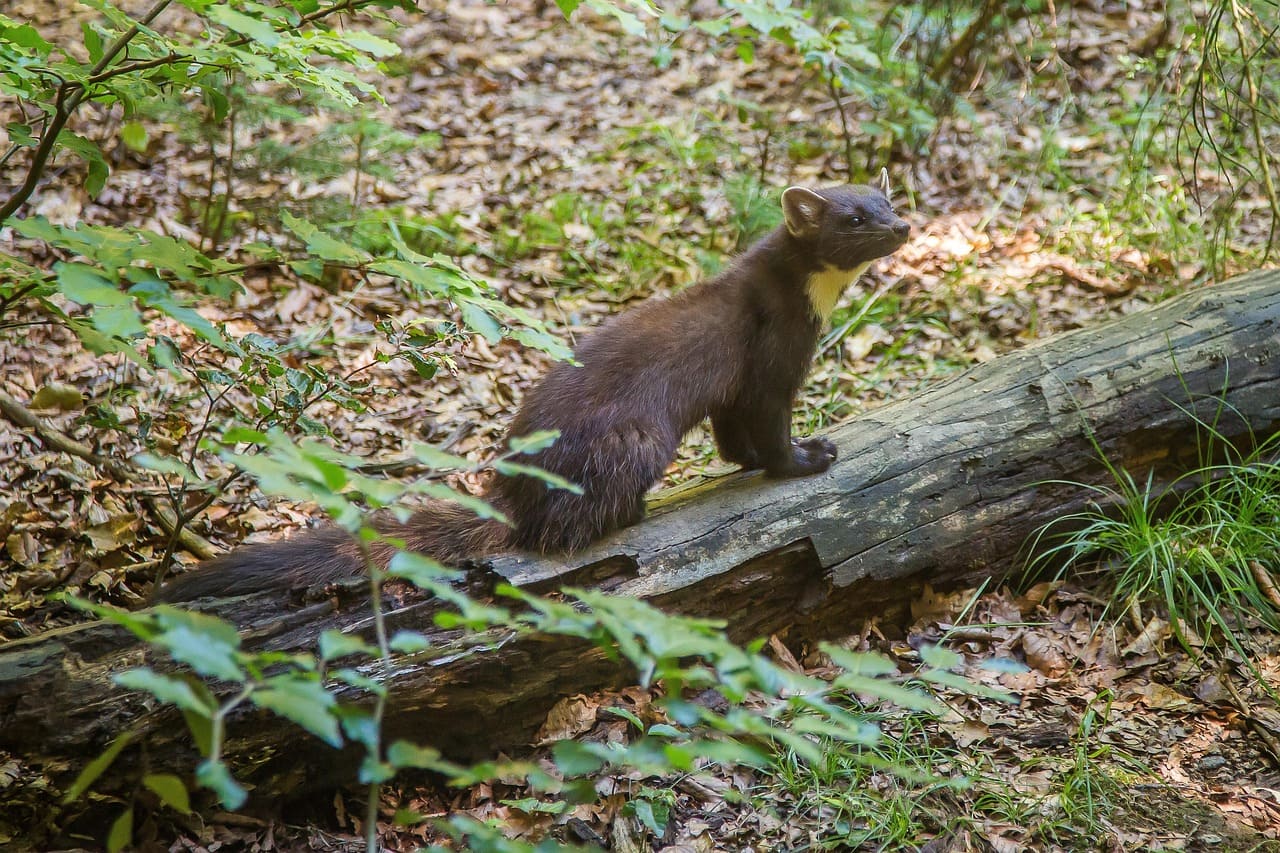
The pine marten is one of the most secretive and rarest mustelids in Switzerland. It lives exclusively in forests, avoids human settlements and reacts highly sensitively to the fragmentation of its habitat. Despite its decline and low population density, it continues to be hunted in the majority of cantons. Annually, around 100 to 150 pine martens are shot by recreational hunters. BirdLife Switzerland comments: «Why 146 of the secretive pine martens are shot is difficult to understand.»
Profile
The pine marten (Martes martes), also called European pine marten, belongs to the family of martens (Mustelidae) and is a comparatively small carnivore species, about the size of a small house cat. Its head-body length measures 40 to 58 centimeters, the bushy tail measures an additional 16 to 28 centimeters. The weight of adult animals ranges between 0.8 and 1.8 kilograms, with males typically 10 to 15 percent heavier than females. Its fur is chestnut to dark brown, silky lustrous and significantly finer than that of the stone marten. The most distinctive distinguishing feature is the throat patch: In the pine marten it is yellowish to orange-colored and rounded at the bottom edge, in the stone marten it is white and forked. The hairy paw pads also distinguish the pine marten from the stone marten, whose pads are bare.
Biology and Lifestyle
The pine marten is a solitary animal and is predominantly active at dusk and night. It is an excellent climber that can make jumps of up to 4 meters between trees and can rotate its hind legs 180 degrees in the process (Wikipedia, Baummarder). Its bushy tail serves as a balancing organ. During the day, it rests in tree hollows, abandoned squirrel dreys, woodpecker holes, or birds of prey nests, changing its sleeping places daily (Waldwissen.net, Baummarder im Kanton Luzern).
The pine marten displays pronounced territorial behavior. Its territories are extraordinarily large, up to 30 square kilometers. In the Swiss Jura, the population density is only 0.1 to 0.8 individuals per square kilometer (Stadtwildtiere Schweiz). This extremely low density makes the pine marten one of the rarest mammals in Swiss forests. The territories of males overlap with those of several females, but are rigorously marked with glandular secretions and defended against same-sex conspecifics.
Reproduction
The mating season falls in the months of June to August. Like the badger and roe deer, the pine marten also exhibits delayed implantation: the fertilized egg only implants in the uterus after a delay of several months, so that the young are not born until the following April. The female typically gives birth to 2 to 4, rarely up to 6 young. The cubs are born blind and barely furred. After around 8 weeks, they leave the nest for the first time and become independent at 12 to 16 weeks. Sexual maturity is reached at about 14 months, but many pine martens do not reproduce for the first time until their third year of life. Life expectancy in the wild rarely exceeds 10 years; in captivity, pine martens can live up to 16 years.
The slow reproduction, late sexual maturity, and large territories make the pine marten particularly sensitive to population crashes. Every shot weighs heavily.
Habitat: Old forests, no compromises
A pure forest dweller
The pine marten is a pronounced forest dweller and, unlike the stone marten, consistently avoids the vicinity of human settlements (Waldwissen.net, Nationalpark Donau-Auen). It prefers old, contiguous deciduous and mixed forests with a pronounced shrub layer and a high proportion of old-growth stands. Tree hollows are essential for it: as daytime hideouts, as rearing sites for the young, and as protection from weather. Forests without old, hollow-rich trees are unsuitable for the pine marten.
In Switzerland, the pine marten occurs in most forests up to the tree line, though it is rare at elevations above 2,000 meters. In the canton of Lucerne, records are concentrated in regions with large, contiguous forest complexes such as the Entlebuch and the Upper Wigger Valley (Waldwissen.net, Baummarder im Kanton Luzern). In areas with fragmented forest stands and sparsely covered agricultural zones, it is largely absent.
Sensitivity to fragmentation
The pine marten reacts most sensitively to obstacles in its habitat among all native mustelids. Buildings, roads, channeled waterways, and terrain lacking cover represent difficult barriers for it to overcome (Waldwissen.net, Baummarder im Kanton Luzern). The increasing fragmentation of Swiss forests through infrastructure and settlement development therefore hits the pine marten particularly hard. While the adaptable stone marten can survive in attics and garages, the pine marten depends on intact forest landscapes.
The most common cause of death besides recreational hunting is road traffic, particularly on forest roads. Young pine martens searching for their own territory who cross forest boundaries are especially endangered.
The hunting: An anachronism without justification
Legal situation
According to the Federal Hunting Act (JSG, Art. 5 Para. 2), the pine marten is a huntable species classified under small game hunting. Cantons may set hunting seasons or provide year-round protection for pine martens. In Switzerland, pine martens are protected in the cantons of Aargau, Appenzell Ausserrhoden, Basel-Landschaft, Geneva, Schaffhausen, Ticino, Thurgau, and Zurich (Waldwissen.net, Pine marten in Canton Lucerne). In all other cantons, it is huntable. According to hunting regulations, snares, poison, and traps are prohibited (except box traps for live capture).
The scale of killing
According to federal hunting statistics, between 60 and 150 pine martens are killed annually in Switzerland. In 2006, 60 animals were killed, compared to 118 in 2005 (FOEN media release, 2007). BirdLife Switzerland cited 146 kills for a later year and commented that it was 'hardly comprehensible' why these secretive animals were being shot (BirdLife Switzerland, hunting statistics). The FOEFL (predecessor of FOEN) warned as early as 2004 that the declining number of shot pine martens suggested a decline in the species (FOEFL media release, 2004).
Additional animals die as roadkill on roads. Exact figures on pine marten roadkill are difficult to collect, as they are frequently confused with stone martens during data collection due to their small size and similarity.
No justification for hunting
Unlike stone martens, pine martens cause no damage to buildings, vehicles, or agricultural crops. They live exclusively in forests and practically never conflict with human interests. There is no 'wildlife damage' that could justify hunting them. Pine martens are shot simply because they are listed as huntable in federal law and happen to be in a recreational hunter's territory. There is no reasonable justification in terms of animal welfare law (AWA, Art. 4).
The designation 'noble marten' refers to the historical motivation for hunting: its dense, silky fur was once more coveted than that of the stone marten and was used in the fur trade. Fur hunting made the species locally rare (Wikipedia, Pine marten). That recreational hunters still hunt pine martens today, despite their fur having no economic significance and causing no damage whatsoever, demonstrates the absurdity of hunting legislation that permits purposeless killing.
More on this: Animal welfare problem: Wild animals suffer agonizing deaths due to recreational hunters
Ecological significance: Mouse hunter and seed disperser
Regulation of small mammals
The pine marten's primary diet consists of voles, bank voles, yellow-necked mice, and other small mammals (Danube-Auen National Park, German Hunting Association). It also preys on squirrels, birds and their eggs, insects, amphibians, and snails. In late summer and autumn, berries, fruits, and nuts occupy an important place in its diet. Rowan berries, rose hips, raspberries, and blackberries are regularly consumed. Pine martens also create food caches in autumn for winter.
As a regulator of mouse populations in forests, the pine marten fulfills an important ecological function. Voles and bank voles can increase explosively during beech and oak mast years, causing considerable damage to forest regeneration through browsing and bark stripping. Pine martens naturally keep these populations in check. Its ecological benefit, like that of badgers and foxes, is not accounted for in any cantonal hunting planning.
Seed dispersal
Through the high proportion of berries and fruits in its diet, the pine marten contributes to the dispersal of plant seeds. As it roams large territories and deposits seeds through its droppings at varying locations, it connects plant populations across vast distances. This ecological service is significant for forest biodiversity, yet it is ignored in the hunting debate.
The pine marten compared to the stone marten: Why the distinction matters
In public perception, pine and stone martens are frequently confused or equated. However, the differences are fundamental. The stone marten (Martes foina) is an adaptable cultural follower that lives in attics, barns and even car engines. It causes damage to vehicles and buildings and is therefore a source of conflict near settlements. The pine marten, by contrast, consistently avoids human settlements and does not conflict with human interests.
That both species are equally classified as huntable under federal law is not justified from a wildlife biology perspective. The risk of confusion also leads to pine martens being shot under the pretext of 'marten hunting,' even though the actual conflict only concerns the stone marten. Eight cantons have already placed the pine marten under protection. The remaining cantons should follow suit.
More on this: Why recreational hunting fails as population control
What would need to change
- Nationwide protection of the pine marten: The pine marten causes no damage, lives exclusively in forests and does not conflict with human interests. What eight cantons have already implemented must be enshrined in federal law. The pine marten must be removed from the catalogue of huntable species.
- Protection of old forest stands and cavity trees: The pine marten depends on tree cavities. Old-growth forest islands and cavity trees must be recognized as structures worthy of protection in all cantons and preserved from timber harvesting. Close-to-nature forest management must explicitly consider the needs of cavity-dwelling species.
- Connecting forest areas: The pine marten reacts more sensitively than any other native marten species to the fragmentation of its habitat. Wildlife corridors, hedgerow strips and permeable forest edge structures must be preserved and expanded. The planning of new infrastructure must ensure permeability for forest-dwelling species.
- Reduction of road mortality: Forest roads are a significant source of danger for the pine marten. Speed restrictions on forest roads and small animal crossings on cantonal roads in forest areas can reduce losses.
- Research and monitoring: There are no reliable population figures for the pine marten in Switzerland. Existing data are based on shooting statistics and chance observations. National monitoring using camera traps and genetic analyses is a prerequisite for an evidence-based protection strategy.
- Separation of pine and stone martens in hunting legislation: As long as both species are listed as huntable in the same legal article, pine martens will be shot under the pretext of stone marten hunting. The two species must be clearly separated in hunting law.
Arguments
'The pine marten is not endangered and can therefore be hunted.' That a species is not considered endangered at the global level (IUCN: Least Concern) says nothing about its local situation. In Switzerland, the population density of the pine marten is extremely low: 0.1 to 0.8 individuals per square kilometer in the Jura. The BUWAL already warned in 2004 of a suspected decline. That a species is not officially endangered does not mean that hunting it is sensible or necessary. There is no reasonable justification for shooting them.
'The pine marten belongs to small game hunting and its hunting is tradition.' Pine marten hunting historically had a single purpose: fur harvesting. This use has been obsolete for decades. Hunting without utilisation and without damage prevention serves no reasonable purpose under animal welfare law. The tradition of fur hunting is not an argument for continuing purposeless killing.
«The pine marten does not regulate itself and must be hunted.» The pine marten regulates itself through its territoriality and food availability. Its large territories naturally limit population density. One cannot speak of 'overpopulation' for a species with fewer than one individual per square kilometre. The eight cantons that already protect the pine marten report no problems from increasing populations.
«Pine martens and stone martens cannot be distinguished when hunting.» The two species can be clearly distinguished by their throat patch (yellow-orange vs. white) and paw pads (furred vs. bare). If recreational hunters cannot tell the two species apart, this is not an argument for hunting pine martens, but against the competence of the shooters. When in doubt: do not shoot. Moreover, the pine marten lives in forests and not near settlements. Where recreational hunting of stone martens takes place, pine martens are usually not found.
«The pine marten is a predator of ground-nesting birds and squirrels and must therefore be controlled.» The pine marten is a natural component of the forest ecosystem and its prey selection is part of a balance refined over millennia. That a predator catches prey animals is not an argument for hunting it, but an expression of functioning ecological processes. The notion that recreational hunters must protect 'useful' animals from 'harmful' ones is outdated and unethical. The pine marten does not decimate species; it regulates populations.
Quicklinks
Articles on Wild beim Wild:
- Studies on the impact of recreational hunting on wildlife
- Why recreational hunting fails as population control
- Animal welfare problem: Wild animals die agonisingly because of recreational hunters
- Animal cruelty: Fox massacre in Switzerland
Related dossiers
- The Alpine ptarmigan in Switzerland: Ice age relic between climate crisis, tourism and gunfire
- The ibex in Switzerland: Smuggled, rescued and again degraded to trophy
- The beaver in Switzerland: Exterminated, reintroduced and newly released for shooting
- The woodcock in Switzerland: Endangered, hunted and politically ignored
- Waterfowl in Switzerland: Winter guests in the line of fire
- Pigeons in Switzerland: Between peace symbol, mass shooting and official starvation
- Corvids in Switzerland: The most intelligent animals in the crosshairs
- The Eurasian jay in Switzerland: Forest gardener in the crosshairs of small game hunting
- The marmot in Switzerland: Ice age relic under climate stress, tourist attraction and mass shooting
- The wild rabbit in Switzerland: severely endangered, yet huntable
- The mountain hare in Switzerland: Ice age relic between climate crisis and gunfire
- The raccoon in Switzerland: Released for shooting because it has the wrong origin
- The stone marten in Switzerland: Cultural follower between attic and gunfire
- The pine marten in Switzerland: Shy forest dweller under hunting pressure
- The badger in Switzerland: Ecosystem engineer in the crosshairs of small game hunting
- The red deer in Switzerland: Exterminated, returned and degraded to shooting target
- The roe deer in Switzerland: most shot wildlife and victim of misguided hunting policy
- The wild boar in Switzerland: Why recreational hunting exacerbates the problem instead of solving it
- The chamois in Switzerland: Between high hunting, climate stress and the myth of overpopulation
- The brown hare in Switzerland: Endangered, hunted and politically ignored
Sources
- Federal Hunting Statistics, FOEN/Wildlife Switzerland: http://www.jagdstatistik.ch (culling and roadkill data)
- BUWAL press release (2004): Hunting statistics 2003, reference to suspected decline of pine marten
- FOEN press release (2007): Hunting statistics 2006, pine marten culling figures
- BirdLife Switzerland: The current hunting statistics and the revised hunting law (birdlife.ch)
- Waldwissen.net/WSL: The pine marten in Canton Lucerne (Holzgang/Muggli, 2005, updated)
- Urban Wildlife Switzerland/Wild Neighbors: Pine marten species profile (stadtwildtiere.ch)
- Danube Floodplains National Park: Pine marten (donauauen.at)
- German Hunting Association: Pine marten species fact sheet (jagdverband.de)
- State Forests Rhineland-Palatinate: Pine marten (wald.rlp.de)
- Wikipedia: Pine marten (Martes martes)
- IG Wild beim Wild (2022/2025): Hunting statistics 2022, fox massacre in Switzerland (wildbeimwild.com)
- Federal Law on Hunting and the Protection of Wild Mammals and Birds (JSG, SR 922.0)
- Animal Welfare Act (TSchG, SR 455)
Our Mission
The pine marten is a phantom of the Swiss forest. Most people have never seen one. It lives in the treetops, hunts at dusk and disappears silently before humans notice it. It causes no damage, conflicts with no human interests and fulfills an important role in the forest ecosystem as a mouse hunter and seed disperser. Nevertheless, it is hunted in the majority of Swiss cantons, without reason, without benefit, without utilization. Its silky fur, which earned it the name 'noble marten,' was once its doom. Today it is the mere fact that it is listed as huntable in federal law. The consequence is clear: The pine marten must be protected throughout Switzerland. What eight cantons have already implemented must no longer be treated as voluntary cantonal action under federal law. This dossier will be continuously updated when new figures, studies or political developments require it.
More on the topic of recreational hunting: In our hunting dossier we compile fact-checks, analyses and background reports.