
Beaver Switzerland: Reintroduced and Approved for Culling
The European beaver was completely exterminated in Switzerland at the beginning of the 19th century. Its fur, meat and castoreum, a glandular secretion considered a miracle remedy, made it the victim of centuries of persecution. The church declared beaver meat to be 'fish' due to its fish-like tail and permitted its consumption during Lent. In 1685, a beaver cookbook with 200 recipes was published (SWI swissinfo.ch, 2024). Dedicated private individuals reintroduced a total of 141 beavers at 30 locations in Switzerland between 1956 and 1977. In 2022, the national population survey counted 4’914 beavers in 1’382 territories (info fauna, Beaver Population Survey 2022). The species has recovered so well that it was removed from the Red List and classified in the 'least concern' (LC) category. The beaver is one of the greatest success stories of Swiss nature conservation. Since February 1, 2025, cantons can cull beavers that cause 'significant damage'. Federal consultation is not even required for these cullings. Pro Natura, WWF and BirdLife Switzerland consider the new regulation unnecessary, too vaguely formulated and possibly illegal. BirdLife managing director Raffael Ayé warns: 'This opens the door to arbitrary culling' (SRF, 2025).
Profile
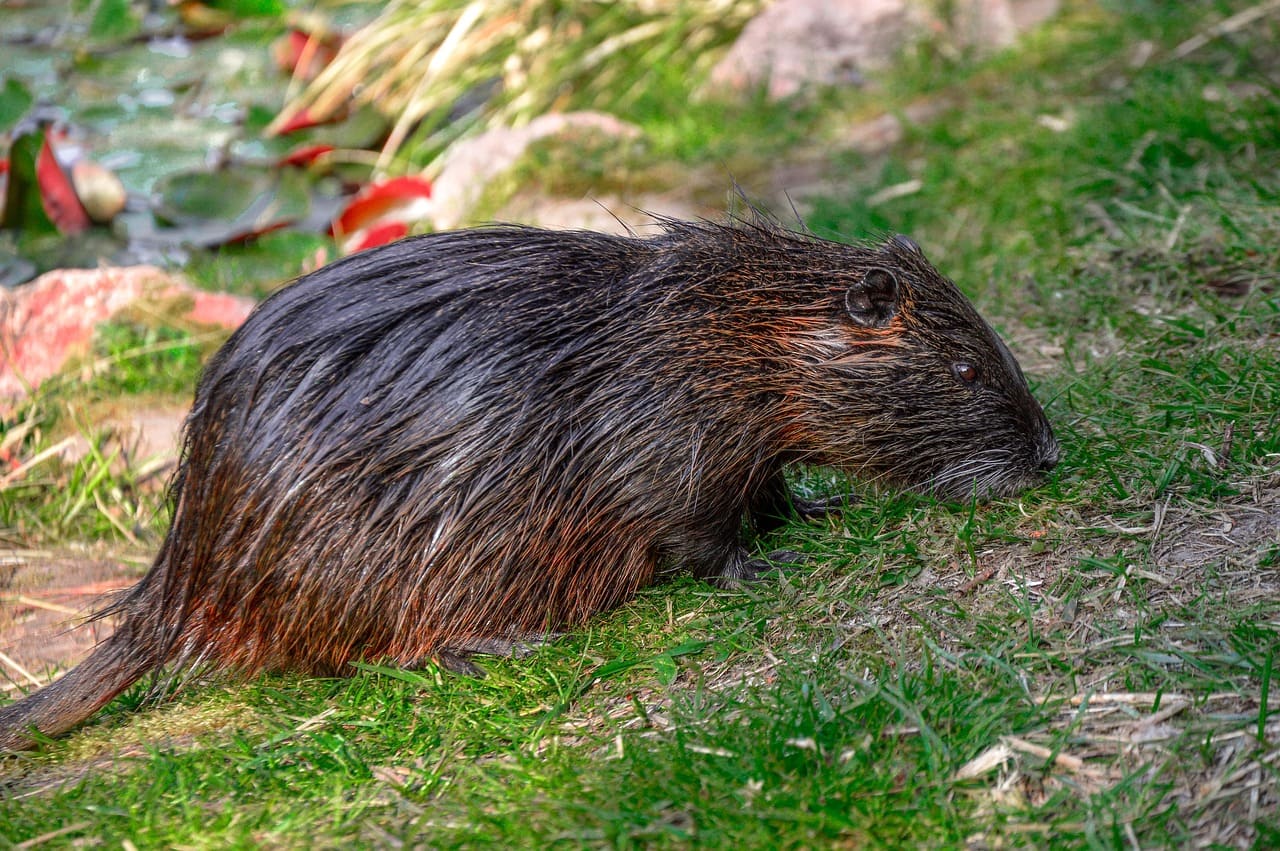
The European beaver (Castor fiber) is Switzerland's largest native rodent. It reaches a weight of 20 to 25 kilograms and a body length of up to one meter, plus the flat, scaly tail (the 'paddle') of about 30 centimeters in length. It is thus heavier than a roe deer. Its fur is dense and water-repellent, brown to dark brown. The powerful orange incisors grow continuously throughout life and enable it to fell tree trunks up to one meter in diameter. The beaver lives monogamously in family groups of four to six animals (parents and young from the last two years). It is nocturnal, strictly vegetarian (bark, branches, aquatic plants, herbs) and territorial. Life expectancy in the wild is 10 to 15 years. After a gestation period of around 105 days, the female gives birth to one to four young. The young leave the parental territory at the age of two years and seek their own territory.
Ecosystem Engineer: For 15 Million Years
The beaver is the only organism besides humans that actively and extensively reshapes its environment. It fells trees, builds dams, dams up streams, creates ponds and constructs lodges. For 15 million years, the European beaver has deployed these landscape-shaping abilities (NaturZYT). Europe's aquatic landscapes have been shaped by millions of years of beaver activity. The floodplains, wetlands and dynamic river landscapes that we consider 'nature' are to a considerable extent the work of the beaver. Its extermination has not only eliminated a species, but interrupted an ecological process that has characterized Europe's waters since the Miocene.
History: Extermination and Return
The Extermination
The beaver was once widespread throughout Switzerland. Three factors led to its complete extermination by the early 19th century: the valuable, dense fur from which felt hats were made; the castoreum (Castoreum), a glandular secretion marketed as a remedy for all kinds of ailments; and the meat, which the Church classified as 'fish' because of the fish-like tail and thus approved for consumption during fasting periods (SWI swissinfo.ch, 2024). Throughout Europe, only around 1,200 beavers survived in a few isolated remnant populations (info fauna, Beavers in Switzerland).
The Reintroduction
In 1956, Geneva naturalist Maurice Blanchet, together with a group of conservationists, released the first beavers at the Versoix in Canton Geneva. By 1977, further release actions followed at 30 locations throughout Switzerland, totaling 141 animals from various European remnant populations. The reintroduction was not coordinated by the federal government, but was the work of dedicated private individuals such as Maurice Blanchet (Geneva), Karl Rüedi (Aargau) and Anton Trösch (Thurgau) (info fauna, Beavers in Switzerland). The beaver has been protected under federal law since 1962 (JSG, SR 922.0).
Population Development: A Success Story
Recovery proceeded slowly: the first national population survey in 1978 counted only a few hundred animals. In 1993 there were around 350. In 2008 the population was estimated at 1,600 beavers. In the most recent survey in 2022, there were 4,914 beavers in 1,382 territories (info fauna, Beaver Population Survey 2022). The population is growing according to a logistic pattern: initially slowly, then exponentially, with saturation tendencies already evident in some long-established areas. The beaver was correspondingly downgraded on the Red List: 1994 'critically endangered' (CR), 2008 'vulnerable' (VU), since 2022 'not threatened' (LC) (info fauna; WWF Basel).
This success story is the result of a consistent hunting ban that has held for over 60 years. It is proof that protection works and that species that demand space from humans are capable of coexistence. This exact success story is now being called into question with the new shooting regulation.
More on this: Dossier: Hunting and Biodiversity
The new shooting regulation: Protection with a backdoor
What applies since February 1, 2025
On December 13, 2024, the Federal Council put the revised Hunting Act together with the adapted Hunting Ordinance (JSV) into effect as of February 1, 2025 (Federal Council, Press Release, 2024). The Hunting Ordinance regulates beaver shootings for the first time. The rule states: Individual beavers can be shot if they cause 'significant damage' or endanger humans, after damage and endangerment could not be prevented by other measures (SRF, 2025). The beaver formally remains a protected species. But its protection no longer applies absolutely.
What the nature conservation organizations criticize
Pro Natura, WWF Switzerland and BirdLife Switzerland consider the new regulations unnecessary and dangerous. Their criticism in detail:
First: No federal consultation before shootings. Unlike with wolves, no prior federal consultation is required for beaver shootings. The cantons can decide on shootings independently. BirdLife Executive Director Raffael Ayé criticizes: 'The Federal Council is thereby attempting in a questionable manner to create the same shooting grounds for beavers as for wolves' (BirdLife Switzerland, 2024).
Second: No clearly defined damage threshold. The formulation 'significant damage' is too vague. There is reason to fear that even minimal damage can be claimed as grounds for shooting (BirdLife Switzerland, 2024).
Third: So far, not a single shooting was necessary. Although there has been a legal possibility for over 30 years to kill beavers under certain conditions, no canton has made use of this until 2025. The conflicts were resolved with preventive measures, as numerous practical examples in the cantons show (SRF, 2025).
Fourth: The family clause problem. Beavers live in family groups. If all members of a family are involved in a 'damage case,' the entire clan would consequently have to be killed (SRF, 2025). The regulation thus endangers not only individual animals, but entire family groups.
Fifth: Possible illegality. Raffael Ayé considers the new rules possibly illegal: 'One cannot simply override the Hunting Act with such an ordinance' (SRF, 2025).
The political context
In 2020, the Swiss electorate rejected a revision of the Hunting Act that would have given the Federal Council the authority to add other species like lynx and beavers to the shooting list. Pro Natura comments: 'Lynx, beavers and other protected animals cannot be decimated preventively. We were able to prevent this with the referendum' (Pro Natura, 2023). That the beaver now reaches the shooting list through the backdoor of the Hunting Ordinance undermines the popular vote of 2020.
More on this: Animal welfare problem: Wild animals die agonizing deaths because of recreational hunters
Ecological significance: The architect of biodiversity
Creating habitats
The BAFU itself documents the beaver's ecological performance in a comprehensive web dossier (BAFU, 2023): In Marthalen (ZH), a single beaver family has created an ecosystem of around 5 hectares, which has since been designated as a forest reserve of 10 hectares. Dragonflies, amphibians, fish and aquatic plants have returned. The BAFU describes the result as the 'Amazon of Switzerland' (info fauna, beaver population survey 2022). The beaver specialist office documents: in 2008 there were 185 beaver dams in Switzerland, by 2022 already 1,316 (info fauna, 2023). Each individual dam creates new wetlands, raises the groundwater level and promotes biodiversity.
The 90-percent gap
The beaver's work is all the more valuable in Switzerland because 90 percent of wetlands have been destroyed over the past 150 years through river straightening and drainage (BAFU, 2023). Wetlands are among the most species-rich habitats in Switzerland and are simultaneously the most endangered. The beaver is the only organism that can create new wetland habitats without humans investing millions in restoration projects. At a time when Switzerland is spending billions on the revitalization of its waterways, the beaver is the country's most cost-effective restoration agent.
Water retention and flood protection
Beaver dams retain water in the landscape, slow runoff and reduce flood peaks. In times of increasing heavy precipitation due to climate change, this service is of growing importance. At the same time, beaver dams raise the groundwater level and create water reservoirs that supply water during dry periods. These ecosystem services are economically quantifiable and far exceed the damage caused by beavers, but are not considered in any cost-benefit analysis.
Water quality
Beaver dams act as natural filters. Due to the longer residence time of water in beaver ponds, diverse chemical and biological decomposition processes take place. Swiss flowing waters are frequently polluted by nitrogen and phosphorus. The retention function of beaver dams helps to reduce these nutrient loads before they reach larger water bodies (info fauna, Beaver in Switzerland).
What would need to change
- Withdrawal of the shooting regulation in the hunting ordinance: The beaver shootings are unnecessary, as 30 years of practice without a single shooting proves. The conflicts can be resolved with preventive measures: tree protection through wire guards, dam removal at critical locations, installation of culverts, bank vegetation with less attractive woody plants. The new regulation must be eliminated without replacement at the next ordinance revision.
- Consistent implementation of preventive measures: The revised hunting ordinance provides that the federal government and cantons participate in damage prevention costs. These funds must be consistently invested in prevention, not serve as a pretext for shootings. The federal government must ensure that shootings are only approved as a last resort and that cantons do not choose the convenient route via the rifle.
- Consistently implement the water space law: Many conflicts with the beaver arise because agriculture and infrastructure extend right up to the water's edge. The consistent implementation of water space according to the Water Protection Act (GSchG) would defuse most conflicts. The beaver needs a riparian strip; when this is guaranteed, there are hardly any problems.
- Use the beaver as a restoration instrument: The BAFU has documented the positive effects of the beaver on biodiversity, water retention and water quality. These findings must be implemented in practice: the beaver should be specifically integrated into restoration projects instead of being combated as a 'pest species'. In Marthalen (ZH) this has already been achieved.
Arguments
«The beaver causes significant damage to infrastructure and agriculture.» Beavers can cause local damage: undermined dams, flooded meadows, felled fruit trees. This damage is real, but manageable. 30 years of coexistence without a single killing prove that prevention works. The ecological services of the beaver (species promotion, water retention, water purification, floodplain formation) exceed local damage by a multiple. Switzerland spends billions on river restoration; the beaver provides the same service for free.
«The new regulation only affects individual cases and does not endanger the population.» The formulation «significant damage» is too vague and without a clearly defined damage threshold. The absence of federal consultation gives cantons too much leeway. Beavers live in family groups; shooting one «damage beaver» can lead to shooting an entire family. Experience with wolf regulation shows that once killing opportunities are created, they are quickly expanded. What begins as an «individual case» becomes routine.
«The beaver is no longer endangered, therefore regulation is justifiable.» The beaver is no longer endangered because it was consistently protected for 60 years. Using this success as an argument against protection is perverse logic: one protects a species until it recovers, then shoots it again because it has recovered. The beaver was once exterminated in Switzerland. The lesson from this history is not that it may be hunted again once there are enough, but that consistent protection works and must be maintained.
«The 2020 popular vote did not affect beaver protection.» In 2020, voters rejected a JSG revision that would have given the Federal Council the authority to put beavers on the shooting list. That the beaver now appears on the shooting list via the hunting ordinance, without direct approval from voters or parliament, undermines the democratic decision. BirdLife considers the ordinance possibly illegal.
«Other countries regulate their beaver populations, Switzerland must follow suit.» The situation in Switzerland is not comparable to countries like Germany or Austria, where beaver populations are significantly larger and aquatic landscapes are structured differently. Switzerland has lost 90 percent of its floodplains. The beaver is the only animal that can create new floodplains. In this situation, every beaver is a gain for biodiversity, not a problem that needs regulation.
Quicklinks
Articles on Wild beim Wild:
- Studies on the impact of recreational hunting on wildlife
- Why recreational hunting fails as population control
- Animal welfare problem: Wildlife dies agonizingly because of recreational hunters
- Animal cruelty: Fox massacres in Switzerland
Related dossiers
- The Alpine ptarmigan in Switzerland: Ice Age relic between climate crisis, tourism and gunshot
- The ibex in Switzerland: Smuggled, rescued and again degraded to trophy
- The beaver in Switzerland: Exterminated, reintroduced and newly approved for shooting
- The woodcock in Switzerland: Endangered, hunted and politically ignored
- Waterfowl in Switzerland: Winter guests in the line of fire
- Pigeons in Switzerland: Between peace symbol, mass shooting and official starvation
- Corvids in Switzerland: The most intelligent animals in the crosshairs
- The Eurasian jay in Switzerland: Forest gardener in the crosshairs of low hunting
- The marmot in Switzerland: Ice Age relic under climate stress, tourist attraction and mass shooting
- The European rabbit in Switzerland: severely endangered, yet huntable
- The mountain hare in Switzerland: Ice Age relic between climate crisis and gunshot
- The raccoon in Switzerland: Approved for shooting because it has the wrong origin
- The Stone Marten in Switzerland: Cultural follower between attic and gunshot
- The Pine Marten in Switzerland: Shy forest dweller under hunting pressure
- The Badger in Switzerland: Ecosystem engineer in the crosshairs of recreational hunting
- The Red Deer in Switzerland: Exterminated, returned and degraded to shooting target
- The Roe Deer in Switzerland: most shot wild animal and victim of misguided hunting policy
- The Wild Boar in Switzerland: Why recreational hunting exacerbates the problem instead of solving it
- The Chamois in Switzerland: Between alpine hunting, climate stress and the myth of overpopulation
- The Brown Hare in Switzerland: Endangered, hunted and politically ignored
References
- info fauna / Biberfachstelle: Beavers in Switzerland, distribution, history, population survey 2022 (infofauna.ch)
- info fauna (2023): Beaver population survey 2022 in Switzerland and Liechtenstein. Angst C., Auberson C., Nienhuis C. (4,914 beavers, 1,382 territories, 1,316 dams)
- BAFU (2023): A diverse creator: When the beaver comes, things get colorful (Web dossier, bafu.admin.ch)
- BAFU: Species promotion birds / Biodiversity (bafu.admin.ch)
- Federal Council (2024): Press release December 13, 2024, Revised hunting law in force from February 1, 2025 (admin.ch)
- SRF (2025): Cantons may soon shoot beavers, under certain conditions (srf.ch, 15.1.2025)
- BirdLife Schweiz (2024): Federal Council adopts problematic hunting ordinance (birdlife.ch, 13.12.2024)
- Pro Natura (2023): New hunting ordinance, Pro Natura watches closely (pronatura.ch)
- Gruppe Wolf Schweiz: Hunting law, beaver and lynx (gruppe-wolf.ch)
- SWI swissinfo.ch (2024): The beaver, history of a reconquest (swissinfo.ch)
- NaturZYT: The beaver is back in Switzerland with its castles (naturzyt.ch)
- WWF Zentralschweiz: Beaver, population 2022 (wwf-zentral.ch)
- WWF Basel: Beaver, threat status and history (wwf-bs.ch)
- Capt S. (2022): Red List of mammals (excluding bats). BAFU / info fauna (Beaver: LC since 2022)
- Federal Act on Hunting and the Protection of Wild Mammals and Birds (JSG, SR 922.0)
- Hunting Ordinance (JSV, SR 922.01), revised as of February 1, 2025
- Animal Welfare Act (TSchG, SR 455)
Our claim
The beaver is the greatest success story of Swiss species protection. From zero to almost 5,000 animals in 66 years. From "critically endangered" to "not threatened". From the last surviving individual to nationwide distribution. This story became possible because dedicated private individuals did not give up, because protection was consistently enforced, and because Switzerland gave its largest rodent 60 years to recover.
The beaver thanks us for it. In Marthalen, a single family has created an "Amazon of Switzerland". At over 1,300 dams throughout the country, new wetlands are emerging, amphibians, dragonflies and fish are returning, water is being retained in the landscape and water quality is improving. Switzerland has lost 90 percent of its floodplains. The beaver is the only one who can create new floodplains, free of charge, around the clock, for 15 million years.
And what does Switzerland do? It puts it on the shooting list by ordinance. Not because it would be necessary: for 30 years, not a single canton has had to shoot a beaver. Not because the people wanted it: in 2020, voters rejected a revision that would have enabled exactly this. But because it is more convenient to shoot an animal than to comply with riparian buffer zones, to put a wire fence around a fruit tree, or to install a culvert in a dam.
The consequence is clear: The shooting regulation for the beaver must be withdrawn. Conflicts can be solved with prevention, as 30 years of practice prove. The beaver is not a pest. It is an ecosystem engineer, a renaturalist, a master builder of biodiversity and a success story that must be protected, not shot. This dossier will be continuously updated when new numbers, studies or political developments require it.
More on the topic of recreational hunting: In our Hunting Dossier we compile fact-checks, analyses and background reports.