
Golden jackal in Switzerland: Natural immigrant under political pressure
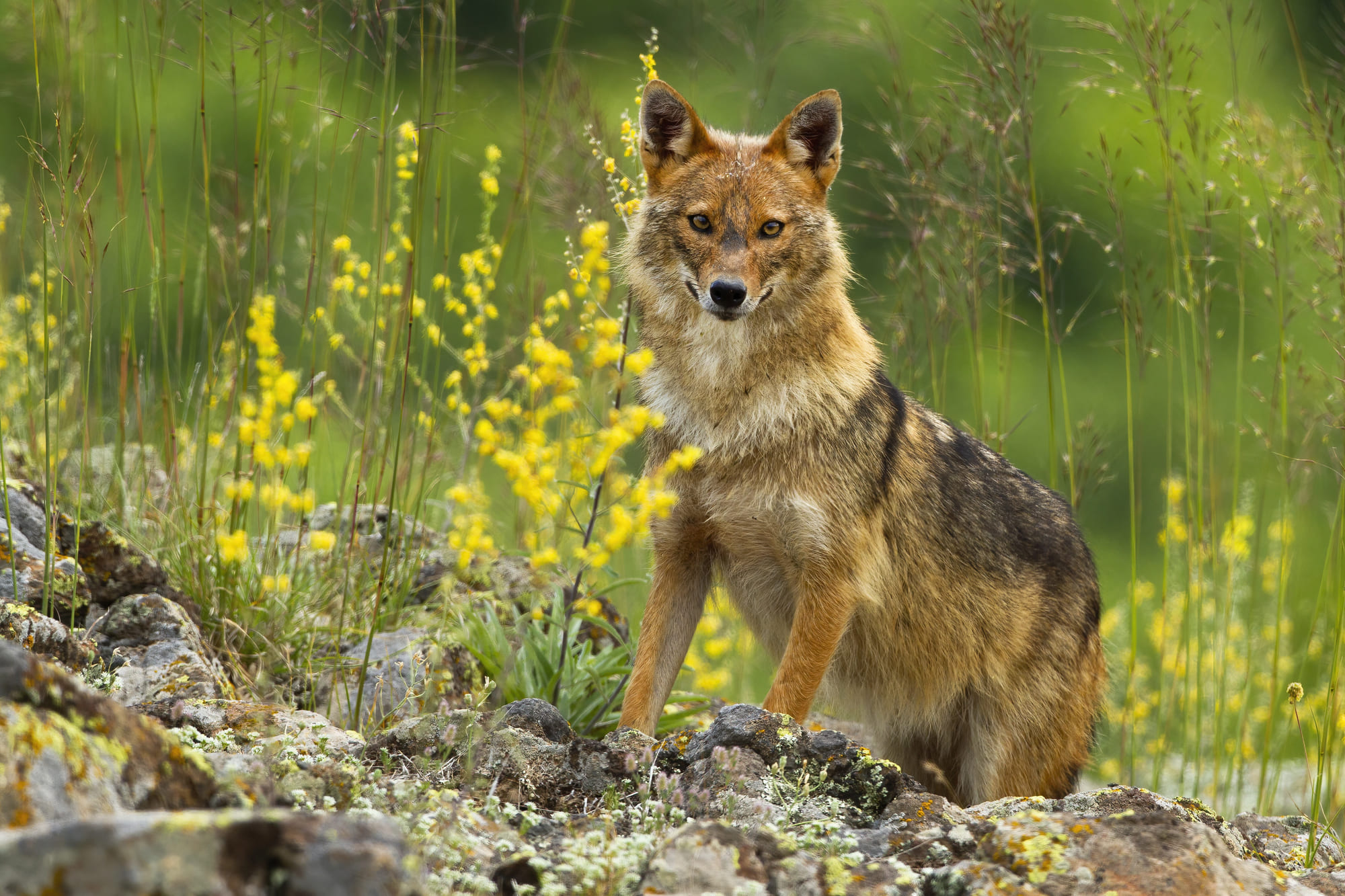
In Switzerland, the golden jackal (Canis aureus) was first documented in winter 2011/12. Since then, sightings have increased: 14 confirmed records in 2024 alone, including at Hönggerberg near Zurich, in Swiss National Park and in Canton Uri. A permanent settlement with reproduction has not yet been established, but two reproducing packs live directly on the Swiss border, in Konstanz district and in Schwarzwald-Baar district. Experts assume that the golden jackal will establish itself in Switzerland in the medium term.
The golden jackal is not an invasive species. It is not a neozoon. It was not introduced by humans, but migrates naturally from southeastern Europe, facilitated by climate change, altered landscape structures and the temporary absence of wolves. Thus it belongs to the native fauna. In Switzerland, it is not on the list of huntable species (Art. 5 JSG) and is therefore automatically protected. At EU level, it is listed in Annex V of the Habitats Directive, which obliges member states to permit removals only in such a way that a favourable conservation status is maintained.
Nevertheless, hunting and agricultural lobbies are already working on the next 'problem animal' narrative. In Austria, golden jackals are hunted in several federal states without systematic monitoring documenting their conservation status. In Germany, a single golden jackal on Sylt triggered months of shooting debates in 2025. The Administrative Court of Carinthia declared golden jackal hunting in Carinthia illegal in March 2026 because it was conducted without the required monitoring. In the 2024/25 hunting season alone, 87 golden jackals were killed in Carinthia.
Switzerland has the rare opportunity to do things differently with the golden jackal from the start, unlike with the wolf: data before shootings, science before symbolic politics, coexistence before reflexive control. This dossier compiles the most important facts about biology, legal status, ecological role, and the political mechanisms that could prepare for new hunting.
What awaits you here
- Profile: Size, weight, fur, confusion risks, and life expectancy.
- Ecological role: Why the golden jackal, as a dietary opportunist, scavenger, and mouse regulator, contributes to biodiversity.
- Distribution and evidence in Switzerland: Chronology of Swiss evidence since 2011 and current developments.
- Natural range expansion vs. neozoa narrative: Why the golden jackal is not an invasive species.
- Legal protection status: Swiss hunting law, FFH directive, Austrian patchwork, and the Sylt debate.
- Threats: Mistaken shootings, political weakening of protection status, and the pattern of 'problem animal' narratives.
- Wolf and golden jackal: Ecological interactions.
- Arguments: Responses to the most common claims by the recreational hunting lobby.
- What needs to change: Political demands.
- Quick links: All relevant articles, studies, and dossiers.
Profile
The golden jackal (Canis aureus) belongs to the dog family (Canidae) and is the only jackal species widespread in Europe. It is closely related to the wolf (Canis lupus), significantly smaller and lighter, and is frequently confused with the red fox. Its fur is golden-yellow to reddish-grey, individually variable, with a dark 'saddle patch' over the back and loins. In ancient Egypt, it was revered as a sacred animal and attributed to the death god Anubis. Body length: 70 to 105 cm (without tail). Tail length: 20 to 30 cm (significantly shorter than a fox). Shoulder height: 40 to 50 cm. Weight: 8 to 16 kg, thus larger than a fox (4.5 to 8 kg) and considerably smaller than a wolf (25 to 35 kg). Confusion risk: high with foxes (reddish coloring), also with wolves under poor visibility conditions. Life expectancy: up to 8 years in the wild.
Biology and lifestyle
Golden jackals are monogamous and form permanent pair bonds. The mating season falls between January and March. After a gestation period of around 63 days, one to six cubs are born. The young are nursed for about eight weeks and reach sexual maturity at one to two years. Young animals often remain with their parents for another year and help raise the next litter, creating a complex social system.
Young golden jackals can travel several hundred kilometers searching for their own territory. This so-called dispersal migration explains why individual animals can appear almost anywhere in Switzerland without a local population existing. Most animals documented in Switzerland so far are young, mobile, male individuals on migration.
The golden jackal is predominantly crepuscular and nocturnal. It hunts alone or in pairs, rarely in packs. In groups, golden jackals can also take larger prey such as deer or sheep. Its characteristic howling is higher than that of wolves and is frequently confused.
Diet
The golden jackal is a pronounced dietary generalist and opportunist. Its diet includes field mice and other small mammals, insects, amphibians, fish, berries, corn, carrion and slaughter waste. It thus occupies a similar ecological niche to the fox and the raccoon dog found in parts of Europe.
Ecological role: Dietary opportunist and carrion recycler
As a carrion recycler, the golden jackal fulfills an important function in the ecosystem: It removes animal carcasses and thereby prevents the spread of diseases. As a mouse hunter, it keeps populations of small rodents in check, with positive effects on agriculture and human health.
The hobby hunting lobby argues that the golden jackal expands the 'range of predators' for ground-nesting birds and small game. This argument ignores the research findings: The decline of ground-nesting birds in Central Europe is demonstrably due to habitat destruction by intensive agriculture, not to the presence of an additional mesopredatory predator.
The natural main enemy of the golden jackal is the wolf. Studies show that golden jackals avoid areas with wolf presence. The simultaneous occurrence of both species is possible and from an ecological perspective a sign of a functioning ecosystem.
More on this: Hunting and biodiversity: Does hunting really protect nature?
Distribution and evidence in Switzerland
The golden jackal originally occurs from Southeast Europe to India. Since the 1950s, it has been increasingly expanding northwest. The European total population is estimated at 70,000 to 117,000 individuals (Ćirović et al. 2016, LCIE).
Swiss evidence overview
- 2011/12: First evidence in camera traps of lynx monitoring in the Northwestern Alps (cantons Bern, Vaud, Fribourg)
- 2015: Sighting south of Disentis, canton Graubünden
- January 2016: A hobby hunter shoots a young, male golden jackal in Surselva (GR), mistaking it for a fox. He reports himself.
- March 2016: A weakened golden jackal is killed in canton Schwyz.
- 2017: Sightings in Graubünden and in the Linth area, first genetic evidence at a sheep kill in Graubünden.
- 2018: Wildlife camera evidence in canton Geneva (Jussy) and in the Linth area.
- 2019: A golden jackal dies in a traffic accident in the Fribourg Seeland.
- 2020: Sighting in Ticino (Sottoceneri).
- 2022/23: Eight confirmed camera trap records, including at Hönggerberg near Zurich (2023).
- 2024: 14 confirmed records through photos and videos, including at Hönggerberg (ZH), in Swiss National Park and in canton Uri.
- March 2025: First documented evidence in canton Lucerne by camera trap between Neuenkirch and Hellbühl.
In 2024, a golden jackal pack was documented for the first time near the Swiss border in Konstanz district. Another pack near the border has been living in the Schwarzwald-Baar district since 2021. KORA started a national golden jackal project for 2025 to 2026.
More on this: Why hobby hunting fails as population control
Natural range expansion vs. neozoa narrative: Not a neozoon
The golden jackal is not a neozoon. It was not transported by humans, not released, not imported. It is expanding northwest under its own power. The European Commission explicitly classifies it as non-alien. KORA states: 'Since the golden jackal has immigrated to Switzerland naturally, it does not count as an invasive species. It is part of Switzerland's biodiversity.'
In Switzerland, no damage to livestock by golden jackals is known to date (KORA-FAQ). Nevertheless, the pattern is predictable: As soon as a new species appears, the lobby machinery begins to label it as a 'problem.'
Legal protection status: Protected, but endangered
Switzerland
In Switzerland, the golden jackal is not listed as a huntable species in Article 5 of the Hunting Act and is therefore automatically protected. Livestock protection measures such as electric fences or livestock guardian dogs are also effective against golden jackals.
EU: Habitats Directive Annex V
The golden jackal is listed in Annex V of the Habitats Directive. Without systematic monitoring, hunting is contrary to EU law.
Austria: Patchwork and EU law violations
Protection status varies by federal state from complete protection (Vienna, Salzburg, Vorarlberg) to year-round hunting without closed seasons (Tyrol). In March 2026, the Administrative Court of Carinthia declared golden jackal hunting seasons unlawful. In Carinthia alone, 87 golden jackals were already killed in the 2024/25 hunting year.
Germany: The Sylt precedent case
In May 2025, a single golden jackal on Sylt killed around 100 sheep and lambs. The Higher Administrative Court of Schleswig approved the shooting, but the animal disappeared without a trace. The case illustrates: An isolated incident becomes a fundamental debate that questions the protection status of the entire species.
More on this: The animal welfare problem of recreational hunting
The 'problem animal' narrative: From wolf to golden jackal
- Arrival: The animal is framed as 'new' or 'foreign'.
- First damage case: An isolated incident receives broad media coverage.
- Lobby reaction: Hunting associations demand 'regulation' and inclusion in hunting law.
- Political implementation: Protection status is lowered, often before data is available.
- Institutionalization: Permanent hunting without scientific justification.
With the wolf, this pattern has led to a culling regulation in Switzerland. With the beaver, which was newly added to the shooting list in 2025, the cycle is repeating. With the golden jackal, Switzerland is currently in phases 1 to 2.
More on this: Hunting myths
Wolf and golden jackal: Ecological interactions
The wolf naturally regulates the golden jackal. In Switzerland, wolves live in the Alpine region, while the golden jackal prefers lower elevations. The simultaneous occurrence of wolves, golden jackals and foxes is widely documented in Europe and is a sign of an intact ecosystem. The hobby hunting lobby simultaneously demands culls for both species, which is ecologically absurd.
More on this: Wolf in Switzerland
Geneva model
In Canton Geneva, recreational hunting has been banned since 1974. When a golden jackal appears in Geneva (documented in 2018 in Jussy), it is observed and documented. Not shot. Should livestock conflicts arise, existing livestock protection structures apply.
What would need to change
- Maintain protection status: No inclusion in Art. 5 Hunting Act without favorable conservation status.
- Strengthen KORA monitoring: Data before decisions.
- Expand livestock protection: Prevention instead of reaction.
- Improve species knowledge: Prevent mistaken shootings due to confusion with foxes.
- Debunk neozoen narrative: Correct communication in politics and media.
- Geneva model as reference: Professional wildlife management also works for new species.
Arguments
'The golden jackal must be regulated before it spreads uncontrollably.' The golden jackal is spreading naturally, not 'uncontrollably'. Its main enemy, the wolf, regulates it naturally. KORA has started national monitoring. Hunting without prior monitoring is contrary to EU law, as confirmed by the Administrative Court of Carinthia in March 2026. Austria has been hunting for years without result: no population decline, but unlawful conditions and a patchwork of regulations.
'The golden jackal endangers ground-nesting birds and small game.' The decline of ground-nesting birds in Central Europe is primarily due to habitat destruction through intensive agriculture. In Southeast Europe, golden jackals have existed alongside the same bird species for millennia. In German national parks, in Geneva and in the Swiss National Park, predators and ground-nesting birds coexist without the bird species disappearing.
«The golden jackal kills sheep. The Sylt debate shows the problem.» The Sylt case is an isolated incident under extreme conditions: a single animal on an island, sheep without herd protection, no escape route for the prey animals. Golden jackal expert Felix Böcker (FVA Baden-Württemberg) classifies such incidents as rare exceptions. In Switzerland, there has not been a single documented case of livestock damage by a golden jackal to date. Herd protection measures such as electric fences and livestock guardian dogs are also effective against golden jackals.
«The golden jackal is an invasive species and doesn't belong here.» False. KORA, the Swiss Wolf Group and the European Commission explicitly classify the golden jackal as a natural immigrant, not as a neozoon. It was not introduced by humans, but migrates on its own from southeastern Europe. The confusion with invasive species like the raccoon is factually incorrect and politically motivated.
«The golden jackal must be included in hunting law so that recreational hunters can manage it.» In Austria, the golden jackal is included in hunting law in several federal states. The result: no systematic monitoring, no population data, no evaluation of conservation status, unlawful hunting without FFH-compliant basis. Inclusion in hunting law is not management, but a license to shoot without data foundation.
Quicklinks
- Golden jackal expanding in the DACH region
- Wolf in Switzerland: Facts, politics and the limits of hunting
- Hunting and biodiversity
- The animal welfare problem of recreational hunting
- Hunting myths
- Why recreational hunting fails as population control
- Studies on hunting criticism
- KORA: Golden jackal distribution
- KORA: Golden jackal project 2025–2026
Related dossiers:
- Golden jackal in Switzerland: Natural immigrant under political pressure
- The otter in Switzerland: Exterminated, returned and politically threatened
- The brown bear in Switzerland: Exterminated, returned and still unwanted
- The wildcat in Switzerland: Back from extermination, threatened by indifference
- The lynx in Switzerland: Predator, keystone species and political object of dispute
- The fox in Switzerland: Most hunted predator without lobby
- Wolf: Ecological function and political reality
- The wolf in Europe: How politics and recreational hunting undermine species protection
- Wolf in Switzerland: Facts, politics and the limits of hunting
- Valais wolf balance: Numbers of a massacre
- Fox hunting without facts: How JagdSchweiz invents problems
- Herd protection in Switzerland: What works, what fails and why culling is not a solution
Sources
- KORA (2025): The golden jackal year 2024. KORA Foundation, Ittigen.
- KORA (2025): Golden jackal project 2025–2026.
- KORA: FAQ Golden jackal. kora.ch.
- Hölling, D. (2024): The golden jackal in Switzerland. waldwissen.net / WSL / KORA.
- Böcker, F. (2025): The golden jackal. FVA Baden-Württemberg.
- Ćirović, D. et al. (2016): Golden jackal population estimate Europe. LCIE / IUCN SSC.
- Administrative Court Carinthia (March 2026): Complaint Animal Protection Austria.
- VG Schleswig (June 2025), OVG Schleswig (July 2025): Golden jackal Sylt.
- Rathmayer, F. (2024): Legal opinion golden jackal Austria. BOKU Vienna.
- JSG (SR 922.0), Art. 5. FFH Directive 92/43/EEC, Annex V.
- Office for Hunting and Fisheries GR (2016): Media release misidentified shooting.
- Canton Lucerne (2025): Media release golden jackal detection.
Our standards
The golden jackal is an animal that is naturally immigrating to Switzerland. It was not imported, not released, not bred. It comes of its own accord. And precisely for this reason, it offers the rare chance to get it right from the beginning: monitoring before culling, data before opinions, coexistence before reflex control. The experiences from Austria and from the Sylt debate show what happens when politics shoots faster than science researches: unlawful conditions, no population decline, but damaged credibility instead. Switzerland has taken a better path with the KORA golden jackal project 2025/26. It is up to politics not to abandon this path prematurely. This dossier will be continuously updated when new figures, studies or political developments require it.
More on recreational hunting: In our Hunting Dossier we compile fact-checks, analyses and background reports.