
The otter in Switzerland: Exterminated, returned and politically threatened
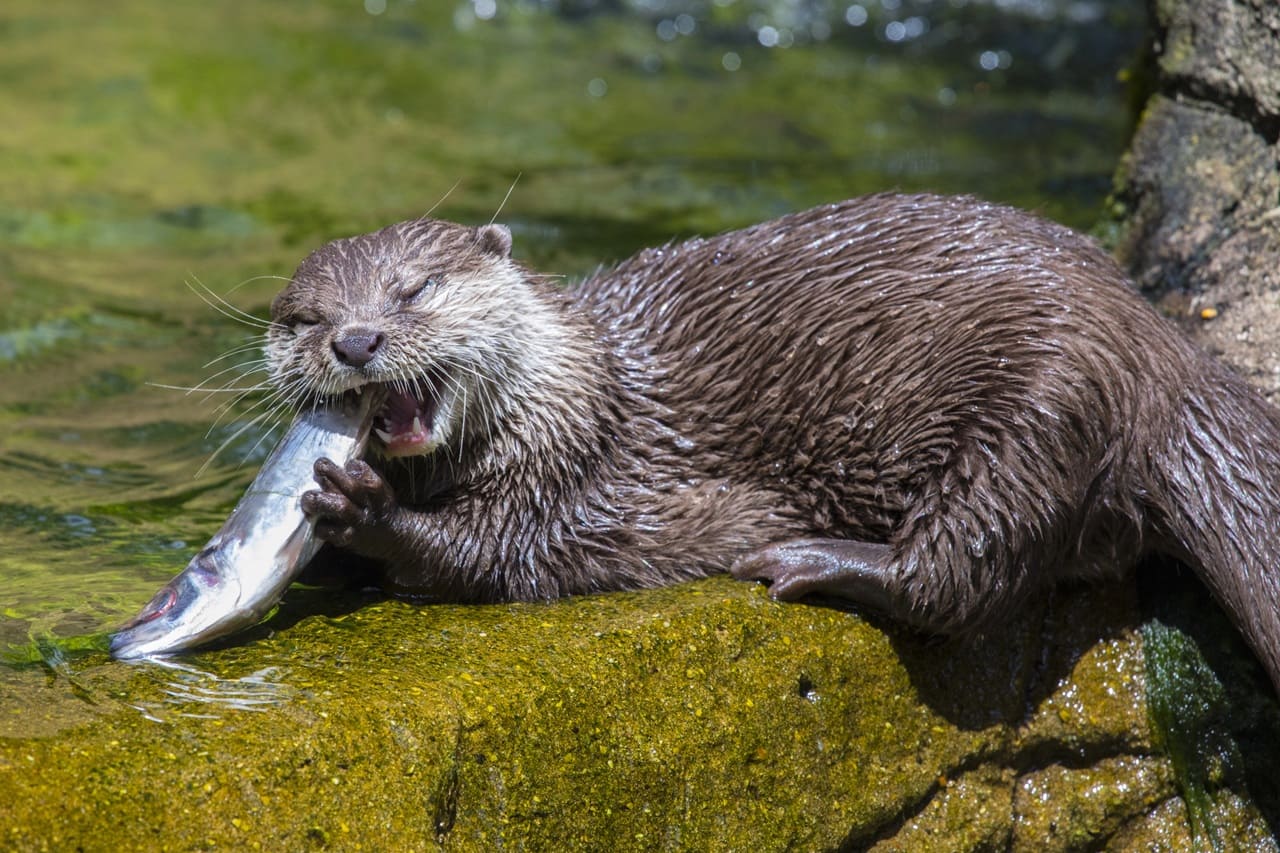
In 1888, the federal government decided by fisheries law to exterminate the otter. Hunting courses, bounties and state-financed trapping equipment followed. In 1952, the otter was placed under protection, but the population had not recovered. In 1989, the last otter swam in Lake Neuchâtel. In 1990, the Federal Office for the Environment declared the "end of the otter in Switzerland". Then what authorities had considered impossible happened: in 2009, an otter was sighted near Reichenau in Graubünden, having returned on its own paws. Since then, it has slowly spread along the Aare, Emme, Rhine, Ticino, Rhone and Inn rivers. In 2025, offspring was documented for the first time in the Surselva and in Canton St. Gallen. But the population numbers fewer than 20 animals. Switzerland's Red List classifies the otter as "critically endangered" (CR). And while the return has barely begun, fishing associations and the recreational hunting lobby are already planning the next round of persecution.
Profile and biology
Characteristics and adaptation
The Eurasian otter (Lutra lutra) belongs to the weasel family (Mustelidae) and the otter subfamily (Lutrinae). It measures 60 to 90 centimeters in length, plus a tail of around 40 centimeters. Males weigh 7 to 12 kilograms. Its streamlined body, webbed paws, and extremely dense fur (up to 70,000 hairs per square centimeter) make it a highly specialized aquatic hunter. Nose, ears, and eyes are positioned at the same height, allowing it to simultaneously see, hear, and smell at the water's surface. When diving, ears and nose seal hermetically, while sensitive whiskers detect the vibrations of fleeing fish.
Lifestyle and Diet
The otter is primarily crepuscular and nocturnal, living as a territorial loner. A male claims a territory of around 10 to 15 kilometers of river course, females somewhat less. It feeds mainly on fish, supplemented by crayfish, amphibians, mollusks, birds, and small mammals. Daily it requires around 15 to 20 percent of its body weight in food, roughly 1 to 2 kilograms. It spends three to five hours daily hunting. The otter cannot afford to overexploit its territory: it depends on healthy, reproducing fish populations. When otters can establish themselves long-term, a waterway is in good health.
Red List Status
The otter was classified as 'extinct' (RE) in Switzerland in 1994. Since its return, it was upgraded to 'critically endangered' (CR) in 2022. Globally, the IUCN classifies the species as 'near threatened' (NT). In the EU, the otter is strictly protected under the Habitats Directive (Annexes II and IV). The Bern Convention lists it in Annex II (strictly protected animal species). In Switzerland, it is a protected species under JSG Art. 7 and listed among FOEN's nationally priority species.
History of Extermination: A Federal Law as Death Sentence
The Fisheries Act of 1888
Until the late 19th century, the otter was distributed throughout Switzerland at almost all waterways. The Federal Fisheries Act of 1888 changed everything: Article 22 ordered 'to promote the extermination of otters and other animals particularly harmful to fisheries as much as possible.' The cantons offered bounties: 30 francs for an otter snout in Canton Zug. State-organized otter hunting courses were arranged, hunting dogs and traps financed. It was a bureaucratically planned, state-financed extermination campaign.
Protection Came Too Late
Already from 1913, hunting statistics dropped to under 10 animals per year. The Swiss League for Nature Protection (today Pro Natura) advocated for otter protection from 1917. In 1952, the animal was finally placed under federal protection, but by then only around 150 otters lived in Switzerland. The population never recovered. The reasons were manifold: waterways had become hostile to life through straightening, dams, and wetland drainage. Added to this was chronic poisoning by PCBs (polychlorinated biphenyls), which destroyed female reproductive success through the food chain. In 1989, the last evidence of a wild otter in Switzerland was recorded at Lake Neuchâtel.
More on this: Dossier: Hunting and Biodiversity
The Return: Back on Its Own Paws
2009 to present
In 2009, an otter was confirmed in Switzerland for the first time at the fish ladder of the Reichenau power plant in the canton of Graubünden. The return occurred naturally: the animals migrated from Austria via the Inn and from France via the Rhone. On the Aare, it is assumed that descendants of otters that escaped from the Dählhölzli zoo in Bern in 2005 established the population. Since then, otters have been confirmed at six Swiss waterways: Aare, Emme, Rhine, Ticino, Rhone and Inn. In 2024, an otter was sighted in the canton of Zurich. In 2025, offspring were confirmed for the first time in the Surselva and in the canton of St. Gallen. In December 2025, the otter reached the Linth plain. The Pro Lutra Foundation estimates the current population at fewer than 20 animals.
What the return means
The otter's return is a natural process, not a human achievement. The animals return on their own when conditions permit: enough fish, reasonably connected waterways and no targeted persecution. The Swiss Ornithological Institute Sempach confirms: «The establishment and spread of cormorant and rook are a result of better international protection.» The same applies to the otter. Its comeback shows: species conservation works when it is allowed to. But this is precisely what is being politically questioned.
Threats: Old enemies, new dangers
Habitat loss
Swiss waterways remain heavily engineered. Channelization, dams, missing riparian vegetation and insufficient residual water at power plants make large sections unsuitable for otters. Otters need clear, shallow, fish-rich waters with natural riparian vegetation and sufficient hiding places. Engineered waterways do not provide this.
Road traffic
With a population of fewer than 20 animals, every loss is existential. In 2025, two otters were run over in the St. Gallen Rhine Valley. Bridges without shore passages force the animals onto roads. The Pro Lutra Foundation wants to test as many Swiss bridges as possible for their «otter-friendliness» in the coming years.
Environmental toxins
PCBs have been banned in Switzerland since 1986, but legacy contamination remains in sediments and waterways. In 2016, during maintenance work on the Punt dal Gall dam wall, PCB-containing particles entered the Spöl in the Swiss National Park. Four years later, a dead eagle owl with extreme PCB contamination was found. Water quality remains a limiting factor for otter expansion.
Political threat: JSG revision and shooting demands
The greatest danger to the otter comes not from nature, but from politics. BirdLife Switzerland, the Fondation Franz Weber and ProTier explicitly warned during the 2020 JSG revision: beaver, lynx, otter, grey heron and goosander threatened to be placed on the list of species declared «regulatable». The Swiss electorate rejected the revision with 51.9 percent. But the pressure remains. In Bavaria, the state government tried in 2023 to allow the shooting of up to 32 otters by decree. The Munich Administrative Court declared the blanket permit illegal. In Austria, thousands of otters are «regulated» annually without the populations declining as a result. Switzerland stands at a crossroads: Will the otter be declared a «pest» again before it has even recovered?
More on this: Dossier: Hunting myths
Ecological significance: Indicator, regulator, ecosystem engineer
Indicator species for water quality
The otter is a reliable indicator of water body quality. Where otters can establish themselves long-term, the water body is healthy: rich in fish, structurally diverse, clean. Its return is not a problem, but a sign that revitalization measures are working. Its absence was for decades an alarm signal for the state of Swiss waters.
Natural fish population regulation
As a territorial loner, the otter differs fundamentally from the cormorant: it cannot overexploit its fish population because it is bound to its territory. Its prey selection regulates sick, slow and surplus fish. In near-natural waters with sufficient structures, no measurable negative effect on fish populations is to be expected.
Connecting waterways
The otter needs interconnected waterways. Its habitat requirements force politics to advance river revitalization, bank restoration and the removal of migration barriers. Whoever protects the otter automatically protects hundreds of other aquatic species.
The 'pest' narrative: Return of an old lie
'The otter empties the waters of fish'
Fish ecologist Clemens Ratschan, who has been researching the situation in Austria for years, knows of no single example where a flowing water body became fish-free due to the otter. The otter can decimate fish populations in its territory, but cannot eliminate them, as it depends on healthy stocks itself. In near-natural, structurally rich waters with sufficient shelter for fish, no measurable negative effect is to be expected. Where fish populations are under pressure, the causes are almost always human-made: construction, dams, pesticides, climate warming, overfishing.
'The otter threatens fish farming'
In Switzerland, pond farming is far less widespread than in Austria or Bavaria, where conflicts are greatest. Open fish ponds affect an otter like a chicken coop with an open door affects a fox. Technical protective measures are needed there: otter-proof fences, diversion ponds, night nets. Shooting is demonstrably ineffective, as the Upper Austria example shows. The solution lies in protecting facilities, not in persecuting the species.
'The otter threatens the grayling'
In the Linth area, one of the last grayling spawning grounds in Switzerland, the otter was detected in 2025. Concern for the endangered grayling is justified, but the otter is not the cause of its endangerment. The grayling suffers from habitat loss, climate warming, overfishing and cormorant pressure. Negative influences from natural predators can be reduced if waters are near-natural and structurally rich and provide sufficient shelter for fish. Misusing the otter as a scapegoat for human-made problems is the same strategy that led to extermination in 1888.
What would need to change
- Absolute protection of the otter in Switzerland: With a population of fewer than 20 animals and Red List status CR ('critically endangered'), any discussion of 'regulation' is absurd. The otter must under no circumstances be placed on the list of regulatable species, neither through JSG revision nor through Federal Council ordinance.
- Comprehensive waterway revitalization: The otter's future depends on water body quality. The Waters Protection Act obligates cantons to revitalization. This obligation must be consistently implemented, with otter-friendly banks, near-natural structures and continuous migration corridors.
- Otter-friendly bridges and underpasses: Road deaths pose an existential threat to a minimal population. All bridges on populated and potential otter waters must be equipped with dry bank passages. The Pro Lutra Foundation has the right approach with its bridge inspection project.
- Prevention instead of shooting in conflicts with fish farming: Where otters visit breeding facilities, otter-proof fences, diversion ponds and technical protective devices must be financed. Shooting is not a solution: In Austria, thousands of otters were killed without reducing conflicts. In Bavaria, the Munich Administrative Court declared blanket shooting unlawful.
- Expand national otter monitoring: The Pro Lutra Foundation and WWF conduct voluntary mapping with the 'Otterspotter' programme. However, systematic, nationally coordinated monitoring is essential to track population development and base political decisions on data rather than lobby interests.
- Remediate PCB legacy contamination: The remaining PCB sources in Swiss waters must be identified and remediated. The 2016 Spöl incident shows that contamination is still a reality.
Arguments
'The otter empties waters of fish and must be regulated.' The otter is a territorial animal that cannot overexploit its own fish stock because it depends on their reproduction. In no documented case has an otter made a watercourse fishless. The actual causes of declining fish stocks are channelisation, pesticides, climate warming and overfishing.
'The return of the otter threatens fisheries.' The managing director of the Swiss Fisheries Association has himself described the return as a positive sign for water quality. Conflicts with fish farming are solvable: diversion ponds, otter-proof fences and technical protective measures work, as experience from Germany and Austria shows. Shooting in Austria has demonstrably not contributed to conflict resolution.
'The otter must be included in the hunting law so it can be regulated when necessary.' BirdLife Schweiz and the Fondation Franz Weber have been warning for years: anyone who puts the otter on the list of regulatable species repeats the mistake of 1888. The JSG revision of 2020 was rejected by the people, partly because it threatened to undermine protection of otters, beavers and lynx. The otter population counts fewer than 20 animals in Switzerland. Any discussion of 'regulation' is not only senseless with this population size, but dangerous.
'In Austria and Bavaria, the otter has caused massive damage. This will also happen in Switzerland.' Switzerland is not Austria: pond farming is far less widespread here. The conflicts in Austria mainly concern open fish ponds that offer easy prey. In watercourses with intact habitat, the otter's impact on fish stocks is minimal or unmeasurable. Prevention is more effective and cheaper than persecution.
'The extermination of the otter was a mistake, but the waters are no better today.' The fact that the otter is returning naturally refutes this claim. Water quality has improved, even if it is not yet optimal. The otter's return is an argument for more revitalisation, not for renewed persecution.
Quicklinks
Articles on Wild beim Wild:
- Otter doesn't have it easy in Switzerland
- Otter confirmed again in Ticino
- Otter confirmed in Grisons
- Studies on the impact of recreational hunting on wildlife
- Why recreational hunting fails as population control
Related dossiers:
- Golden jackal in Switzerland: Natural immigrant under political pressure
- The otter in Switzerland: Exterminated, returned and politically threatened
- The Brown Bear in Switzerland: Exterminated, Returned, and Still Unwanted
- The Wildcat in Switzerland: Back from Extinction, Threatened by Indifference
- The Lynx in Switzerland: Predator, Keystone Species, and Political Object of Dispute
- The Fox in Switzerland: Most Hunted Predator Without a Lobby
- Wolf: Ecological Function and Political Reality
- The Wolf in Europe: How Politics and Recreational Hunting Undermine Species Protection
- Wolf in Switzerland: Facts, Politics, and the Limits of Hunting
- Valais Wolf Balance: Numbers of a Massacre
- Fox Hunting Without Facts: How JagdSchweiz Invents Problems
- Livestock Protection in Switzerland: What Works, What Fails, and Why Culling Is No Solution
Source References
- Pro Lutra Foundation: History and Situation of the Otter in Switzerland (prolutra.ch)
- info fauna / CSCF: Swiss Otter Specialist Center (infofauna.ch)
- WWF Bern and Solothurn: Otterspotter Monitoring 2017–2024 (wwf-be.ch)
- Canton of St. Gallen, Office for Nature, Hunting and Fisheries (2026): The Otter Has Reached the Linth Plain. Press Release
- Swiss National Museum / Aufdermauer, C. (2025): The Last Otter. Blog on Swiss History
- Franz Weber Foundation (2020): Revision of the JSG. Fact Sheet Otter
- BirdLife Switzerland: Revision of the Hunting and Protection Act, What Is at Stake?
- ProTier: Hunting Law Revision, Danger for Otters and Other Protected Species
- BUND Nature Conservation Bavaria / DUH (2024): Otter Culling in Bavaria Remains Prohibited. VGH Ruling
- Bern Convention: Annex II (strictly protected animal species)
- EU Habitats Directive: Annexes II and IV
- Swiss Otter Group (1990): Report to BUWAL on the End of the Otter in Switzerland
- Federal Act on Fisheries (1888/1889), Art. 22
- Federal Act on Hunting and the Protection of Wild Mammals and Birds (JSG, SR 922.0)
- Ratschan, C. (2024): Otters and Fisheries in Austria. In: Petri-Heil
Our Mission
The history of the otter in Switzerland is a history of state-organized extermination. In 1888, the federal government decided to destroy it. By 1989, the goal was achieved. Then, after 20 years of absence, it returned on its own. Not because humans had planned it, but because nature is more resilient than politics. The otter today counts fewer than 20 animals in Switzerland. It is listed on the Red List as 'critically endangered.' It is strictly protected by the Bern Convention and Swiss hunting law. And yet, its 'regulation' is already being discussed before it has even recovered. The fisheries associations and the recreational hunting lobby employ exactly the same narratives as in 1888: 'harmful to fisheries,' 'competitor,' 'pest.' The consequence is clear: the otter must remain absolutely protected in Switzerland. Its return is an opportunity, not a problem. This dossier will be continuously updated when new numbers, studies, or political developments require it.
More on recreational hunting: In our Hunting Dossier we compile fact-checks, analyses, and background reports.