Switzerland: Statistics on Fatal Hunting Accidents
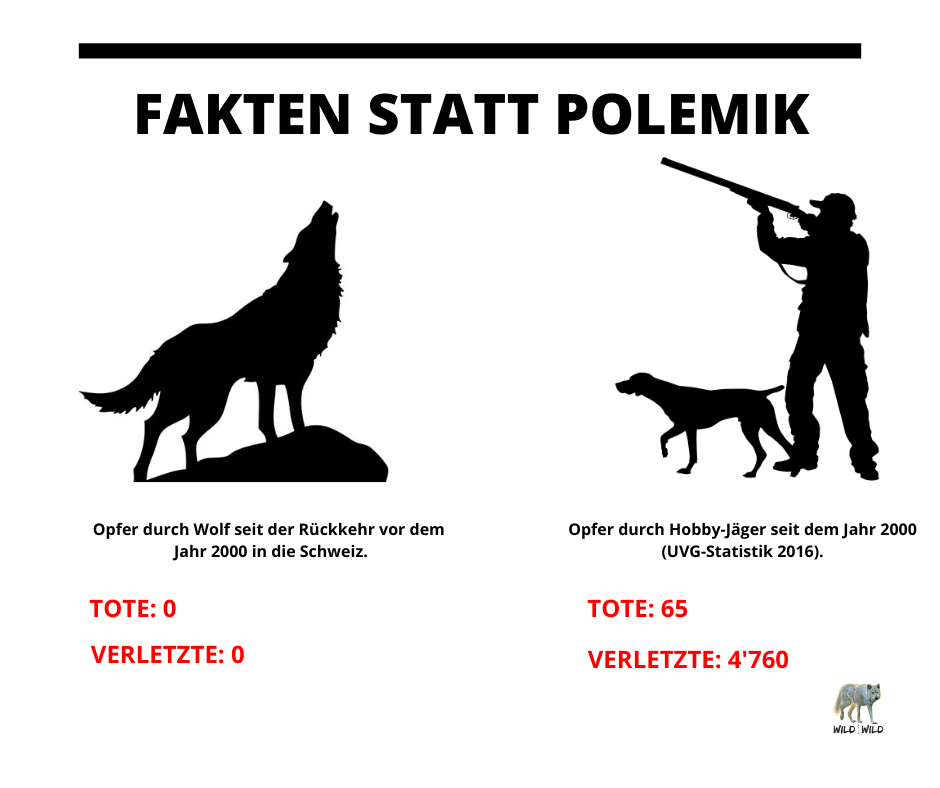
In Switzerland, every year more people are injured and killed by the risk group of hobby hunters than by Islamic terrorists, cults, the Mafia, wolves, and biker gangs combined.


Hobby hunting is not a harmless nature experience, but a deliberate engagement with deadly weapons in a densely used landscape.
Since the BFU statistics began in 2000, more than 75 people were killed in hunting accidents through to 2019. Statistically, a hunting accident occurs every 29 hours and approximately every three and a half months a person loses their life.
Over a multi-year average, around four hobby hunters in Switzerland seek out the eternal hunting grounds while pursuing their hobby each year. From around the age of 45, the number of accidents rises significantly. Particularly affected is the age group of older men — precisely the group that ventures into the forest with rifles and live ammunition.
What official accident statistics actually record
The available figures come primarily from two sources: the BFU statistics on non-occupational accidents and special analyzes of UVG data from accident insurers. Both have one thing in common: they capture only part of the reality.
An analysis of UVG data for the years 2006 to 2015 shows that approximately 300 recognized accidents occur annually in the activity category of hobby hunting. During this period, around 2 fatalities per year and approximately 2 new disability pensions per year were recorded. Only a small proportion of fatal and serious accidents are attributable to gunshots. Far more common are falls and tumbles in difficult terrain, triggered by hectic hunting situations, darkness, poor visibility, and time pressure.
More recent analyzes of UVG data for 2016 to 2020 confirm this picture: in the activity category of hunting, an average of around 300 accidents per year are recognized, with approximately one fatality, two disability pensions, and annual costs of around 3.6 million francs. The majority of serious accidents occur due to falls and tumbles outdoors in the hunting area.
What is decisive is what these statistics do not capture: the UVG statistics refer only to employed persons with compulsory accident insurance. Children, students, homemakers, the self-employed, and in particular the large group of retired hobby hunters are entirely absent. Yet they represent a considerable proportion of the persons who handle hunting weapons. The actual number of hunting accidents and fatalities is therefore significantly higher than the official UVG figures.
Unreported cases and endangerment of third parties
The BFU figures relate to classic hunting accidents. Criminal offences involving hunting weapons, domestic tragedies, threats with firearms, suicides, and also many near-misses do not appear in them.
Even more problematic: the endangerment of uninvolved third parties by hobby hunters can scarcely be discerned from the data of accident insurers. Yet media outlets and animal protection organisations have repeatedly reported, for years, on cases in which walkers, neighbours, or other hobby hunters were struck.
A recent example is the fatal hunting accident at Oulens-sous-Echallens in the canton of Vaud. At the end of November 2024, a 64-year-old hobby hunter was killed there by a shot fired by a colleague, when a group of hobby hunters attempted to drive a sounder of wild boar out of dense undergrowth. The public prosecutor's office is investigating a fatality that occurred during a leisure activity involving firearms.
Such events are not regrettable coincidences but are inherent to the system. Where shots are fired with bullets and pellets in forests, fields, and in the vicinity of paths, people and domestic animals inevitably end up in the line of fire. Hobby hunting shifts the risk onto all others who simply wish to use the forest as a recreational space.
Hunting as a hobby with high social costs
Hunting weapons are not only dangerous in the forest. They are repeatedly used in domestic conflicts, threats, or suicides. Every weapon stored in the cabinet of a hobby hunter is potentially part of a future tragedy. Animal protection advocates and criminologists have pointed out for years that privately owned firearms significantly increase the risk of fatal escalations within social environments.
Added to this are the financial consequences. According to UVG assessments, hunting accidents billed to accident insurers alone cause an average of several million francs per year. These costs are ultimately borne by the general public, while recreational hunting is predominantly a hobby of a small minority.
Hobby hunters as a risk group
The canton of Graubünden sees a particularly high number of accidents involving hobby hunters, followed by hunting accidents abroad. Next come the cantons of Ticino, Aargau, Valais, St. Gallen and Bern. All persons fatally injured while hunting since the year 2000 with a BFU entry were residents of Switzerland.
The statistics thus make it clear: recreational hunting is not a folkloric remnant tradition, but a real safety risk that emanates primarily from a specific risk group. In practice, it is predominantly older men who are out and about with hunting weapons, often in demanding terrain and in situations where stress, peer pressure and adrenaline play a role. Mistakes then have fatal consequences.
Hunting weapons lead to abuse in our social lives. Time and again there are firearm suicides, threats and fatal tragedies. Year after year, people are killed and injured by hobby hunters and hunting weapons, in some cases so severely that they end up in wheelchairs or have limbs amputated. – IG Wild bei Wild
Game wardens instead of hobby hunters
Since the year 2000, dozens of people in Switzerland have been killed in the context of recreational hunting, with hundreds more seriously injured and an unknown number of unreported near-accidents and criminal offences involving hunting weapons. At the same time, to this day there is no complete, centrally maintained statistical record of all deaths and injuries directly or indirectly related to recreational hunting.
Modern, ethical wildlife management does not need hobby hunters carrying lethal weapons in their leisure time. Professional, strictly controlled game wardens could reduce safety risks while simultaneously improving the protection of people and wildlife.
As long as recreational hunting continues in its current form, the sobering conclusion remains: it is not wolves or other wildlife that pose a safety problem, but a small risk group of armed leisure hunters.
In the view of IG Wild beim Wild, hobby hunters annual medical-psychological fitness assessments modelled on the Dutch system, as well as a binding upper age limit. The largest age group among hobby hunters today is 65+. In this group, age-related limitations such as declining eyesight, slowed reaction times, difficulties with concentration and cognitive deficits increase statistically significantly. At the same time, accident analyses show that the number of serious hunting accidents involving injuries and fatalities rises significantly from middle age onwards.
The regular reports of hunting accidents, fatal errors and the misuse of hunting weapons highlight a structural problem. The private ownership and use of lethal firearms for recreational purposes largely eludes continuous oversight. From the perspective of IG Wild beim Wild, this is no longer justifiable. A practice that is based on voluntary killing while simultaneously generating considerable risks for humans and animals forfeits its social legitimacy.
Hobby-hunting is furthermore rooted in speciesism. Speciesism describes the systematic devaluation of non-human animals solely on the basis of their species membership. It is comparable to racism or sexism and can be justified neither culturally nor ethically. Tradition is no substitute for moral scrutiny.
Critical scrutiny is particularly indispensable in the field of hobby hunting. Scarcely any other field is so thoroughly shaped by euphemistic narratives, half-truths and deliberate disinformation. Where violence is normalised, narratives frequently serve as justification. Transparency, verifiable facts and an open public debate are therefore essential.
Unterstütze unsere Arbeit
Mit deiner Spende hilfst du, Tiere zu schützen und ihrer Stimme Gehör zu verschaffen.
Jetzt spenden →