Egyptian Geese Shot at Stadlersee: Recreational Hunting Destroys Idyll
At the Stadlersee in Stadel near Niederglatt ZH, a recreational hunter shot and killed a pair of Egyptian geese last Saturday.


The male was found floating dead in the lake; the female was shot in an adjacent field.
Walkers and residents who had observed the pair of geese for months and taken pleasure in their offspring reacted with horror and grief. One resident even set up a memorial website , reports 20.min.ch.
Invasive or simply unwanted?
The Egyptian goose originates from Africa and was brought to Europe in the 18th century as an ornamental bird. Having escaped from captivity, the animals established feral populations. Since 2003, the species has also been breeding in Switzerland. In the EU it has been listed as an “invasive alien species” since 2017, and Swiss federal law obliges cantons to prevent the spread of the breeding population.
But what does “invasive” really mean? The Egyptian goose uses similar habitats to native waterfowl and can compete with them. BirdLife Switzerland confirms that measures are necessary. At the same time, the organisation acknowledges that the animals could also have been captured. Reaching for the shotgun is therefore by no means the only option.
Recreational hunting as a “solution”: convenient, brutal, questionable
The incident at the Stadlersee illustrates in exemplary fashion how recreational hunting operates: a recreational hunter shoots two animals that were cherished by the local community, invokes legality, and disappears. What remains are dead animals and grieving people. The fact that the shooting was “legally impeccable” does not make it ethically justifiable.
Recreational hunting invariably presents itself as the simple solution in situations where more nuanced approaches are called for. Capture, relocation, clutch management, deterrence: all of these methods exist and are successfully employed in other countries. Yet they require expertise, patience, and the willingness to treat animals as sentient beings rather than targets.
When Compassion Is Declared a Problem
Particularly revealing is the reaction to the local resident's grief. In comment sections and among recreational hunters, empathy for animals is regularly dismissed as naive or “anthropomorphizing.” The so-called “cute effect” is ridiculed. Yet the capacity to feel empathy for other living beings is not a weakness. It is the expression of a shift in values that the recreational hunting lobby is attempting to halt by any means necessary.
The local resident gets to the heart of it: animals are often the better role models. A pair of Egyptian geese raising their chicks together deserves more respect than a recreational hunter who shoots them from ambush.
The bigger question: Who does nature belong to?
The incident at Stadlersee raises a fundamental question: Who does nature belong to? The recreational hunters who decide over life and death with lease agreements and hunting licences? Or the general public, which takes pleasure in the wildlife and strives for a non-violent coexistence?
The regulation of invasive species may be necessary in certain cases. But the manner in which it is carried out says a great deal about our society. As long as recreational hunting is regarded as the standard instrument, scenes like those at Stadlersee will not cease: shots fired in broad daylight, dead animals in full view of families and children, and the cynical declaration that everything is “legally unimpeachable.”
It is time for Switzerland to take a different path. Paths that do justice to both species protection and animal welfare. Recreational hunting is not part of that.
More on the subject of recreational hunting: In the dossier The Role and Criticism of Recreational Hunters we shed light on the training, power and self-image of recreational hunters. What the research says about this is shown by Hunting fact-checked: the state of research.
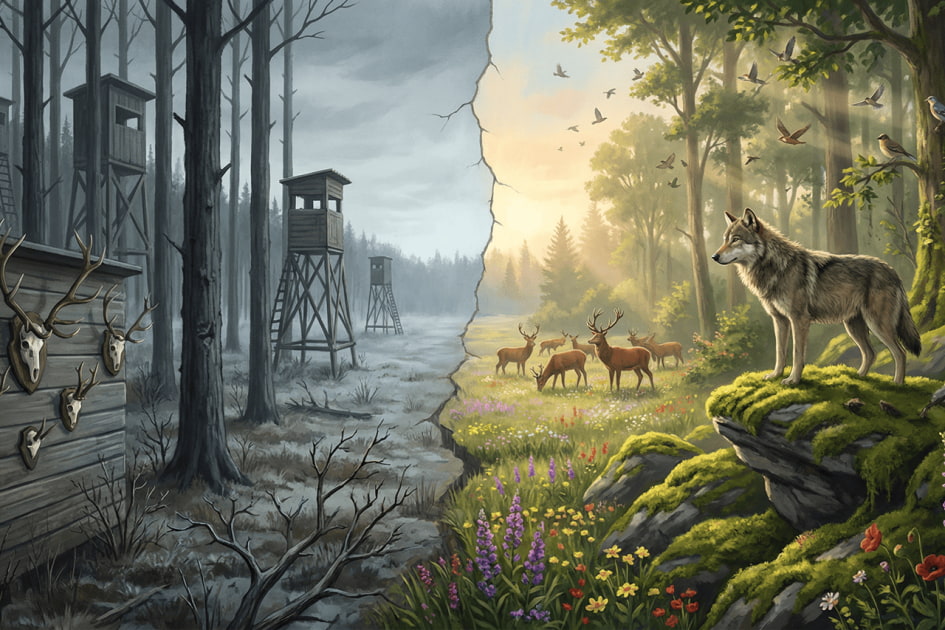
The position of IG Wild beim Wild: IG Wild beim Wild rejects recreational hunting. Our model is the canton of Geneva, which has managed without recreational hunting since 1974: without hunting seasons, without hunting dogs, without driven hunts, without high seats, without the animal cruelty and crime that go hand in hand with hunting season elsewhere. What has worked there for over fifty years disproves every position paper by JagdSchweiz. An association that bases its policy on claims it refutes in its own documents is not a professional organisation, but a factory for misinformation.
Support our work
With your donation you help protect animals and give their voice a hearing.
Donate now →