Are wolves in Switzerland dangerous to humans? Facts and myths
The wolf as a scapegoat: fearmongering without foundation.

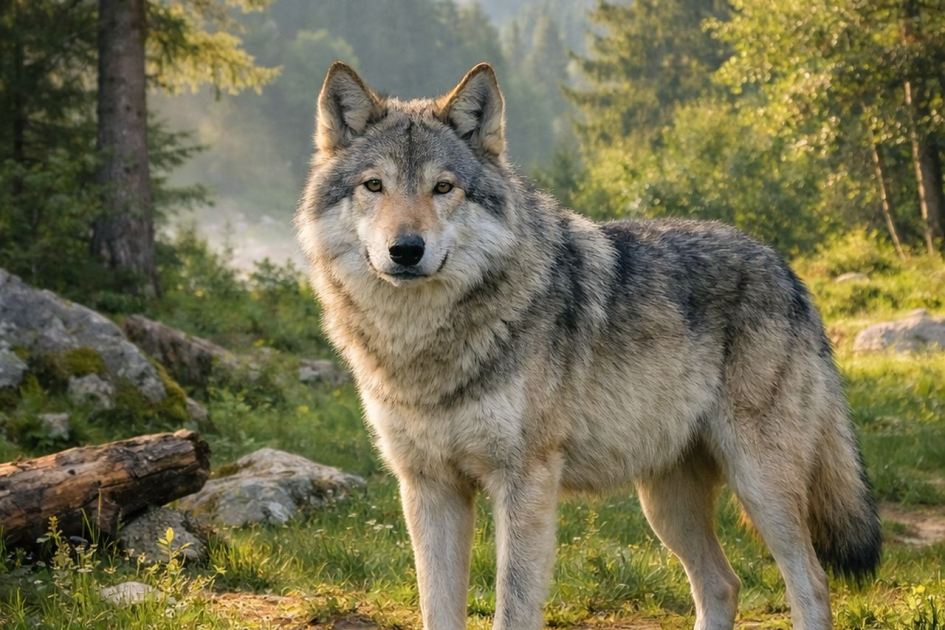
In the entire documented history of Switzerland, there is not a single confirmed fatal wolf attack on a human being.
The portrayal of the wolf as a threat to the population is scientifically untenable – yet it is politically exploited to justify culling and to undermine species protection.
What do the facts say about wolf attacks on humans?
Worldwide, documented attacks by wild, healthy wolves on humans are extremely rare. In modern European history, there are virtually no verified fatalities caused by healthy wild wolves. In Switzerland, not a single confirmed case has ever been recorded in which a person was killed or seriously injured by a wolf. The Dossier Wolf in Switzerland states: zero statistical attacks on humans.
This record holds despite the fact that the wolf has been returning to Switzerland since the mid-1990s – initially through natural migration from Italy and France – and that approximately 30 packs with an estimated 300 animals now live in the country. In all these years of a growing wolf population, not a single attack on a human has occurred.
How dangerous is the wolf compared to other animals?
A sober comparison reveals: the wolf is statistically insignificant as a threat to humans. Cattle, dogs, and wasps claim multiple human lives in Switzerland every year. Hunting accidents – caused by hobby hunters – cost at least 75 people their lives between 2000 and 2019. These figures are documented in the fact-check of the JagdSchweiz brochure.
The wolf, by contrast, fundamentally avoids humans. Wolves are flight animals in relation to humans and typically behave defensively when they can avoid contact. Conflicts arise almost exclusively when wolves have been conditioned – that is, when they have been systematically fed or habituated to human proximity.
Why is the wolf nevertheless portrayed as a threat?
The fear narratives surrounding the wolf have little to do with biological reality, but all the more with hunting politics. As the dossier Hunting Myths demonstrates, the hunting lobby systematically deploys threat scenarios to push through regulatory measures – that is, lethal removal – at the political level. The wolf as a “danger” is perfectly suited to trigger emotional reactions among the public.
Political figures such as Christophe Darbellay (CVP Valais) – himself an active hobby hunter – have exploited wolf policy as a platform for self-promotion. The cantonal initiative “Wolf fertig, lustig!” from the Canton of Valais in 2016 was a political mobilization campaign that Pro Natura labeled an “eradication initiative” – not a public safety measure.
What role do the media play in generating fear?
The media play a decisive role in public perception of the wolf. As the Dossier on Media and Hunting Topics shows, wolf kills of livestock are routinely given prominent coverage, while scientific evidence for the wolf's ecological significance is scarcely afforded any space. Broadcast formats that foreground the emotional distress of mountain farmers shape the public image far more powerfully than sober statistics.
What is often missing is context: every year, approximately 4,000 sheep still die in Switzerland from disease, falls, and weather exposure – frequently as a result of inadequate supervision. These deaths generate no headlines. The 336 wolf kills in 2022 – the highest figure since 1998 – on the other hand, do.
What about aggressive behavior by wolves?
Problematic approach behavior by wolves – situations in which a wolf does not avoid a human – is extremely rare and almost always attributable to habituation. This means the wolf has learned not to perceive humans as a threat. This occurs when wolves are deliberately or inadvertently fed, or when they have grown up in intensively settled areas.
In such cases, targeted measures are called for – behavioral training, hazing, and in extreme cases, removal of the individual animal. These measures differ fundamentally from blanket pack culls, which are scientifically counterproductive: more than 200 scientists have criticized in an open letter that wolf removals destroy the social structure of packs, thereby leading to more conflicts, higher reproduction rates, and more unstable behavior.
What do scientists say?
The scientific consensus is clear: healthy wild-living wolves do not attack humans. The Wolf in Switzerland dossier documents how over 200 scientists criticized Swiss wolf policy in an open letter. They warn that endangered species such as the wolf do not belong under hunting law and that culling exacerbates conflicts rather than resolving them.
Wolf policy should be based on scientific evidence – not on the emotional pressure of a lobby that extracts political capital from the killing of predators.
How should people best behave during wolf encounters?
Encounters with wolves in the wild are extraordinarily rare. Wolves are shy and typically avoid humans before any contact occurs. Anyone who does encounter a wolf should remain calm, draw attention to themselves (loud voice, large gestures), and move away slowly but confidently. Running or panicking is counterproductive.
The FOEN and cantonal wildlife authorities officially recommend the same approach. The wolf is not a murderous predator from a fairy tale – it is a wild animal that avoids humans.
Does killing wolves protect the public?
No. Public safety is not a scientifically valid argument for wolf culling in Switzerland, because no documented threat exists. The killing of wolves is a measure to protect livestock under certain conditions – not a safety measure for humans. Anyone who conflates the two is spreading disinformation.
As the Hunting Myths dossier demonstrates, equating wolves with danger to humans is a classic lobby narrative. It serves to keep wolf populations small – in the interest of those who regard the wolf's prey as “their” wildlife.
What would be the alternative to blanket culling?
The answer is: consistent herd protection. The Calanda pack in Graubünden – the first resident pack of modern Switzerland – proved that wolves and agriculture can coexist: in an area with 1,500 sheep, there were only 37 livestock kills over five years, thanks to systematic protective measures. More in the Herd Protection in Switzerland Dossier.
Additionally, public communication about the wolf should be based on facts – and not on the fear-mongering of interested parties, as described in the Hunter Lobby in Switzerland Dossier .
Conclusion
The wolf poses no danger to humans in Switzerland. Not a single fatality, not a single confirmed serious attack in all of Swiss history. The fear narratives circulating in the political debate are not supported by facts – they are instruments of a hunting lobby that wants to eliminate predators from the forest. Those who are objectively informed recognize: the real threat to sheep does not come from the wolf, but from their keepers and from a herd protection policy that is not consistently implemented for political reasons.