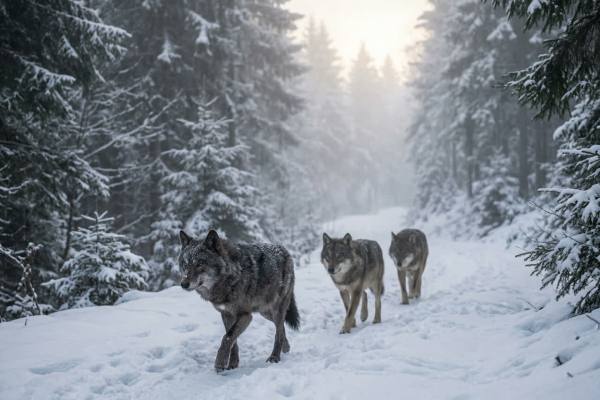
Podcast episode: hunting, wolves and wild animals
Wolf culls authorised in advance, kill tallies from three cantons, and what the WWF report on 100 years of "Hege und Pflege" (game management) really says.

Podcast episode: hunting, wolves and wild animals
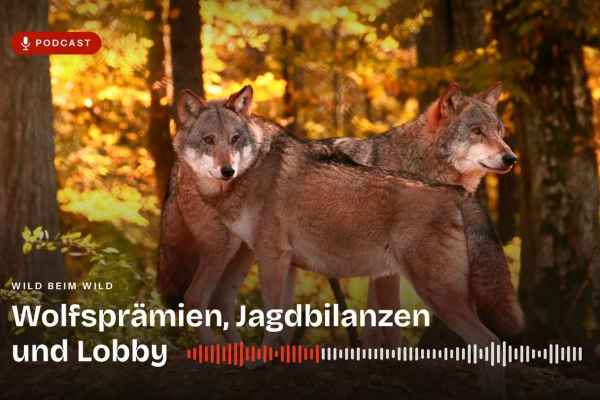
This edition of "Wild beim Wild" is about an autumn in which the authorities are approving more kills than ever, while the outlook for biodiversity is bleaker than ever. The episode takes in wolf regulation, the hunting season in the cantons and the new WWF report.
Wolf regulation and predators
Since a change to the Hunting Ordinance, the FOEN can, according to KORA, approve the regulation of wolf pups "before their presence has been confirmed". In the case of at least four Grisons packs, federal approval was in place before the first official confirmation of reproduction. In the case of the Stagias pack, two days passed between the first confirmation of the litter and two wolves being dead.
The interim report after five weeks shows: since 1 September, at least 26 wolves have been killed pre-emptively, and the FOEN has issued authorisations for 37 packs. No authority publishes an overall tally, which is why IG Wild beim Wild keeps the wolf kill counter continuously updated.
Romania is approving 969 brown bears for killing. In the Jura, the Mont Tendre pack is considered to have disappeared, while the cross-border Jougne pack has moved into the canton of Neuchatel. What is structurally missing in herd protection is spelled out in the article on the shortage of shepherds in the Alps: herd protection stands or falls with people who are able to stay. In Schwyz, basic protection was lacking in three of four predation incidents.
The hunting season in the cantons
In Grisons 17 wolves and around 8,400 chamois, roe deer and red deer were killed in September. The authority calls the outcome "positive". For the IG Wild beim Wild, an authority that books the killing of more than 8,000 wild animals in 30 days as a success is not practising wildlife management but a leisure pursuit with a state stamp. In the trophy photo competition run by RTR the winning picture showed a recreational hunter with a nine-year-old female chamois, and a game warden again acted as the draw's lucky fairy a week after the complaint to the ombudsman's office. Yet RTR itself cites a study according to which 96.1 to 98.5 per cent of emotional reactions to such images are negative.
In the Valais the high hunt falls entirely within the red deer rut. 1,607 red deer and 1,617 chamois were killed, 150 of the deer in federal hunting ban areas. In 2020 the Federal Supreme Court ruled that only specially qualified persons may shoot there. An ibex of the highest age class costs Valais recreational hunters 5,000 francs, other Swiss residents 12,500 and those living abroad 25,000 francs. When the same animal costs five times as much depending on place of residence, it is not regulation but the sale of a trophy. On the chamois hunt the tally shows more dead animals despite additional protective rules.
Ticino pays 500 francs for every wolf killed, with a cost ceiling of 250,000 francs a year. The Ticino high hunt claimed two human lives through falls. A Toggenburg recreational hunter received a 200-franc fine for shooting a red deer during the closed season, which he mistook for a roe buck.
In In Zug the Federal Supreme Court rejected the recreational hunters' urgent application: the duty to carry out follow-up searches and the end of the fox bounty remain in force for now. Neuchatel continues to permit hunting of the endangered brown hare, Fribourg opens its fauna fund to shooting ranges. And in Spain the number of hunting licences has halved in twenty years, while kills reach one record after another.
Wild animals, protection and biodiversity
The WWF Living Planet Report 2026 reports an average decline of 73 percent in the monitored vertebrate populations since 1970. Switzerland has catching up to do compared with other countries, says WWF chief Thomas Vellacott. That is also the verdict on more than 100 years of 'conservation and care' by recreational hunters. The report names overexploitation as one of the most important causes of species loss. The otter shows that things can be different: once persecuted, it is returning thanks to restored rivers.
The Fireworks initiative of 29 November directly affects wild animals: on New Year's Eve, wild geese flew up to 16 kilometres further than usual. The case of Berngau, where a recreational hunter shot dead two authority employees during a weapons inspection, raises the question of effective suitability tests. Zurich has no strategy for dealing with Raccoons, even though Germany shows that hunting does not stop its spread. And the article on the Antlers explains why red deer regrow it every year.
More permits, more kills, dwindling populations: conservation worthy of the name begins with not shooting.
More on the subject of recreational hunting: The scientific evidence is presented in the overview Studies on the Effects of Recreational Hunting.
The position of IG Wild beim Wild: IG Wild beim Wild rejects recreational hunting. Our model is the canton of Geneva, which has managed without recreational hunting since 1974: without hunting seasons, without hunting dogs, without driven hunts, without high seats, without the animal cruelty and crime that go hand in hand with hunting season elsewhere. What has worked there for over fifty years disproves every position paper by JagdSchweiz. An association that bases its policy on claims it refutes in its own documents is not a professional organisation, but a factory for misinformation.
Wild animals need a voice
Once a week: research, petitions and background information on recreational hunting. Free of charge and can be unsubscribed from at any time.
All articles are written by IG Wild beim Wild as well as by external co-authors. Research, structuring and editorial processes may be supported by AI-assisted tools.
Support our work
With your donation you help protect animals and give their voice a hearing.
Donate now →