Valais high hunt 2026: More chamois killed despite additional protection rules
From 21 September to 3 October, recreational hunters killed 1,617 chamois and 1,607 red deer. The canton justifies restrictions on chamois hunting with the presence of wolf and lynx.

Photo: Cristian Grecu / Unsplash
“Ban Broken”
The Valais high hunt from 21 September to 3 October 2026 has been evaluated. According to the balance sheet of the Department for Hunting, Fisheries and Wildlife (DJFW) dated 8 October, 1,607 red deer and 1,617 chamois were killed, both figures above last year's. Over 2,100 high hunt licences were issued, roughly the same number as in 2025. The canton describes the result as “satisfactory”.
The figures for the 2026 high hunt
The number of red deer killed rose from 1,427 to 1,607. The kill quota target of 1,700 animals was not entirely reached. Nonetheless, a supplementary hunt is “not required”, the canton writes. In areas with problems regarding forest regeneration and wildlife damage, the wildlife wardens are to take on additional kills. According to the DJFW, the higher result was favoured by the later start of the hunt at the beginning of the red deer rut and the summer drought.
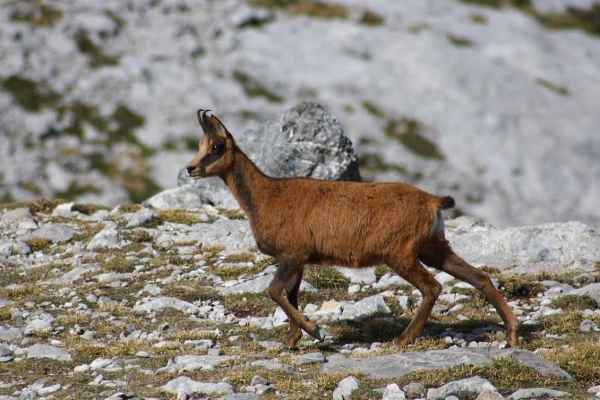
For chamois, the number rose from 1,537 to 1,617. In the longer term this is not an increase: in 2024 there were still 1,761 chamois. In addition, there were 192 female roe deer (2025: 212) and 11 wild boars (2025: 22).
Chamois protection due to wolf and lynx, yet more kills
As in the previous year, 2.5-year-old chamois and female yearlings were more strongly exempted from recreational hunting. New special rules now applied in three further wildlife zones: there, each recreational hunter was only permitted to shoot one mature chamois buck. The canton is thus restricting recreational hunting for certain age and sex classes, citing pressure from wolf and lynx in these regions as the reason. Nevertheless, more chamois were shot overall than in the previous year. The DJFW attributes this mainly to the good weather, which made recreational hunting easier in the high mountains.
Whether these measures actually relieve pressure on the protected classes cannot be assessed from the published overall figures. For 2026, a breakdown by sex and age is missing. In the previous year, the canton had provided such a breakdown: in 2025, 413 female chamois were shot, compared with 593 in 2024.
The cited balance reports do not give comparable figures on how many chamois are killed by wolf and lynx. By contrast, they state the impact of recreational hunting precisely: 1,617 chamois killed. As for the lynx, a research group at the University of Bern estimates the Valais population for winter 2025/26 at 37 independent animals, with an uncertainty range of 26 to 52. This is considerably lower than the figure of up to 80 lynx cited in the political debate. The study is so far only available as a preprint and has not yet been peer-reviewed. Nevertheless, the canton intends to be the first to apply for a kill permit for the lynx. More on this in the article Valais: University of Bern study counts 37 lynx instead of the claimed 80.
The question of age structure also remains unresolved. A study commissioned by the Valais hunters' association recommends allowing more bucks to grow into older age classes. Whether the 2026 kills take this recommendation into account cannot be determined from the overall balance. Background: Science warns, politics shoots.
150 red deer from federal hunting ban areas
In federal hunting ban areas, recreational hunting is prohibited. However, the cantonal authorities may permit kills where this is necessary, for instance, to prevent excessive wildlife damage (Art. 11 para. 5 JSG). In 2026, 150 red deer were killed by this means; they are included in the total of 1,617 animals. The perimeters lay within six ban areas, from the Aletsch Forest to Haut de Cry-Derborence, partly within integrally protected zones. According to the canton, all persons entitled to hunt who acquire an A, A+B or G licence for 2026 could register. They had to commit to actively participating during the regulation period.
How narrow this latitude is was established by the Federal Supreme Court in, of all cases, a case from Valais. In its ruling on the Aletsch Forest of 25 November 2020 (1C_243/2019, BGE 147 II 186), it upheld an appeal by Pro Natura. The group of persons permitted to shoot in hunting ban areas is «narrowly circumscribed and clearly defined: these are primarily the wildlife protection authorities, whereby the cantons may also call upon persons entitled to hunt.» It could not be inferred from this «that all persons entitled to hunt in a canton are automatically authorised to kill animals in hunting ban areas». What is required is an «individually ordered involvement». For each kill it must be specified which animal, of which species, sex and age, in what number, in which area, and under what conditions is to be killed. The Valais regulation in force at the time failed because it was addressed «to a collective, namely all persons entitled to hunt».
Whether the 2026 arrangements meet these requirements, for example through individual orders issued to the approved persons, is not evident from the cantonal tender. It cites only the licence and registration as prerequisites. We have documented the allocation in the Valais ticker, the fundamental criticism is set out in the article End to recreational hunting in wildlife sanctuaries.
IG Wild beim Wild's assessment
The Valais balance sheet states the interventions of recreational hunting precisely: in just under two weeks, 1,617 chamois were killed. At the same time, the canton justifies restrictions on chamois hunting with the presence of wolves and lynx. Whether the protected age and sex classes were actually relieved is not shown by the published figures.
From the perspective of the IG Wild beim Wild, the level of kills itself must therefore also be up for discussion. Anyone who justifies the protection of chamois with the influence of predators should disclose how the kills that are still permitted are compatible with this protection goal. Regarding the 150 red deer from the hunting ban areas, the canton must explain how an open sign-up for all licence holders is compatible with the «individually ordered involvement» required by the Federal Supreme Court. The hunting ban in federal protected areas must not be undermined by recreational hunting under another name.
Sources: Canton of Valais, high hunt 2026 summary, 8.10.2026, reproduced in the Walliser Zeitung, at Jagd & Natur, La Télé/Keystone-ATS and in the Nouvelliste; previous year's figures: blue News/Keystone-SDA, 2.10.2025; Canton of Valais, regulatory kills in EBG 2026; Federal Supreme Court, 1C_243/2019 of 25.11.2020 (BGE 147 II 186).
More on the subject of recreational hunting: In our dossiers on the criticism of recreational hunting gather fact-checks, analyses and background reports. The scientific evidence is presented in the overview Studies on the Effects of Recreational Hunting.
The position of IG Wild beim Wild: IG Wild beim Wild rejects recreational hunting. Our model is the canton of Geneva, which has managed without recreational hunting since 1974: without hunting seasons, without hunting dogs, without driven hunts, without high seats, without the animal cruelty and crime that go hand in hand with hunting season elsewhere. What has worked there for over fifty years disproves every position paper by JagdSchweiz. An association that bases its policy on claims it refutes in its own documents is not a professional organisation, but a factory for misinformation.

All articles are written by IG Wild beim Wild as well as by external co-authors. Research, structuring and editorial processes may be supported by AI-assisted tools.
Support our work
With your donation you help protect animals and give their voice a hearing.
Donate now →