Roe deer hunting in the canton of Bern: what Platform J's portrait of a recreational hunter leaves out
A media portrait marking the start of the Bernese roe deer hunt presents recreational hunting as a quiet nature experience and leaves its contradictions uncommented.

The featured recreational hunter in an interview with Plattform J. Screenshot: plattformj.ch, accessed on 1 October 2026.
«Cull»
The roe deer hunt began in the canton of Bern on 1 October.
To mark the start of the season, the Bernese platform Platform J has dug out a portrait from its archive: in autumn 2024, an editor accompanied a recreational hunter on a stalking hunt, with the article first published on 9 October 2024. The re-publication is part of the series «Women in Male Domains» and is linked to the outlet's own «Hunting Fever» competition, in which readers themselves go «hunting» in the autumn. In this competition, the editorial team writes in effect, money flows at the end instead of blood.
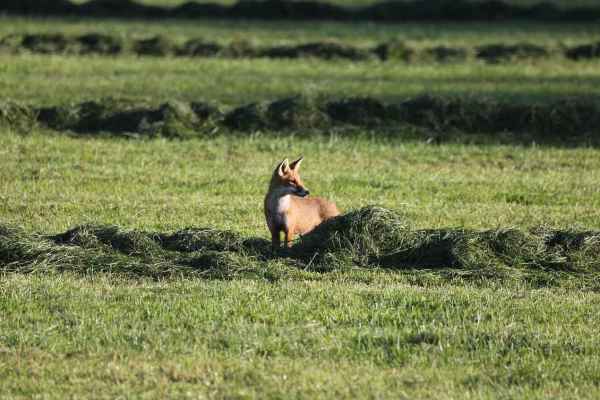
The portrait paints a peaceful picture: mist over the field, waiting for the sunrise, a fox that is spared. Under the headline «Gut feeling decides», the recreational hunter explains that prejudices against recreational hunting are based on isolated cases, that recreational hunting prevents damage to the forest, that game meat is organic meat, and that walkers need not be afraid. These statements are not put into context. Wild beim Wild has compared them against official regulations and the current state of research.
What the official hunting seasons actually provide for
Platform J writes that the roe deer hunt takes place on Mondays, Wednesdays and Saturdays until 15 November. These are the regular hunting days, but for the current season the information is incomplete. The 2026/2027 hunting regulations issued by the cantonal Directorate of Economic Affairs, Energy and the Environment also provide for an additional Thursday hunt on roe deer in selected priority areas within wildlife zones 1, 4, 5, 7 and 10. According to the same hunting regulations, each recreational hunter may acquire up to nine roe deer.
The notion of autumn as "hunting season" is also too simplistic. According to the canton's official overview, the hunting season for wild boar runs from 2 August to 31 January, and for foxes, raccoon dogs and raccoons from 1 September to 28 February. Which species may be hunted where, when and on which days varies by area and closed days. For people seeking recreation, however, the fact remains that armed recreational hunters can be expected somewhere in the canton for most of the year. How this disturbance regularly gets left out of the public debate is also illustrated by the case from the Eschenberg forest.
The fox and the gut feeling
The scene with the fox is meant to demonstrate restraint: it looks healthy, so it is spared. Conversely, this means the fox was a potential target, and that a glance through binoculars decides over life and death. A visual check is not a health assessment, and "gut feeling" is not a criterion of hunting regulations.
The scene also fits poorly with the later claim that every non-human animal killed ends up on the plate. Foxes are practically never eaten in Switzerland. The game-meat argument therefore cannot justify fox hunting at all. How contradictory the justifications of the recreational hunting associations are when it comes to fox hunting is documented in the fact-check JagdSchweiz argues against itself. The state of research on the effect of hunting on fox populations can be found on the page Hunting Fact Check.
Forest protection through recreational hunting?
The recreational hunter describes herself as a nature conservationist, because recreational hunting is said to prevent damage to the forest caused by excessive wildlife populations. The relationship is not that simple. Hunting pressure can influence the behaviour of roe deer and thus the distribution of browsing damage: hunted animals become more wary and retreat more into the cover of the forest during the day — precisely where regeneration is growing. Whether recreational hunting actually reduces forest damage therefore also depends on hunting pressure, hunting locations and forest structure, not solely on the number of kills. How the forest-versus-wildlife debate regularly ignores this factor is shown by the example of Lucerne.
The canton of Geneva has had no recreational hunting since 1974. Regulatory interventions there are carried out by professional game wardens, and the forest has not collapsed. These experiences are described in the article on Geneva hunting ban.
“Organic game meat” without organic certification
«Bio» is a protected term in Switzerland, subject to certification and controls. Products of hunting are excluded from the scope of the Bio Ordinance, meaning game meat from free-living wild animals is never bio-certified. Its distribution is governed by separate inspection and hygiene rules, which are not equivalent to a bio-certification process. How the «bio» narrative works is shown in the fact check «Bio Bio Plus» and other legends.
Separate from this is the health risk. The Federal Food Safety and Veterinary Office (BLV) states that game meat from animals killed with lead ammunition can contain high lead levels, and recommends eating such game only rarely. The BLV advises that children up to the age of seven, pregnant women, breastfeeding women and women wishing to conceive should, as a precaution, avoid game meat entirely, since the ammunition used cannot always be determined. How the catering trade and the media gloss over these warnings is shown in the analysis of the Grisons gourmet trail.
Part of the image of the quiet wait hunt is something the portrait mentions only in passing: in the afternoon, the recreational hunter switches to a driven hunt with dogs, and a colleague kills a roebuck. Shots at moving animals, or shots taken under time pressure, carry a higher risk of wounding, which is why this second form of hunting deserves its own assessment. What missed shots and follow-up searches mean for the animals affected and the dogs deployed is described in the article Why so many hunting dogs are needed.
«No need to be afraid» in the shared forest
The recreational hunter reports that she is not infrequently approached by outsiders about recreational hunting, often out of unease. Her answer: there is no need to be afraid. The general risk in the Bernese forest cannot be quantified from a single case. But that bystanders can indeed be harmed during a hunt is shown, for example, by the trial following a driven hunt accident in Harkebrügge, in which a woman was seriously injured by a shotgun pellet in her own garden. The unease felt by forest visitors is not a misunderstanding that can be cleared up with a conversation, but an understandable reaction to firearms in a recreational area.
Commentary: recreational hunting as entertainment format
Platform J packages the killing of non-human animals in three friendly frames: as an archive gem, as an emancipation story, and as a prize draw. The fact that, at the end of the day, a roebuck is dead appears in the text as a “success”. The claim that criticism of recreational hunting is based on isolated cases remains unchallenged, and no voice critical of hunting appears.
The gender discourse distracts from the core issue here. For the roe deer, it makes no difference whether a man or a woman pulls the trigger. The question is not who is allowed to hunt, but whether recreational hunting lives up to its own justifications. From our point of view, media outlets that run a prize draw called “Hunting Fever” and dig up portraits of recreational hunters for it are engaging in image cultivation rather than journalism. The same pattern can currently be seen at the broadcaster RTR, which is raffling off a hunting licence and crowning the “most beautiful” trophy photo. Independent surveys show that the public views recreational hunting considerably more critically than such formats suggest, as set out in the article on the hunting barometer. Further background information is compiled in the Dossiers by Wild beim Wild.
More on the subject of recreational hunting: In our dossiers on the criticism of recreational hunting gather fact-checks, analyses and background reports. What the research says about this is shown by Hunting fact-checked: the state of research.
The position of IG Wild beim Wild: IG Wild beim Wild rejects recreational hunting. Our model is the canton of Geneva, which has managed without recreational hunting since 1974: without hunting seasons, without hunting dogs, without driven hunts, without high seats, without the animal cruelty and crime that go hand in hand with hunting season elsewhere. What has worked there for over fifty years disproves every position paper by JagdSchweiz. An association that bases its policy on claims it refutes in its own documents is not a professional organisation, but a factory for misinformation.

All articles are written by IG Wild beim Wild as well as by external co-authors. Research, structuring and editorial processes may be supported by AI-assisted tools.
Support our work
With your donation you help protect animals and give their voice a hearing.
Donate now →