RTR: SRG broadcaster raffles hunting licence and crowns the “most beautiful” trophy photo
The fee-funded Radiotelevisiun Svizra Rumantscha runs a daily kill hotline, a photo competition featuring dead wild animals, and a greetings slot for recreational hunters during the Grisons high hunt.
«Hunter's Tales»
Anyone running a household in Switzerland pays around 335 francs a year to Serafe.
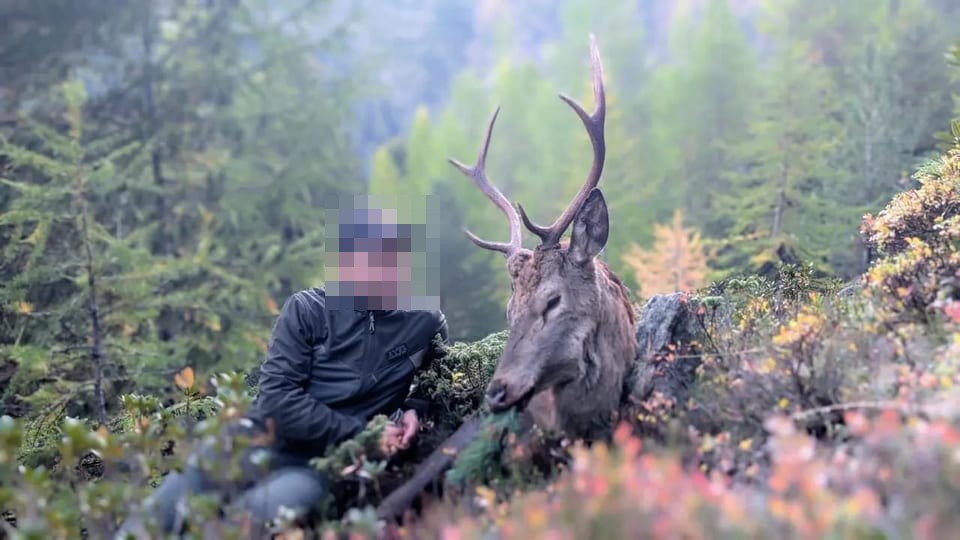
This is how the SRG is financed, and this also finances Radiotelevisiun Svizra Rumantscha (RTR), the Romansh-language corporate unit of the SRG. What RTR does with this money during the Grisons high hunt 2026 can be read on its own website: the broadcaster runs a hunting portal, takes kill reports by phone every hunting day, raffles off a hunting licence for 2027 among the entrants, and lets the public vote for the «most beautiful» photo of the hunt. The winning image of 2025 shows a recreational hunter with a living being he has shot dead.
The kill hotline
The campaign is called “La Preda”, the prey. According to RTR, listeners can call the studio at 10:30 a.m. on every hunting day, from 3 to 13 and from 21 to 30 September 2026, to report a killed animal. The questions asked are: who shot it, which animal, on what day, at what time, and where. The prize is the hunting licence for the year 2027. In 2025, according to RTR, a recreational hunter from La Punt Chamues-ch won after his kill had been reported. The broadcaster congratulated him “cordialmain”.
A public broadcaster is thus offering a cantonal hunting permit – that is, the official authorisation to kill wild animals – as a competition prize. Imagine if Swiss Television raffled off a firearms acquisition permit among viewers. In recreational hunting, this counts as the cultivation of tradition.
The photo competition
Running alongside this is the segment «Preda, atmosfera, cumpagnia», German for «Prey, atmosphere, camaraderie». RTR invites the public to submit photos from the 2026 hunting season and has even published a guide for this purpose: «Tips and tricks for better hunting photos». At the end of the season, the most beautiful image is chosen by public vote. The 2025 winner: a recreational hunter with the sixteen-point stag he had killed.
In its terms of participation, RTR reserves the right not to publish photos that are «unworthy of the hunt or the animal». The broadcaster thus has its own dignity clause, similar to the one in the code of the Grisons hunters' association. And as with the association, practice shows what the clause is actually worth: a grinning shooter next to his dead red deer is deemed worthy enough for first place.
What an ethologist has to say about such images
How trophy photos come across outside hunting culture was described by the Ticino ethologist Nash Pettinaroli at the end of September 2026 in an interview with tio.ch after a photo of a recreational hunter driving a killed red deer through the streets of the Luganese region on a trailer went round. For Pettinaroli, this is not an isolated case but a symptom: more and more recreational hunters are putting their dead prey on display, on social media, in WhatsApp statuses, as selfies next to the carcass. He calls this display «disgusting» and warns of a creeping desensitisation: anyone who turns the death of a living being into a trophy photo erodes the empathy of an entire society. He rejects the argument that recreational hunting regulates the ecosystem, and refers to the zoologist Ragnar Kinzelbach, the biologist Karl-Heinz Loske, and the former director of the Gran Paradiso National Park, Bruno Bassano, who all describe recreational hunting as superfluous. What remains as the motive, he says, is pure pleasure. Pettinaroli, who says he has been threatened and had his car tyres slashed, asks: how can the death of a living being move someone? It is precisely this image, which a behavioural researcher describes as a sign of eroding empathy, that RTR crowns as the «most beautiful» photo of the hunt.
Greetings hour, hunting trainee, hunting music
Then there is «Salids da chatscha», a programme in which recreational hunters are greeted, congratulated and serenaded with music, under the hunters' greeting motto «en bucca d’luf». There is the series «Il practicant da chatscha», in which an RTR presenter accompanies the season as a hunting trainee, starting with being fitted out with gear. There is the segment «Tempra da chatscha en la musica», featuring choral, brass band and folk music pieces about the hunt. And since 2007 there has been the series «Latin da chatscha», hunters' tales, in which old recreational hunters tell their stories.
Even the youngest viewers are catered for: in the children's programme «Minisguard», RTR explains why hunting is «necessary at all». The answer turns out just as one would expect from a broadcaster that, in the same breath, raffles off a hunting permit.
In fairness: RTR also reports on the darker sides. In early September 2026, the broadcaster documented five cases from police reports in which recreational hunters in Grisons had shot domestic animals – two horses and three dogs, most recently a horse in Avers Cröt on the first hunting Sunday of 2026. This kind of reporting fulfils a journalistic function. Alongside it, however, the hunting portal largely stages kills, trophies and hunting camaraderie in an affirmative light.
What the law requires of the SRG
The Radio and Television Act (RTVG) sets limits for the SRG. Under Article 4 paragraph 1 RTVG, programmes must neither glorify nor trivialise violence. Under Article 4 paragraph 4, licensed programmes must adequately reflect the diversity of events and views across the totality of their editorial broadcasts. According to Article 5a RTVG, the SRG's online offerings are subject to the same programme principles regarding factual accuracy and depictions of violence, whereas the diversity requirement applies only to election and referendum dossiers. Article 24 RTVG further obliges the SRG to contribute to the free formation of opinion through comprehensive, diverse and factually appropriate information.
Recreational hunting is socially and politically contentious in Grisons. There are popular initiatives, petitions, criminal complaints and court proceedings, and a 2024 study of 1,050 Generation Z respondents shows that trophy photos on social media predominantly trigger rejection. In the sections of the RTR hunting portal that we examined, we found no critical framing of hunting, no statement from an animal welfare organisation, no scientific perspective on the claimed necessity of recreational hunting, and no reference to alternative models such as the canton of Geneva, which has been hunting-free since 1974.
Whether a daily kill hotline and a public competition featuring images of killed animals are compatible with the ban on trivialising violence is a question that can be put to the SRG.R ombudsman's office. Anyone can file a complaint there within 20 days of publication. In any case, a broadcaster that stages kills as a public game and raffles off a hunting permit is no longer a neutral observer. It has become part of the hunting culture it claims to document. And it does so with money that must also be paid by those residents of Grisons who reject that culture.
Commentary by IG Wild beim Wild
The Grisons hunters' association states in its code of conduct that trophy photos must respect the dignity of the wild animal. Its sections do not adhere to this, as we documented in the article Hunting code Grisons: The contradiction within its own ranks. The Grisons judiciary sees no reason to examine such images, as we described in the article When hunting images become the justice system's blind spot in Grisons. And now it turns out that the canton's public broadcaster is turning these very same images into a competition.
That, in our view, is the real scandal. Not that hunting associations post what hunting associations post. But that a fee-financed institution with a statutory information mandate treats recreational hunting like a public festival, reports kills like scores in a game, and raffles off a hunting licence as if it were a ski pass. Large parts of the portal are not reporting on hunting, but advertising for it. No police officer, no soldier would be allowed to pose with their victims the way the winning photos from RTR show. A police officer who had themselves photographed laughing next to someone killed after a fatal use of firearms, and posted the picture online, would lose their job before the day was over. A soldier who posed like this with the fallen would be dishonourably discharged. Service law allows for no grey area here, and no one would think of excusing such behaviour as tradition. In the case of recreational hunting, the general public finances the stage for it.
The IG Wild beim Wild is documenting the Grisons 2026/27 hunting season on an ongoing basis in the article Grisons hunt 2026/27: incidents, violations and developments at a glance.
Sources (all accessed on 25 September 2026):
RTR hunting portal «Chatscha grischuna»: https://www.rtr.ch/novitads/grischun/chatscha
«La Preda, Annunziai la preda» with terms of participation (RTR, 2 September 2026): https://www.rtr.ch/novitads/grischun/chatscha/la-preda-annunziai-la-preda-3
Winning photo 2025 «Quai è la pli bella fotografia da la chatscha 2025» (RTR): https://www.rtr.ch/novitads/grischun/chatscha/preda-atmosfera-cumpagnia-quai-e-la-pli-bella-fotografia-da-la-chatscha-2025
«Tips e trics per meglras fotografias da chatscha» (RTR): https://www.rtr.ch/novitads/grischun/chatscha/chatscha-2024-tips-e-trics-per-meglras-fotografias-da-chatscha
«Preda per negligientscha» (RTR, 8 September 2026): https://www.rtr.ch/novitads/grischun/chatscha/preda-per-negligientscha-dus-chavals-e-trais-chauns-ch-en-daventads-preda
Radio and Television Act (RTVG, SR 784.40), Art. 4, 5a, 24, 91 and 92.
More on the subject of recreational hunting: In the dossier The Role and Criticism of Recreational Hunters we shed light on the training, power and self-image of recreational hunters. The scientific evidence is presented in the overview Studies on the Effects of Recreational Hunting.
The position of IG Wild beim Wild: IG Wild beim Wild rejects recreational hunting. Our model is the canton of Geneva, which has managed without recreational hunting since 1974: without hunting seasons, without hunting dogs, without driven hunts, without high seats, without the animal cruelty and crime that go hand in hand with hunting season elsewhere. What has worked there for over fifty years disproves every position paper by JagdSchweiz. An association that bases its policy on claims it refutes in its own documents is not a professional organisation, but a factory for misinformation.

All articles are written by IG Wild beim Wild as well as by external co-authors. Research, structuring and editorial processes may be supported by AI-assisted tools.
Support our work
With your donation you help protect animals and give their voice a hearing.
Donate now →