Zug recreational hunters challenge follow-up search obligation and abolition of fox bounties before Federal Supreme Court
Ten francs per fox tail, five per crow: because the canton of Zug has scrapped these bounties and is sticking with the follow-up search obligation after missed shots, six recreational hunters are taking legal action in Lausanne.
«The Salt Lick»
Six recreational hunters from Zug have filed an appeal with the Federal Supreme Court against several provisions of the cantonal hunting regulations for 2026/27.
This is reported by the «Zuger Zeitung» and the «Bote der Urschweiz», based on a statement from the appellants. In parallel, the six have also lodged a complaint and an administrative appeal with the Cantonal Council against the Department of the Interior. Their accusation: the regulations exceed the canton's authority, violate superior law, and harm biodiversity.
Two points are at the centre of the dispute. The canton no longer pays bounties for killed foxes and crows. And it requires a follow-up search with a certified dog after every shot that fails to bring down the animal.
The appellants justify taking the matter directly to Lausanne by pointing out that the canton of Zug has no cantonal abstract review of norms for such ordinances. According to the «Bote», the Department of the Interior confirms that there is no cantonal lower instance. For now, the proceedings have no effect on the current season: as long as the Federal Supreme Court has not ruled on the requested suspensive effect, the regulations remain unchanged. Depending on the species, recreational hunting in Zug runs from 1 September 2026 to 15 February 2027.
Ten francs per fox tail
Until last season, the canton of Zug paid so-called turnover bounties: 10 francs per delivered fox tail — known as a "fox brush" in hunters' parlance — and 5 francs per crow. This was set out in § 20 of the 2025/26 hunting regulations. The Directorate of the Interior repealed these provisions on 29 June 2026; since 3 July 2026 they no longer apply. The only thing that remains is the possibility, within the framework of special permits, of paying bounties for killing animals that cause damage. Appellant Charly Keiser sees this as reducing the incentive to hunt predators and describes himself as «stunned». If foxes and crows are no longer shot in sufficient numbers, he argues, ground-nesting birds, roe deer fawns and brown hares would come under pressure. The six are demanding the «immediate withdrawal» of the provisions.
The Directorate of the Interior counters that the matter was examined by experts and discussed in detail in the cantonal hunting commission. Foxes and crows may continue to be shot; only the flat-rate financial incentive has been scrapped. It sees no professional justification for additionally increasing hunting pressure on these species with money. Where there are concrete species-protection or damage problems, targeted measures would be taken.
A bounty per tail is the oldest form of wildlife policy: it rewards the killing, not its effect. This logic dates back to a time when foxes, birds of prey and corvids were categorically regarded as «vermin», as the article Pest or beneficial species: the ideology behind fox hunting traces. The fact that a canton is abolishing this bounty in 2026 is not an attack on biodiversity, but the belated end of a relic.
The study that the canton itself commissioned
The scrapping does not stand alone. Following a petition by the Lucerne lawyer Pascal Wolf, the Zug Office for Forestry and Wildlife had fox hunting investigated by the SWILD bureau. The 25-page study by Dr Claudia Kistler and Dr Fabio Bontadina concluded in May 2026 that licence hunting of foxes in Zug neither sustainably reduces populations nor curbs wildlife diseases. Hunted populations compensate for losses through more offspring, better survival rates and immigration. The hunting commission subsequently decided on 16 June 2026 to adopt three measures, including no longer proactively promoting fox hunting. The background is documented in the articles Canton of Zug stops promoting fox hunting.
On 19 June 2026, Landammann Andreas Hostettler confirmed the hunting commission's decisions to the petitioner in writing. Ten days later, on 29 June, the Directorate of the Interior abolished the bounty payments for foxes and crows. The reporting does not draw an explicit link between the study, the commission's decision and the abolition of the bounty. However, the sequence of events and the substance strongly suggest one: a kill bounty is proactive promotion of hunting in its purest form. Anyone demanding its reinstatement is essentially contesting the consequence of a wildlife-biology expert study.
The complainants' biodiversity argument likewise does not hold up against the state of research. The decline of the European hare, grey partridge or skylark is primarily due to intensive agriculture, lack of cover and habitat loss. In Switzerland, roe deer fawns die mainly under the mower blade. Where foxes are hunted, young animals and immigrants quickly fill the gaps, and the pressure on ground-nesting birds remains unchanged. Contradiction is now even coming from hunting circles, as the article Rift in the hunters' camp: Ecological Hunting Association questions JagdSchweiz's fox hunting stance shows. The state of research can be found on the page Hunting Fact Check.
Follow-up search after every missed shot
The second point of contention is Paragraph 17 of the Hunting Operations Regulations. It requires that a follow-up search with a dog certified for this purpose be initiated immediately after every shot fired that does not result in a kill. The complainants consider this disproportionate and going beyond the federal hunting act. Even after a shot where one is certain nothing was hit, a follow-up search must be organised, they argue.
The Directorate of the Interior justifies the rule with a simple animal welfare consideration: if a kill does not result, it cannot be ruled out in every case that an animal was nevertheless wounded. A supposedly certain missed shot is therefore not the same as an uninjured animal. In fact, the obligation is not new. The 2025/26 Hunting Operations Regulations already contained it in essentially the same wording in § 17, including immediate notification of the wildlife wardens. For 2026/27, individual paragraphs were adjusted, but the underlying principle remained unchanged. What is being contested, then, is not a new requirement, but an animal welfare rule under which the Zug recreational hunters have been hunting for years.
This is exactly where the crux of the matter lies. Whether a shot has hit its target is judged by the shooter alone, often at dusk, at a distance and under pressure. A wounded roe deer, a fox with a shattered jaw or a red deer with a leg wound not infrequently flees without any visible sign and dies hours or days later. The Amden case, in which a wounded animal was not tracked down, shows just how little the controls take effect without clear obligations: “Quite common in hunting circles”: what rulings and hunting reports from three cantons show. A mandatory follow-up search after every missed shot shifts the risk to where it belongs: from the injured non-human animal to the person who fired the shot. That precisely this minimum animal welfare rule is being fought all the way to the Federal Supreme Court says more about the self-image of part of the Zug recreational hunting community than about the regulation itself.
A minority against its own association
The appellants speak of a «wrong political direction» and accuse the canton of disregarding local conditions as well as the interests of biodiversity, agriculture and the hunting community. The Directorate of the Interior counters that the discontent of a few recreational hunters does not mean that these concerns have not been taken into account. The regulations, it says, are drawn up every year together with the hunting commission and the hunting community. The Zug Cantonal Licence Hunters' Association stands behind the hunting operation regulations.
This means six individuals are not only opposing the cantonal administration, but also their own association. The Federal Supreme Court will examine whether the Zug rules are compatible with superior law. One question, however, the proceedings have already answered: Zug shows that a canton can draw consequences from wildlife-biological findings, and that resistance to this does not come from science.
All information on fox hunting in the canton of Zug, on the decision and on contact details can be found on the campaign page Fox hunting in the canton of Zug. An overview of all cantons is offered by End fox hunting, the background information in the dossier «The fox in Switzerland».
Sources: «Zuger Zeitung» / «Bote der Urschweiz», 24 September 2026; canton of Zug, Hunting Operation Regulations 2025/26 and 2026/27 (BGS 932.111).
Addendum of 26 September 2026
The Zug Cantonal Licence Hunters' Association, which according to its own statements represents nearly all Zug licence hunters, has distanced itself “explicitly and in no uncertain terms” from the group around Charly Keiser. As zentralplus reports, the association criticises the six complainants for having portrayed themselves in their press release as “the hunters of Zug”. The distancing explicitly concerns the demand to relax the mandatory follow-up search, the demands regarding the fox and crow bounty, and the personal attribution of responsibility to Regierungsrat Andreas Hostettler.
Keiser describes the SWILD study commissioned by the canton as “nonsense” and the comparison between Geneva and Zug as “pointless”, as reported by zentralplus. He does not name the “numerous other studies” that allegedly come to the opposite conclusion. The state of research shows the opposite: more than 30 studies and case examples, including Luxembourg, Geneva, England and national parks, demonstrate that fox populations regulate themselves and that hunting neither reduces populations nor protects ground-nesting birds. The overview is available on the page Hunting Fact Check, the evidence on self-regulation in the Self-regulation dossier.
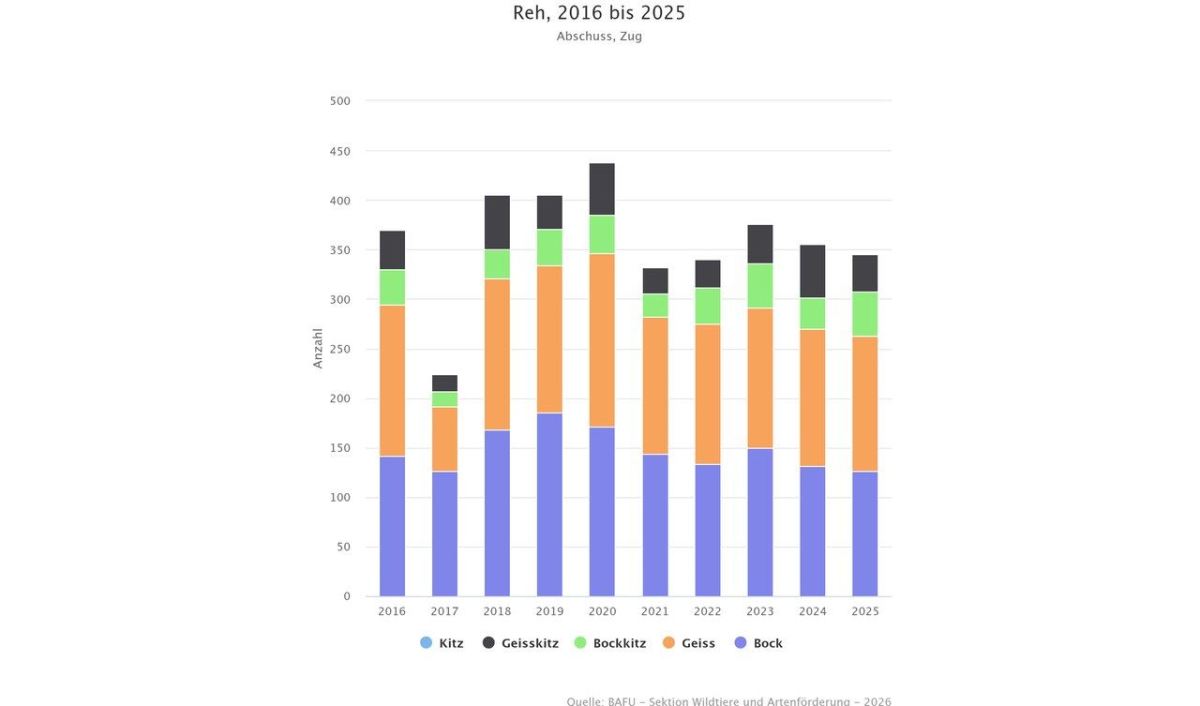
It is also notable who is speaking here on behalf of roe deer fawns, hares and grouse. According to Federal Hunting Statistics, Swiss recreational hunters kill around 10,000 roe deer fawns every year, along with brown hares, black grouse and ptarmigan. In the canton of Zug itself, recreational hunters shot around 345 roe deer in the 2025 hunting year, including more than 80 fawns – nearly a quarter of the total kill. This proportion has remained stable at between a fifth and a quarter since 2016. Anyone who shoots dozens of roe deer fawns themselves, year after year, can hardly pose as their protector against the fox.
The canton of Geneva, whose comparison Keiser considers pointless, has managed without recreational hunting since 1974; necessary interventions are carried out by professional game wardens. Since then, an increase in biodiversity has been documented there, particularly among ground-nesting birds and brown hares: with 17.7 brown hares per 100 hectares, the highest density in the whole of Switzerland was recorded in Geneva in 2016. The evidence for this can be found on the page Geneva without recreational hunting.
The group has also newly criticised the canton's hunting app, because it records kill locations and the positions of recreational hunters; according to the Department of the Interior, the data protection questions are currently under review. In future, the hunting commission wants to collect more precise figures on kills, wildlife damage, special kills and fallen game in order to be able to assess the effectiveness of fox hunting. The appeal before the Federal Supreme Court is likely to face an uphill battle: the obligation to conduct a follow-up search already applied previously, federal law leaves the details to the cantons, and there is no legal entitlement to a kill bounty.
Sources: zentralplus, «A hunting group takes aim at Hostettler», 26 September 2026; Federal Hunting Statistics (jagdstatistik.ch).
More on the subject of recreational hunting: In the dossier The Role and Criticism of Recreational Hunters we shed light on the training, power and self-image of recreational hunters. The scientific evidence is presented in the overview Studies on the Effects of Recreational Hunting.
The position of IG Wild beim Wild: IG Wild beim Wild rejects recreational hunting. Our model is the canton of Geneva, which has managed without recreational hunting since 1974: without hunting seasons, without hunting dogs, without driven hunts, without high seats, without the animal cruelty and crime that go hand in hand with hunting season elsewhere. What has worked there for over fifty years disproves every position paper by JagdSchweiz. An association that bases its policy on claims it refutes in its own documents is not a professional organisation, but a factory for misinformation.

All articles are written by IG Wild beim Wild as well as by external co-authors. Research, structuring and editorial processes may be supported by AI-assisted tools.
Support our work
With your donation you help protect animals and give their voice a hearing.
Donate now →