Pest or beneficial species: the ideology behind fox hunting
Tens of thousands of foxes die in Zurich, and in more than nine out of ten cases the canton cannot name a reason. This is not a gap in the data, but a mindset that judges animals by category rather than by individual case, one that was codified by the state in the Reich Hunting Act of 1934.

«In the old den»
After the AfD's election victory in Saxony-Anhalt, Swiss satirist Mike Müller spoke on «X» of «a good million Nazis».
An AfD voter reported him for defamation, slander and insult. Zurich criminal law specialist Matthias Michlig told Nau.ch that the complaint has «rather poor chances of success», since in cases of defamation only the directly injured person is entitled to file a complaint, and this direct personal impact is regularly absent in blanket attacks on large groups.
That is the boundary within which one may name an ideology without pillorying an individual person. This is exactly the boundary needed here. We are not saying that this or that recreational hunter is a Nazi. We are saying: the thinking that has sustained fox hunting to this day originates from an era that must be called by its name.
The fox dies because it is a fox
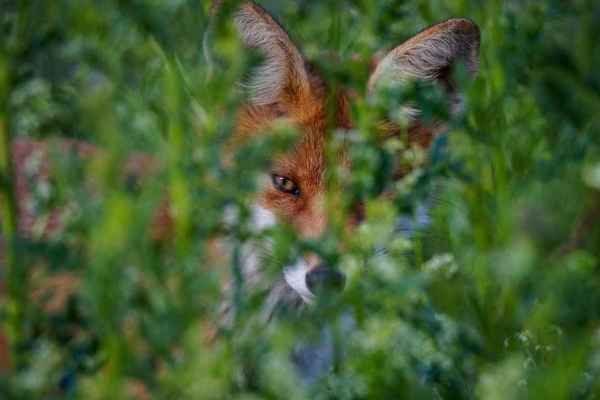
The canton of Zurich justifies fox hunting by claiming that a large proportion of the animals are sick or in conflict with agriculture and the population. The electronic game register, in which recreational hunters record their own kills, tells a different story. Of the 21,846 foxes shot between 2015 and 2025, only 7.7 percent carry any indication of illness or injury. Conflicts with agriculture and the population are not recorded by the administration at all, and it itself admits that it cannot back up its claim with any data. For more than nine out of ten foxes shot, therefore, not a single documented reason exists.
This is not an oversight, it is the very core of the matter. These foxes do not die because they are sick, nor because they have caused damage, but because they are foxes. The kill needs no justification in the individual case, because the justification has long since been embedded in the category. The fox is filed under “killable”. And this filing has a history.
The full data analysis can be found in our article Fox hunting in Zurich: The game register disproves the canton's disease justification.
A hunting act from the era of forced conformity
Shortly after seizing power, Hermann Göring had a hunting act drawn up. On 3 July 1934, it was passed as the first binding, uniform Reich Hunting Act and replaced the 17 state hunting laws then in existence. It elevated “German Waidgerechtigkeit” (hunting ethics) to a legal concept, alongside a duty of wildlife management, hunting examinations and kill quotas. Göring prefaced the act with a preamble he largely wrote himself, which invoked a “noble art of German hunting craft”, built upon “ancient Germanic tradition”.
Accuracy requires a distinction that hunting apologists themselves like to invoke. The technical part of the act is considered comparatively apolitical, and the full blood-and-soil codification is said to reside not in hunting law but in the 1935 Reich Nature Conservation Act and the forcibly conformed nature conservation apparatus. However, the German Wikipedia characterises precisely Göring's preamble as shaped by eugenic thinking and National Socialist blood-and-soil ideology. The völkisch-Germanic framing is thus present in the hunting act itself.
That hunting and nature conservation bore the same signature was no coincidence. Nature conservation under National Socialism began in 1933 with the forced conformity of associations and the exclusion of Jewish members, was institutionally placed under the Reich Forestry Office under Göring, and was ideologically bound up with a völkisch concept of homeland and blood-and-soil ideology. The head of the Reich Office for Nature Conservation, Walther Schoenichen, published a work in 1942 entitled “Naturschutz als völkische und internationale Kulturaufgabe” (Nature Conservation as a Völkisch and International Cultural Task) and was an antisemite for much of his career. Hunting, nature conservation and völkisch notions of order converged within the same apparatus, under the same man.
Beneficial and harmful: how a category became law
The ideological heart of this order is a single distinction: useful or harmful. There is the cherished, the "strong" game that one raises in order to kill it, and there is the "vermin" that one exterminates so that the cherished game may flourish.
This was no mere image, it was law. The term "vermin" was part of the content of the German Federal Hunting Act until 1976, and protecting game from vermin was considered part of the "content of hunting protection". Fox, wolf, otter, lynx, beaver, birds of prey and crows were combated with the help of bounties. At the beginning of the 20th century, poisoned bait laced with strychnine was laid out against the fox. The fox was the prototype of the predator whose right to exist was denied by category.
The National Socialists did not invent this classification, but they charged it ideologically. In the pedagogy of the 1930s and 1940s, animals served to explain to children what, in the National Socialist sense, constituted a "pest" or "parasite". The category was therefore not merely a technical hunting term, but part of a worldview in which hunting, nature conservation and völkisch order converged within the same apparatus. One does not need to spell out the inhumane side of this worldview to see its core: the presumption to divide life according to its usefulness to an established order and to eliminate what is deemed inferior.
Why Switzerland is not exempt
This is where the hunting lobby strikes back, and one must take the wind out of its sails. Swiss hunting law does not originate from the Nazi era. The federal Hunting and Protection Act dates from 1986, hunting is regulated at cantonal level, and it is not derived from the Reich Hunting Act. Whoever claims the opposite makes themselves vulnerable.
Only, that changes nothing about the underlying thinking. The law is newer, but the mental template is the same. "Fair chase", the idea of game management, man as regulator, the silent division of the animal world into desirable and undesirable: all of this lives on unchanged in the self-image of Switzerland's recreational hunters. And the Zurich fox demonstrates it. When a canton has 21,846 animals shot and cannot give a reason for more than nine out of ten of them, it is not acting according to biology, but according to category. The fox has remained the "pest", even without the word still appearing in the law. Geneva has managed without fox hunting since 1974. So it is possible without it. Zurich does not want to.
The predictable objection
Hunting apologists, including a report by the Scientific Service of the German Bundestag, argue that the technical part of the Reich Hunting Act was couched in apolitical language. That is even true, and it refutes nothing. The problem is not the individual clause, but the world-view that produced it. Even hunting media confirm that this continuity exists: the trade magazine «Pirsch» wrote about it under the title «Green clauses, brown mindset». And the nature conservation association NABU states that the massive persecution of predators is a consequence of the «vermin control» propagated in hunting circles, and that the fox is still hunted without justification to this day.
What follows from this
In the end, the case of Mike Müller shows the right approach: one may name a world-view without defaming an individual person. Wild beim Wild does exactly that. We do not claim that the Zurich game warden or the recreational hunter next door is a National Socialist. We state that the category which has cost 21,846 foxes their lives stems from a way of thinking that a criminal regime cast into law: the division of life into valuable and worthless. This foundation needs to be dismantled, and the first step towards that is to name it.
More on this topic: The sociological proximity of recreational hunting and right-wing extremism is shown in our article The overlaps between recreational hunters and right-wing extremists. How hunting acts organise control is set out in the dossier Hunting Laws and Control. Who is behind the figure is shown by The recreational hunter in the 21st century. Anyone wanting to change the Zurich practice will find the way on the campaign page Stop fox hunting.
More on the subject of recreational hunting: In the dossier The Role and Criticism of Recreational Hunters we shed light on the training, power and self-image of recreational hunters. The scientific evidence is presented in the overview Studies on the Effects of Recreational Hunting.
The position of IG Wild beim Wild: IG Wild beim Wild rejects recreational hunting. Our model is the canton of Geneva, which has managed without recreational hunting since 1974: without hunting seasons, without hunting dogs, without driven hunts, without high seats, without the animal cruelty and crime that go hand in hand with hunting season elsewhere. What has worked there for over fifty years disproves every position paper by JagdSchweiz. An association that bases its policy on claims it refutes in its own documents is not a professional organisation, but a factory for misinformation.

All articles are written by IG Wild beim Wild as well as by external co-authors. Research, structuring and editorial processes may be supported by AI-assisted tools.
Support our work
With your donation you help protect animals and give their voice a hearing.
Donate now →