Why so many hunting dogs are needed: the concealed flip side of the examination idyll
JagdSchweiz celebrates blood-tracking dog trials as animal welfare. Yet the follow-up search merely reflects how often hobby hunting misses its mark. Behind it: earth hunting, artificial burrow facilities and a life in the kennel.
«Lullaby for the Uncounted»
Hobby hunting clubs celebrate their blood-tracking dog trials as a contribution to animal welfare.
They never ask the decisive question: why are these hordes of dogs needed in the first place? The honest answer leads to missed shots, earth hunting, training on live animals and a life in the kennel.
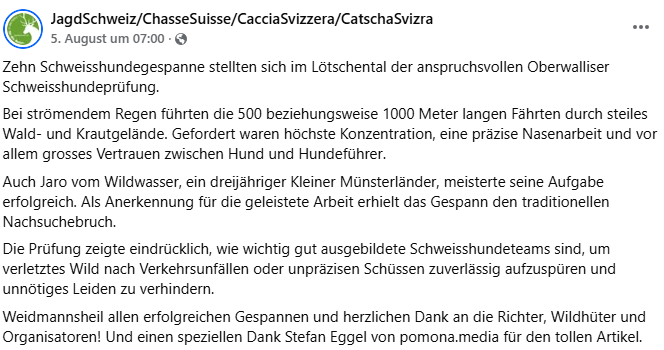
At present, numerous dog trials are taking place all across Switzerland, and the hobby hunting clubs like to portray themselves as guardians of animal welfare. JagdSchweiz, the umbrella body of Switzerland's hunting organisations, celebrated the trials on its official Facebook page with the message that well-trained hunting dogs are «indispensable for responsible hunting». There is talk of «passion», «commitment» and «good searching», of voluntary hours and certified teams on 500- and 1,000-metre tracks. What is consistently missing from this self-portrayal is the only question that counts: why are these hordes of blood-tracking dogs needed in the first place?
The honest answer appears in no JagdSchweiz communiqué. A tracking dog follows the blood trail of an animal that was not killed instantly. «Schweiss» is the hunting euphemism for the blood that a wounded, fleeing animal loses. Every single follow-up search is thus the documentation of a shot that failed to hit its target cleanly. The elaborate training celebrated here as a virtue is in truth the admission of a structural problem: on the hobby hunt, animals are regularly missed, grazed and wounded.
The follow-up search as a mirror of the miss rate
How often shots miss can only be quantified where records are kept at all, and that is the great exception. There is no Switzerland-wide statistic on follow-up searches for wounded game. Only a handful of cantons document follow-up searches in the first place. Where figures do exist, they are sobering: in Grisons in 2016, out of 5,440 red deer killed, 564 animals had a gunshot wound. That is more than one in ten red deer that were not killed cleanly but merely wounded.
The picture becomes even clearer with the success rate of follow-up searches. Depending on the canton, it stands at just 35 to 65 per cent. This means that around half of the animals wounded on the hobby hunt can never be released from their suffering. They drag themselves away with shattered legs, gut shots or splintering bones and perish over hours or days, beyond the reach of any statistic.
In expert circles, the follow-up search rate is, for good reason, regarded as an approximate value for the miss rate. Anyone wishing to understand this connection will find it derived in detail in our analysis of the driven hunt: shots at fleeing animals are fundamentally less reliable than shots at stationary ones. It is precisely for these predictably unclean hits that the celebrated dogs are kept on hand.
Geneva proves that it can be done differently
The decisive question is not how many dogs an unclean hobby hunt requires, but whether the unclean hobby hunt is needed at all. The canton of Geneva provides the answer. There, hobby hunting has been banned since 1974, and the few necessary kills are carried out by professional game wardens with state-recognised specialist training, at night, using light amplifiers and after individual identification of the animal.
The result is a hit quality that hobby hunting can only dream of. The cantonal wildlife inspector puts it in these words: «Ninety-nine point five per cent of the animals shot are killed instantly.» The suffering is minimal, he says; there are almost no cases in which animals survive a kill wounded. Where the work is done professionally and with a single, well-considered shot, the entire follow-up search infrastructure simply becomes superfluous. Why this works is shown in our article on the hunting ban in the canton of Geneva.
The contrast could hardly be sharper: on the one hand an instant-death rate of 99.5 per cent with three full-time staff, on the other a nationwide follow-up search success rate of 35 to 65 per cent among tens of thousands of hobby shooters. It is not the extent of the dog training that determines the animals' suffering, but the skill at the trigger.
Geneva thereby exposes a second self-deception. Alongside the follow-up search, the JagdSchweiz post explicitly names the «work before the shot» as a field of deployment for the dogs. This very use has nothing to do with animal welfare. Flushing and tracking dogs drive wild animals out of their cover so that the hobby hunter can get a clear shot at all. This does not serve the animal, but the hunting success. In Geneva, where aim is taken with light intensifiers and the wait is based on identifying individual animals, not a single dog is needed for this. Where the work is done professionally, no animal has to be chased and flushed out first so that a leisure shooter gets an opportunity.
Driven hunts: the system that produces the follow-up search
The demand for follow-up searches is densest where hobby hunting shoots most sloppily: in driven and driven hunts. Here all the risk factors converge: fleeing animals moving at changing speeds, unclear backgrounds, several shooters in close proximity and the social pressure to pull the trigger within a fraction of a second. That animals are frequently grazed and wounded under these conditions is not an operational accident but the predictable consequence of the method. Anyone wishing to read up on the connections in detail will find them in our analysis of the driven hunt.
The celebrated tracking-dog trials thus hold in reserve precisely the capacity that a form of hunting makes necessary in the first place – one that predictably wounds rather than kills many animals. The dogs repair what the driven hunt causes.
What the trial photos do not show
The bloodhound examination is the presentable side of hunting dog work. The unpresentable side takes place underground and behind fences, and there it is not about follow-up searches, but about the training itself, often on live animals.
In the artificial earth the earth dog is prepared for earth hunting on a live fox. Although fox and dog are separated by a grille, from an animal welfare perspective the fox suffers mortal fear. The Schweizer Tierschutz classifies training on live foxes as an act of cruelty to animals. Experts judge the operation as training «for aggression», which as the setting of animals against one another is legally highly problematic. What happens in such facilities is shown in our article Cruelty to foxes in the artificial earth.
In the wild boar enclosure the dog is «tested» on hand-reared wild boars. Such enclosures present a picture that is completely detached from reality, as we set out in the article Wild boar enclosures in Switzerland: the animals are accustomed to dogs and humans and behave in a way that would never occur in the wild.
And in actual earth hunting the hobby hunter sends the dog into the burrow of a defensive animal. For this purpose the dogs are deliberately bred or trained to have «wild aggression», that is a certain prey drive, and they do not shy away from physical confrontations with their opponent either. In the narrow burrow the confrontation then occurs: actual fights are entirely possible, especially when the fox has to defend itself from a dead end. With the badger, which grows up to 18 kilograms and stands its ground against the dog instead of fleeing, severe bite injuries regularly occur on both sides. Why this archaic form of hunting deserves to be banned is shown in our dossier on the badger in Switzerland. And the fact that the burrow, as the natural refuge of the predators, is affected makes the intervention all the more serious.
All year in the kennel: the price the dogs pay
Hobby hunting shapes its dogs for its own purposes and fails to do justice to them for the rest of the year. For earth hunting, prey drive is deliberately bred in; for other tasks, a strong urge to move and to search. It is precisely this disposition that makes the animals utterly unsuited to a life in the kennel — and it is precisely there that they end up disproportionately often. The Swiss Animal Protection organisation notes that hunting dogs are particularly frequently kept in kennels and, because of their very high need for exercise and their extremely acute sense of smell, suffer especially under this form of housing. Often the kennels stand away from the settlement, so that the barking disturbs no one.
The documented consequences of this isolated housing are distressing. The Swiss Animal Protection organisation lists stereotypies such as circling and tail-chasing, apathy, self-licking of wounds, as well as aggression and excessive fearfulness. It is telling that the aggression here is not an innate viciousness but a reaction to under-stimulation and isolation. It is not the dog that is the problem, but the housing that denies it everything it was bred for. That this is no isolated case is shown by Valais, where the cantonal veterinary office had to respond to a growing number of housing arrangements that did not comply with animal welfare rules, in many cases involving hunting dogs.
What such conditions look like in concrete terms is documented by a case from the canton of Jura, over which IG Wild beim Wild filed a criminal complaint in April 2023. A hobby hunter kept at least four hunting dogs there in kennels that did not meet animal welfare standards, without daily exercise and without an outdoor enclosure. The dogs were in poor condition, behaviourally disturbed and aggressive as a result of years of such housing, the kennels full of faeces and urine. The full investigation can be found in the article Do the Jura hobby hunters protect more than they hunt?. That hunting dogs spend the whole year leading a miserable and bleak life in a kennel and can only let off steam during the hunting season is therefore not a polemical distortion, but proven by our own investigation.
If you pay attention in everyday life, you can see the pattern: hunting dogs that spend most of the year on a balcony, in a cellar or in a kennel, barking day and night out of frustration. What is a matter of course for a family dog — the daily exercise, the social contact, the mental stimulation — is denied to many of these highly driven animals. They are made keen for a few days of hunting a year and are managed for the remaining three hundred days like a tool that is put away when it is not needed.
How the dogs themselves suffer
For all the justified outrage at the suffering of hunted wild animals, one victim is regularly overlooked: the hunting dog itself. From an animal welfare perspective, it suffers on several levels — not because individual hobby hunters are malicious, but because the system treats the dog primarily as a high-performing working animal. Where usefulness and hunting function become the decisive yardstick, rest, bonding, health and a self-determined dog's life fall by the wayside.
The training itself is already stressful. Dogs are trained for toughness and confrontation with live wild animals, led into narrow pipes towards foxes and placed in situations that are also highly stressful and prone to injury for them. Animal welfare organisations additionally document as risks intimidating training methods extending to painful collars and electric stimulation devices. Such methods are contrary to animal welfare and must not be trivialised as folklore.
On top of this comes the danger during the work itself. In follow-up searches, drive hunts and earth hunts, dogs work in confusing terrain, in thorns and in water, and in the immediate vicinity of injured, defensive wild animals. Bite, stab and tear wounds, falls, gunshot injuries as well as damage to the eyes, head and neck are possible consequences. Particularly distressing is that dogs are used to pursue animals that have already been shot and are in a state of panic. In doing so, they become participants in a process that also burdens them physically and psychologically. Just how comprehensively this is documented is shown by our dossiers Hunting dogs: deployment, suffering and animal welfare and Hunting dogs — victims of hobby hunting.
What animal welfare and the law say
Criticism of the use of hunting dogs does not come from the activist corner, but from legal opinions and veterinary practice. The Swiss Animal Welfare Ordinance, in Art. 22 para. 1 lit. d TSchV, fundamentally prohibits the use of live animals for the training or testing of dogs, but grants an explicit exception for hunting dogs. This is precisely the legal core of the problem: what would count as animal cruelty for any other dog owner — setting a dog on a live animal — is legal for hobby hunting. Under Art. 75 TSchV, the only regulation is that the corresponding facilities require a cantonal permit; the act itself remains permitted.
The Swiss animal welfare organisation fundamentally rejects the use of earth dogs in earth hunting, and the Foundation for the Animal in Law concludes in an expert opinion that earth hunting fulfils the criminal offence of animal cruelty under Art. 26 of the Animal Welfare Act on several counts, both towards the wild animals and towards the dogs used. How brutal the reality is underground is described by veterinarian Dr. Ralf Unna from his practice: dogs would often emerge from the burrow badly mauled, with multiple lower-jaw fractures and multiple injuries to their legs and faces, which would have to be treated over weeks. For him this is a clear violation of the Animal Welfare Act.
How high the risk of injury is when used against wild boars is suggested by a 2019 survey cited in hunting circles: according to it, 95 percent of the dogs used in drive hunts on wild boar sustained injuries. As a survey this does not replace an independent study, but it fits into a clear picture that also supports the mis-shot thesis. The Veterinary Association for Animal Welfare reports that in driven hunts around two thirds of wild boars and about 60 percent of female roe deer show shots that are not immediately fatal. This is precisely where the fundamental problem becomes apparent: in Switzerland there is no binding obligation to report injured or killed hunting dogs whatsoever, just as there is no nationwide statistic for wounded wild animals. Without these figures the extent of the suffering remains invisible, and that is precisely what is politically intended.
A home-made problem, sold as a virtue
The calculation, which no club thank-you spells out, is simple. So many hunting dogs are needed precisely because so many shots miss their mark. The training, the drills and the examinations are not the solution to an animal welfare problem, but the management of a problem that hobby hunting produces itself. A profession that had mastered its craft would need no comprehensive infrastructure of blood-tracking dogs to clean up its own missed shots.
The federal hunting teaching manual states the principle unmistakably: the hunter's assessment of his own shot («I'm sure I missed») is irrelevant to the decision to conduct a follow-up search. Every animal that has been shot at and fled is to be searched for, because shooters are notoriously mistaken about their own hit performance. This is not an outside accusation; it is written in their own teaching.
It is telling that JagdSchweiz itself names the decisive cause in other contributions: in a report on an Upper Valais blood-tracking dog examination, the association writes that well-trained teams are needed to track down injured game after traffic accidents «or imprecise shots». So the imprecise shots are well known; they simply do not appear in the celebrated examination post. Anyone reading the next association announcement about «quality hunting dog work» should therefore keep in mind the question that is never asked there: a large part of this work would simply be superfluous if shots did not so often miss. «Suchenheil» is no reason for congratulations. It is the starting shot for the search for an animal that is suffering because a hobby shooter missed his target.
«Enjoyment» instead of necessity: the frame gives itself away
Hobby hunting gives itself away most clearly where it reveals its actual motive. In a further contribution, JagdSchweiz promotes the «Genusswoche Baselland», which is dedicated «entirely to hunting and to the valuable foodstuff game», with «delicious game recipes» and an invitation to discover the «diversity of Basel-Country hunting culture». With that, the self-disclosure is delivered: hobby hunting is not a necessity of food procurement, but a leisure pleasure staged as enjoyment and culture. Anyone who frames killing as «enjoyment» cannot at the same time invoke a practical necessity.
And the advertised «valuable foodstuff» is anything but harmless. The Federal Food Safety and Veterinary Office advises children up to the age of seven, pregnant women, breastfeeding mothers and women wishing to have children to avoid eating game as far as possible, because it cannot be ruled out that it was killed with lead ammunition. The current body of studies, which we have compiled in the article Game meat: health risks from lead and PFAS, is unambiguous: the average lead content in European game meat is around fourteen times higher than assumed in EU risk assessments, and there is no safe threshold value for lead. For children who regularly eat roe deer meat, an increased risk of IQ loss is documented. The French authority ANSES therefore advises limiting game consumption to no more than three times a year. Added to this are PFAS as persistent environmental toxins and zoonoses such as trichinosis, hepatitis E and salmonella. What is celebrated here as «indulgence» is, for the most vulnerable population groups, a scientifically and officially named health risk.
What must change
When the threads are drawn together, a picture emerges that has nothing more in common with the idyll of the examination. Dogs are bred for earth hunting with a heightened prey drive and sent into fights with foxes and badgers. They are trained on live foxes, even though this comes close to the offence of cruelty to animals. They provide the follow-up search capacity that a notoriously imprecise shooting practice makes necessary in the first place. And for the greater part of their lives many of them are kept isolated in kennels. In this chain, an animal suffers at every link: the fox, the badger, the wounded roe deer and the dog itself.
For over fifty years, Geneva has shown that this chain is not needed. Professional game wardens achieve an instant-death rate of 99.5 per cent, entirely without earth hunting, without training enclosures, without armies of kennels. Where work is done with professional expertise instead of leisure pleasure, the reason for almost everything described here disappears. This is not a utopia but a lived cantonal reality, as set out in our article on the hunting ban in the canton of Geneva.
That is why three things are needed: a nationwide ban on earth hunting and on training with live animals, a binding obligation to conduct follow-up searches with public success statistics, and consistent enforcement of animal welfare requirements in dog keeping. In the medium term, the Geneva model of professional wildlife management points the way out of a system that does not prevent animal suffering but merely manages it. Until then, this holds true: those who truly value hunting dogs do not celebrate their examinations, but end the practice that forces them into this existence in the first place.
LET'S STAY IN TOUCH!
We would like to send you the latest news and offers in our newsletter.
Support our work
With your donation you help protect animals and give their voice a hearing.
Donate now →