How Spanish providers court Swiss hobby hunters
A promotional email reveals bluntly what hobby hunting is actually all about.
«The pleasure hunt»
Recently another promotional email landed in our inbox that reveals, as rarely before, what the hobby hunting industry is actually striving for.
A Spanish provider calling itself «Hunting in Spain» specifically courts hobby hunting clubs with group trips to over 30 private hunting estates in Spain. The message is unmistakable: «Give your members the best hunting experience in Spain.»
What is missing from this email is at least as revealing as what it contains.
A product catalogue for dead animals
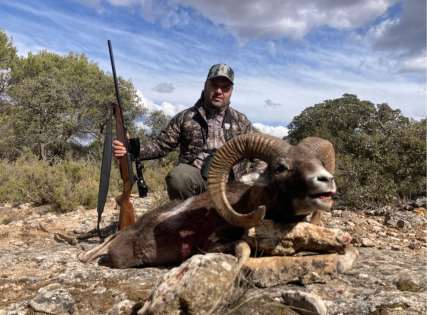
The email reads like the brochure of a tour operator, except that the goods consist of non-human animals. On offer are Barbary sheep, red deer, ibex, mouflon, fallow deer, wild boar, roebuck, chamois, grey partridge and rabbit, along with «premium driven hunts», meaning driven hunts in which as many animals as possible are to be killed in a short time. The provider promises «Trophy documentation», that is, the official documentation of the killed animals as trophies, as well as rifle hire and ammunition for those who arrive without their own equipment.
Everything is thoroughly organised: airport transfer, selected hotels and «premium hunting lodges», traditional Spanish cuisine, bilingual professional-hunter guides, hunting licences and permits. According to the provider, the only thing the club members have to arrange themselves is the flight. The rest is a tightly scheduled consumer experience in which the killing of wild animals is sold as the highlight of a holiday package.
Not a word about populations, not a word about ecology
Telling is what does not appear anywhere in the entire email: no mention of population figures, no talk of ecological necessity, not a single reference to species conservation or wildlife management. Instead, the language of sales dominates: «Best price guarantee», «exclusive access», «flexible dates», «tailor-made programs». The provider positions itself explicitly as an alternative to traditional hunting outfitters, because it owns the hunting estates itself and can thus offer more favourable conditions without intermediaries.
This self-presentation matches what other commercial providers of hobby hunting trips to Spain openly advertise: within the relevant industry, the country is described as a place with particularly good «trophy quality», with predictable costs and comfortable infrastructure for visiting hobby hunters. There is talk of «trophy-class» roe deer bucks, of four ibex subspecies found exclusively in Spain, and of trophy scores under the CIC system. It is about quantity, choice and trophy size, not about the preservation of populations.
The imbalance that stands out
Here lies the actual point that this email exemplarily exposes: advertising of this kind reaches our editorial team regularly, addressed to hobby hunting clubs, promising experience, exclusivity and low prices for the killing of wild animals. What in all these years has never landed in our inbox is a comparable promotional email for reforestation projects, the rewetting of bogs, the renaturation of watercourses or species conservation programmes, addressed to the same target group.
This asymmetry is no coincidence. It shows what is actually in demand in the hobby hunting scene and what is not. If «nature conservation» or «wildlife management» were truly the central concerns that hobby hunting associations like to emphasise in their public communication, there would have to be a market for club trips to actively enhance habitats. This market does not exist. There is a market for the killing of animals with the largest possible trophies at the most attractive possible conditions.
What the email reveals about the industry
The provider's self-description as the owner of over 30 private hunting estates also points to a business model designed for scalability. Wild animals are managed on these areas in such a way that a constant demand can be served, with «guaranteed» trophy opportunities and recurring bookings by clubs as customers. This is a logic of commodity production, not of nature conservation.
The emphasis that hobby hunting can be booked «easily» and that they take care of ºbsolutely everything» also fits this picture. The threshold for club members is kept as low as possible. Anyone who wants to hunt no longer has to plan, organise or grapple with the legal and logistical hurdles, but instead books a ready-made package, much like a package holiday.
The official price catalogue
With the promotional email we received the official price catalogue «Range of Services 2026–2027» from the same provider. Point by point, it confirms what the promotional email only hinted at: wild animals are classified into medal classes according to body measurements and CIC points and billed accordingly. Medals are even awarded, bronze, silver, gold, depending on the trophy size of the dead animal.
| Wild animal / category | Price |
|---|---|
| Iberian ibex, gold medal (from 230 CIC points) | 6’000 € |
| Iberian ibex, extra point above 240 CIC | 250 € / point |
| Iberian ibex, female animal | 500 € |
| Barbary sheep, gold medal (over 75 cm) | 5’000 € |
| Wild boar, single animal | 300 € |
| Montería complete package (two driven hunts, all-inclusive) | 1’500 € |
The contract terms in the catalogue also follow a purely commercial logic. If the guide finds «clear traces of blood», the assignment is considered fulfilled according to the catalogue, regardless of whether the animal is actually found. The deposit of 40 to 80 percent is not refunded in this case. All trophies are also «measured on site» in order to determine the definitive price, which is to be paid in cash or compensated. A female ibex costs, at 500 €, only a fraction of a male animal with a gold medal, because it lacks the sellable trophy.
Also telling is the claim with which the provider labels its logo: «Passion for Genuine Hunting». On the very same pages, alongside it, there is nothing but a pure price grid organised by body parts and the centimetre measurements of horns and antlers. Nowhere in the entire document is there any trace of «Passion» or «Genuine Hunting» in the sense of a respectful treatment of wild animals; only a single rule under «Prohibited Actions» calls for promoting «respectful behaviour» towards roe deer and fawns, while for practically every other species there is a price per point.



Licence and firearm: all included
For anyone wondering how foreign hobby hunters can even hunt in Spain so effortlessly: the provider takes care of this part entirely as well. Spain formally requires a valid hunting licence plus hunting liability insurance; no substantive assessment of the guests' suitability takes place, what counts is the hunting licence already acquired in the home country. The provider issues the necessary temporary permit and insurance on site or arranges them via the regional administration; for the association's members this is reduced to a mere formality. The original promotional email already promised exactly this: «Hunting licences, permits & trophy documentation».
With the firearm, too, there is no hurdle that is not commercially absorbed. Anyone wishing to bring their own weapon needs the European Firearms Pass as well as an import permit applied for in advance at the Spanish consulate, which in turn requires an invitation letter from the provider. Anyone who does not want this or does not own a weapon is simply provided with one: both the promotional email («Gun rental, ammunition & hunting equipment if required») and the price catalogue, which explicitly lists «Firearm rental» in the Monteria package, offer the rental weapon as a standard service. All the hurdles that should actually serve a certain control function, suitability, weapons law, licensing, are thereby cleared out of the way by the provider. What actually remains for the association's members is really just the flight.
The same mechanism in Switzerland
The same principle can be demonstrated in the Swiss hunting administration itself, only with different labels. Switzerland has two cantonal systems, both based on paying for the right to kill.
- Licence hunting (16 cantons, mainly the Alpine and western Switzerland: Bern, Grisons, Valais, Vaud, Ticino etc.): hobby hunters obtain a licence from the canton for a fee, entitling them to kill a set number of animals per species.
- Territorial hunting (9 cantons, mainly the Central Plateau: Zurich, Aargau, Lucerne, Solothurn etc.): the canton or municipalities lease the hunting rights for an area to hunting associations over several years in return for a lease rent, which is based on the number of kills; the more that is killed, the more the lease is justified.
In both systems, payment is directly tied to the killing of animals: with the licence per animal or quota, with the lease via the kill-dependent rent. This is structurally the same logic as with the Spanish provider: the state or the municipality is the beneficiary of a fee that becomes more lucrative the more is killed, officially justified with «population regulation» rather than «trophy», but that changes nothing about the payment mechanism.
The Valais example: ibex hunting for foreigners
This logic is most clearly evident in the canton of Valais. Since 1991, with an interruption from 2021 until the end of 2024 following public pressure, it has allowed foreign and out-of-canton hobby hunters to hunt ibex for payment: 25,000 francs for foreigners, 12,500 francs for Swiss from other cantons, 5,000 francs for Valais residents. Non-Valais hunters may only shoot male animals over 11 years old, that is, precisely those with the largest horns – effectively a trophy guarantee for a surcharge. For 2025 the canton expects around 460,000 francs in revenue from this, 60 per cent of it from foreign clients. Until 2019 the authority even cooperated with private hunting agencies that marketed the «experience» including a helicopter flight over the Alps, until a television report and a petition with 70,000 signatures led to the temporary ban. More on the history of these «ibex safaris» and the global business of trophy hunting in our dossiers «The ibex in Switzerland: smuggled, saved and once again reduced to a trophy» and «Hobby hunting tourism: trophy hunts, hunting trips and fairs».
Conclusion
The advertising email and the price catalogue together form a clear document of how the commercial side of hobby hunting really works. They reveal an industry optimised for availability, price per CIC point and trophy size, not for ecological necessity. Anyone reading these documents without the self-portrayal of the hobby hunting associations in mind simply sees a holiday package with a price list for the killing of wild animals. And that is exactly what it is.
LET'S STAY IN TOUCH!
We would like to send you the latest news and offers in our newsletter.
Support our work
With your donation you help to protect animals and give their voice a hearing.
Donate now →