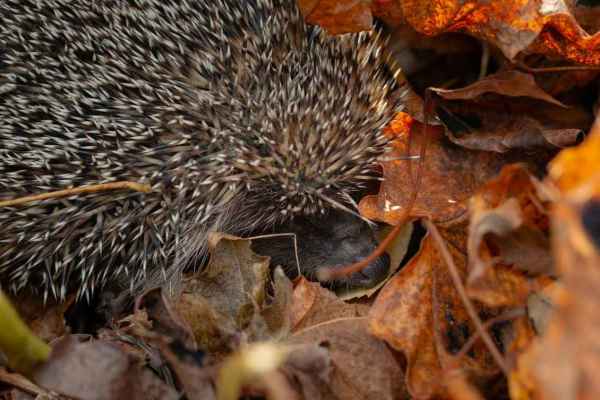
Hedgehogs sprayed with paint: police see a breach of the Animal Welfare Act
White paint on their spines, unknown culprits and speculation about the motive: marked hedgehogs have been discovered in Effretikon. Specialist agencies warn of health risks, and the police see a breach of animal welfare legislation.

Photo: Viktor Smoliak / Unsplash
The night belongs to the hedgehog
In recent weeks, hedgehogs with their spines sprayed with white paint have appeared in Effretikon ZH. The Zurich cantonal police regard this as a breach of animal welfare legislation. Who is behind it and why remains unknown, and Effretikon is not the first place where such finds have been made.
Two marked hedgehogs in a garden
As the «Zürcher Oberländer» first reported on 5 November, local resident Ursula Alayan found a sick hedgehog with a white paint mark at the end of September and took it to the Hinwil hedgehog rescue centre. Whether the paint mark was connected to its illness is not known. In October, her wildlife camera recorded another hedgehog with a white paint mark. By that point Alayan had already put up flyers in the neighbourhood and drawn attention to the problem in a local Facebook group, as she tells blue News. She fears it will continue next year.
Police: dignity and welfare violated
The Zurich cantonal police were informed on 30 October, as they confirmed to blue News. They classify the spraying as a breach of animal welfare legislation, with the dignity and welfare of the hedgehogs in particular affected. In their assessment, a white paint mark can impair the camouflage of a nocturnal wild animal, and dyes can also be absorbed through the skin and prove toxic. The police have no leads on the perpetrators and are not aware of any further cases in the canton.
The Swiss Animal Protection STS (Schweizer Tierschutz) told blue News that even being caught and held can cause hedgehogs considerable stress. There are also possible risks from the dyes themselves and from the spray mist, which the hedgehogs breathe in. If deliberate mistreatment is suspected, the STS advises contacting the police or the cantonal veterinary office.
Basel, Stein am Rhein, Regensdorf
Effretikon is not an isolated case. According to the STS, several sprayed hedgehogs were already found in the Basel area in 2022. In Stein am Rhein (canton Schaffhausen), several hedgehogs were sprayed with paint in May 2023, and in April 2024 another hedgehog sprayed black turned up there. The STS has no systematically collected figures and therefore cannot say whether such cases are increasing. The Hedgehog Centre Zurich knows of one case from Regensdorf: a man had marked two hedgehogs with white paint over large areas of their bodies so that he could recognise them again.
Ritual or recognition?
Marco Schaffner, head of the Hinwil hedgehog rescue station, raised a spiritual motive with the "Zürcher Oberländer": the markings could be part of a shamanic ritual with which people wanted to protect the "voodoo hedgehogs". There is no evidence for this. Annekäthi Frei, co-director of the Hedgehog Centre Zurich, considers an esoteric explanation rather unlikely. The more obvious explanation, she says, is again the wish to recognise individual hedgehogs. Ursula Alayan came across this pattern in her online research: people mark hedgehogs, feed them and recognise them again on a wildlife camera.
Markings with a scientific purpose must be distinguished from arbitrary spraying. The STS points to scientific studies, in which legal requirements and the gentlest possible methods must be observed. Monika Waelti, head of the office of Pro Igel Schweiz, told blue News of professionally run hedgehog stations that, when caring for a litter of young hedgehogs, apply a small dab of paint to individual spines. This, she said, is not comparable to spraying an entire hedgehog.
Commentary: A wild animal is not a project
Whether someone in Effretikon wanted to recognise the hedgehogs or had other ideas in mind remains unclear. For assessing the intervention, that is secondary: catching a wild animal, holding it and dyeing it for one's own purposes is not an expression of care. It is possessiveness over a living being that belongs to no one.
Yet the Western European hedgehog already has problems enough. Since October 2024, the International Union for Conservation of Nature (IUCN) has listed it on its Red List as near threatened, mainly because of roads, sealed surfaces and intensive agriculture. That hedgehogs are also declining in the city of Zurich has been documented for years. Anyone who catches and marks a hedgehog merely in order to recognise it again subjects it to unnecessary stress, and in late autumn, moreover, at the very time when it is preparing for hibernation. Catching and caring for sick or injured hedgehogs under expert guidance is something quite different.
Caution is also needed when feeding. Pro Igel assessed ten dry and four wet foods from Swiss shops on the basis of the manufacturers' information. According to «Beobachter», none of the products examined was judged suitable. This result concerns the ready-made foods tested, not every expert-guided supplementary feeding of hedgehogs in need of help.
Anyone who really wants to help hedgehogs leaves leaves and brushwood piles lying in the garden, switches the robotic lawnmower off at night and keeps gaps in fences open. Anyone who finds an injured or sick hedgehog should contact a hedgehog rescue centre or a veterinary practice.
A hedgehog does not need a dot of paint to survive. It needs gardens in which it is allowed to be a hedgehog, unseen and undisturbed. Our study overview shows which other human-made dangers threaten wild animals in built-up areas: Wild animals: a fact check.
More on the subject of recreational hunting: In our dossiers on recreational hunting gather fact-checks, analyses and background reports. The scientific evidence is presented in the overview Studies on the Effects of Recreational Hunting.
The position of IG Wild beim Wild: IG Wild beim Wild rejects recreational hunting. Our model is the canton of Geneva, which has managed without recreational hunting since 1974: without hunting seasons, without hunting dogs, without driven hunts, without high seats, without the animal cruelty and crime that go hand in hand with hunting season elsewhere. What has worked there for over fifty years disproves every position paper by JagdSchweiz. An association that bases its policy on claims it refutes in its own documents is not a professional organisation, but a factory for misinformation.
Wild animals need a voice
Once a week: research, petitions and background information on recreational hunting. Free of charge and can be unsubscribed from at any time.

All articles are written by IG Wild beim Wild as well as by external co-authors. Research, structuring and editorial processes may be supported by AI-assisted tools.
Support our work
With your donation you help protect animals and give their voice a hearing.
Donate now →