Geneva and the hunting ban

Since 19 May 1974, the canton of Geneva has had no recreational hunting. Around two-thirds of voters said yes at the time to the ban demanded by animal welfare advocates. What the hunting world experienced as a shock is today the most important empirical refutation of the core thesis of the recreational hunting lobby: that nature collapses without recreational hunters. The opposite is true. And Geneva has been proving it for 50 years.
Legally and ecologically, the Geneva model is the most precise argument the hunting-critical movement has. Not a thought experiment, not a laboratory study, but lived reality in a densely populated canton of 500,000 inhabitants, with an international airport, intensive agriculture, and a direct border with France and the canton of Vaud, where intensive hunting continues. If this model works — and it does — then the question is no longer whether, but when.
What awaits you here
- The model: game wardens instead of recreational hunting: How Geneva regulates wild animals with a dozen professional wildlife wardens for one million francs a year — and why this is cheaper than the recreational hunting system.
- What nature has achieved in 50 years: How wildlife populations have developed since 1974: 30,000 winter visitors, the highest density of brown hares in Switzerland, the country's last remaining grey partridge population.
- Animal welfare as a systemic feature: Why 99.5 percent of animals shot are killed instantly, why there are no driven hunts, and what becomes visible every day at the border with France.
- Poaching as a mirror of the neighbourhood: What the contrast between Geneva and the neighbouring cantons reveals about two fundamentally different attitudes towards wild animals.
- The political reaction: silence as strategy: Why 90 percent of Geneva's population opposes reintroducing recreational hunting — and why the model is nonetheless ignored in national hunting policy.
- 10 percent ecological area as a pioneering achievement: How Geneva creates habitats for grey partridges, birds of prey and predators — without regulating foxes, martens or badgers.
- What would need to change: Concrete political demands for transferring the Geneva model to other cantons.
- Argumentation guide: Answers to the most common objections to the Geneva model.
- Quick links: All relevant articles, dossiers and sources.
The model: game wardens instead of recreational hunting
The canton of Geneva regulates its wildlife populations with a dozen professional wildlife wardens who share just under three full-time positions. The cost: around 600,000 francs per year for staff. Added to this are 250,000 francs for prevention and 350,000 francs for compensation for wildlife damage, mostly caused by pigeons rather than big game. The total budget for wildlife management: around one million francs per year, which amounts to the price of a cup of coffee per resident.
By comparison: in other cantons, thousands of recreational hunters have to be managed through licence sales, hunting supervision, follow-up search systems, damage settlement, kill quota planning and administrative apparatus — and this does not even include the external costs caused by browsing pressure, wildlife-vehicle collisions and biodiversity losses. The long-standing Geneva fauna inspector Gottlieb Dandliker (2001 to 2025) summed it up: «The hunting ban for recreational hunters in Geneva is the cheapest alternative for the canton and is clearly financially sustainable in the long term.»
More on this: Initiative calls for «Game wardens instead of hunters» and The game warden model: professional wildlife management with a code of honour
What nature has achieved in 50 years
Before the hunting ban in 1974, wild boars in the canton of Geneva had been completely wiped out by recreational hunters over the course of decades. Today, around five wild boars live per square kilometre of forest, a low level that remains stable and is professionally controlled. Around 327 wild boars are removed by game wardens each year, with young animals preferentially shot; lead sows and large boars are explicitly spared for ethical reasons: if the nursing mother is missing, the young die and the sounder loses its social stability.
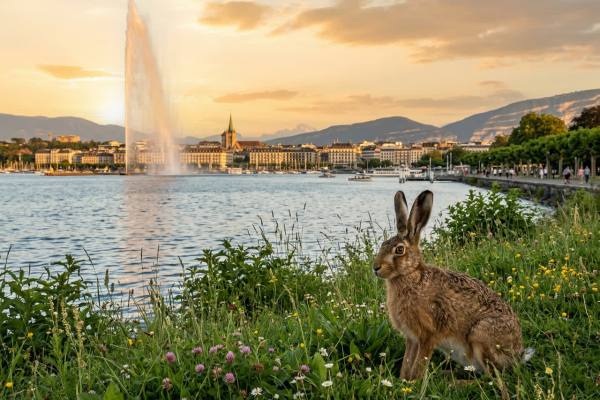
The canton today has a stable ungulate population of around 100 red deer and 330 roe deer. The hare density is among the highest in Switzerland. Geneva is one of the last strongholds for wild rabbits and grey partridges on Swiss soil. The number of wintering waterfowl has multiplied since 1974: from a few hundred to 30,000 winter visitors. Pochards and tufted ducks, great crested and little grebes, goosanders and various other duck species have become established in the canton. In the Swiss National Park in the Engadin, where hunting has not taken place for 100 years, the chamois population has remained constant at around 1,350 animals since 1920, and the vegetation has developed a complete species composition, with biodiversity doubling.
More on this: Studies on the impact of hunting on wild animals and Hunting and biodiversity: does recreational hunting really protect nature?
Animal welfare as a systemic feature, not a claim
The game wardens in Geneva work exclusively at night, using light intensifiers and infrared. This increases accuracy and minimises suffering: “99.5 per cent of the animals shot are killed instantly,” said Dandliker. Stress for animals not shot is “minimal”. There are practically no cases in which animals survive a kill while wounded. Driven hunts, drive hunts, flushing out of packs: none of this exists in Geneva.
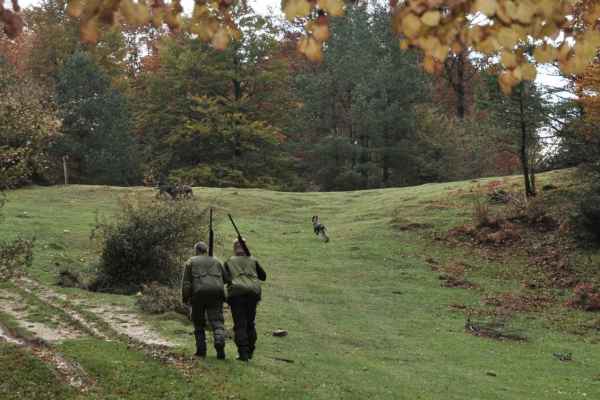
The contrasting picture is visible every day. On the border with France and the canton of Vaud, where intensive militia hunting with driven hunts is practised, wild animals actively seek refuge in hunting-free Geneva. Some swim across the Rhône to do so. Dandliker reported: “We regularly have groups of wild boar orphans here from the French hunt, who have lost their mother and come into the villages.” The consequences of hunting pressure on the other side of the border become visible on Geneva soil every day. And they prove exactly what is not happening on the Geneva side.
More on this: Why recreational hunting fails as population control and Wild animals, mortal fear and lack of stunning
Poaching as a mirror of the neighbourhood
Geneva's proximity to France and the canton of Vaud brings not only wild animals seeking asylum, but also poachers who follow them. In the canton of Vaud, an illegally shot wolf was found in 2024 – a 32-kilogram male wolf, shot with a firearm a week before it was found. The culprit was never caught. At the same time, the group Wolf Schweiz documented unlawful kills of the lead animals of the Marchairuz and Risoux packs in the Vaud Jura.
Psychologically, this contrast is revealing. On one side of the border: a system that protects lead animals because their social function for the stability of the group is understood and respected. On the other side: a system that deliberately eliminates lead animals because it wants to destabilise populations and thereby simplify hunting practice. Both systems are an expression of an attitude towards wild animals, not a technical necessity. Geneva answered this question of attitude in 1974. The answer is: wild animals are not targets.
More on this: Poaching of a wolf in the canton of Vaud and The wolf in Switzerland: facts, politics and the limits of hunting
The political reaction: silence as a strategy
In 2004, a survey by the Erasm Institute found that almost 90 per cent of Geneva's population opposed reintroducing recreational hunting. In 2009, a corresponding motion failed in the cantonal parliament by 71 votes to 5, with 6 abstentions. The population values the hunting-free environment because it allows them to experience wild animals while out walking. This impression is scientifically confirmed: a long-term cantonal study documents a strong increase in biodiversity.
Nevertheless, the Geneva model is largely absent from national hunting policy. Hunting associations, cantonal administrations and federal authorities, who decide on new hunting acts, wolf regulations and protected-area issues, do not cite Geneva. The reason is obvious: a functioning counter-model makes the claim that recreational hunting is irreplaceable politically untenable. So it is ignored — until someone calls it by its name. This dossier does exactly that.
More on this: Switzerland hunts, but why still? and Hunter lobby in Switzerland: how influence works
10 per cent ecological area as a pioneering achievement
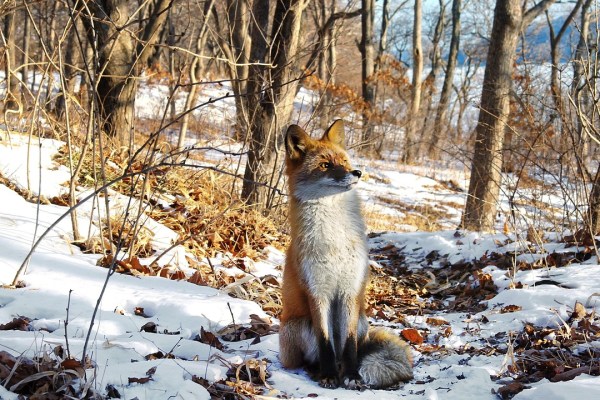
Geneva is not only hunting-free but also a pioneer in land-use policy: 10 per cent of agricultural land consists of ecological compensation areas — that is, high-quality habitats for biodiversity. Grey partridges, birds of prey and predators such as martens and foxes benefit from this. Foxes, martens and badgers are not regulated: «Predators are widely present but cause no problems,» says Dandliker.
This is the decisive difference compared to the recreational hunting system: in Geneva, no animals are removed out of hunting interest, but exclusively where there is an ecological, animal-welfare-related or safety justification. The hunting of birds around the airport is a safety measure, not a leisure activity. This categorical difference — intervention as the exception rather than killing as the rule — is the structural core of the Geneva model.
More on this: Alternatives to Hunting: What Really Helps, Without Killing Animals and Wildlife corridors and habitat connectivity
What needs to change
- Federal recognition of the game warden model as an equivalent alternative: The federal hunting act must recognise professional wildlife management along the lines of the Geneva model as a fully equivalent alternative to recreational hunting. Cantons that choose this path must not be treated as special cases. Template motion: Hunting ban modelled on Geneva
- Cantonal pilot projects with scientific evaluation: At least two to four cantons test the game warden model in clearly defined areas, with transparent cost calculation, independent success monitoring and comparison with the results of recreational hunting over the same period. Template motion: Game wardens instead of recreational hunters
- Total cost accounting for recreational hunting: The external costs of recreational hunting are recorded in full for the first time: wildlife-vehicle collisions, administrative expenditure, hunting accidents, biodiversity losses caused by blocked protected areas, browsing damage caused by hunting-induced concentration of wild animals. Only with an honest tally is a fair comparison with the Geneva model possible.
- Protection of lead animals as standard practice: Experience from Geneva shows that the targeted protection of lead sows and dominant animals stabilises populations and reduces wildlife damage. This practice must apply as a minimum standard in all cantons, not just in Geneva.
- Principle of public access for hunting decisions: Kill figures, justifications, error rates and cost statements are made publicly accessible in all cantons. The Geneva model operates under full transparency. Whatever recreational hunting has to hide, it must disclose. Template motion: Transparent hunting statistics
Argumentary: what recreational hunters say about Geneva, and what is actually true
«Geneva is too small and too urban, the model cannot be transferred.» At 280 square kilometres, Geneva is indeed a small canton. But it is densely populated, has intensive viticulture, direct cross-border traffic with France and an international airport. If wildlife management without recreational hunting works in this context, no structural argument speaks against it working equally well in larger, less densely populated cantons.
«Geneva still has kills, though.» Yes. Game wardens shoot where necessary. This is not a contradiction of the hunting ban but its very core: professional intervention instead of armed leisure pursuits. The difference does not lie in whether shooting ever happens, but in who shoots, why, when, with what aim and under what control.
«Geneva has a wild boar problem.» The figures disprove this. Around 327 wild boars are culled annually, the population is stable, and wildlife damage is quantified at CHF 17,830. Wildlife damage in the canton of Geneva is comparable to that in the canton of Schaffhausen, even though hunting is permitted in Schaffhausen.
«The model is too expensive.»One million francs per year, a cup of coffee per resident. By comparison: the external costs of militia-based hunting in other cantons — wildlife-vehicle collisions, administrative overheads, hunting accidents, biodiversity losses due to blocked protected areas — are never fully accounted for. Honesty about costs is conspicuously absent only on the side of the hunting lobby.
Quick links
Articles on Wild beim Wild:
- Geneva hunting ban
- The psychology of hunting in the canton of Geneva
- Initiative calls for «Game wardens instead of hunters»
- Why recreational hunting fails as population control
- Poaching of a wolf in the canton of Vaud
- Studies on the impact of hunting on wild animals
- Switzerland hunts, but why still?
- template texts for hunting-critical motions in cantonal parliaments
Related dossiers
- Wildlife corridors and habitat connectivity: why wildlife bridges and spatial planning are more effective than kills
- The cultivated landscape as myth
- Hunting laws and oversight: why self-supervision is not enough
- Alternatives to recreational hunting
- Geneva and the hunting ban
- The game warden model – professional wildlife management with a code of honour
The canton of Geneva is not a special case. It is proof. Proof that wildlife populations do not collapse without an armed recreational lobby, but flourish. That professional wildlife management is cheaper, more animal-welfare-compliant and ecologically more effective than a decentralised militia hunting system without uniform standards. And that the population, who live alongside wild animals every day, knows and appreciates this.
The real question is not whether the Geneva model works. The question is why it has been systematically ignored in national hunting policy for 50 years. The answer is not a scientific one: it is a political one. IG Wild beim Wild documents the model, its figures and its consequences, because an honest societal debate about recreational hunting must begin with Geneva. This dossier is continually updated whenever new studies, figures or political developments require it.
More on the topic of recreational hunting: In our hunting dossier we compile fact checks, analyses and background reports.