Clock change: why the week after 25 October is dangerous for wild animals
On Sunday the clocks go back, and the evening rush hour falls into twilight. A large study quantifies the effect on wildlife collisions. What is missing from the warnings: evening twilight is regular hunting time across almost all of Switzerland.

Symbolic image. Photo: Nikola Tomašić / Unsplash
«The Stolen Night»
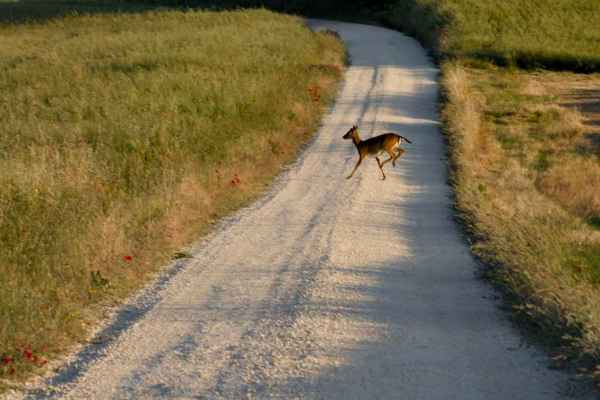
In the night to Sunday, 25 October 2026, the clock goes back from 3 a.m. to 2 a.m. Anyone who used to drive home from work in daylight will be on the road in evening twilight from Monday. For roe deer, foxes and badgers nothing changes: they follow the light, not the clock. It is precisely this shift that makes the days after the clock change dangerous, for the animals and for the people behind the wheel.
Wild beim Wild recently showed that autumn is the most accident-prone time of the year, based on the Mobiliar analysis. A large US study shows how clearly the effect of the clock change can be measured. And one point is missing from the current warnings issued by police and insurers.
What research on the clock change shows
One of the largest studies on the subject comes from the USA. A team at the University of Washington led by Calum Cunningham and Laura Prugh analysed more than one million collisions with deer from the years 1994 to 2021, together with 96 million hourly traffic counts. The results were published in 2022 in the journal Current Biology.
- Almost 10 per cent of all collisions occurred in the two weeks around the return to standard time in autumn.
- In the week after the change, the number of collisions rose by 16 per cent. The researchers attribute this to the abrupt rise in traffic after sunset.
- Two hours after sunset, collisions were 14 times more frequent than two hours before sunset.
No comparable jump was found by the researchers after the spring clock change. They explain the autumn peak by the fact that, in the deer species studied, two factors overlap: the mating season and the clock change. This needs to be borne in mind when applying the findings to Switzerland, where the roe deer rut falls in summer. What matters most for Switzerland is the mechanism: evening rush-hour traffic shifts abruptly by one hour relative to sunset and falls into the twilight hours, when wild animals are most active. Whether accident numbers here rise as sharply is not shown by the US study.
For Switzerland, Mobiliar offers a pointer regarding the spring clock change: in the week after it, the insurer recorded more wildlife accidents than in the week before. It has not published a corresponding figure for autumn.
7,651 roe deer in a single year
How many wild animals die on Swiss roads is shown by the Federal Hunting Statistics, which Wildtier Schweiz compiles on behalf of the FOEN. In the 2025 hunting year, 7,651 roe deer killed by vehicles were recorded, according to Wildtier Schweiz with a slightly declining trend. For foxes, according to the overview by Waldwissen.net, there were around 6,000 animals. In the same year, 29,328 recreational hunters killed 74,914 hoofed wild animals (excluding ibex) and 23,152 predators such as foxes, badgers and martens.
The statistics only capture animals that were reported and found. Smaller species and animals that flee injured into the forest and die there are largely missing. Why the official figures are too low is explained in the Wildlife Corridors dossier.
What the police and insurers are saying now
Several police forces have issued warnings about wildlife accidents in recent weeks:
- The Central Switzerland police forces jointly reminded drivers of the rules of conduct on 1 October. Wildlife accidents must be reported, via the emergency number 117. According to the forces, a sudden evasive manoeuvre is often more dangerous than controlled braking.
- The Basel-Landschaft police warned on 19 October of an increased risk of accidents in the early morning hours and at dusk.
Among the insurers, Mobiliar presented its figures on 8 October; Wild beim Wild has analysed them here. AXA, Switzerland's largest motor vehicle insurer, has not yet published its figures for 2025. For 2024 it reported costs of more than CHF 11.5 million for wildlife accidents, with a single claim costing almost CHF 3,800.
Geneva in the damage statistics
AXA breaks down its claims frequency by canton, that is, the number of wildlife collisions per insured vehicle. For 2024 it stands between 5 and 6.9 per thousand in Fribourg, Jura, Thurgau and Schaffhausen, against a Swiss average of 3.2 per thousand. The least affected are Basel-Stadt at 0.8 per thousand, as well as Nidwalden and Geneva at 1.2 per thousand each.
In Geneva, recreational hunters have not hunted since 1974; wildlife regulation is in the hands of professional environmental wardens. The AXA figures do not prove that abandoning recreational hunting reduces wildlife collisions. Geneva is highly urbanised, and AXA itself attributes the high figures in rural cantons to the many roads running through wooded stretches. But they do show that a canton without recreational hunting can sit well below the Swiss average for registered wildlife collisions. The blanket claim that road safety depends on recreational hunting therefore cannot be sustained. More on this in the dossier on Geneva and the hunting ban.
The same week: recreational hunting at dusk
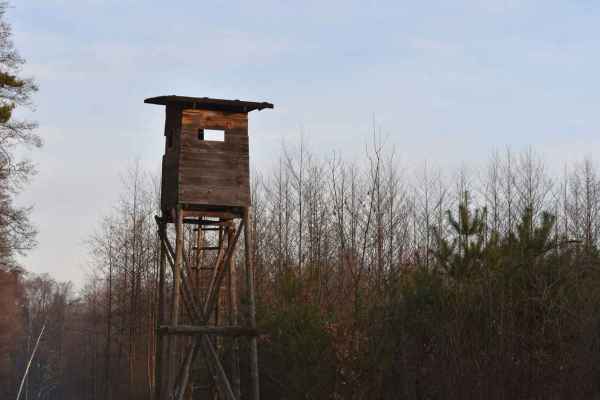
The police reports are addressed to motorists. Recreational hunting appears in them only as hunting supervision, searching for the injured animal after an accident. That at the same time of day it is startling wild animals is not mentioned. Yet dusk is regular hunting time across almost all of Switzerland.
Since 1 February 2025, the federal hunting ordinance does prohibit hunting in forests at night (Art. 3ter JSV). But night is defined only as the period from one hour after sunset to one hour before sunrise. Outside forests, federal law has no ban on night hunting, and in winter nocturnal wait hunting for fox, badger and marten is permitted even in forests. The canton of Aargau, for example, sets out these rules in its circular letter.
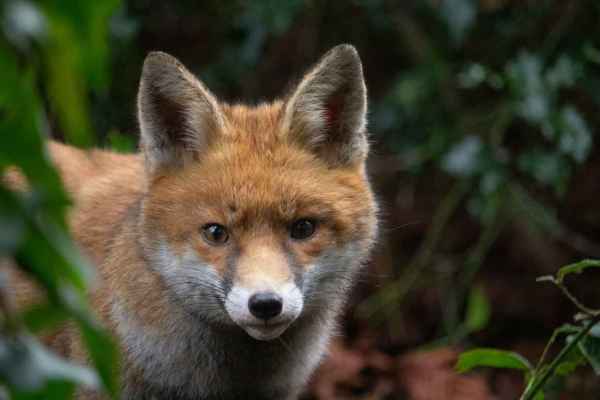
Fox and badger, which after roe deer die most often on the roads, are open to hunting by the end of October in every canton except Geneva. This is shown by the overview of closed seasons 2025 in the Federal Hunting Statistics: the longest cantonal closed seasons, for badger in Glarus and Zug for instance, end in early October. Only in Geneva does a year-round closed season apply to both species.
After the clocks change, the sun sets, depending on the region, between about 5.15 and 5.30 pm. Hunting is thus permitted until around 6.15 to 6.30 pm, exactly the hour in which the evening rush-hour traffic now falls into dusk. Two cantons show how differently this is handled:
- In Grisons foxes, badgers, tree and stone martens as well as raccoons, raccoon dogs and muskrats may even be hunted “without time restrictions” in eight hunting districts from 20 to 31 October (Ordinance on hunting operations, Art. 84).
- Ticino shows that things can be done differently: there, small-game hunting from the end of October is restricted to 07.30 to 16.30 and ends before sunset. The ongoing incidents are documented by the Ticino hunting ticker.
Whether and to what extent recreational hunting increases the risk of accidents this week has not been studied for Switzerland. However, the report by the Keystone-SDA news agency on the Mobiliar analysis names, alongside twilight traffic, the red deer rut and foraging, stress caused by hunting as a reason for the higher number of accidents in autumn. Those who urge motorists to take care at dusk while at the same time allowing recreational hunting at dusk are sending contradictory signals. The Confederation and the cantons could restrict hunting in the two weeks around the clock change to the period between sunrise and sunset, as Ticino demonstrates. That would be a precautionary measure that could be implemented immediately.
What helps now
For motorists, the following applies with particular force over the next two weeks: reduce speed at the edges of woods and fields, be ready to brake, expect further animals, and when wild animals are on the carriageway, brake in a controlled manner rather than swerving. After a collision, stop, secure the scene of the accident and notify the police immediately on 117, even if the animal has run off. Anyone who fails to report a wildlife accident, or reports it only later, commits an offence.
Instead of using wildlife accidents across the board as an argument for kills, the cantons should defuse the danger spots along roads: wildlife warning systems, wildlife crossings, restored wildlife corridors and lower speed limits at known game crossings at dusk. Which measures demonstrably work is set out in the Wildlife Corridors dossier.
Continue reading on Wild beim Wild
- Autumn wildlife collisions: hunting stress also named as a contributing cause
- Wildlife crossings: caution during the clock change
- Dossier: The roe deer in Switzerland
- Dossier: The fox in Switzerland
- What recreational hunting really costs Switzerland
- Grisons hunting 2026/27: incidents, violations and developments
Sources
- Cunningham, Prugh et al.: “Permanent daylight saving time would reduce deer-vehicle collisions”, Current Biology, 2022, DOI 10.1016/j.cub.2022.10.007; summary by the University of Washington
- Mobiliar: “Attention, wild animals: accidents increase from October”, 8.10.2026
- AXA: “Wildlife accidents: what to do and where to be careful”, October 2025
- Zug Police for the Central Swiss police forces: “Wildlife accidents: protecting lives through the right behaviour”, 1.10.2026
- Basel-Landschaft Police via Polizeinews: “Beware of game crossings”, 19.10.2026
- Keystone-SDA via Nau.ch: “More collisions with wild animals on the roads in autumn”, 10.10.2026
- Federal Hunting Statistics, FOEN: Closed seasons 2025 by canton
- Canton of Lucerne, lawa: Changes arising from the revision of the Federal Hunting Ordinance, March 2025
- Canton of Aargau: Hunting circular, June 2025
- Wildtier Schweiz via Naturschutz.ch: «Database on wild animals and hunting updated», August 2026
- Waldwissen.net: «The Federal Hunting Statistics»
- Canton of Grisons: Ordinance on the conduct of hunting (BR 740.025), Art. 84
- Canton of Ticino: Regolamento sulla caccia 2026, synopsis of current law and proposed amendment (Art. 39 and 41)
More on the subject of recreational hunting: In the dossier The Role and Criticism of Recreational Hunters we shed light on the training, power and self-image of recreational hunters. The scientific evidence is presented in the overview Studies on the Effects of Recreational Hunting.
The position of IG Wild beim Wild: IG Wild beim Wild rejects recreational hunting. Our model is the canton of Geneva, which has managed without recreational hunting since 1974: without hunting seasons, without hunting dogs, without driven hunts, without high seats, without the animal cruelty and crime that go hand in hand with hunting season elsewhere. What has worked there for over fifty years disproves every position paper by JagdSchweiz. An association that bases its policy on claims it refutes in its own documents is not a professional organisation, but a factory for misinformation.
Wild animals need a voice
Once a week: research, petitions and background information on recreational hunting. Free of charge and can be unsubscribed from at any time.

All articles are written by IG Wild beim Wild as well as by external co-authors. Research, structuring and editorial processes may be supported by AI-assisted tools.
Support our work
With your donation you help protect animals and give their voice a hearing.
Donate now →