Wildlife accidents in autumn: the insurer cites hunting stress as a contributing cause
In the last quarter, Mobiliar counts around 12 per cent more wildlife accidents and names hunting-related stress as one of the reasons. How large that share is remains unclear. What is clear: the peak season of recreational hunting falls in the most accident-prone time of the year.

Symbolic image. Photo: Mario Beducci / Unsplash
«Driven hunt»
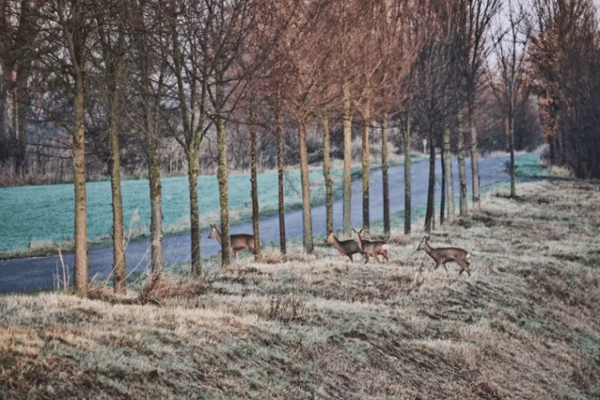
Anyone driving along a country road after work in October should expect roe deer. That is hardly new. What is new is who is saying it these days, and how: Mobiliar has analysed wildlife accidents over five years and explicitly names “the stress caused by hunting” as one of the reasons for the higher accident figures in the last quarter. The news agency Keystone-SDA published.
In the debate on recreational hunting, road safety is regularly invoked: without kills there would be more wild animals and therefore more wildlife accidents. Mobiliar now points to an aspect that is neglected in such blanket justifications: recreational hunting can not only alter populations but also trigger stress and additional movement. What share this factor has in the registered accidents cannot be determined from the published figures.
What the Mobiliar analysis shows
Between 2021 and 2025, Mobiliar registered over 10,500 collisions with wild animals. In the last quarter of the year, accident figures were around 12 per cent above average, with a further peak in April.
Regional differences are large:
- Thurgau: 2.05 claims per 1,000 insured vehicles
- Grisons: 1,85
- Jura: 1,75
- Swiss average: 1,16
Roe deer and red deer were involved most often, with around 7,350 reported claims. Foxes (1,020), badgers (900) and wild boars (510) were involved less frequently. An accident with a wild boar cost on average around 3,000 francs, with a roe deer or red deer about 2,700 francs.
For the autumn rise, the insurer cites several reasons without weighting them: because of the shorter days, commuters are more often on the road at dusk, when animals are also active. Added to this are the rut of the red deer, the search for food before winter and, indeed, the stress caused by recreational hunting.
The figures only cover vehicles insured with Mobiliar. They therefore do not show the full extent, but they do reveal a pattern. According to statistics from the Federal Office for the Environment (FOEN), road traffic is the second most common known cause of death for large wild animals in Switzerland, after recreational hunting.
Autumn is peak season for recreational hunting
The accident-prone season overlaps with the most intensive phase of recreational hunting. The 2026 calendar shows this:
- In the Valais the high hunt ran from 21 September to 3 October. In 13 days, according to the Department of Hunting, Fishing and Wildlife 1,607 red deer and 1,617 chamois were killed.
- In the Ticino the small-game hunt begins on 16 October. According to the cantonal hunting regulations it runs until 30 November, on Tuesdays, Wednesdays, Thursdays, Saturdays and Sundays.
- In Grisons foxes, badgers, tree and stone martens as well as raccoons, raccoon dogs and muskrats may be hunted in eight hunting districts from 20 to 31 October «without time restrictions» (Ordinance on hunting operations, Art. 84). The usual shooting hours then do not apply, so recreational hunting is also permitted at dusk. More on this in the Grisons hunting ticker.
- In addition, in many cantons with territorial hunting there are driven hunts in late autumn, in which beaters and dogs comb through entire stretches of woodland.
The current hunting dates illustrate the overlap with the accident-prone season; they do not prove a causal link with the damage claims analysed from 2021 to 2025. The suspected mechanism, however, is simple: anyone who flushes out wild animals with gunshots, beaters and dogs sets them in motion. Stressed animals flee, change their resting places and may cross roads at times and in places where they would not otherwise be moving. Wildlife biologists have been discussing this effect for years.
What the research says
The body of evidence is not clear-cut. An overview of some studies from Europe and the USA:
A study from Portugal (Torres et al., Mammalian Biology, 2025) examined 3,374 collisions with wild boars, red deer and roe deer from 2019 to 2022. The hunting season explained some of the collisions with wild boars and roe deer.
In Galicia (Lagos et al., European Journal of Wildlife Research, 2012), researchers from the University of Vigo found a cluster of accidents involving wild boars between October and January across 6,255 accidents. The lead author, Laura Lagos, told the news agency SINC that these months coincided with the hunting season, when beaters flushed the animals out and they often crossed the roads. During the hunting season, the accident rate was also higher on Sundays, one of the two hunting days in the region. The authors do point out, however, that night-time traffic is also heavier at weekends.
A Croatian study (Vrkljan et al., Croatian Journal of Forest Engineering, 2020) describes the influence of hunting as scientifically unresolved. It discusses that driven hunts can set wild boars in motion, but also stresses how difficult it is to separate hunting, foraging and reproduction as causes. At the time, there was no reliable evidence for a direct link.
A study from the US state of Indiana (Delisle et al., Science of the Total Environment, 2024) found a different effect. It examined targeted recreational hunting. There, collisions with white-tailed deer fell by around 21 per cent along 618 kilometres of particularly dangerous roads after the authorities had specifically permitted longer hunting periods and higher kill quotas. The study concerns a different species, a different hunting system and a different landscape. Moreover, it involved a targeted measure along accident hotspots rather than the area-wide recreational hunting that is customary in Switzerland.
It follows that there are indications that hunting activity can increase the risk of accidents, at least temporarily, especially during driven hunts. The sources consulted here, however, do not demonstrate that customary recreational hunting in Switzerland reduces wildlife accidents overall. Anyone who cites wildlife accidents as a justification for recreational hunting would have to provide this evidence for Swiss conditions.
High cantonal figures, but no evidence of the effect of recreational hunting
It is striking that the three cantons with the highest accident rates have very different hunting systems. Thurgau relies on territorial hunting, while Grisons and Jura use licence hunting. What they have in common is that recreational hunters are active everywhere. The figures alone prove no connection, since road networks, traffic density, forest cover and wildlife populations differ greatly. They show that existing hunting practice does not prevent wildlife collisions in these cantons. Whether it increases or reduces their frequency cannot be deduced from the cantonal figures alone.
A comparison with Geneva would be interesting. There, recreational hunters have not hunted since 1974, and wildlife regulation is in the hands of professional environmental wardens. Whether the Mobiliar analysis includes figures for Geneva is not apparent from the published information. Such a comparison could provide additional indications. It would, however, only be meaningful if differences in traffic, habitats and wildlife populations were taken into account.
Prevention right at the roadside
Wildlife collisions can also be tackled directly on the road network. The canton of Fribourg lists on its website:
- Wildlife warning systems that alert drivers to animals crossing and thus lead to lower speeds and greater attention. After testing, this system was found to be “very convincing”.
- Wildlife crossings over or under roads that guide animals safely to the other side while also connecting habitats.
- Preservation and restoration of wildlife corridors.
- Lower speeds at dusk and at night.
The canton also notes that road traffic accidents are the main cause of losses among wild mammals, and that more than a thousand dead mammals and birds are found on Fribourg's roads every year.
These measures start where animals and traffic meet, and they work regardless of how many animals are shot. Politically, there is also the question of whether driven hunts near roads and recreational hunting without defined shooting times in the season with the most accidents can be justified. The accident risk of such forms of hunting has not been quantified for Switzerland; that is precisely why the cantons ought to examine it before granting such permissions.
What drivers can do
Mobiliar advises drivers to be especially alert on country roads and at the edges of woodland. At wildlife-crossing warning signs, speed should be reduced. If an animal appears: brake in a controlled manner, dip the headlights and do not swerve, since, according to Mobiliar, evasive manoeuvres often lead to more serious accidents than the collision itself. After a collision, stop, switch on the hazard lights, secure the scene and notify the police immediately on 117. Do not touch injured animals. Anyone who fails to report the accident is liable to prosecution.
Conclusion
Mobiliar expressly names hunting-related stress as one factor behind the higher accident rate in autumn. How large its contribution is remains unclear in the published figures. Anyone who justifies recreational hunting across the board with road safety must therefore also take into account the risks posed by hunting-related disturbance. The peak season of recreational hunting falls in the most accident-prone time of the year. The canton of Fribourg names concrete starting points for prevention: wildlife warning systems, safe crossings, intact wildlife corridors and adapted speeds. This is where the cantons should focus, instead of using wildlife accidents as an argument for more kills.
Continue reading on Wild beim Wild
- How are wild animals stressed by hunting?
- Dossier: The high hunt in Switzerland – traditional ritual, zone of violence and stress test for wild animals
- Dossier: Geneva and the hunting ban
- Dossier: Wildlife corridors and habitat connectivity
- Dossier: The roe deer in Switzerland
- The same old hunting arguments, fact-checked
- Grisons hunting 2026/27: incidents, violations and developments
Sources
- Keystone-SDA via Nau.ch: “More collisions with wild animals on the roads in autumn”, 10.10.2026
- Schweizer Bauer: “Thurgau leads the field in wildlife accidents”, 11.10.2026
- Torres, Neves, Grilo, Leite, Rossa, Carvalho: “Wrong place at the wrong time: patterns explaining ungulate-vehicle collisions in Portugal”, Mammalian Biology, 2025
- Lagos, Picos, Valero: “Temporal pattern of wild ungulate-related traffic accidents in northwest Spain”, European Journal of Wildlife Research, 2012, DOI 10.1007/s10344-012-0614-6; summary at SINC
- Vrkljan, Hozjan, Barić, Ugarković, Krapinec: “Temporal Patterns of Vehicle Collisions with Roe Deer and Wild Boar in the Dinaric Area”, Croatian Journal of Forest Engineering, 2020
- Delisle, Reeling, Caudell, McCallen, Swihart: “Targeted recreational hunting can reduce animal-vehicle collisions”, Science of the Total Environment, 2024
- State of Fribourg: Prevention of traffic accidents involving wild animals
- Canton of Grisons: Ordinance on the conduct of hunting (BR 740.025), Art. 84
- Canton of Ticino: Hunting Regulation 2026, Overview Table, Art. 39
- Municipality of Gränichen: Wildlife collision
More on the subject of recreational hunting: In our dossiers on the criticism of recreational hunting gather fact-checks, analyses and background reports. The scientific evidence is presented in the overview Studies on the Effects of Recreational Hunting.
The position of IG Wild beim Wild: IG Wild beim Wild rejects recreational hunting. Our model is the canton of Geneva, which has managed without recreational hunting since 1974: without hunting seasons, without hunting dogs, without driven hunts, without high seats, without the animal cruelty and crime that go hand in hand with hunting season elsewhere. What has worked there for over fifty years disproves every position paper by JagdSchweiz. An association that bases its policy on claims it refutes in its own documents is not a professional organisation, but a factory for misinformation.
Wild animals need a voice
Once a week: research, petitions and background information on recreational hunting. Free of charge and can be unsubscribed from at any time.

All articles are written by IG Wild beim Wild as well as by external co-authors. Research, structuring and editorial processes may be supported by AI-assisted tools.
Support our work
With your donation you help protect animals and give their voice a hearing.
Donate now →