Deadwood, Benjes hedge, stone pile: habitat for wild animals in the garden
How brushwood piles, deadwood, stone piles and nest boxes help hedgehogs, lizards and tits through the winter.
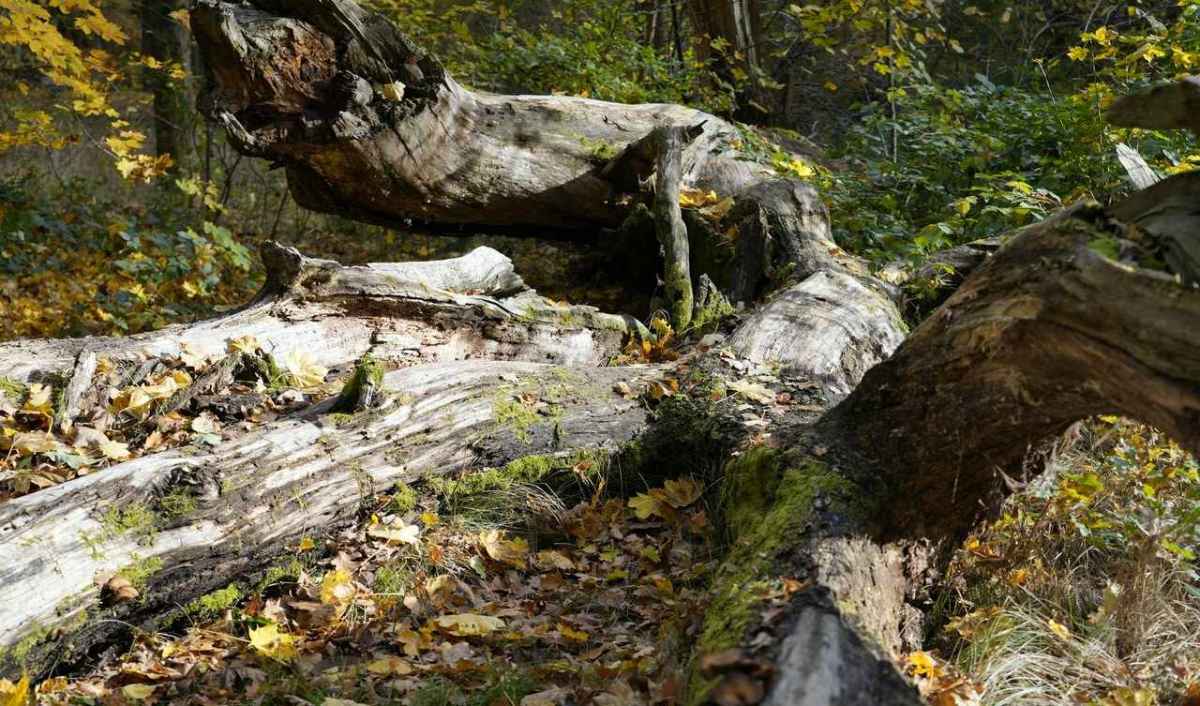
Lying deadwood is, over decades, a habitat for beetles, fungi and small animals. Photo: Antje Winkler / Unsplash
The night belongs to the hedgehog
Anyone who clears branches, stones and dry wood out of the garden in autumn and winter is removing more than mess. Brushwood piles, deadwood and stone piles are winter quarters, nursery and pantry all in one for hedgehogs, lizards, wild bees and birds. Right now, when pruning produces a lot of material, such small structures can be created with very little effort.
Switzerland is too tidy
Small structures are lacking in Switzerland not only in gardens. For a little owl project run by BirdLife Switzerland, the landscape was compared with southern Germany: in Baden-Württemberg there are on average three times as many brushwood piles, hedges or stone walls and five times as many tree cavities (Beobachter). There are also regional gaps when it comes to deadwood. In Swiss forests the quantity has increased markedly, but according to interim results of the fifth National Forest Inventory, the Central Plateau stands at only 18.5 cubic metres per hectare (WSL). That is below the Confederation's target of 20 cubic metres for this region and well below the national average of 29.3 cubic metres. In the densely populated Central Plateau in particular, gardens can therefore close gaps between habitats.
And the need is great. Around a quarter of all forest species depend on old and dead wood, in Switzerland alone over 1,700 beetle species and over 2,700 larger fungi (WSL). Our article shows how much tidy gardens harm hedgehogs: Hedgehogs in hibernation: why the leaves can stay in the garden.
Deadwood: leave it lying instead of disposing of it
Dead trees and branches can stay where they pose no danger to people, buildings or paths. If in doubt, an arborist can assess whether a tree is still stable and safe from breaking. If wood has to be removed for safety reasons, it can be left in a quiet corner of the garden as lying deadwood. A safe, dead tree can also be overgrown by a climbing rose with single flowers, which provides pollen for wild bees and rose hips for thrushes in autumn. Particularly valuable is thick, sunlit deadwood from broadleaved trees, on which many threatened beetle species depend (WSL).
Brush piles and Benjes hedges
A brush pile is the simplest small structure: thick branches at the bottom, finer ones above, with leaves and stems in between. Brush and wood piles offer shrews, hedgehogs, least weasels, stoats and polecats a hiding place and winter quarters, reptiles use them as shelter and egg-laying sites, and wild bees and beetles as habitat (Canton of Bern). For reptiles, the pile is best placed in partial shade to full sun and sheltered from the wind (karch).
Anyone with a lot of cuttings can build a Benjes hedge, also known as a deadwood hedge. For this, posts are driven into the ground in two rows and the space between them is filled with branches and twigs. In the lower part, amphibians and small mammals find shelter, while higher up birds such as the wren nest. As the material rots, the hedge is continually topped up from above. Over time, herbs and later shrubs germinate in the shelter of the branches, often from seeds carried in by birds (NABU). Wild roses or brambles along the hedge provide additional protection for nests.
Stone piles for lizards and slow worms
Stones store the sun's warmth during the day and release it again at night. Wall lizards and sand lizards bask on them, slow worms hide in the gaps, and spiders and wild bees use dry crevices. According to the specialist agency karch, there is no standard construction guide; what matters is a sunny, wind-sheltered spot (karch). Around 80 per cent of the stones should measure 20 to 40 centimetres, while the rest may be finer or coarser, ideally rock from the surrounding area. If the pile is also to serve as winter quarters, it needs frost-proof cavities: the karch recommends a hollow 80 to 100 centimetres deep, filled with stones and with good drainage. Smaller piles without a hollow are also valuable, above all as basking spots and hiding places. A fringe of old grass and native flowering perennials such as marjoram or bellflowers attracts insects and gives the animals cover. More on the shy reptiles in the garden: Snakes in the garden: No need to fear the sensitive creatures.
An important point for upkeep: do not rearrange or dismantle existing brush and stone piles from November to March, because animals are hibernating in them, and leave them undisturbed in July and August too, when reptile eggs may be lying inside (Canton of Bern). New piles can be built at any time regardless.
Nest boxes for tits
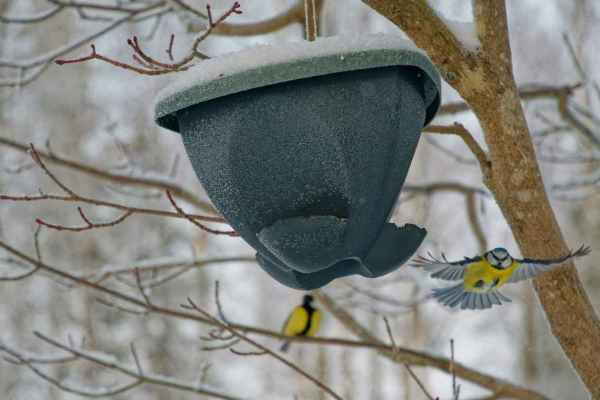
Blue tits search for aphids and caterpillars and readily move into nest boxes. The decisive factor is the entrance hole: 26 to 28 millimetres for blue tit, coal tit and marsh tit, 32 millimetres for great tit and tree sparrow (NABU). A perch beneath the hole is not necessary, but the box must be openable for cleaning, according to the leaflet from the Swiss Ornithological Institute in Sempach and BirdLife Switzerland. Now is a good time to put them up: in winter the boxes offer protection from damp and cold, and from February tits begin searching for nesting sites. What helps and what harms when feeding birds is explained in the article Feeding birds correctly.
What else helps
- Leave leaves lying under hedges, shrubs and on flower beds, and keep leaf blowers in the shed (Leaf blowers drive hedgehogs away).
- Never run robotic lawnmowers at dusk or at night when hedgehogs are on the move (Robotic lawnmowers kill hedgehogs).
- Do without pesticides and slug pellets.
- Create gaps of at least 10 by 10 centimetres in fences so that hedgehogs can travel from garden to garden (Hedgehog Centre Zurich).
Which human-made dangers demonstrably harm wild animals in built-up areas is collected in the dossier Wild animals: a fact check. All of the IG Wild beim Wild's garden articles are gathered on the page Wildlife-friendly garden.
Comment: Habitat instead of the shotgun
Anyone who builds a brush pile offers protection not only to hedgehogs and tits. Stone martens and badgers also use such hiding places, and both can be hunted in Switzerland. The fox is the most hunted predator of the country. Recreational hunting of predators is often justified by the protection of hedgehogs, songbirds and ground-nesting birds. Yet for the hedgehog, the International Union for Conservation of Nature (IUCN) cites the deterioration of its habitat through intensive agriculture, roads and urban development as the causes of its decline. No justification for the recreational hunting of predators can be derived from this.
What non-human animals lack is habitat, and any garden can give it back. That takes no shotgun, but a quiet corner, a pile of branches and the courage not to tidy everything away. Why it is not the wolf, lynx and fox that need regulating, but recreational hunting itself, is shown by the dossier Regulate recreational hunters, not predators. And anyone who finds an injured wild animal in their garden does not have to let anyone in with a gun: Recreational hunters may not simply trespass.
Do you have a tip, a source or a correction for this article? Write to us.
Seen something yourself?
A driven hunt next to a hiking trail, a shot fired near houses, a trap in the forest or an injured wild animal: report it to the Recreational Hunter Radar. We check every tip-off and treat your details confidentially.
More on the subject of recreational hunting: In our dossiers on recreational hunting gather fact-checks, analyses and background reports. The scientific evidence is presented in the overview Studies on the Effects of Recreational Hunting.
The position of IG Wild beim Wild: IG Wild beim Wild rejects recreational hunting. Our model is the canton of Geneva, which has managed without recreational hunting since 1974: without hunting seasons, without hunting dogs, without driven hunts, without high seats, without the animal cruelty and crime that go hand in hand with hunting season elsewhere. What has worked there for over fifty years disproves every position paper by JagdSchweiz. An association that bases its policy on claims it refutes in its own documents is not a professional organisation, but a factory for misinformation.
Wild animals need a voice
Investigations, petitions and background on recreational hunting. As a thank-you, you will immediately receive our free guide «Recreational hunting on your doorstep: what you can do».
Support our work
With your donation you help protect animals and give their voice a hearing.
Donate now →