Ticino hunt 2026/27: incidents, violations and developments at a glance
Wild beim Wild is documenting the 2026/27 hunting season in Ticino on an ongoing basis. The ticker features official announcements, incidents, violations, kills and other notable events – updated chronologically.

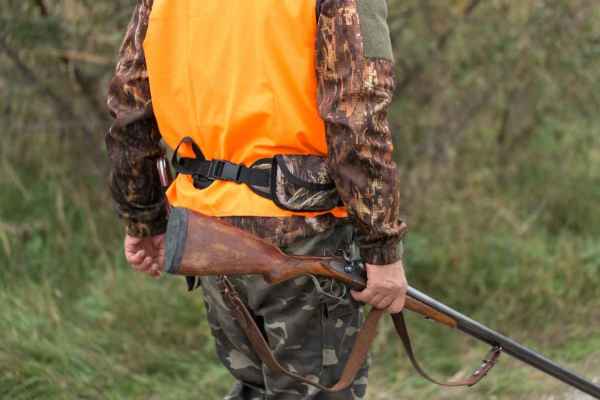
The 2026/27 hunting season in Ticino opened on 5 September 2026. With the start of the high hunt, around 1,800 recreational hunters are out and about in the canton.
Just how deeply recreational hunting is culturally rooted in Ticino is shown by the article The psychology of recreational hunting in the canton of Ticino.
Ticker
16.10.2026
Fri 04:55
Mairengo: injured goat killed, genetic analysis still pending
The list of “Casi di predazione” kept by the Ufficio della caccia e della pesca records a new case: on 9 October an injured goat was found in Mairengo (municipality of Faido) and subsequently killed. According to the list, the result of the genetic analysis is still outstanding, so genetic confirmation of wolf involvement is not yet available. Under herd protection, the case already carries the note «Animali non proteggibili», meaning the office considers protecting these animals unfeasible. Since 20 August the list has not recorded a single case classified as «Animali protetti adeguatamente»; the remaining cases carry the notes «non proteggibili», «non protetti adeguatamente per cause di forza maggiore» or «Proteggibilità in fase di analisi», and one has no note at all. The list does not disclose the criteria by which the office classifies animals as unprotectable. Background: Shortage of herders on the alpine pastures: who protects the herds?
08.10.2026
Thu 04:00
Yes to the wolf threshold value: Piero Marchesi takes over the Ticino department for recreational hunting and wolf regulation
Since his swearing-in on 7 October, Piero Marchesi (SVP) has, according to RSI headed the Dipartimento del territorio and is thus also politically responsible for the Ufficio della caccia e della pesca, which implements recreational hunting and wolf regulation in the canton. He takes over the seat of Claudio Zali (Lega), who announced his resignation effective 30 September in July. How Marchesi stands on the wolf is shown by his vote in the National Council: on 23 September he voted in favour of the motion 25.4464, which seeks to allow the killing of individual wolves or entire packs «as soon as the wolf population reaches a predefined number of animals». According to “Corriere del Ticino”, the Greens reacted with a statement entitled «Dopo Rösti, un’altra volpe nel pollaio» and fear a rollback of climate and environmental policy. In the current regulation period, the FOEN has approved the killing of two thirds of the young animals born in 2026 for nine packs in Ticino. The motion aims to create an additional basis for killing based on a fixed population figure; this brings a numbers-based limitation of a protected species more sharply into focus, and what further conditions would apply would have to be clarified by the draft legislation. Background on the motion: Wolf threshold: National Council approves stockpiled kills
06.10.2026
Tue 04:08
Official tally: more stags than hinds, more bucks than does
In its communication of 5 October the Department of the Territory breaks down the high hunt by sex: of 1,882 red deer killed, 972 were male, 675 female, plus 235 calves. The canton justifies the kill quota with damage to forest and crops, and for a reduction in the population it is above all the killing of female animals that counts; according to the office, the follow-up hunt from mid-November is meant to fulfil the quota and correct «il rapporto tra i sessi» (RSI). For the chamois, the plan envisaged 350 bucks and 350 does respectively; 254 bucks and 162 does were killed. The office attributes the slight increase compared with 2025 mainly to the good weather on Tuesday, 8 September, the day specifically dedicated to the adult chamois buck. It explains the 30 per cent decline in roe deer partly by a «interesse venatorio più limitato», the roe deer being a «preda meno ricercata». The authority thus itself confirms that the bag follows the interest of the shooters rather than the need used to justify recreational hunting. On the planning: Ticino's hunting planning: record kills and open questions
05.10.2026
Mon 11:53
Six licence revocations, 130 self-reports and 13 contaminated wild boars
The department has subsequently released: a good 130 self-reports, 45 minor violations and six licence revocations for particularly serious violations of cantonal and federal law. What the self-reports were specifically made for is broken down by the official statement not apparent. Mathematically, for every 1’721 recreational hunters, around 13 of them make a self-report, within 20 hunting days. The cantonal veterinary office has also confiscated 13 wild boars due to elevated caesium-137 levels. Since January, 1’528 wild boars have been killed (2025: 2’041), which the canton itself interprets as an indication of a declining population. Nevertheless, a special hunt will follow until early 2027, the summer hunt could return in 2027, and both the follow-up hunt and the special hunt are open, for an additional fee, to people without a high hunt permit. On the effect of the constant pressure: The Wild Boar Paradox Finally Solved.
Corrected on 06.10.2026: An earlier version stated that the self-reports mostly concerned mistaken kills, and that roughly one in thirteen had shot the wrong animal. The official announcement states «poco più di 130 autodenunce», without breaking them down by reason or person.
04.10.2026
Sun 07:33
Caccia bassa from 16 October: 15 woodcocks per recreational hunter
From 16 October to 30 November, the Caccia bassa takes place in Ticino on five days per week. The 2026 hunting regulations allow each person two hares (one brown hare and one mountain hare), one black grouse and 15 woodcocks; for all other huntable species there is no quantitative limit. The comparison with Grisons and Valais: Low-ground hunt 2026: What Grisons, Ticino and Valais are releasing for the kill.
04.10.2026
Sun 07:30
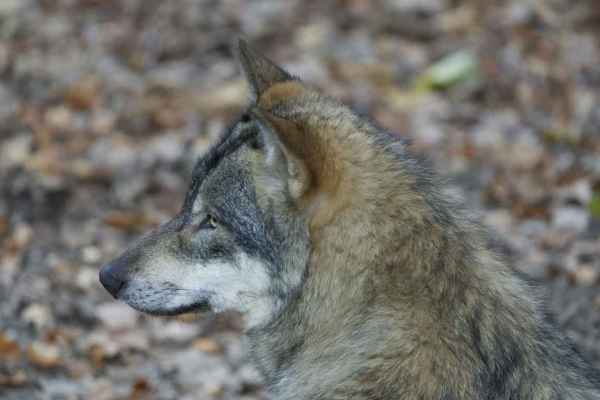
«Zero wolves»: wolf opponents want to remove the species entirely, only 6 of 117 livestock killed were adequately protected
After the National Council approved the motion for a cap on the wolf population, Roberta Soldati, president of the «Associazione per la protezione del territorio dai grandi predatori», named, in “Corriere del Ticino”, her target figure for Ticino: “zero”. Sem Genini of the Ticino Farmers' Association also considers zero to be correct. Their main argument is that many alpine pastures cannot be protected. The canton's kill statistics of 28 September shows how far this argument actually holds: of 117 livestock animals killed, only 6 were adequately protected. For 52 animals, the office considered protection unreasonable; for 45, it classified protection as inadequate; and for a further 13, as inadequate due to force majeure. The argument that alpine pastures cannot be protected therefore covers less than half of the kills. The KORA foundation notes in the same article that there is no clear link between an upper limit and fewer losses. A target figure of zero does not mean population regulation, but the complete removal of a protected species from the canton — even in places where the office itself finds herd protection to be insufficient. On the motion: Wolf threshold: National Council approves stockpiled kills.
Corrected on 05.10.2026: An earlier version stated that reasonable protection was lacking for 45 animals. The office lists them under the category «protezione non adeguata» (inadequate protection). In addition, the 52 animals in the category «protezione non esigibile» (protection not reasonable) and the 13 animals in the category «protezione non adeguata (forza maggiore)» (inadequate protection due to force majeure) were missing.
03.10.2026
Sat 16:13
500 francs per wolf killed: What the canton pays recreational hunters in the wolf programme
How recreational hunters are compensated under the cantonal wolf programme «Gruppo Controllo Lupi» was already made public by «Corriere del Ticino» on 8 June: a flat starting fee of 300 francs, 30 francs per hour up to a maximum of 80 hours, and 500 francs for each wolf killed. According to RSI, the pilot project's budget amounts to at most 250,000 francs per year. With the reported kill in the Camoghè pack, the question of whether this success bonus was paid out arises concretely for the first time. The canton does not disclose who did the shooting. By comparison: in Valais, a recreational hunter was fined 300 francs for illegally killing a female wolf. The detailed analysis: 500 francs per wolf: Ticino pays a bounty for every wolf kill.
Sources: Corriere del Ticino, “Una nuova alleanza per regolare i lupi”, 08.06.2026; RSI, “Ticino: formati 88 cacciatori per abbattere i lupi”, 17.06.2026.
03.10.2026
Sat 07:54
Camoghè: The pack is barely confirmed, and already the first pup is killed
The cantonal office for hunting and fishing reported on 2 October that a young wolf born in 2026 from the Camoghè pack was killed in the Valle Morobbia. The pack is new: according to the department, only the five pups documented this year on the ridge between San Jorio and Gazzirola confirmed the formation of its own pack. The department made this confirmation public on 24 September, while the FOEN's approval to kill up to two-thirds of the pups already dates from 21 September; the Council of State ordered it at the end of September. According to the office, the culling is being carried out with the involvement of recreational hunters with wolf training and a permit. The reports make no mention of any livestock kills attributed to the pack. The first offspring of a new pack thus serves simultaneously as proof of its existence and as the reason for its decimation. On the role of recreational hunters: Ticino Trains 88 Recreational Hunters for Nocturnal Wolf Kills.
Sources: Corriere del Ticino, “Abbattuto un giovane lupo del branco Camoghè”, 02.10.2026; ticinonews, “Valle Morobbia: abbattuto un giovane lupo”, 02.10.2026; RSI, “Abbattuto un giovane lupo del branco Camoghè”, 02.10.2026; Corriere del Ticino, “Undici piccoli nuovi lupi in Ticino”, 24.09.2026; FOEN, Status of cantonal applications, 24.09.2026.
02.10.2026
Fri 07:10
«Fewer, but killed better»: Office breaks down the high hunt results
The “Corriere del Ticino” broke down the high hunt results by species on 1 October: 1,882 red deer (2025: 2,163), 501 chamois (463), 399 wild boars (284) and 167 roe deer (239). Office head Tiziano Putelli sums it up: «Si è cacciato un po’ meno, ma meglio», with the office measuring «quality» by the sex ratio of the red deer killed. Putelli explains the decline in roe deer partly by competition from red deer and the presence of wolf and lynx — in other words, by precisely the kind of natural regulation that the canton simultaneously combats in the case of the wolf through the killing of pups. From the end of September, the red deer rut must be able to take place «senza il disturbo dell’attività venatoria», says Putelli; in Valais, however, the high hunt began on 21 September, right in the middle of this period. Missed kill quota figures do not worry the office, because late-autumn and winter hunts for red deer and wild boar will follow. The results therefore do not measure whether the killing was necessary, only how much of it still remains to be made up by the end of the year. On the Valais counter-model: «More than shooting»? The Valais High Hunt between Image Film and Red Deer Rut.
Sources: Corriere del Ticino, «Caccia alta, pesa il caldo», 01.10.2026 (statements by Tiziano Putelli, Ufficio della caccia e della pesca); Walliser Bote, 18.09.2026 (start of the Valais high hunt).
02.10.2026
Fri 07:05
Peloso and Camoghè: Council of State allows young wolves to be killed in two further packs, federal government has approved nine Ticino packs
The Ticino Council of State has decided to kill up to two thirds of the young wolves born in 2026 in the Peloso and Camoghè packs, as reported by the «Corriere del Ticino» on 25 September. FOEN approved this on 16 September (Peloso) and 21 September (Camoghè). The kills are also to be carried out by recreational hunters who have completed the training for wolf regulation and hold a permit. According to information published in mid-September, the Peloso pack, located between lower Vallemaggia, Valle di Vergeletto and lower Onsernone, consists of two parent animals and three pups. As early as 28 August, FOEN had, according to its overview of applications approved for puppy kills in seven further Ticino packs (Bedretto, Lepontino, Molare, Madom, Aspra, Carvina, Onsernone); including Peloso and Camoghè, that makes nine. Neither the federal list nor the newspaper report names any kills attributed to these packs: here, “preventive” means a pack pays the price for reproducing, not for a proven instance of damage. On the role of recreational hunters: Ticino Trains 88 Recreational Hunters for Nocturnal Wolf Kills.
Sources: Corriere del Ticino, 25 September 2026; FOEN, “Fourth preventive regulation of wolf packs: status of cantonal applications,” 24 September 2026.
30.09.2026
Wed 04:22
Wild boar summer hunt: canton opened hunting ban areas and paid 4 francs per kilo
The Regulations of the Office for Hunting and Fisheries on the 2026 wild boar summer hunt show just how far the canton went. In the district of Mendrisio, recreational hunting from 1 June to 31 July was explicitly permitted even within the cantonal hunting ban areas of Gole della Breggia and Valle della Motta — precisely the places where wild animals are meant to find refuge. Shooting took place daily from 8pm to 6am, using artificial light, thermal-imaging and residual-light attachments, and silencers. From 25 May onwards, recreational hunters were allowed to bait the animals with maize and monitor them with wildlife cameras. There was no restriction by age, sex or number, right in the middle of the period when sows are rearing their piglets. Anyone delivering an animal to the collection point in Rivera received 4 francs per kilo from the canton. All of this is justified by reference to African swine fever, even though the canton already admitted back in 2024 that the summer hunt does not reduce the population. Why opening any part of a protected area at all undermines its very purpose is shown in our article Wildlife sanctuaries: Why wolf kills hollow out the very idea of protection.
28.09.2026
Mon 19:34
High hunt over: 2’949 animals killed, follow-up hunt from mid-November
Ticino's high hunt ended on Sunday. In September, 1’721 recreational hunters killed 2’949 red deer, chamois, roe deer and wild boars, as the official announcement of 5 October shows; the RSI had previously reported a rounded figure of 2’950, citing the cantonal office for hunting and fisheries. For red deer, the tally stands at around 1’900 animals, while the kill quota requires 2’900. Therefore, a follow-up hunt is to take place from mid-November to the end of December. The office expresses satisfaction with the “quality” of the kills and attributes the lower tally to the heatwave in early September. Notably, the quota for chamois and roe deer was also missed, which, according to the office, is not a problem due to “conservative” management. For red deer, however, the planned figure is treated as mandatory, even if this means hunting and disturbing non-human animals once again during the energy-sapping early winter.
For wild boars, the office gave no figure in this first assessment, noting that the cull during the high hunt was "never particularly high." The reason: wild boars are now hunted in Ticino in several phases spanning much of the year, with a summer hunt in June and July, a high hunt in September, and a subsequent winter hunt, after the federal government suspended the closed season citing African swine fever. The canton itself already admitted in 2024 that the summer hunt does not reduce the population. Not part of the official tally: in the same season, two recreational hunters died in accidents in Ticino.
Addendum 02.10.2026: According to the «Corriere del Ticino» of 1 October 1,882 red deer and 399 wild boars were killed during the high hunt (2025: 284). See entry from 02.10.2026.
Corrected on 06.10.2026: An earlier version, based on RSI, stated 1’720 recreational hunters and 2’950 animals. According to the official announcement of 5 October, there were 1’721 recreational hunters, and the four species together total 2’949 animals.
22.09.2026
Tue 12:16
Dead red deer as a display piece: ethologist takes aim at the selfie culture of Ticino's recreational hunters
For days, a photo has been circulating in the Luganese region showing a recreational hunter driving through the streets with a killed red deer on a trailer. For ethologist Nash Pettinaroli, this is no isolated incident but a symptom of a wider trend: more and more recreational hunters are putting their dead prey on display — on social media, in WhatsApp statuses, as selfies next to the carcass. Pettinaroli calls this kind of display in an interview with tio.ch «repulsive» and warns of a creeping desensitisation: anyone who turns the death of a living being into a trophy photo erodes the empathy of an entire society.
The ethologist also rejects the most popular justification narrative. To the argument that recreational hunting regulates the ecosystem, he counters with the voices of science: zoologist Ragnar Kinzelbach, biologist Karl-Heinz Loske and the former director of Gran Paradiso National Park, Bruno Bassano, have all consistently described recreational hunting as superfluous, since intact wildlife populations regulate themselves. This is exactly what our fact check on the six central hunting-lobby myths documents as well. For Pettinaroli, in the end only one motive remains: pure pleasure. The narrative of ecosystem regulation, he says, merely serves to dress up this pleasure.
The context in which the interview appears is striking. Only recently, the president of the Ticino recreational hunting association had publicly stated that his greatest emotion was watching his daughter kill her prey. Pettinaroli, who says he has already been threatened and had his car tyres slashed, counters: how can the death of a living being move anyone?
18.09.2026
Fri 16:42
Survey in neighbouring country: 82 per cent consider recreational hunting unsafe, only 3 per cent want to promote it
Just across the Ticino border, one of the largest surveys on recreational hunting ever conducted in Europe was published this week: Ipsos Doxa surveyed 7,002 people in Italy on behalf of the Fondazione Capellino. 75 per cent want to abolish recreational hunting, phase it out, or limit it to a few emergency cases, while only 3 per cent want to promote it. 82 per cent consider it not entirely or not at all safe — explicitly including for people out in the forest and on hiking trails. Even the electorate of the governing parties, which are currently relaxing the hunting act, mostly wants the opposite. For Ticino, this is more than a glance over the fence: here, a safety distance of 50 metres from residential buildings still applies, the ongoing high hunt has already claimed two human lives, and Ticino's recreational hunters are also active across the border. A survey of this scale would be overdue in Ticino too. More on this in the detailed article.
16.09.2026
Wed 15:15
FCT president calls violations “nearly gone”, hunting report counts 186 proceedings
On tio.ch, Davide Corti, president of the Federazione Cacciatori Ticinesi, declares recreational hunting to be “scientific wildlife management”, disease prevention and environmental protection. Serious violations and poaching, he says, have “almost disappeared”. The canton's 2024 hunting report contradicts him on every point: 190 self-reports, 82 disciplinary fines, 186 infringement proceedings, nine offences referred to the public prosecutor, and at least 16 revocations of hunting rights – even 37 according to the statistical table in the same report. This is no marginal phenomenon, but the documented lower bound of an enforcement problem. In the same interview, Corti himself names the illegal use of night vision devices as the association's “main concern”; something that is supposedly gone cannot simultaneously be the biggest concern.
The alleged “ethics” must be measured against practice: 3’377 red deer, roe deer and wild boars killed during the 2024 high hunt, a record, up 48 percent from ten years earlier; 143 lactating hinds shot dead, 87 of which were brought in without a calf for inspection, which the canton records as progress. Wild boar kills have quintupled since 2000, and wildlife biology research has been explaining for two decades why high hunting pressure is precisely what drives reproduction upward. With chamois, twice as many bucks as does are killed; the canton names trophy hunting as the cause and still permits it. Corti wants to “manage” the wolf “like other species” — preventive kills of a protected predator whose protective effect, according to KORA, remains unproven to this day.
The journalist does not ask a single follow-up question, cites no figures, and mentions neither the two dead recreational hunters from the opening weekend nor the femicide in Faido, where a recreational hunter with a silencer shot a woman dead. His headline is Corti’s strongest memory from forty years of licence hunting: his daughter’s first kill. That is the most honest sentence in the whole interview, and it says more about recreational hunting than all the management jargon that came before it.To the analysis
15.09.2026
Tue 14:32
Red deer flown in by helicopter from Piedmont: provincial police confirm Ticino recreational hunter
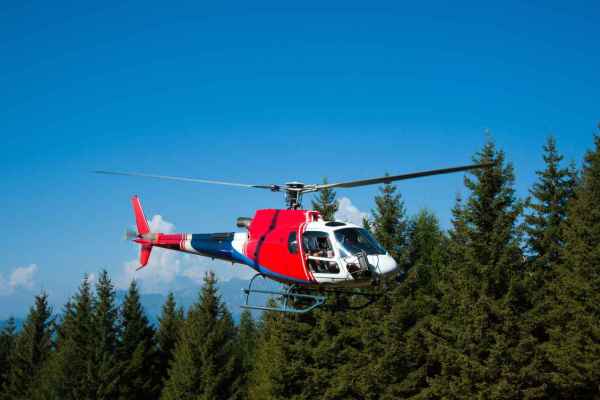
The royal stag that was killed at the weekend in the Ossola valley and flown across the border by helicopter is a Ticino case. The commander of the Verbano-Cusio-Ossola provincial police confirms to tio.ch: the recreational hunter holds a Ticino licence and is additionally authorised in the VCO province, the helicopter belongs to a Ticino company, and the animal was set down near Cimalmotto in the municipality of Campo (Vallemaggia). What is being objected to is the overflight of a bird sanctuary without the required notifications, and the fact that the recreational hunter himself was on board, which is prohibited for hunters in Italy. The recreational hunter and the flight company must each pay a fine of over 5’000 euros. The case therefore falls entirely within Ticino’s jurisdiction; we have asked whether the Ufficio della caccia e della pesca is examining any licence-related consequences. More on this in the detailed article.
06.09.2026
Sun 12:18
54-year-old recreational hunter falls to his death during hobby hunt on Pizzo Sassariente (Locarnese)
A 54-year-old Swiss man residing in the Locarnese region died on Saturday afternoon during a hobby hunt in the Pizzo Sassariente area. The Ticino cantonal police announced this on Sunday morning.
Shortly after 4.30 pm, the joint alarm centre (CECAL) received a missing person report. A search operation involving the cantonal police, Swiss Alpine Rescue (SAS) and REGA was launched. At around 6 pm, the lifeless body was found at an altitude of around 1,450 metres on the slope of Val della Porta. According to initial findings, the man fell while hunting. The exact circumstances are being clarified by an investigation. A care team was called in to support the family.
Context: Once again, Ticino's high hunt has claimed a human life, and once again it is no “accident out of the blue”, but the predictable consequence of a leisure activity that drives people into the steepest, most fall-prone terrain, alone, off secured paths, often at dusk. The fall at 1,450 metres is part of a long series of fatal hunting accidents in the Alpine region. No red deer, no roe deer is worth a human life. Recreational hunting is not nature conservation, but a deadly risk that hunters voluntarily take on and which regularly endangers uninvolved people as well.
05.09.2026
Sat 19:08
On the first weekend of the Ticino high hunt, the season claimed its first fatality. Shortly after 1 p.m., a 69-year-old Swiss man resident in the Riviera district fell down a slope near the Riale Crenone in the Biasca area at an altitude of around 700 metres. Despite resuscitation attempts by the Rega, the emergency services were only able to confirm the man's death. A care team was called in for the relatives. According to the cantonal police, the exact circumstances of the fall are still under investigation.
The case fits a recurring pattern: the majority of fatal Hunting accidents in Switzerland are not shooting accidents but falls in steep, rugged terrain into which recreational hunters venture in pursuit of their leisure pastime. That someone aged 69 should be out in such terrain to kill wild animals is not an isolated case but structurally inherent to the system.
This is precisely where the long-standing demands of IG Wild beim Wild come in. The largest age group among recreational hunters is 65+, in other words those with increasing age-related weaknesses in eyesight, concentration and reaction time. From the age of 45 onwards, the number of accidents involving people and animals rises markedly. For this reason the IG has long demanded that recreational hunters be required to undergo regular medical and psychological aptitude testing, following the Dutch model, and that an upper age limit be introduced for the active practice of recreational hunting. Both have long been taken for granted in other safety-critical activities.
On a fundamental level, IG Wild beim Wild calls for the abolition of recreational hunting and its replacement by professional, state-run wildlife management. The regulation of wild animals, where it is necessary at all, belongs in the hands of trained, salaried specialists working to clear standards, not in the leisure time of private individuals. Such a system would not only be gentler on wild animals and more soundly based in expertise, it would also help to prevent tragedies such as the one in Biasca.
Responsibility does not end with the individual recreational hunter. It is the canton that permits recreational hunting in dangerous terrain in the first place, without mandatory medical and psychological aptitude tests and without an upper age limit. As long as it clings to this system and refuses to act on the long-standing demands for greater safety, it bears, in the view of IG Wild beim Wild, political co-responsibility for the numerous deaths of recent years.
05.09.2026
Sat 08:44
From «user» to «fauna manager»: how Corti reframes a fourfold increase in kills as responsibility
On the eve of the opening of the high hunt Davide Corti, president of the Ticino recreational hunting federation, declares that the modern Alpine hunter is not a «user» but a «manager of the Alpine fauna». He supplies the decisive figure himself: when he took out his hunting licence, some 1’600 ungulates a year were killed in Ticino; today the figure is around 7’000. What is being sold here as grown «responsibility» and «management» is in truth a quadrupling of the killing. A manager whose only measurable achievement consists in killing four times as many animals as before is not practising nature conservation, but justifying the expansion of recreational hunting under a new label.
Corti's handling of the increased pressure on wild animals is particularly brazen: tourism and leisure use are said to be to blame, not recreational hunting. Yet hikers, bikers and tourists do not kill or torment wild animals. Recreational hunting does, and in Ticino practically all year round. Taken together, the summer hunt, the high hunt, fox and wild boar hunting as well as wolf regulation create a system in which wild animals are hunted or disturbed by unnecessary recreational hunting activities during large parts of the year. A reliable, long period of rest across the canton is barely discernible for many of the animals affected.
Hunting seasons in Ticino at a glance
- Wild boar summer hunt: 1 June to 31 July 2026, daily from 8pm to 6am, only from the assigned elevated hide in the forest; with no restriction by age, sex or number, and in the district of Mendrisio also within two hunting ban areas (Office regulations).
- High hunt: 5 to 19 September and 23 to 27 September 2026.
- Fox hunting («Caccia bassa»): in accordance with the annual cantonal season regulations; in the winter months with additional methods depending on the area and authorisation.
- Late-autumn hunt for red deer: according to the office, from mid-November, presumably until the end of December; for chamois and roe deer, recreational hunting for 2026 has concluded.
- Winter hunt for wild boars: by cantonal order; dates for 2026/27 still open.
- Proactive wolf regulation: by cantonal order within the respective applicable authorisation period.
Hardly a month remains free. Corti's reference to tourism distracts from precisely this.
Silencers: «only advantages»? Two Ticino cases say the opposite
When it comes to the newly permitted silencers, too, Corti makes no effort to weigh things up: they supposedly have «only advantages». How these advantages can play out in the hands of recreational hunters is demonstrated twice over by the same canton within just a few months. A Ticino recreational hunter was convicted as a poacher, with a silencer, night vision device and illegal lure traps. And in the femicide of Faido committed by a recreational hunter, nobody heard the fatal shot fired at the 56-year-old woman, which is why the police assume a silencer was used. The spread of silencers via exemption permits under hunting law is therefore not a pure «advantage», but a control problem with real victims, and not only in the animal world.
05.09.2026
Sat 06:51
The Ticino Office for Hunting and Fishing (UCP) is calling on the public to report sightings of wolf pups born this year, including date, location and, if possible, photo or video material. The authority openly states that the purpose is to facilitate applications for the “proactive regulation” of wolf packs. The day before, the Ticino Council of State decided to have up to two thirds of the young wolves born this year in the Molare and Lepontino packs killed, with the involvement of recreational hunters.
IG Wild beim Wild therefore does not recommend reporting such sightings to the UCP. The information requested demonstrably does not serve independent scientific monitoring, herd protection or low-conflict coexistence, but rather the preparation of pre-emptive killings of wolf cubs. This runs counter to a form of wildlife protection that takes social pack structures, natural regulation and the ecological function of the wolf seriously. An intact natural dynamic is also important for protection forests: predators can influence the spatial use and behaviour of ungulates and thereby counteract excessive browsing damage at local level.
Moreover, wolves do not reproduce indefinitely in one place. Young animals disperse, colonise vacant and suitable habitats and connect populations across cantonal and national borders throughout the entire continent.
Original notice from the UCP
Report of young wolves sighting – To facilitate requests for proactive regulation of wolf packs in Ticino, the UCP invites reports of any sightings of young wolves born this year. Reports, indicating the date and location of the sighting and accompanied, if possible, by photographs or videos, may be sent to:
4 September 2026 – News, Department of the Territory
04.09.2026
Fri 14:51
The wolf as scapegoat: official figures expose who is really failing
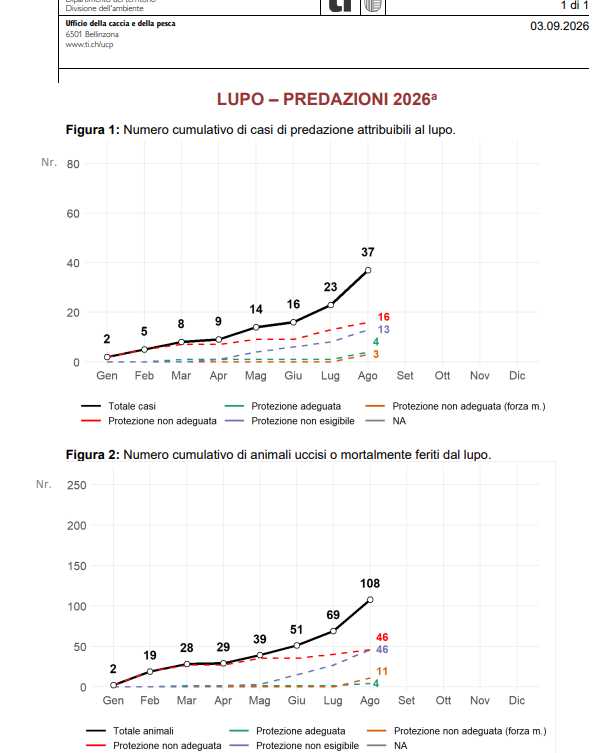
Official figures from the UCP in Bellinzona («Lupo – Predazioni 2026», as of 3 September) show unsparingly: of 108 livestock killed by wolves so far this year, only 4 were adequately protected — not even 4 percent. For a large proportion of the remaining animals, the authority classifies the protection as inadequate, and for a further proportion as not reasonable. Nevertheless, it is the wolf that is regulated, hunted and cleared for killing, while those actually responsible go unpunished. As Wild beim Wild already showed in the case of Paudo and in the analysis of the enforcement practice of the veterinary office has documented, this is not an isolated case but systematic: for years Ticino has tolerated unprotected herds in known wolf areas, fails to penalise the breaches and then makes the Predators pay for its own failure to enforce.
Corrected on 04.10.2026: An earlier version stated that in 96 percent of attacks, livestock keepers had not fulfilled their protection obligation. However, the authority distinguishes between inadequate and unreasonable protection; only in the former case is there an unfulfilled protection requirement. According to current status as of 28 September of 117 livestock killed, 6 were adequately protected, 45 were not adequately protected, 13 were not adequately protected due to force majeure, and for 52 protection was deemed unreasonable.
04.09.2026
Fri 11:25
Record bag of red deer: even the organised recreational hunters doubt the official justification
The canton has drastically intensified the hunting of red deer in recent years: 2’163 animals during the 2025 high hunt, compared with 1’787 in 2022. Tellingly, even the cantonal hunters' federation FCTI contradicted the authorities' assumption of a growing population in 2021 and warned of a «merciless campaign» against the red deer. With the chamois population the pattern is reversed: the maximum quota of 800 animals has never been reached since 2022, and in the Gambarogno-Tamaro-Lema area the population collapsed so severely that hunting there had to be suspended for three years. Kill figures therefore say little about whether the killing is ecologically justified; above all they reflect the canton's own release policy. Following the 2025 high hunt, Ticino also recorded more than 140 self-reports and 19 licence withdrawals for serious violations, including a case of poaching with a silenced weapon and a thermal imaging device. More on this in the detailed article.
04.09.2026
Fri 10:54
Season opens with a 50-metre safety distance – the increase promised since 2019 is still missing
Since 5 September, around 1,800 recreational hunters have once again been out and about across the canton during the high hunt, in two phases running until 27 September. Just how precariously the protection of the public is calibrated is shown by one detail: according to the Office for Hunting and Fishing, recreational hunters need only keep 50 metres’ distance from residential buildings, campsites and nature trails — the length of a swimming pool. Following serious hunting accidents in autumn 2019, in which among others a chimney sweep wearing a high-visibility vest was shot dead, the canton announced an increase to 200 metres. It was never implemented; to this day the 50-metre rule applies. Since July 2026, silencers have also been permitted, which makes shots near settlements quieter, but no safer. In the Blenio Valley, where the high hunt is now beginning, the case of Faido/Leontica also continues to reverberate: a recreational hunter shot his ex-wife and blew up a house — further evidence of the recurring pattern of legal access to firearms and violence in the hunting milieu. More on this in the detailed article.
03.09.2026
Thu 16:58
Ticino authorises the killing of the Molare and Lepontino packs without a single proven livestock kill
On 3 September, with the blessing of the Federal Office for the Environment, the Council of State ordered the killing of up to two thirds of the young born in 2026 in the Molare and Lepontino packs, to be carried out in part by specially trained recreational hunters. For neither Molare nor Lepontino does the canton cite a single livestock kill attributed to the respective pack as justification; the cantonal reasoning is deliberately kept general. Under the revised Hunting Ordinance, the mere proof of two or more cubs born this year is already sufficient — a killing on spec, without any evidence of individual misconduct. The rulings are expressly directed against the «giovani lupi» and even instruct recreational hunters not to shoot when animals are of roughly equal size, so as not to hit a parent animal. What is being punished is thus not a pack that has demonstrably caused damage, but the mere fact that it has reproduced. More on this in the detailed article.
Addendum 02.10.2026: According to the FOEN overview (as of 24.09.2026) the federal government has in the meantime approved pup culls in nine Ticino packs, alongside Molare and Lepontino also Bedretto, Madom, Aspra, Carvina, Onsernone, Peloso and Camoghè. See entry from 02.10.2026.
Background
- Dossier: How many hunting accidents happen in Switzerland?
- Dossier: Poaching and hunting crime in Switzerland
More on the subject of recreational hunting: In the dossier Poaching and hunting crime in Switzerland we document cases, legal questions and recurring patterns. The scientific evidence is presented in the overview Studies on the Effects of Recreational Hunting.
The position of IG Wild beim Wild: IG Wild beim Wild rejects recreational hunting. Our model is the canton of Geneva, which has managed without recreational hunting since 1974: without hunting seasons, without hunting dogs, without driven hunts, without high seats, without the animal cruelty and crime that go hand in hand with hunting season elsewhere. What has worked there for over fifty years disproves every position paper by JagdSchweiz. An association that bases its policy on claims it refutes in its own documents is not a professional organisation, but a factory for misinformation.
Wild animals need a voice
Once a week: research, petitions and background information on recreational hunting. Free of charge and can be unsubscribed from at any time.

All articles are written by IG Wild beim Wild as well as by external co-authors. Research, structuring and editorial processes may be supported by AI-assisted tools.
Support our work
With your donation you help protect animals and give their voice a hearing.
Donate now →