How many hunting accidents happen in Switzerland?
In Switzerland, around 300 accidents recognised under the Accident Insurance Act (UVG) are registered every year in connection with recreational hunting. According to the Swiss Council for Accident Prevention (BFU), more than 75 people have been killed in connection with recreational hunting since 2000.
«What Begins at the High Seat»
Statistically speaking, a hunting accident happens every 29 hours. Yet to this day there is no central, comprehensive reporting obligation, and the number of unreported cases is considerable.
What do the BFU data since 2000 say?
The Swiss Council for Accident Prevention (BFU) has been documenting hunting accidents for decades. The analyses since 2000 show a consistently worrying picture: over a period of around 25 years, more than 75 fatal hunting accidents were recorded. That averages out at three deaths per year in the recorded categories alone. On top of this come dozens of seriously injured people every year, many with permanent damage.
The BFU distinguishes between firearm accidents, falls and other accidents during hunting. Firearm accidents account for a considerable share of serious and fatal accidents, contrary to the narrative occasionally cited by the hunting lobby that recreational hunting is "safer than golf". Source: BFU – Swiss Council for Accident Prevention.
SUVA data 2006–2015 and 2016–2020: what the figures show
SUVA (the Swiss National Accident Insurance Fund) records hunting accidents as leisure accidents under the Accident Insurance Act (UVG). The analysis for the period 2006–2015 shows around 300 recognised accidents a year in the field of recreational hunting, around 2 deaths per year and around 2 new disability pensions per year.
The following period, 2016–2020, confirms these figures and adds an important cost dimension: still around 300 accidents per year, around 1 death per year (in the recorded group), around 2 new disability pensions per year and annual insurance costs of around CHF 3.6 million.
These CHF 3.6 million per year relate exclusively to recreational hunters who, as employees, are compulsorily insured against non-occupational accidents. The costs are borne through the NBU premiums paid by all employees. The total cost to the national economy, including uninsured persons, is far higher.
The hidden figures: who goes uncounted
The SUVA statistics have a fundamental gap: they only cover people who are compulsorily insured under the Accident Insurance Act (UVG). Retired recreational hunters – statistically a particularly accident-prone group, since older age cohorts are disproportionately represented among hunters – fall entirely outside the statistics. The same applies to self-employed people without voluntary UVG cover, homemakers, students and foreign guest hunters who hunt in Switzerland.
Because recreational hunters in Switzerland are considerably older than the population average – many are aged 55 or over, and a substantial proportion are already retired – the number of unreported cases is structurally significant. A complete nationwide hunting accident statistic still does not exist.
Distribution by canton: where do most accidents happen?
The regional distribution of hunting accidents follows hunting intensity and the character of the terrain. According to BFU analyses, the Grisons account for 28% of all recorded hunting accidents. They are followed by accidents abroad (Swiss recreational hunters on hunting trips) at 16%, Ticino at 7%, Aargau at 6% and Valais at 5%. The remaining cantons share the other 38%.
The high share of the canton of the Grisons is explained by the alpine terrain, the high hunt (which sends thousands of recreational hunters into difficult mountain terrain every year) and the sheer size of the hunting ground. The 16% of accidents abroad show that Swiss recreational hunters also run considerable accident risks on hunting trips overseas.
A concrete case: the fatal accident in Vaud, December 2024
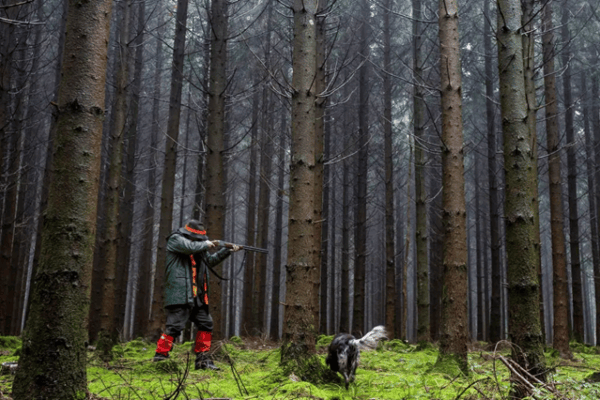
In December 2024, a 64-year-old recreational hunter was shot dead by a colleague in Oulens-sous-Echallens in the canton of Vaud. A group was trying to flush wild boars out of dense undergrowth. In the confusion of the situation, another recreational hunter opened fire and fatally hit the 64-year-old. The case is a textbook illustration of the dangerous combination of group pursuit, poor visibility and high stress levels that is typical of drive hunts and driven hunts.
Such cases are not isolated incidents. In previous years, too, fatal hunting accidents occurred in various Swiss cantons, caused by mistaking a person for an animal or by stray shots within groups. The lack of public documentation prevents these cases from being systematically examined.
alcohol and recreational hunting
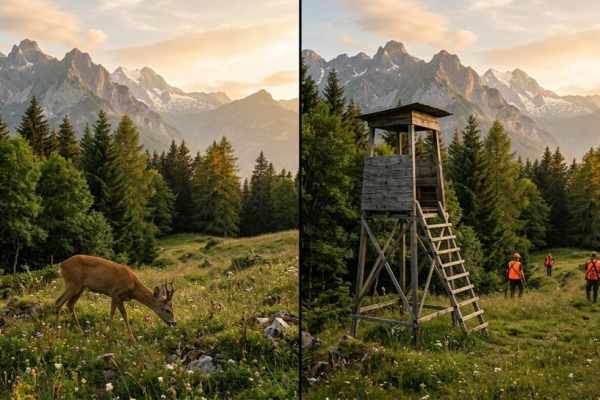
One factor that is barely discussed in public debate is alcohol consumption. On many hunts – particularly sociable driven hunts and group hunts – drinking together is part of hunting culture. Periods of waiting at the high seat and driving game alternate with breaks at which schnapps and wine are served.
In Switzerland there are no nationwide, binding statutory alcohol bans for recreational hunters during active hunting. Some cantons have recommendations or rules in their hunting ordinances, but a clear 0.5 per mille limit with systematic checks, comparable to road traffic law, has not been established in hunting. Anyone who drinks alcohol while driving risks losing their driving licence; anyone who drinks alcohol while out hunting with a rifle risks – apart from the lives of others – little in the way of legal consequences.
JagdSchweiz's conflict of interest in compiling its own statistics
JagdSchweiz, the umbrella organisation of Swiss recreational hunters, itself collects and publishes data on hunting accidents. This creates an obvious structural conflict of interest: the association that lobbies for the interests of recreational hunters and wants to present hunting in the most positive light possible is at the same time producing the statistics on which public debate and the authorities rely.
JagdSchweiz statistics do not cover the same population as those of SUVA or the BFU, which makes direct comparisons difficult. The association has an interest in presenting accident figures as low as possible. There is no independent external review of JagdSchweiz's own data collection. The cantons, which are supposed to report hunting accidents, do so at different bodies and according to different criteria.
No central reporting obligation: a structural problem
Unlike in other hazardous leisure activities, there is no central, comprehensive reporting obligation for all accidents in recreational hunting in Switzerland. The cantons handle recording differently, and some do not record accidents systematically at all.
The contrast with other European countries is striking: in France, where hunting is particularly intensive and socially controversial, the government introduced a public database of hunting accidents after a series of fatal accidents and enshrined minimum distances from residential areas in law. Switzerland is a long way from comparable transparency measures. Further information on European comparisons can be found in our dossier on hunting victims in Europe.
What the 3.6 million francs do not include
The annual SUVA costs of 3.6 million francs for hunting accidents cover only direct insurance benefits for the group subject to compulsory accident insurance under the UVG. Not included are: costs of accidents involving pensioners and self-employed people; costs of psychological aftercare for accident victims and witnesses; costs of criminal prosecution and court proceedings following hunting accidents; costs of search and rescue operations (helicopters, mountain rescue); loss of productivity due to disability; costs of accidents abroad. The real overall economic costs are therefore considerably higher. More in the dossier “What recreational hunting really costs Switzerland”.
Hunting accidents and poaching: the criminal dimension
Not all firearm incidents in a hunting context are accidents. Some of the reported cases involve illegal kills, poaching and the deliberate shooting of wild animals outside the permitted times, areas or species. These cases are categorised differently in the hunting accident statistics, but they are part of the overall picture. Our dossier on poaching and hunting crime sheds light on this dimension.
Political demands: what would be needed
From a hunting-critical perspective, the following are urgently needed: a central, independent duty to report all hunting accidents regardless of insurance status; complete recording of all victim groups, including retirees and foreign hunting tourists; an alcohol and drug ban while hunting, analogous to road traffic law; safety distances from settlements, hiking trails and recreational areas; and independent oversight of the JagdSchweiz statistics. Further context is provided by our Dossier on recreational hunting and weapons.
Conclusion: transparency instead of association statistics
Hunting accidents in Switzerland are not a marginal phenomenon. Around 300 recorded accidents per year, CHF 3.6 million in direct insurance costs, a massive number of unreported cases because retirees and self-employed people are not recorded – and an interest group that holds sovereignty over its own accident statistics. This is no coincidence, but the result of a lobby structure that prevents transparency. As long as there is no independent, complete and mandatory hunting accident statistic, the true extent of the problem remains in the dark.
Further content on wildbeimwild.com:
- Dossier: Hunting accidents in Switzerland
- Dossier: Hunting victims in Europe – deaths, injuries and a continent without statistics
- Dossier: Recreational hunting and weapons
- Dossier: Poaching and hunting-related crime in Switzerland
You can find more background on current hunting policy in Switzerland in our dossier on wildbeimwild.com.
Do you have a tip, a source or a correction for this article? Write to us.
More on the subject of recreational hunting: All Dossiers at a glance bring together fact checks, analyses and background reports. The scientific evidence is presented in the overview Studies on the Effects of Recreational Hunting.
The position of IG Wild beim Wild: IG Wild beim Wild rejects recreational hunting. Our model is the canton of Geneva, which has managed without recreational hunting since 1974: without hunting seasons, without hunting dogs, without driven hunts, without high seats, without the animal cruelty and crime that go hand in hand with hunting season elsewhere. What has worked there for over fifty years disproves every position paper by JagdSchweiz. An association that bases its policy on claims it refutes in its own documents is not a professional organisation, but a factory for misinformation.
Support our work
With your donation you help protect animals and give their voice a hearing.
Donate now →