Hunting Accidents in Switzerland

Recreational hunting is often presented as a controlled activity. “Safety” is a fixed part of hunters' self-image. Yet one topic remains astonishingly quiet: hunting accidents. This is not just about tragic individual cases, but about a structural risk that arises from a simple fact: recreational hunting means firearms in a densely used landscape in which people, pets and wild animals share the same space.
The figures from the BFU (Swiss Council for Accident Prevention) and SUVA speak clearly: between 2000 and 2019, more than 75 people were killed in hunting accidents in Switzerland. Statistically, a hunting accident happens every 29 hours, and roughly every three and a half months a person loses their life. At the same time, the true extent is considerably greater than the official statistics show. This dossier makes the structures behind the figures visible and explains why the public debate on the issue is still missing.
What awaits you here
- What the statistics show and what they conceal: BFU figures, SUVA data and the systematic under-reporting in Swiss hunting accident statistics.
- Typical accident patterns: falls, shootings, mistaken identity: What the most common causes of accidents are and which factors increase the risk.
- Driven hunts: a structurally increased risk: Why drive hunts and driven hunts pose particular dangers for shooters, beaters and bystanders.
- Ricochets and rebounds: the underestimated risk in public space: What studies reveal about the rebound behaviour of rifle bullets and why this matters for the Swiss recreational landscape.
- Pets in the line of fire: cases that exemplify what is structurally going wrong: From the Weimaraner in Sedrun to the livestock guardian dog in Valais.
- Night hunting and new technologies: when efficiency increases the risk: What the expansion of hunters' scope for action means for safety.
- Transparency and oversight: who records what, and who monitors whom? The structural weakness in Swiss hunting accident statistics.
- What a consistent safety policy would mean: Concrete minimum standards that would call for a serious safety debate.
- Argumentation guide: Answers to the most common objections to an independent safety debate.
- Quick links: All relevant articles, statistics and dossiers.
What the statistics show and what they conceal
The data are clear enough to sound the alarm, yet so patchy that the full extent of the problem remains invisible. The BFU statistics document more than 75 deaths from hunting accidents between 2000 and 2019. An analysis of UVG data from the accident insurers (SUVA and others) for 2006 to 2015 shows around 300 recognised accidents per year during recreational hunting, with roughly 2 deaths and about 2 new disability pensions per year. More recent analyses for 2016 to 2020 confirm this picture: still around 300 accidents a year, about one death annually, two new disability pensions and annual costs of around CHF 3.6 million.
The 2026 season shows that nothing has changed: on the opening weekend of the Ticino high hunt, on 5 and 6 September 2026, two recreational hunters died in falls, a 69-year-old and a 54-year-old at Pizzo Sassariente (Ticino Tracker 2026/27). By comparison: in France, the only country with comprehensive state recording, the OFB reported 100 firearm-related hunting accidents and 11 deaths for the 2024/25 season, and 92 accidents and 4 deaths for 2025/26. In Italy, the AVC dossier for 2025/26 documents 33 recreational hunters involved in accidents (10 dead, 23 injured) and 13 bystanders (2 dead, 11 injured) (Hunting victims in Europe).
What these statistics fail to capture is crucial: the SUVA data cover only employed persons with compulsory accident insurance. Children, students, homemakers, self-employed people and, most relevantly, retired recreational hunters are missing entirely. The latter in particular make up a considerable share of the people who actively handle hunting weapons. The canton of Grisons records a particularly high number of hunting accidents, followed by the cantons of Ticino, Aargau, Valais, St. Gallen and Bern. All persons killed in hunting accidents since 2000 with a BFU entry were resident in Switzerland. The actual number of hunting accidents and fatalities is considerably higher than the official figures; how much higher cannot be said without a central, independent system of recording. That is itself a political problem.
More on this: Switzerland: statistics on fatal hunting accidents and Hunting and weapons: risks, accidents and the dangers of armed recreational hunters
Typical accident patterns: falls, shootings, mistaken identity
Contrary to public perception, shooting accidents are not the most common cause of death in hunting accidents in Switzerland. Falls and plunges in rough terrain are far more frequent, triggered by hectic hunting situations, darkness, poor visibility and time pressure. This is explained by the risk group: they are predominantly older men moving through demanding terrain with hunting weapons and heavy equipment, often in situations where stress, peer pressure and adrenaline play a part. Mistakes there have fatal consequences.
Shooting accidents follow typical patterns: confusing animal and target, poor visibility, unclear fields of fire, miscommunication within groups and impulsive action under social pressure. A recent example is the fatal hunting accident at Oulens-sous-Echallens in the canton of Vaud: at the end of November 2024, a 64-year-old recreational hunter was killed by a shot fired by a colleague while a group was trying to flush a sounder of wild boars out of a thicket. In May 2026, the district court of Yverdon convicted the shooter of negligent homicide and gave him a suspended prison sentence of ten months; he had fired two warning shots to keep the wild boars away from his hound, and in doing so hit a colleague standing lower down in the head. This case illustrates a familiar pattern: in hunting groups, group dynamics can systematically lower individual caution. Those who do not want to be seen as 'not pulling their weight' in the group are more likely to act impulsively, at the expense of safety.
More on this: High hunt in Switzerland: traditional ritual, zone of violence and stress test and Recreational Hunting and Crime: Suitability Checks, Reporting Obligations and Consequences (template text)
Driven hunts: structurally elevated risk
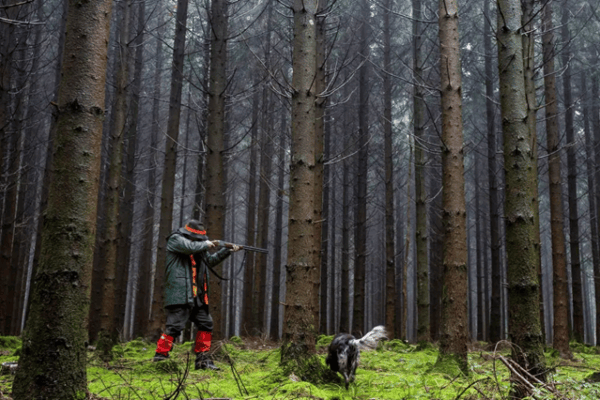
Drive hunts and driven hunts are the form of hunting accident with the highest structural risk potential. Several people shoot at the same time, wild animals move quickly through the terrain, and spatial orientation can be lost in seconds. Hunt leaders bear responsibility for the placement of shooters' stands, must know the danger zones and ricochet directions of all stand combinations, and at the same time must ensure that nobody leaves their stand.
The technical reality exacerbates the problem: lead-free bullets, which are increasingly being used because the hunting ordinance in force since 1 February 2025 bans lead-containing rifle ammunition from 6 mm calibre upwards (transitional period until 31 December 2029), retain 36 per cent more mass and 28 per cent more energy after ricocheting than lead-containing bullets, according to studies by the DEVA. Ricochets from shots fired at driven hunts therefore travel further and with greater effect than before. On roadways, in forest soils with stones and along path edges, dangerous ricochets are systematically created. Hiking trails, forest roads and recreational use of the Swiss forest are everyday reality. Recreational hunting therefore does not take place in an enclosed space, but where people are out and about, often without knowing that a drive hunt is taking place.
More on this: Ban on driven hunts (template motion) and Lead ammunition and environmental toxins from recreational hunting
Ricochets and deflected bullets: the underestimated risk in public spaces
Even shooting in full compliance with the rules does not guarantee safety for third parties. Bullets can be deflected by branches, stones, frozen ground or vehicle tracks. An impact angle of at least 10 degrees on soft soil is needed for a bullet to be reliably absorbed; for a recreational hunter shooting freehand from a standing position, that corresponds to a distance of just ten metres to the ground. In drive hunts, where game passes by at 50 metres to the side, shallow impact angles with a corresponding ricochet risk are the rule, not the exception.
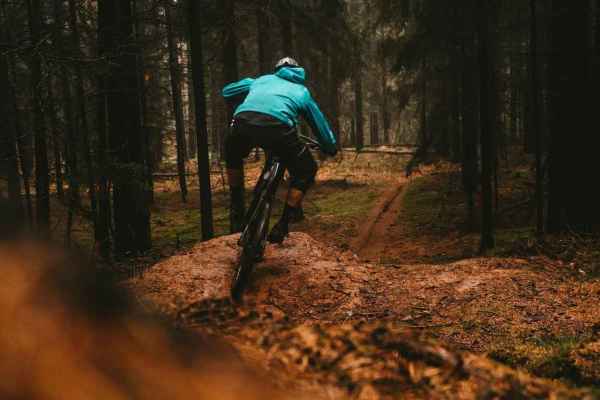
The consequence for society is clear: as long as recreational hunting, especially driven hunting, takes place without consistent closure of public paths and without independent advance notice, the ricochet risk cannot structurally be controlled. Hikers, cyclists and walkers who do not know that a drive hunt is taking place in a stretch of woodland bear a risk that is neither communicated to them nor limited by binding safety distances.
More on this: Public Safety: Minimum Distances, Exclusion Zones, Reporting Obligation (template text) and Hunting and Human Rights
Pets in the line of fire: cases that show exemplarily what goes wrong
On the night of 10 February 2024, a 79-year-old recreational hunter in Sedrun GR shot dead a leashed Weimaraner that he mistook for a fox. The recreational hunter fired from his house at the animal, which was out walking with its owner on a residential street, after 11 p.m. in poor light. The shooter did not see the owner or the lead. The public reaction was fierce: "The hunter should have his licence revoked," wrote 20 Minuten. The public prosecutor and the Grisons cantonal police are investigating.
This case is not an isolated one. In October 2024, a recreational hunter in Valais shot a livestock guardian dog that he claims to have mistaken for a wolf. The dog was worth around CHF 8,000; training and replacement costs fall on the taxpayer. It is an incident that shows by example that mistaken shootings of pets and farm animals are no isolated cases. They are the product of a system in which mix-ups remain structurally possible, because age checks, eyesight requirements and minimum technical standards for hunting weapons have not kept pace with the safety demands of a densely populated recreational landscape.
More on this: Valais recreational hunter shoots livestock guardian dog instead of wolf and Hunting laws and oversight: why self-supervision is not enough
Night hunting and new technologies: when efficiency increases the risk
The revised JSV, in force since 1 February 2025, in principle prohibits hunting in the forest at night (Art. 3ter), but exempts wait hunting and allows cantonal exceptions. In the canton of Bern, targeted night-time kills during defined full-moon periods are already practice. In the 2025/2026 wolf regulation in Valais, night hunting of wolf packs is expressly provided for.
Night hunting structurally increases the safety risk: visual checks are limited, identifying animals becomes harder, and walkers and people seeking recreation are out at night with no warning signs. Thermal cameras and night-vision optics improve accuracy, but they do not improve the ability to fully grasp the context around the target. They allow recreational hunters to shoot in situations in which earlier generations would not have fired, not because it has become safer, but because the technology lowers the threshold of inhibition. The more technology, the more night hunting, the more "efficiency" as the goal, the more important the question becomes: who sets the limits, and is that really an independent body?
More on this: Night hunting and hunting technology and Recreational hunting starts at the desk
Transparency and oversight: who records what, and who monitors whom?
To this day there is no complete, centrally maintained statistic on all deaths and injuries directly or indirectly linked to recreational hunting in Switzerland. JagdSchweiz publishes its own document, 'Zum Thema Jagdunfälle' (On the subject of hunting accidents), which draws on SUVA data. In other words, the very organisation responsible for representing the interests of recreational hunting is the one communicating the extent of its own safety risks. That is a classic conflict of interest.
What is missing: a central hunting accident statistic, maintained independently of the Confederation and the cantons, that covers all affected groups, including retirees, children, accompanying persons and bystanders. Also missing: a duty to report near-misses, shots at pets, and incidents that carry no criminal consequence but point to a safety problem. In a system where the same actors who hunt also help determine the rules and oversight, an unrecorded number of cases inevitably arises. Safety must be verified independently, not within a system that legitimises itself.
More on this: Hunter lobby in Switzerland: how influence works and Independent Hunting Oversight: External Control Instead of Self-Regulation (template text)
What needs to change
- Central, independent hunting accident statistics: Maintained by the BFU or the FOEN, with a duty to report all accidents, near-misses and incidents involving third parties, regardless of the occupational status of those affected. Template motion: Independent Hunting Oversight: External Control Instead of Self-Regulation
- Mandatory eyesight and reaction tests: As a condition for licence renewal, in particular for recreational hunters over 65. Analogous to fitness-to-drive tests in road traffic. Template motion: Recreational Hunting and Crime: Suitability Checks, Reporting Obligations and Consequences
- Binding public announcement of all hunts: Especially for drive hunts and driven hunts: a duty to announce them in municipal gazettes and cantonal apps, with the terrain perimeter and time window. Template motion: Public Safety: Minimum Distances, Exclusion Zones, Reporting Obligation
- Closure of hiking trails and forest tracks: During driven hunts, passive information is insufficient. Active closure with a signage requirement meets the standard applied to other hazardous activities in public spaces.
- Ban on night hunting in areas used for recreation: Night-time kills without complete safety perimeters and independent authorisation are incompatible with the protection of the general public.
- Age limits and technical fitness testing: Hunting licences should be renewed periodically from a defined age onwards, with an independent fitness test, as in road traffic.
- Independent accident investigation: Every hunting accident involving injured or killed third parties must be investigated by an independent authority, not by the cantonal hunting administration, which is organisationally close to actors with ties to hunting. Template motion: Independent Hunting Oversight: External Control Instead of Self-Regulation
Talking points
“Hunting accidents are rare; statistically, recreational hunting is safer than many other leisure activities.” Around 300 recognised accidents a year appear in the SUVA statistics, plus a considerable number of unreported cases among retirees, children and accompanying persons, who are not recorded. On top of this come accidents involving third parties (hikers, pet owners), which appear in no hunting-specific statistics. Anyone who claims “rare accidents” must explain how they know this when recording is systematically incomplete.
“Recreational hunters are well trained and safe.” In Grisons around 3,836 animals were merely wounded over five years instead of being killed in line with animal welfare standards, and fixed penalty fines of over CHF 700,000 were issued for unlawful kills. A 79-year-old recreational hunter in Sedrun shot a dog on a lead in 2024, believing it to be a fox. Training and qualifications do not protect against structural risks that grow systematically with ageing hunters, night hunting and driven hunts.
“Accidents can happen anywhere; that is no argument against recreational hunting.” Accidents can happen anywhere, but not everywhere is the general public required to co-finance and tolerate a system that deploys firearms in shared public spaces without full transparency. Recreational hunting does not take place in an enclosed space. The general public bears the residual risk and therefore has the right to independent oversight, complete statistics and binding safety standards.
Quick links
Articles on Wild beim Wild:
- Switzerland: statistics on fatal hunting accidents
- Valais recreational hunter shoots livestock guardian dog instead of wolf
- High hunt in Grisons: control and consequences for recreational hunters
- Recreational Hunting and Crime: Tightening Suitability Checks, Reporting Obligations and Consequences (template text)
- Public Safety: Minimum Distances, Exclusion Zones, Reporting Obligation (template text)
- Ban on driven hunts (template motion)
- Lead-Free Hunting: Ban on Lead-Containing Ammunition in the Canton (template text)
Related dossiers:
- Hunting and Wildlife Diseases
- Night hunting and high-tech: the myth of fair hunting
- Hunting Dogs: Use, Suffering and Animal Welfare
- Lead ammunition: the toxic legacy of recreational hunting
- High hunt Switzerland: Traditional ritual and stress test
- Swine fever as a justification for recreational hunting
- Hunting Accidents in Switzerland
- Hunting and Animal Welfare: What the Practice Does to Wild Animals
- Hunting and Weapons
- Driven Hunt in Switzerland
- Wait Hunting: Waiting, Technology and Risks
- Earth hunting
- Trap hunting
- Wait hunting
- Special Hunt in Grisons
- Swiss Hunting Statistics 2025: What the Federal Figures Show
- Poaching and hunting crime in Switzerland: Systematic impunity and the limits of self-control
A hunting accident every 29 hours, a death every three and a half months: these are not isolated cases but a structural risk arising from a simple fact: firearms in a densely used leisure landscape, supervised by a system that largely monitors itself. The BFU documents over 75 deaths in two decades. The SUVA records around 300 accidents a year, but excludes retirees, children and bystanders. Nobody knows the true figure, because nobody collects it. This is not a deficit in oversight; it is a political failure.
This dossier documents the structures behind the figures, drawing on BFU and SUVA data, case studies and scientific studies. The information is updated continuously as new accidents, rulings or political developments require.
Do you know of hunting accidents, dangerous situations or missing safety information in your region? Write to us with the date, location and source: wildbeimwild.com/kontakt
More on the topic of recreational hunting: in our hunting dossier we bring together fact checks, analyses and background reports.