
Hunting victims in Europe: Deaths, injuries and no statistics
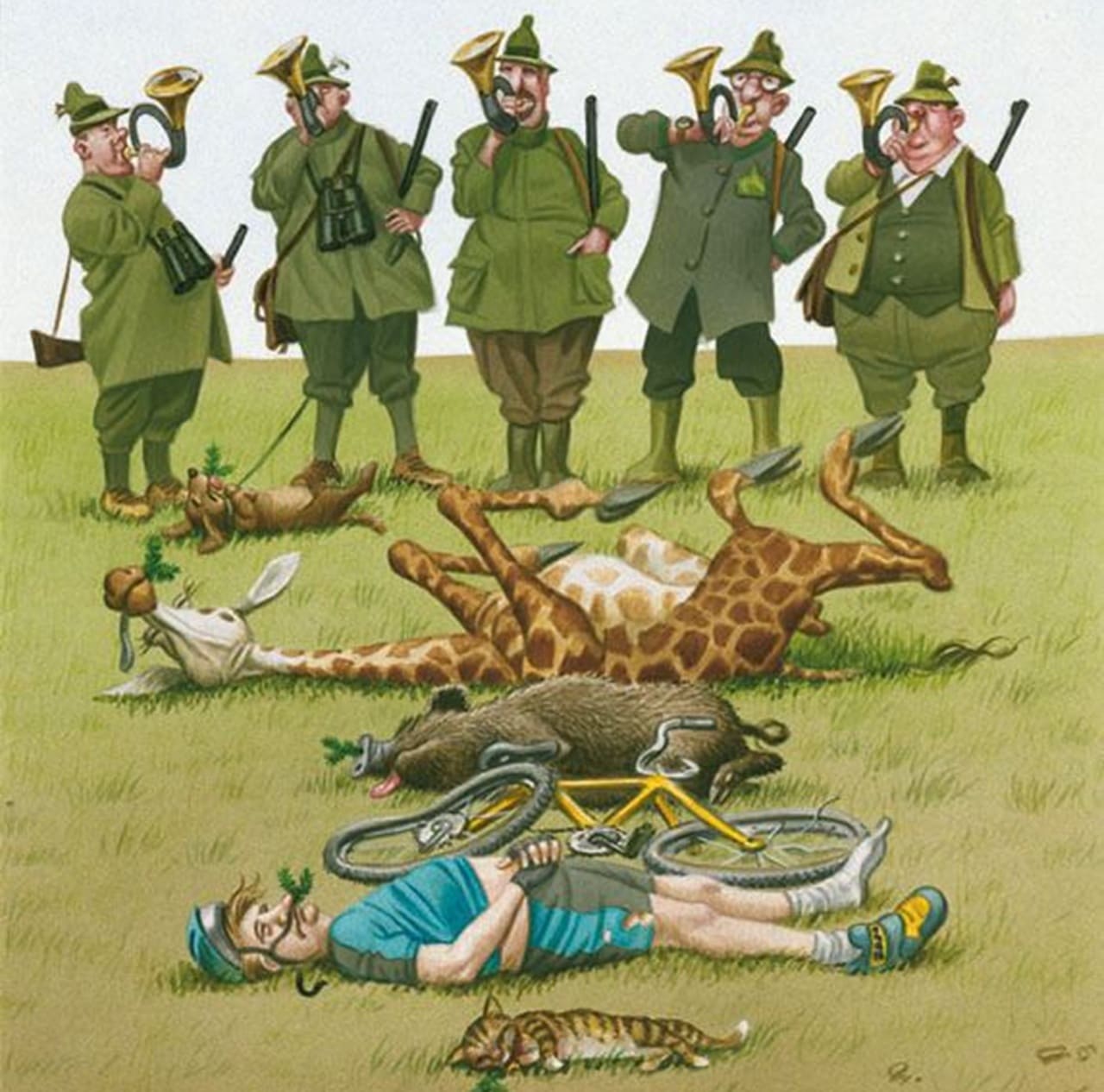
In France, during the 2024/2025 season, 100 hunting accidents involving firearms were officially registered: 11 deaths, 16 injured non-hunters, including three severely injured, as well as 135 property damage incidents in which 58 residential buildings, 27 vehicles and 50 pets were shot. In Italy, the University of Urbino reports 62 accidents and 14 fatalities for the same season, though these figures are based on media evaluations and suggest considerable unreported cases. In Spain, between 2007 and 2022, at least 125 people died from hunting weapons, with over 729 injured. In Switzerland, mathematically speaking, a hunting accident occurs every 29 hours; since 2000, over 75 people have been killed in the context of recreational hunting.
What connects these figures: They are not the result of systematic European monitoring, but fragments from national authority reports, media evaluations, NGO dossiers and transparency requests. A central, publicly accessible register for hunting accidents in Europe does not exist. The hunting lobby has no interest in its creation. And most governments do not ask.
What the recreational hunting community presents as an 'unavoidable residual risk' of a 'responsible leisure activity' reveals itself upon closer examination as a structural safety problem: Tens of thousands of armed hobby hunters move annually through forests, fields and mountain regions that are simultaneously used by walkers, hikers, mushroom gatherers, farmers, residents and pets. When people die in the process, it is treated as an isolated case. This dossier shows why it is not.
The AVC dossier from Italy, the OFB statistics from France, the transparency request data from Spain, the BFU analyses from Switzerland and the PETA chronicle from the German-speaking region prove: hunting victims are not accidents. They are the predictable result of an armed mass recreational activity without adequate state control, without European coordination and with a lobby that has successfully prevented the public from knowing the true dimension of the problem for decades.
What awaits you here
- France: The only country with comprehensive state recording – and what its figures show. How the Office français de la biodiversité (OFB) systematically documents hunting accidents, why the figures for the 2024/2025 season are alarming and what 135 property damage incidents per season reveal about the scale of the problem.
- Italy: The AVC dossier and an organisation fighting the lobby. How the Associazione Vittime della Caccia (AVC) has been documenting hunting victims since 2007, what the 2025/2026 dossier shows, and why the hunting lobby successfully recommended that the state withdraw the organisation's status as a recognised environmental protection organisation.
- Spain: 125 deaths in 15 years – and no national register: How Spain obtained hunting accident data through a transparency request, what the Guardia Civil data shows, and why regions like Catalonia and the Basque Country do not even appear in national statistics.
- Switzerland: 300 accidents per year – and a systematically undercounted dark figure: What the BFU statistics and UVG data say about recreational hunting, which groups of people are missing from the statistics and what 3.6 million francs in annual costs reveal about the true extent.
- Germany: No central statistics – PETA maintains the chronicle: Why Germany still has no official comprehensive recording of hunting accidents, how PETA fills this gap and what the individual case reports structurally have in common.
- Uninvolved victims: pedestrians, pets, residents: Who becomes victims outside the recreational hunting community, what patterns the documentation shows and why public space is not a safe place as long as recreational hunting takes place within it.
- The European dark field: What the data does not show: Why all available figures are underestimates, what distortions arise from missing registers, different definitions and political pressure and what an honest overall assessment would mean.
- What would need to change: Concrete political demands: EU-wide accident register, national reporting requirements, public exclusion zones, liability reform.
- Arguments: Responses to the most common justifications from recreational hunters and their associations.
- Quick links: All relevant articles, studies and dossiers at a glance.
France: The only country with comprehensive state recording – and what its figures show
France is a special case in Europe: The Office français de la biodiversité (OFB) has been systematically recording hunting accidents for years and publishes annual reports – a practice that does not exist in the majority of European countries. This transparency comes at a price: it makes visible what remains hidden in other countries.
For the 2024/2025 season, the OFB reports 100 firearm accidents, 11 deaths – all recreational hunters – as well as 16 injured non-hunters, including three seriously injured. In addition, there were 135 property damage incidents in which 58 residential buildings, 27 vehicles and 50 pets were shot at. This is not an exceptional case of a bad season: In the 2024/2025 season, fatal accidents rose from 6 to 11 – almost doubling compared to the two previous years. The animal protection organisation ASPAS speaks of a 'significantly increased' number and warns that the long-term trend of declining accident numbers does not justify the annual spikes upward.
What makes the OFB figures particularly revealing: They show not only hunting accidents with personal injury, but also shot houses, vehicles and pets – a category that simply does not exist in other national statistics. When 58 residential buildings and 27 vehicles are shot at in France alone in a single season, this is not a marginal phenomenon, but a measure of how much broader the danger potential of recreational hunting in public spaces is than accident figures with personal injury suggest.
More on this: A man dies in Harchies and Europe looks away and Hunting in Switzerland: Fact-check, hunting types, criticism
Italy: The AVC dossier and an organisation fighting the lobby
In Italy there is no state-wide complete recording of hunting accidents. What exists instead is the work of the Associazione Vittime della Caccia (AVC), which has systematically evaluated media reports since 2007, documented individual cases and published an annual dossier. In parallel, the University of Urbino evaluates press reports nationwide. Both sources show the same picture for the 2024/2025 season: 62 accidents, 14 deaths.
The AVC dossier 2025/2026 goes even further. It documents 33 deaths of hobby hunters through their own actions – and 13 deaths of people who had no connection whatsoever to hunting: walkers, neighbours, family members, random bystanders. The regions of Sardinia, Piedmont and Tuscany lead the tragic statistics. The dossier states that the ratio between hunter victims and non-hunter victims is 'not a marginal phenomenon, but a structural warning signal'. And: Fewer hunters, but a persistently high number of victims – the claimed safety improvement is not happening in reality.
How does the hunting lobby react to this documentation? The Federazione Italiana della Caccia welcomed the 2023 decision by the Italian Ministry of the Environment to withdraw AVC's status as a recognised environmental protection organisation. The official justification: The figures published by the AVC were 'undoubtedly biased' and likely to trigger 'social alarm'. In other words: The hunting lobby has successfully ensured that Italy's most important victim documentation has been discredited by the state. This is not a response to a safety problem. This is its cover-up.
More on this: Hunting victims in Italy: The AVC dossier 2025/2026 and Hunting and animal protection: What the practice does to wild animals
Spain: 125 deaths in 15 years – and no national register
In Spain there is no national register for hunting accidents. What exists is the result of a transparency request by the investigative platform Maldita.es to the Guardia Civil: For the period August 2007 to December 2020 – almost 14 years – the evaluation revealed 63 deaths and 483 injured, of which 215 were seriously injured. And that without the data from Catalonia and the Basque Country, which have their own police structures and do not appear completely in the national statistics of the Guardia Civil.
A parliamentary inquiry from 2022 revealed an updated figure: Between 2007 and March 2022, at least 125 people died from hunting weapons in Spain, 729 were injured. For 2025 alone, a media evaluation documents 9 deaths and 27 injured in at least 9 autonomous communities. The fatal hunting accident in Catalonia in November 2025 – a hobby hunter killed another during a driven hunt on a private reserve – represents a pattern: The province of Toledo leads the Spanish accident list, followed by areas in Castile-La Mancha, a region where hunting is deeply rooted in everyday culture and correspondingly little critically questioned.
What the Spanish data particularly clearly shows is the geographical inequality of the data situation: Where police competencies are decentralized, hunting accidents disappear from national statistics. This is not a technical problem, but a political one: When hunting accidents don't have to be recorded centrally, no political pressure emerges to reduce them.
More on this: Fatal hunting accident in Spain: A shot that should shake Europe and A man dies in Harchies and Europe looks away
Switzerland: 300 accidents per year – and a systematically undercounted dark figure
In Switzerland, BPA (Swiss Council for Accident Prevention) and SUVA data at least save part of the picture. Since 2000, over 75 people were killed in hunting accidents by 2019. Mathematically speaking, a hunting accident happens every 29 hours; approximately every three and a half months a person dies. For the years 2016 to 2020, the UVG data confirms: annually around 300 recognized accidents, about 1 death, 2 new disability pensions, annual total costs of around 3.6 million francs.
However, these numbers must be read with a crucial caveat: The UVG statistics only capture employees with mandatory accident insurance. Pensioners, self-employed individuals, children, housewives and househusbands as well as students are completely missing. Yet retired hobby hunters represent a significant and growing share of those standing in the hunting grounds with weapons in autumn. What they experience, suffer or cause does not appear in any official Swiss hunting accident statistics. A reporting obligation for hunting injuries and deaths – regardless of insurance status – exists neither at federal nor cantonal level. In Switzerland, the statistics of fatal hunting accidents thus reliably count only what the insurance system reflects, and systematically ignore what happens outside of it.
The canton of Graubünden is particularly accident-prone, followed by hunting accidents abroad and the cantons of Ticino, Aargau, Valais, St. Gallen and Bern. All persons who died in hunting accidents since 2000 with BPA entries were residents of Switzerland – hunting tourism from abroad does not appear in this statistic at all. The real extent of the danger thus lies significantly above what the official numbers suggest.
More on this: Switzerland: Statistics of fatal hunting accidents and Initiative demands 'wildlife wardens instead of hunters'
Germany: No central statistics – PETA maintains the chronicle
Germany still has no official, nationwide statistics on hunting accidents today. What exists at the federal level are fragmentary data from health reporting on firearm deaths that do not differentiate by context and allow no conclusions about hunting accidents in the specific sense. The animal rights organization PETA fills this gap with a chronicle of hunting accidents and acts of violence with hunters' weapons in German-speaking areas – a continuously updated collection of individual cases that shows what state authorities do not systematically record.
The chronicle documents a broad spectrum: shot pets, wounded walkers, hunting accidents among hunters, cases of people being mistaken for game, cases of hunting dogs being shot. It also shows that hunting weapons are used in the context of disputes and rampage killings – an aspect that does not systematically appear in any hunting statistical evaluation. A Correctiv fact-check on the claim that around 130 people have been killed by hunters in Germany since 2015 could not verify this number – not because it would be false, but because the data situation simply is not sufficient to prove or disprove it. That in itself is a finding.
The German example represents a European pattern: where no reporting obligation exists, no data is generated. Where no data is generated, no political pressure emerges. And where no political pressure emerges, nothing changes. The hunting lobby in Germany, as in other countries, has successfully prevented hunting accidents from being recorded with the same systematic approach as traffic accidents or workplace accidents. The result is a structural information deficit that primarily harms the victims.
More on this: Hunting and Animal Cruelty and Category page Crime and Hunting
Uninvolved victims: pedestrians, pets, residents
Hunting accidents are frequently treated in public perception as accidents within the hunting community: one hobby hunter accidentally hits another, a shot goes in the wrong direction, a fall on steep terrain. This is wrong – not only as a description, but as a political framing. A growing share of victims has nothing to do with recreational hunting.
In France, during the 2024/2025 season, 16 non-hunters were officially injured by gunshots, three of them severely. In the property damage figures for the same year, 58 houses and 27 vehicles were shot at – concrete living spaces of people who were at home or on the street on Sunday afternoon and did not know that a hobby hunter was shooting in their vicinity. In Italy, according to the AVC dossier, at least 13 people died in the 2025/2026 season who had no connection whatsoever to hunting. In Spain, a media analysis finds that the pattern is not geographically random, but closely linked to the hunting intensity of the respective region.
In Switzerland and the German-speaking region, the PETA chronicle repeatedly documents cases in which pets were shot, hikers were shot at, or people near hunting areas were put in mortal danger. Public space – forest, field, mountain meadow – is no longer a neutral place during hunting season. It temporarily becomes an armed restricted zone without the people who use it being systematically warned or protected. This is not a side effect of recreational hunting. It is its structural characteristic.
More on this: A man dies in Harchies and Europe looks away and Dossier Hunting and Animal Protection
The European dark figure: what the data doesn't show
All available figures on hunting victims in Europe are underestimates. This is not a claim, but a methodological fact resulting from several factors. First: only France systematically and completely records hunting accidents through a state agency. All other countries rely on media analyses, insurance data, transparency requests, or NGO documentation – sources that are structurally incomplete.
Second: definitions vary. What counts as a 'hunting accident' in France may be recorded in Spain, Germany, or Switzerland under 'firearms accident', 'hunting activity', 'recreational accident', or not recorded at all. Falls and crashes during hunting season triggered by time pressure, darkness, or terrain frequently do not appear in Swiss UVG statistics as 'hunting accidents', although they are causally so. Third: retirees, children, self-employed persons, and other groups not subject to mandatory insurance are completely absent from almost all national statistics. Particularly in recreational hunting, the group of over-60s is disproportionately large.
What a complete European registry would reveal can be glimpsed from the available fragments: hundreds of deaths per decade, thousands of injured, tens of thousands of property damage incidents, a growing proportion of uninvolved victims – and a lobby that successfully prevents these figures from being compiled and presented to the public in their entirety. The demand for an EU-wide registry is therefore not bureaucratic, but democratic: whoever does not measure risks cannot be held accountable for them.
More on this: Switzerland: Statistics on fatal hunting accidents and Hunting myths: 12 claims you should critically examine
What would need to change
First: EU-wide, standardized registry for hunting accidents. The European Commission maintains detailed accident statistics for road traffic, the workplace, and consumer goods. No equivalent exists for hunting accidents. A mandatory, standardized reporting system at EU level – with uniform definitions, categorization schemes, and public reporting obligations – is the basic prerequisite for making the structural extent of the problem visible.
Second: National reporting obligation for all hunting accidents involving personal injury. In Switzerland, Germany, Spain, Italy and other European countries, hunting accidents involving personal injury must be reported immediately and completely to a central authority – regardless of the insurance status of the affected persons. This reporting obligation must also apply to accidents outside hunting season as well as accidents involving hunting weapons in recreational contexts.
Third: Public restricted zone signaling during hunting season. When battue hunts, driven hunts and high seat hunts take place, affected areas must be clearly and publicly signaled for the duration of the hunt. The right to free use of public space does not end where a group of hobby hunters moves in with weapons. Hiking trails, recreational areas and public forests are not hunting reserves.
Fourth: Liability reform. Anyone who injures or kills persons through negligent action as a hobby hunter or hunt organizer must be held comprehensively liable under civil law – including for psychological damages, consequential costs and damage to pets. Current legislation in many countries privileges recreational hunting compared to other armed leisure activities.
Fifth: Mandatory insurance and safety certification. Obtaining a hunting license must be tied throughout Europe to current safety certification – regular refresher training, shooting tests and psychological aptitude assessments. Anyone carrying a deadly weapon in public space must demonstrate their capability to do so, and not just once during the initial hunting course.
Sixth: Sunday and public holiday ban for battue and group hunts. In France and Italy, demands for a hunting ban on Sundays and public holidays have already been discussed in parliament. The reasoning is simple: on these days, particularly many people use public spaces for recreation – and the risk of coming near recreational hunting is therefore greatest. A Sunday in the forest should not pose a security risk.
Arguments
«Hunting accidents are rare – statistics show a positive trend.» The supposedly positive trend is based on data that is structurally incomplete. Retirees, self-employed persons and other non-mandatory insured groups are missing from almost all national statistics. In France, the only country with true comprehensive recording, fatal accidents in the 2024/2025 season almost doubled compared to the two previous years. Anyone speaking of a positive trend is describing a fragment of reality, not reality itself.
"Most victims are hunters themselves – it's a risk they voluntarily assume." First, this is no longer true for a growing proportion of victims: In Italy, according to the AVC dossier 2025/2026, at least 13 people died who had no connection to hunting whatsoever. In France, 16 non-hunters were injured by gunshots. Second: Even when hunters take risks among themselves, they do so in public space – space that others also use without being asked.
"Modern training and safety regulations have drastically reduced accident numbers." If this is true, then why is there no complete, publicly accessible accident statistic in any European country except France? The claim of declining numbers cannot be verified where no numbers are collected. And where numbers are available – such as in France for 2024/2025 – they contradict the claim.
"Hunting accidents are not comparable to traffic accidents – they are too rare to be politically relevant." In France, during the 2024/2025 season, 58 residential buildings, 27 vehicles, and 50 pets were officially shot. These are property damage incidents in populated areas – regardless of whether people were injured in the process. If the same number of houses were shot at by another armed recreational activity, the topic would immediately become politically relevant. The difference lies not in the scale, but in social acceptance.
"We are interested in safety ourselves – the hunting lobby is working intensively on it." The Federazione Italiana della Caccia successfully lobbied the Italian Ministry of Environment to withdraw protective status from the AVC – the country's most important victim documentation organization. This is not safety work. This is information suppression.
"In Switzerland, hunting is well regulated." Switzerland's UVG statistics systematically exclude large population groups – including retired hobby hunters – from accident recording. There is no mandatory reporting requirement for hunting injuries and deaths outside the insurance system. The actual number of hunting accidents and deaths is therefore significantly higher than official figures – in a country that sees itself as an animal welfare state.
Quicklinks
Articles on Wild beim Wild:
- Switzerland: Statistics on fatal hunting accidents
- Hunting victims in Italy: The AVC dossier 2025/2026
- A man dies in Harchies and Europe looks away
- Fatal hunting accident in Spain: A shot that should shake Europe
- Initiative demands 'gamekeepers instead of hunters'
- Switzerland hunts, but why actually?
- Hunting and animal cruelty
- Hobby hunters and their joy in animal cruelty
Related dossiers:
- Psychology of hunting: Why people kill animals and how recreational hunting normalizes its violence
- Hobby hunting tourism: Trophy hunting, hunting trips and trade fairs – a global leisure industry at animals' expense
- Hunting and children
- Hunting victims in Europe: Deaths, injuries and a continent without statistics
- Kill photos: Double standards, dignity and recreational hunting's blind spot
- Why animal welfare law ends at the forest boundary
- Ending recreational violence against animals
- Trophy hunting: When killing becomes a status symbol
Our claim
Hunting victims in Europe are not an unavoidable residual risk of a harmless recreational activity. They are the predictable result of an armed mass activity without adequate state control, without European coordination, and with a lobby that has prevented the public from knowing the true dimension of the problem for decades. France shows what is possible when a state completely records accidents and reports publicly. What France's numbers show is alarming. What complete European recording would show is therefore foreseeable.
The first and most urgent consequence is political in nature: an EU-wide, standardized register for hunting accidents, combined with national reporting obligations, public danger zone signaling, and liability reform that effectively protects uninvolved victims. The second consequence is societal in nature: Recreational hunting is an armed leisure activity in public space. It is not a privileged special domain that evades state control because it has tradition. Where people die and houses are shot at, transparency is not an option, but a democratic minimum requirement. This dossier will be continuously updated when new figures, court decisions, or political developments require it.
More on the topic of recreational hunting: In our hunting dossier we bundle fact-checks, analyses, and background reports.