
Around 30,000 recreational hunters are active in Switzerland. Some of them travel halfway around the world for their hunting trips. Hunting travel catalogs offer bookable experience packages featuring ibex in Valais, red deer in Eastern Europe, and antelope in South Africa. Hunting fairs like "JAGD & HUND" in Dortmund – Europe's largest hunting fair – bring this market together annually in an exhibition center where gun dealers, tour operators, and taxidermists exhibit side by side.
What is marketed by hobby hunters as "connection to nature", "conservation" and "wildlife population control" turns out, upon closer inspection, to be a global leisure industry that sorts animals according to trophy value and willingness to pay, uses patent hunting cantons as exclusive hunting grounds for foreign guests, aestheticizes violence against wild animals as a lifestyle product at hunting fairs and instrumentalizes the argument of "species protection" to defend a practice that is rejected by a broad majority of the population.
The animal rights organization Tier im Recht describes recreational hunting tourism as "questionable and highly problematic" and documents that Swiss citizens regularly participate in trophy hunts for exotic animal species and import the trophies into Switzerland. ProTier criticizes the fact that some Swiss cantons issue hunting licenses for sought-after species such as the ibex to wealthy foreign hunters, sometimes including helicopter transport to the hunting grounds, and sometimes for five-figure sums in Swiss francs. A large majority of the Swiss population rejects trophy hunting and supports a ban on the import of hunting trophies. This dossier documents the facts, identifies the economic mechanisms and ethical contradictions, and shows why recreational hunting tourism is not a niche issue, but rather a magnifying glass on the core nature of recreational hunting.
What awaits you here
- From experience to package: How recreational hunting tourism works. How hunting tour operators market wild animals as bookable products, what's in the catalogs, and what that says about the self-image of recreational hunting.
- Hunting cantons and ibex trophies. How hunting tourism works in Switzerland, which cantons attract foreign hunting guests, which deter them – and why the difference is politically crucial.
- Trophy hunting abroad: price lists, safaris, trophy imports. What's in the catalogs of safari outfitters, how much is paid for individual animals, and what Swiss hunters bring home with their hunting trophies.
- JAGD & HUND and other trade fairs: How an industry celebrates itself. How hunting fairs normalize hunting trips, who exhibits, what is advertised, and why hunting fairs shape the public image of recreational hunting.
- The economics of hunting tourism: Who profits, who pays the price? Why the value creation argument doesn't hold water, where the money flows, and what alternatives exist.
- Animal ethics: When the value of a life depends on its trophy. What it means to sort animals according to their trophy value, why this is incompatible with modern animal welfare thinking, and what surveys reveal about public opinion.
- "Protection through use": The most popular argument and its weaknesses. Why the hunting lobby relies on species conservation rhetoric, what's wrong with the logic, and what alternatives exist.
- What would need to change : Concrete political demands: Import ban on trophies, restriction of patent hunting licenses for foreigners, regulation of hunting fairs.
- Argumentation : Answers to the most common justifications of the hobby hunting lobby.
- Quick links : All relevant articles, studies and dossiers at a glance.
From experience to package: How hobby hunting tourism works
Hunting tour operators now offer their products much like holiday brochures for beach vacations: with booking forms, reviews, photo galleries, and package prices. On the websites of providers like Jagdreisen Fabrig or international safari outfitters, you can find offers in more than 20 countries on five continents. Included are access to hunting grounds, accommodation, guiding by a local hunting guide, hunting rights for specific species, and trophy preparation. If desired, the export of the trophy back home can also be booked as an add-on
The language of the catalogs is revealing. They talk about "dream hunts," "chances of success," "trophy quality," and "unforgettable experiences." Wild animals are presented not as individuals with their own inherent interests, but as units of performance that cost different amounts depending on species, size, and rarity. A wild boar costs less than a kudu, a kudu less than a buffalo—and a buffalo with particularly impressive horns more than an average one. The trophy is the product; the animal is the raw material.
This logic isn't limited to exotic countries. It also applies to hunting offers in German-speaking countries and Switzerland: The hunting ground is the "experience," the hunting fee is the price, and the killed chamois, red deer, or ibex is what the paying guest takes home—either as a trophy or a photograph. Hobby hunting tourism is therefore not the exception within hunting culture, but its most extreme manifestation: What can still be disguised as "tradition" and "wildlife management" in the local hunting grounds appears on international booking platforms in its stark economic logic.
More on this topic: Hunting in Switzerland: Fact check, hunting methods, criticism and hunting myths: 12 claims you should critically examine
Hunting cantons with hunting licenses and ibex trophies: Hunting tourism in Switzerland
In Switzerland, hunting tourism is not a fringe phenomenon, but a politically regulated practice that varies considerably from canton to canton. The focus is on the cantons with hunting licenses – that is, those cantons where hunting licenses are not granted to leaseholders but allocated by the authorities – and particularly sought-after species such as ibex, chamois, and black grouse. Some cantons have recognized that foreign hunting guests are willing to pay considerable sums for these trophies
ProTier documents that the canton of Valais has in the past issued hunting licenses for ibex to foreign hunters, sometimes including helicopter transport to high mountain areas, for sums in the five-figure Swiss franc range. There is no evidence of an objective need to regulate these culls; the animals are not dying because their population is problematically large, but because someone is willing to pay for it. Recently, foreign hunters in Valais were again permitted to hunt ibex trophies – a decision that remained politically controversial and led to discussions about the proportionality of such license grants
Graubünden demonstrates that there is another way. A cantonal representative explained to SRF that there is no need for hunting tourism: there are enough local hunters. Accordingly, the licensing fees for foreigners have been set so high that participation becomes economically unattractive: a high-altitude hunting license costs foreigners almost 14,629 Swiss francs – roughly twenty times the price for locals (760 francs) and five times the price for those from outside the canton (around 2,813 francs). This example shows that hunting tourism can be politically controlled. The question is whether the political will exists to restrict it – or whether cantons will continue to offer wild animals as exclusive trophies for wealthy guests.
More on this topic: The wolf in Europe – how politics and hobby hunting undermine species protection and sample texts for motions critical of hunting in cantonal parliaments
Trophy hunting abroad: price lists, safaris and trophy imports
Abroad, the logic of recreational hunting tourism becomes particularly evident. Safari outfitters in South Africa and Namibia publish detailed price lists, assigning fixed euro amounts to various animal species. Antelopes, wild boars, jackals, big game: everything has its price. Additional charges apply depending on trophy class and size, along with separate costs for taxidermy and export fees to the buyer's home country. For buffalo, sable antelope, or other prestigious species, package deals in the five-figure euro range are quoted for just a few days of hunting
The Foundation for Animal Law (TIR) documents in a report on trophy hunting that Swiss citizens regularly participate in this form of hunting tourism and import trophies of exotic animals into Switzerland. The TIR describes this tourism as "questionable and highly problematic" and notes that a clear majority of the Swiss population rejects the killing of wild animals solely for the purpose of obtaining trophies and supports an import ban on hunting trophies. What the affluent minority considers an adventure trip and a legitimate leisure activity thus contradicts a societal consensus that has become increasingly pronounced in Switzerland.
The selection process is particularly problematic: It's not sick, weak, or population-biologically dispensable animals that are preferentially hunted, but rather the strongest, largest, and most impressive specimens – because they provide the coveted trophies. Studies indicate that this selection based on trophy value can alter the genetic structure of wildlife populations in the long term, because dominant individuals, which normally shape reproduction, are deliberately removed. This is not species conservation. It's the opposite.
More on this topic: Wild animals, mortal fear and lack of stunning: Why animal welfare law ends at the forest edge and lead ammunition and environmental toxins from recreational hunting
JAGD & HUND and other trade fairs: How an industry celebrates itself
The "JAGD & HUND" (Hunting & Dog) trade fair in Dortmund is considered Europe's largest hunting fair. Every year, the exhibition halls are transformed into what the organizers themselves call "Europe's largest hunting ground": a multi-day event where weapons, optics, clothing, off-road vehicles, and dogs are exhibited alongside international hunting travel providers. The hunting community meets here, books safaris, compares firearms catalogs, and exchanges information about trophies. The host city of Dortmund also touts the fair as an economic boost, filling hotels, revitalizing the restaurant industry, and bringing thousands of visitors to the city.
What's missing from this self-description is the question of what's actually being advertised at these trade fairs. International providers present hunting trips for animal species that are sometimes highly endangered in their countries of origin, or whose hunting is ethically and ecologically highly controversial. Trophy hunting of big game in Africa, high-altitude hunts in Central Asia, bear hunting trips in Eastern Europe: all of this finds its market between the beer tent and the gun display case. The ethical and animal welfare issues raised by these practices are not addressed in the official trade fair press release. What counts is sales.
Hunting fairs thus fulfill a dual function: they are a marketplace for a global hunting industry, and they are a normalization machine. Laypeople visiting such fairs experience hunting as a natural leisure activity with its own fashion world, its own celebrities, and its own lifestyle offerings. The animals that are hunted are not present in this picture – except as trophies, fur trimmings, and taxidermy specimens. The fair presents hunting as the hunting lobby wants to see it: large, attractive, modern. What it doesn't show is the part that appears in price lists: the dead animal as a bookable service.
More on this topic: Images of hunters: Double standards, dignity and the blind spot of recreational hunting and the psychology of hunting
Economics of hunting tourism: Who earns, who pays the price
The hunting lobby regularly defends hunting tourism with economic arguments: hunting trips bring added value to rural regions, create jobs, and generate tax revenue for countries that depend on this income. The argument sounds pragmatic – but it is selective and incomplete in key respects
First, significant portions of the revenue do not flow to the hunting regions themselves, but rather to hunting tour operators in the tourists' home countries, to equipment suppliers, and to lodge owners. Local communities in hunting areas—particularly in Africa—often benefit only to a limited extent from hunting tourism revenue, while bearing the ecological and social consequences of intensive hunting of their wildlife populations. Second, for almost all regions that currently offer hunting tourism, equivalent or more economically attractive alternatives exist: wildlife viewing, nature photography, ecotourism, and educational programs can generate the same revenue—without a single animal being killed. The claim that hunting tourism is economically indispensable cannot be empirically substantiated.
Thirdly, and crucially: The logic of "conservation through use"—which we will discuss in more detail in the next section—links an animal's economic value to the possibility of killing it. In this calculation, wild animals are only "valuable" as long as they can be marketed as trophies. Species that are too rare, too small, or too unattractive for the trophy market don't even appear in the economic justification of hunting tourism. This is not a conservation logic; it is a market logic that borrows conservation rhetoric.
More on this topic: Hunting and animal welfare: What the practice means for wild animals and alternatives to hunting: What really helps without killing animals
Animal ethics: When the value of a life depends on its trophy
A large ibex with mighty horns, a magnificent stag with heavy antlers, a kudu with sweeping horn spirals: the more impressive, the more expensive the package. Recreational hunting tourism links an animal's life to its trophy value – not to its intrinsic worth as a sentient being, but to its marketability as a decorative object. What sounds like an economic truism is, from an animal ethics perspective, a fundamental shift in values: protection exists only for animals that can be killed and sold. Animals that "bring nothing" are, in this logic, worth less.
The Foundation for Animal Law maintains that a clear majority of the population opposes trophy hunting. The idea of killing protected, rare, or particularly charismatic animals simply because someone desires their horns or fur as a trophy contradicts a growing standard of compassion and animal welfare that has become firmly established in society over the past few decades. This is particularly evident in high-profile cases: When Cecil the lion was killed as a trophy by an American dentist in Zimbabwe in 2015, it sparked outrage worldwide. The reaction demonstrated that a growing segment of the population no longer views animals as objects whose lives can be bought.
What applies to lions and elephants also applies to ibex in the Valais, chamois in the Alps, and red deer in Eastern European hunting grounds. The mechanism is the same: an animal's life is priced in a catalog. The only difference lies in its geographical and media visibility. Recreational hunting tourism normalizes this logic by making it bookable, measurable, and marketable—and by giving it a festive setting at hunting fairs.
More on this topic: Wild animals, mortal fear and lack of stunning: Why animal welfare law ends at the forest edge and wolf trophy hunting: How EU bans become a farce due to loopholes
"Protection through use": The most popular argument and its weaknesses
“Conservation through utilization” is the most frequently cited justification for trophy hunting and hunting tourism. The argument, in simplified terms, is this: if wild animals generate revenue through hunting trips, local communities and government agencies have an economic incentive to protect wildlife and their habitats. Animals are only safe if their survival is profitable. This logic is not entirely wrong, but it is selective, ethically problematic, and less empirically sound than its proponents claim.
The fundamental problem lies in the mechanism itself: in this logic, protection is not unconditional, but rather tied to the possibility of killing. An animal that no one desires as a trophy receives less protection in this calculation. A species that loses its trophy value—because it becomes too rare, because the market shifts, because trophy prices fall—also loses its "protection value." This is not a conservation logic, but rather the application of market mechanisms to ecological systems, which produces unstable and ethically untenable results in the long term. Moreover, the effectiveness depends crucially on who receives the money and whether it is actually invested in conservation measures—a question that remains unsatisfactorily answered in many hunting tourism regions.
The alternative exists and works: In Botswana, for example, hunting tourism was largely banned in 2014. Instead, the focus shifted to photographic tourism and wildlife observation. Revenues increased, wildlife populations recovered, and the country is now one of the most successful examples of non-lethal nature tourism. This shows that "conservation through use" is not a law of nature, but a political decision—and one that can be reversed. The choice between "trophy hunting or no protection" is a false dichotomy that the hunting lobby maintains for its own benefit.
Read more: The wolf in Europe – how politics and recreational hunting undermine species conservation and Hunting myths: 12 claims you should critically examine
Public perception: What hunting tourism reveals about hunting
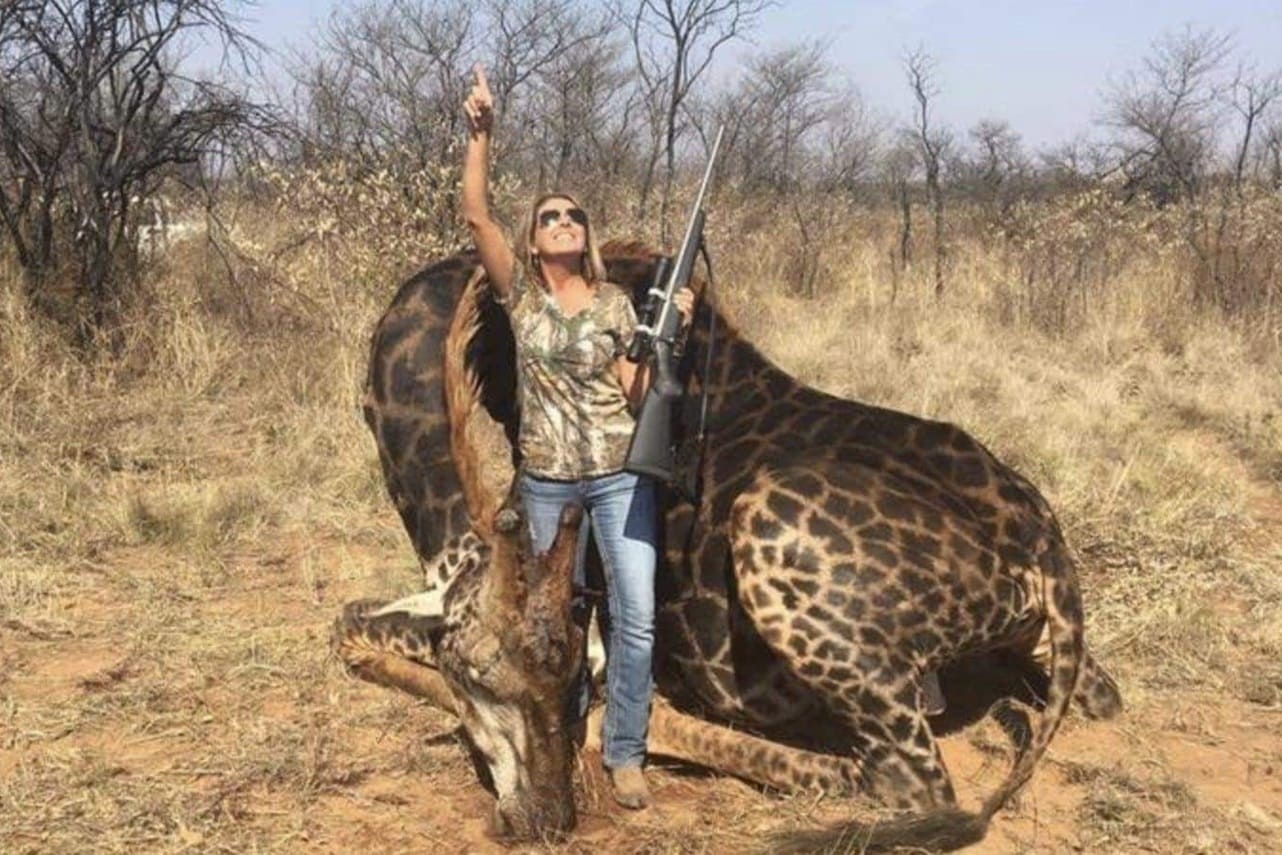
Images of trophy hunters posing next to dead lions, ibex, or antelopes circulate on social media and regularly generate public outrage. For the hunting lobby, such images are a problem: they undermine any narrative of "humility," "respect," and "connection with nature" with which hunting associations describe their activities. Anyone smiling and posing for the camera next to a dead lion makes visible what recreational hunting tourism means in practice—and, crucially, what it does not mean: conservation, nature protection, and responsibility.
Even within the hunting community, hunting tourism is not without controversy. When Graubünden declared it would not pursue hunting tourism and would raise fees for foreign hunting guests to a prohibitive level, this also sent an implicit signal: hunting tourism damages the image of hunting. The argument was revealing: they didn't need foreign hunting guests because there were enough local hunters. What remains unclear, however, is whether hunting tourism damages the image of hunting or whether it's a problem of the practice itself. Anyone who has wild animals killed for a fee is providing a service. The question of whether this service is socially acceptable cannot be answered solely by the hunting lobby.
Surveys and political debates in several European countries show that the public is increasingly critical of this issue. In Switzerland, a majority supports an import ban on hunting trophies. The EU has been discussing stricter import restrictions on trophies of protected species for years. Those who dismiss recreational hunting tourism as socially irrelevant ignore the fact that it shapes public debate and faces opposition from democratic majorities.
More on this topic: Hobby hunting as an event and hunter lobby in Switzerland: How influence works
What would need to change
- Import ban on hunting trophies in Switzerland: Switzerland is a significant import market for hunting trophies. A legal import ban, similar to initiatives in the EU, sends a clear signal that Switzerland will no longer be a buyer of trophies from problematic hunting practices. Animal welfare organizations and a large majority of the population support this step.
- Federal restrictions on hunting licenses for foreign guests: Cantons that issue hunting licenses for sought-after species to foreign hunters may only do so in very limited, ecologically justified exceptional cases. Licenses for hunting ibex, chamois, and black grouse may not be used as a source of income.
- Transparency requirements for hunting tourism in Switzerland: Cantons that issue hunting licenses to foreign guests will be required to publicly disclose the number, type, and revenue generated by these licenses. Model proposal: Transparent hunting statistics
- Regulation of hunting fairs: Hunting fairs that promote hunting trips for protected or endangered animal species on Swiss soil or with Swiss participation are subject to stricter regulations. Anything that cannot be traded directly may not be marketed indirectly through hunting trip packages.
- Promoting non-lethal nature tourism alternatives: Cantons and the federal government provide funding for wildlife observation infrastructure, nature photography programs, and ecotourism. Those who want to preserve wildlife as an economic asset invest in non-lethal alternatives. Model initiative: Wildlife observation as an alternative to recreational hunting.
- International cooperation for stricter CITES rules: As a CITES member, Switzerland actively advocates for stricter regulations on the trophy trade and trophy hunting of endangered species, acting as a driving force, not as a silent observer.
Argumentation
“Hunting tourism generates added value and therefore protects wildlife.” This argument reverses cause and effect: If animals are only protected as long as they can be killed and marketed, it's not nature conservation, but a market mechanism with an expiration date. As soon as the trophy market collapses, the incentive for conservation disappears. Botswana has shown that non-lethal nature tourism creates significantly more stable and ethically justifiable incentives for conservation. Furthermore, substantial portions of the revenue from hunting tourism do not flow to local communities or conservation programs, but rather to tour operators and outfitters in the hunting guests' countries of origin.
“Trophy hunting is a legal leisure activity – it is the personal decision of the hunters.” Individual freedom ends where it is exercised at the expense of others – in this case, at the expense of sentient animals and at the expense of a societal consensus that overwhelmingly rejects trophy hunting. The majority of the Swiss population supports an import ban on hunting trophies. A leisure activity pursued against such a clear majority will requires particularly strong justification – trophy hunting does not provide it.
"Only the strongest animals are hunted – this improves the genetics of the population." The opposite has been proven. The selective removal of the largest, strongest, and most impressive individuals deprives populations of precisely those animals that would normally dominate offspring. Studies show that this form of selection reduces genetic traits such as antler and horn size in the long term. The hunting lobby is defending this practice with an argument that contradicts science.
"Hunting fairs are just like any other travel fair." The difference lies in the product: A travel fair sells holiday experiences. A hunting fair sells, among other things, hunting rights for animal species whose hunting is ecologically controversial or internationally regulated. Anyone marketing hunting trips for lions, buffalo, or ibex as a normal lifestyle product faces a problem explaining it to a society that values animal welfare.
“Switzerland has nothing to do with it – that’s a problem for other countries.” Switzerland is the country of origin for hunting tourists, an importer of hunting trophies, and the location of hunting events and associations that promote and facilitate international hunting tourism. Switzerland is part of the system – and as a wealthy democracy, it has a duty to acknowledge its shared responsibility and take appropriate measures.
“Hunting tourism in Swiss cantons isn’t tourism; it’s just local custom.” An ibex sold to a foreign hunter for a five-figure sum doesn’t die any more “natively” than one killed on an international safari. Geographical proximity doesn’t change the economic logic: Here, a wild animal is being commercially marketed as a trophy – regardless of where the paying guest comes from.
Quick links
Posts on Wild beim Wild:
- Hunting law – Trophy hunting for rich foreigners (ProTier)
- Ready to ambush: Valais hunters ban night vision devices
- Switzerland is hunting, but why exactly?
- Initiative calls for "game wardens instead of hunters"
- Hunting and animal cruelty
- What it takes to be a hobby hunter
Related dossiers:
- Hunting in Switzerland: Fact check, hunting methods, criticism
- Hunting myths: 12 claims you should critically examine
- Psychology of hunting
- Wild animals, mortal fear, and lack of anesthesia
- Hunter photos: Double standards, dignity and the blind spot of recreational hunting
- Hunting and animal welfare: What the practice does to wild animals
- Alternatives to hunting: What really helps without killing animals
- The wolf in Europe – how politics and recreational hunting are undermining species conservation
- Lead ammunition and environmental toxins from recreational hunting
- Hunting dogs: Use, suffering and animal welfare
External sources:
- Foundation for Animal Law (TIR): Questionable and highly problematic hunting tourism (World of Animals 2022, PDF)
- SRF: No foreigners – Graubünden scares away hunting tourists
- SRF: Foreigners are once again allowed to engage in controversial trophy hunting in Valais
- ProTier: Hunting law – trophy hunting for rich foreigners
- HUNTING & DOG: Official trade fair website
- PETA: Chronicle of hunting accidents in Germany, Austria and Switzerland
- Wikipedia: Trophy hunting – overview and controversy
Our claim
Hunting tourism represents hunting in its most consistent and honest form: as a global leisure industry where animals are turned into bookable experiences, price list items, and decorative trophies. Those who market wild animals in this way can hardly speak of "conservation," "connection to nature," and "responsibility" towards the "creature." The narrative and the practice don't align, and hunting tourism makes this more apparent than any other form of hunting.
A modern wildlife policy that takes animal welfare and species conservation seriously must address these contradictions and correct them politically. This means: a ban on importing hunting trophies, a federal restriction on issuing hunting licenses to foreign visitors, greater transparency regarding hunting tourism in Switzerland, and consistent promotion of non-lethal nature-based activities. The question is not whether regions should be allowed to profit economically from wildlife – it is how: with cameras, binoculars, and respect for the living animal, or with bullets, price lists, and trophy walls. This dossier is continuously updated as new data, political developments, or legal decisions necessitate it.
More on the topic of hobby hunting: In our dossier on hunting, we compile fact checks, analyses and background reports.