Shortage of herders on the alpine pastures: who protects the herds?
An RTS report shows why herd protection reaches its limits without experienced alpine staff.
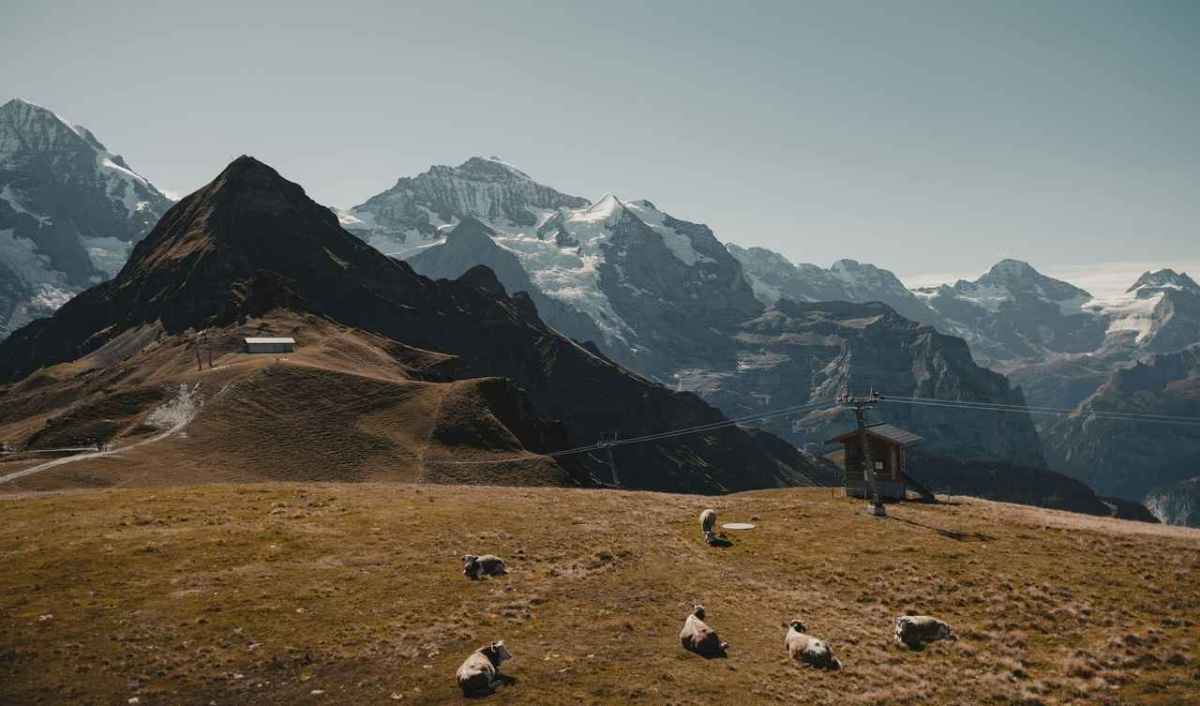
Stock image. Photo: Kevin Schmid / Unsplash
«No fence, no herder»
Cantons finance kill premiums, regulatory dispositives and total culls of entire wolf families.
Meanwhile, what is needed to implement many protection measures is missing on the alpine pastures: experienced herders who stay with the herd. A report by RTS shows just how large this gap is.
On 4 October 2026, Swiss French television examined the herding profession in its programme «Mise au Point». Since 2013, the Châteauneuf agricultural school near Sion has offered herder training. Around twenty people start the course each year. According to RTS, only two or three of them go on to become herders. Grégoire Bonvin, head of the agricultural department, notes that many have a «utopian idea» of this profession (translated).
A profession at its limit
RTS accompanied 28-year-old Dounia Ravonel from Geneva, who has worked as a herder for five years. The previous year, she spent four months in a hut at 2,000 metres, without running water, electricity or a toilet. Her dog died, and she herself injured her ankle. That she carries on is also thanks to her employer Isabelle Dumoulin from Lourtier in the Val de Bagnes, who keeps 230 ewes. Dumoulin openly admits that it is not easy work, that the wages are «not exactly great» and that living conditions on the alp are «not always pleasant» (translated).
In the meantime, Ravonel's accommodation has been improved: solar panels now supply electricity, along with a refrigerator and a dry toilet. This shows that conditions can be concretely changed when herd owners are willing to do so.
Jonas Crétin is more explicit. He herded around 650 sheep in Valais until 2024 and gave up after five years. He speaks of working weeks of up to 60 hours and of not even having a decent stove to dry his shoes. The final straw was an epidemic that killed 200 to 250 lambs within two weeks. Crétin has filed a complaint against his former employers, which, according to RTS, is rare in this small milieu.
Herd protection stands and falls with staffing
RTS explicitly names the connection to the wolf. The return of the predator has changed the work of herders, and according to RTS, protective measures are also relevant for compensation after wolf attacks. Livestock guardian dogs and night enclosures are mentioned in particular, which often require the presence of a herder. A night enclosure does not build itself, guard dogs need guidance, and a herd that is directed during the day is different from one left to its own devices.
How severely alpine farming as a whole suffers from staff shortages is shown by a study by the Bern University of Applied Sciences (BFH-HAFL) and the Swiss Society for Alpine Economy from April 2026. It is based on around 360 respondents and covers all alpine staff, not just shepherds. Around 17,000 people work every year on about 6,500 summer farming operations. The study names clear employment conditions, experience-appropriate wages, and professional personnel management as decisive for retaining experienced staff. Infrastructure alone is not enough.
The federal government already promotes summer pasturing according to the grazing system and supports additional herd protection measures under certain conditions. According to the 2026 overview, sheep alps with constant herding receive 400 francs per normal grazing unit, rotational pastures 320 francs, and other pastures 120 francs. Anyone implementing a farm-specific herd protection concept can receive an additional 250 francs per normal grazing unit for constant herding or rotational pasture. However, financial contributions alone do not solve the staff shortage: protective measures need people who can implement them in everyday practice.
What priorities politics sets
While RTS documents serious deficiencies in accommodation and working conditions, cantons are simultaneously financing wolf kills. Ticino pays recreational hunters in the wolf programme a starting fee, an hourly wage, and 500 francs for every wolf killed, with a budget of up to 250,000 francs per year. Valais releases entire packs such as the Nanz pack for total elimination, without disclosing how the affected herds were protected.
The official figures show how much remains open when it comes to protection. According to the kill statistics of the Ticino Office for Hunting and Fishing, as of 28 September 2026, of 117 livestock killed, 6 were adequately protected. For 45 animals, the office classified protection as inadequate, for 13 as inadequate due to force majeure, and for 52 protection was deemed unreasonable, as documented by the Ticino Ticker in the entry dated 4 October.
In the compiled cantonal statistics excluding Ticino, a total of 183 livestock killed by wolves were recorded by the end of July 2026, compared with 402 in the same period the previous year (Alpine summer 2026: wolf kills halved). The contrast between Upper and Lower Valais suggests that husbandry and herd protection play an important role. How great their influence is compared with other factors cannot be determined from this comparison alone.
A structural problem that can be solved
Anyone who takes the staff shortage seriously must ask uncomfortable questions. According to RTS, around a third of Swiss livestock keepers employ mainly foreign workers. A livestock keeper from La Forclaz in Vaud says in the programme that he can't find Swiss herders, calling them «dreamers» (translated). The statements by Ravonel and Crétin paint a different picture: what is lacking are working conditions that can be endured over several seasons.
The IG Wild beim Wild therefore calls for a shift in priorities. Public funds that currently flow into kill bounties, regulation schemes and the training of recreational hunters for nocturnal wolf kills belong instead in fair wages, dignified accommodation, year-round prospects, and training followed by working conditions that enable more participants to enter the profession. Herd protection is not a question of fences alone. It is a question of people who are able to stay with the herd.
Dounia Ravonel puts it succinctly in the programme. She says she was told from the start that in this profession she would have to be tough. «If I become tough, I break», she says (translated). An alpine farming system that listens to such voices needs fewer guns and more respect for those who actually protect the herds.
Sources: RTS, «Alpages suisses: le métier de berger face à la pénurie» (article title on the page: «»Il va falloir être dure«»: le métier de berger face à ses propres limites»), with the television report «Moutons cherchent berger» from «Mise au Point», 4 October 2026: RTS article; BFH-HAFL, «La saison d’alpage se profile, mais le personnel fait défaut», 20 April 2026; Canton of Basel-Landschaft, Ebenrain, «Direct payments for summer pasturing, overview 2026»; Office for Hunting and Fishing, Ticino, predation statistics «Lupo, Predazioni 2026», as of 28 September 2026.
More articles: Dossier: Regulate recreational hunters, not predators
More on the subject of recreational hunting: What the research says about this is shown by Hunting fact-checked: the state of research.
The position of IG Wild beim Wild: IG Wild beim Wild rejects recreational hunting. Our model is the canton of Geneva, which has managed without recreational hunting since 1974: without hunting seasons, without hunting dogs, without driven hunts, without high seats, without the animal cruelty and crime that go hand in hand with hunting season elsewhere. What has worked there for over fifty years disproves every position paper by JagdSchweiz. An association that bases its policy on claims it refutes in its own documents is not a professional organisation, but a factory for misinformation.

All articles are written by IG Wild beim Wild as well as by external co-authors. Research, structuring and editorial processes may be supported by AI-assisted tools.
Support our work
With your donation you help protect animals and give their voice a hearing.
Donate now →