Nanz pack approved for total kill: Valais plans to kill the next wolf family
Second pack within a week: Valais is also permitted to completely remove the wolves between Visperterminen and Staldenried. Detailed data on the damage remains publicly unknown.
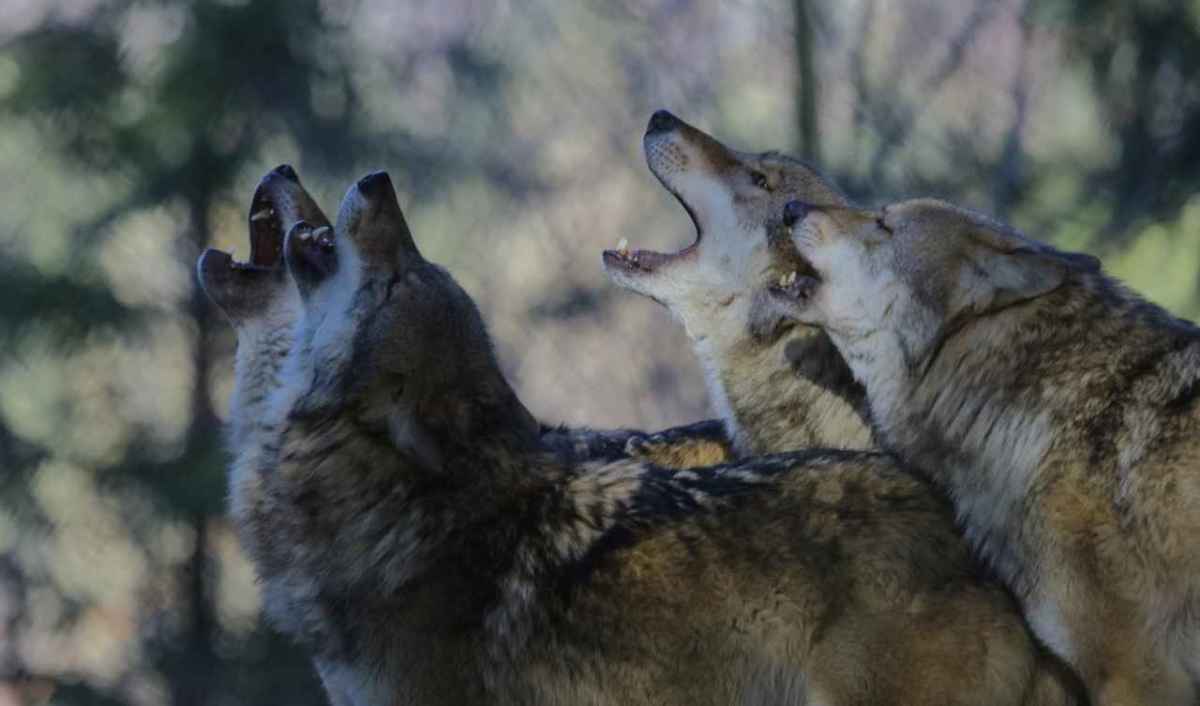
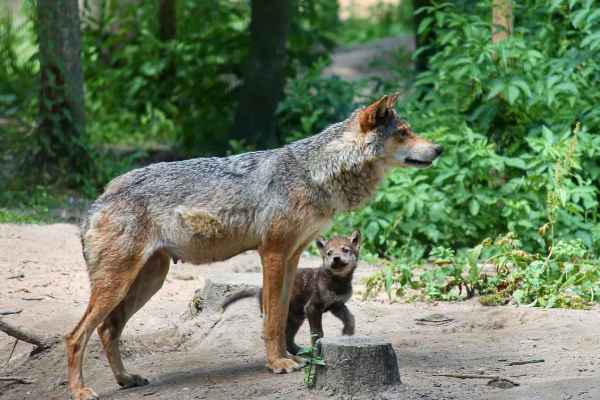
Wolves live in family groups. A complete removal means the entire pack is killed, parent animals and young wolves alike.
«In the Pack»
The Federal Office for the Environment (FOEN) has approved the canton of Valais's request for the complete removal of the Nanz pack.
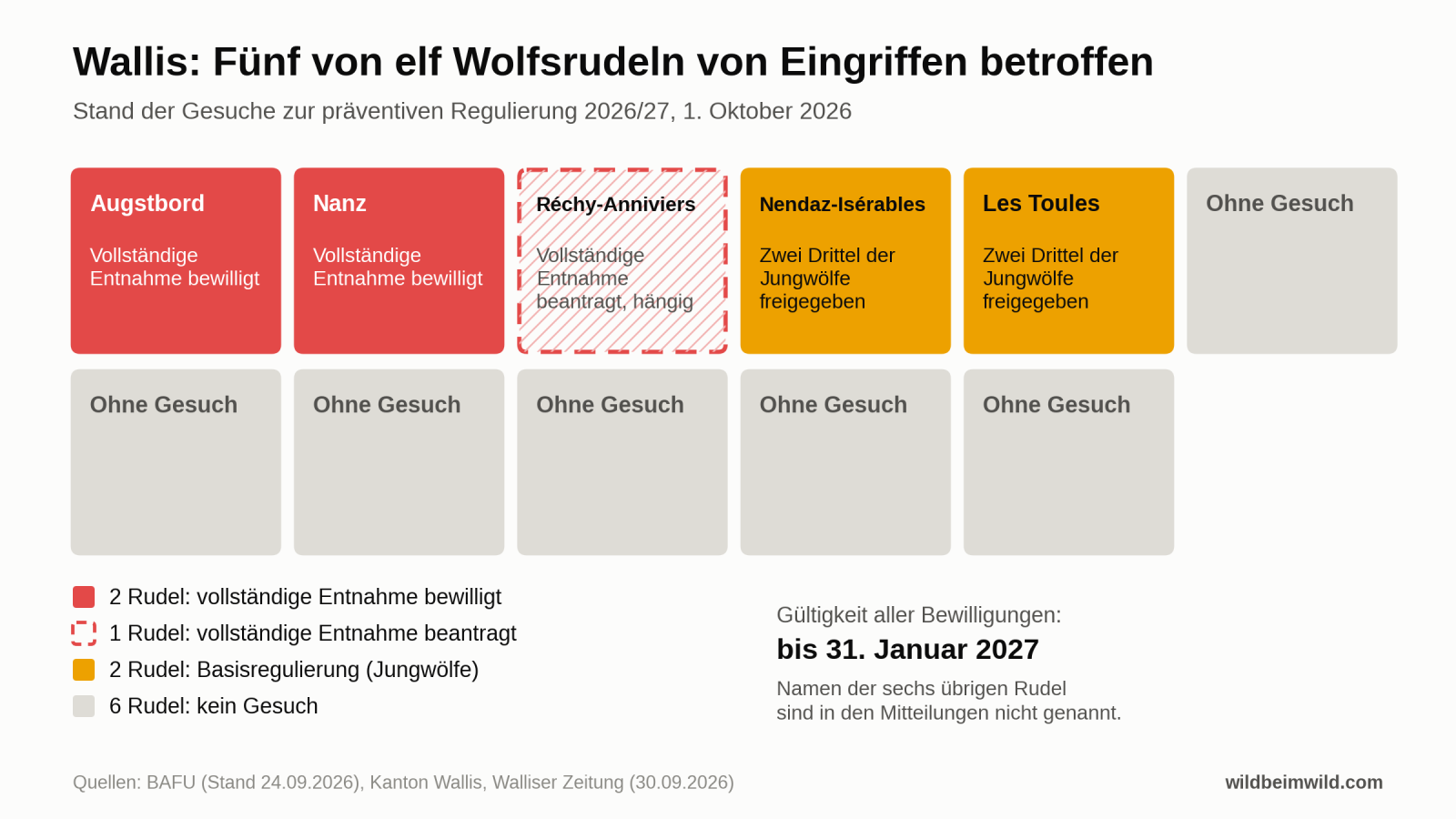
The cantonal decision came into force upon publication in the official gazette on 30 September 2026 and is valid until 31 January 2027. Six days earlier, the complete removal of the Augstbord pack had already come into force. A decision on the third application, concerning the Réchy-Anniviers pack, has not yet been made.
The publicly released statements provide no detailed information on livestock kills, herd protection, pack size, or the genetic attribution of the damage. Yet precisely this information would be crucial for assessing whether killing an entire wolf family is proportionate.
Second pack within a week
The Nanz pack lives between Visperterminen and Staldenried in Upper Valais. On 28 August 2026, the canton had submitted five applications to the federal government: the complete removal of the Augstbord, Nanz, and Réchy-Anniviers packs, as well as the so-called basic regulation for Nendaz-Isérables and Les Toules.
The Federal Office for the Environment (FOEN) has meanwhile decided on four of the five Valais applications:
- 14 September (FOEN decision, in force since 18 September): At Nendaz-Isérables and Les Toules, up to two-thirds of the wolf pups born in 2026 may be removed.
- 23 September (FOEN decision, in force since 24 September): The Augstbord pack may be removed in its entirety.
- 30 September (entry into force): The Nanz pack may be removed in its entirety.
- Pending: the application for the complete removal of the Réchy-Anniviers pack.
The Valais orders were signed by State Councillor Christophe Darbellay. The canton states its aim as being «to effectively minimise conflicts in problem areas…» where wolves have killed livestock.
This means that five of the eleven current Valais packs are affected by interventions that have been officially approved or applied for. If Réchy-Anniviers is also approved, three of them may be removed in their entirety.
What the public is not told
None of the published announcements state how many wolves belong to the Nanz pack. Likewise missing are the number of livestock kills attributed to the pack, the herd protection status of the affected herds, and the genetic evidence linking the damage to this particular pack.
This gap is nothing new. Already with the Valais applications from late August, it was publicly impossible to verify exactly what the applications were based on. Conservation organisations had already previously accused the Valais wolf management of double-counting damage cases and failing to carry out genetic analyses.
A look back shows why transparency would be necessary. When the canton first ordered a regulation in the Nanz area in 2023, KORA reported 56 livestock killed within four months. Of these, 22 were killed in situations that were protected or could not reasonably be protected. In April 2026, the canton then ordered the kill of a single wolf in the Visperterminen region, after seven sheep or goats had been killed on agricultural land there within four months. According to La Télé, a wolf pair was living in the region at the time, for which no reproduction had been documented in 2025. Whether this lone wolf or the wolf pair from that time is identical to the pack now listed as the Nanz pack cannot be determined from the publicly available documents.
More wolves do not automatically mean more livestock kills
The Valais figures show no simple correlation between the number of wolves and livestock losses. According to the cantonal balance sheet, published by KORA in February 2026, 401 livestock animals were killed by wolves in 2023, 341 in 2024, and 318 in 2025. At the same time, the number of genetically identified wolves rose from 61 (2024) to 75 (2025).

This alone proves no causal relationship. But it contradicts the blanket claim that rising wolf numbers inevitably lead to rising livestock losses. What remains decisive is how consistently herd protection is implemented and how damage is attributed to individual packs. At national level, too, nature conservation organisations point in connection with the wolf threshold value to declining livestock losses.
In the winter of 2025/26, Valais killed 24 wolves as part of proactive regulation, 17 of them during the complete removal of three packs (Chablais, Salentin, Simplon). A year later, three packs are once again on the list for complete removal. Whether new wolves have since moved into the vacated territories is not revealed by the official statements. Yet the question remains: what is the point of wiping out a pack if the next ones are up a year later?
Who shoots, and who is allowed to defend themselves?
One thing is clear: Valais also involves recreational hunters with a valid regulation permit in proactive wolf regulation. The canton's website states: «Hunters who hold a valid regulation permit may kill wolves within the relevant regulation perimeters.» The Nanz perimeter is already listed there. It has not yet been disclosed who actually carries out the kills in the Nanz perimeter and how many animals are killed by the wildlife wardens as opposed to authorised hunters.
This is more than a detail. In a complete removal, the parent animals holding the pack together are also killed. If they are hit first, young animals are left without guidance.
At the same time, judicial oversight is becoming more difficult. In August 2026, the Federal Supreme Court denied the association CHWolf the right to appeal against wolf kills. In practice, only those organisations entitled to appeal under federal law, such as Pro Natura or WWF, can still contest this. It is not currently known whether any of them will take action against the Nanz ruling.
Regulation as a precaution
The Valais permits are based on preventive regulation: packs may be regulated between 1 September and 31 January to prevent future damage, without any new damage having to be documented during the respective decision period. This logic is being further expanded at federal level. In September, the National Council adopted a motion for a threshold value for the wolf population. At the same time, the consultation on the revision of the Hunting Ordinance is running until 16 October 2026. It aims to allow wolf kills even during the whelping season and in federal wildlife sanctuaries. In its explanatory report, the Federal Council itself acknowledges that this entails a risk of leaving orphaned young animals behind.
The publicly available information does not disclose how the actual damage, herd protection measures, and the attribution to the respective pack were weighed in each individual case. Anyone wanting more transparency and stricter requirements can take part in the consultation until 16 October.
What must happen now
IG Wild beim Wild demands from the canton of Valais and the FOEN:
- the publication of the application documents concerning Augstbord, Nanz and Réchy-Anniviers, including kill statistics, herd protection status and genetic attribution;
- a public evaluation of whether the packs removed in the winter of 2025/26 actually reduced livestock losses in their territories;
- a renunciation of complete removals as long as this effect has not been proven;
- transparency about who carries out the kills and how many wolves are killed.
A complete removal must be justified with verifiable data. A canton that wants to wipe out entire wolf families must be able to prove that there is no other way. This evidence is so far missing from the publicly available documents.
Sources
- Walliser Zeitung, 30 September 2026: Permit for the complete regulation of the Nanz pack
- watson, 30 September 2026: Canton of Valais allowed to completely regulate another wolf pack
- Blick Romandie, 30 September 2026: Valais: la régulation complète de la meute de Nanz autorisée
- FOEN, as of 24 September 2026: Preventive regulation of wolf packs: status of cantonal applications
- Canton of Valais: Wolf regulation 2026-2027
- Jagd & Natur, 25.09.2026: Valais allowed to fully regulate the Augstbord pack
- Polizeiticker.ch, 18.09.2026: FOEN approves kills for two wolf packs
- KORA, 03.02.2026: Review of 2025/2026 wolf regulation in the canton of Valais
- KORA, 08.09.2023: Regulatory kill ordered for the Nanz region wolf pack
- La Télé, 27.04.2026: Shooting of a wolf ordered in the Visperterminen region
More on the subject of recreational hunting: In our dossiers on recreational hunting gather fact-checks, analyses and background reports. The scientific evidence is presented in the overview Studies on the Effects of Recreational Hunting.
The position of IG Wild beim Wild: IG Wild beim Wild rejects recreational hunting. Our model is the canton of Geneva, which has managed without recreational hunting since 1974: without hunting seasons, without hunting dogs, without driven hunts, without high seats, without the animal cruelty and crime that go hand in hand with hunting season elsewhere. What has worked there for over fifty years disproves every position paper by JagdSchweiz. An association that bases its policy on claims it refutes in its own documents is not a professional organisation, but a factory for misinformation.

All articles are written by IG Wild beim Wild as well as by external co-authors. Research, structuring and editorial processes may be supported by AI-assisted tools.
Support our work
With your donation you help protect animals and give their voice a hearing.
Donate now →