Fox hunting ban: hunting protection president calls vaccination 'extreme'
In Aargau and Jura, Pascal Wolf is no longer asking for a review but for a ban on general fox hunting. The president of the Aargau Hunting Protection Association calls vaccinating instead of shooting a 'very extreme stance'. The evidence from studies shows otherwise.

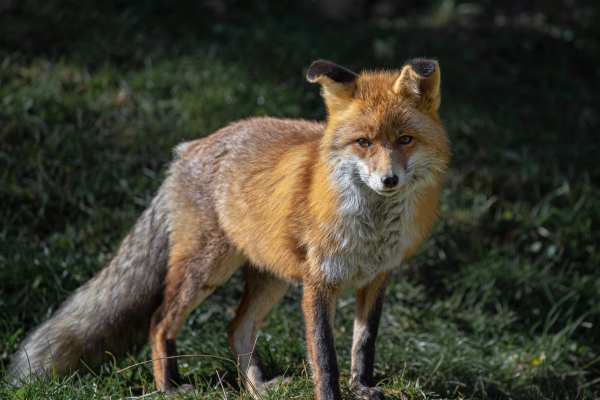
Red fox in the forest. Stock image: Kate Russell, Unsplash
An Old Promise Echoes in the Forest
On 17 October 2026, the 'Aargauer Zeitung' reports on a petition submitted to the Aargau cantonal government by the Lucerne lawyer Pascal Wolf. Gerhard Wenzinger, president of the Aargau Hunting Protection Association, calls the proposal to vaccinate foxes and combat parasites instead of shooting them 'a very extreme stance'. The day before, 'Le Matin' reported from Jura: there too, in a five-page letter, Wolf is demanding a ban on regular fox hunting. 'Le Quotidien Jurassien' ran the headline: 'Renard fan de foot abattu: un militant exige l'interdiction de la chasse au goupil».
A ban instead of a statement
With the new submissions, the campaign changes fundamentally. In more than twelve cantons, Wolf had so far asked the governments to examine the scientific necessity of fox hunting and to comment on it. Most responded with platitudes and relied on a position paper from JagdSchweiz. Four cantonal governments have still not answered the enquiries from IG Wild beim Wild (Four cantonal governments leave 30 questions unanswered). Only Zug had the question examined by wildlife researchers and has no longer promoted fox hunting since (Canton of Zug curbs fox hunting after study).
The new petition no longer asks for an opinion. It demands the ban outright: a year-round closed season for the red fox, kills only in individual cases, for instance where there is a considerable danger to public safety or animal health, the killing of sick or injured foxes only where wildlife wardens or a veterinarian have found no prospect of recovery, and priority for vaccination and parasite control. Wild beim Wild has already presented the full draft with six measures (Pascal Wolf's motion reaches the EU Parliament). It is available as a template text for cantonal parliaments in our collection of hunting-critical motions.
In the Jura, the petition lands in the middle of a heated debate. A tame fox had interrupted a cup match in Saint-Ursanne and was later shot by the wildlife wardens (Saint-Ursanne: wildlife wardens shoot the football fox). According to «Le Matin», the parliamentarian Martin Braichet now wants to ask the government whether alternatives to shooting were seriously considered. His enquiry is titled «Quand l’homme crée le problème, l’animal doit-il payer de sa vie?».
What is shot in Aargau
According to the cantonal hunting statistics 2025 recreational hunters in Aargau shot 1,837 foxes last year; in 2024 the figure was 1’986. In 2025 a further 1,220 foxes were recorded as fallen game, 767 of them on the roads. Together that is over 3,000 dead foxes in a single year. Aargau is therefore not leaving the fox population to «itself», as Wenzinger fears: it has been intensively hunted for decades. Wenzinger claims that further kills would curb mange, but he cites no evidence.
Mange: what the research shows
The studies we have compiled on our page Hunting Fact Check paint a different picture. Pisano et al. (2019, Parasites & Vectors) document the spread of mange in Switzerland over more than 60 years. The study provides no evidence that today's regular fox hunting contains mange. Zurich shows how little fox hunting has to do with disease at all: of 21,846 foxes shot, only 7.7 per cent carried a note of illness (The Wildbuch refutes the disease justification). Added to this is the so-called disturbance effect: when territorial animals are killed, others move into the vacated territories, and diseases may therefore spread rather than recede (Prentice 2012).
Mange is not harmless: in Bristol, the fox density in 2004 was only 15 per cent of its level before the 1994 outbreak; Soulsbury et al. (2007) assume that affected populations take 15 to 20 years to recover.
What is missing from the debate: foxes that survive
Far from every fox that catches mange dies of it. Many develop antibodies, survive the disease and carry on living. In Berlin, 43.6 per cent of the foxes examined had antibodies against the mite, but only 19.3 per cent were visibly ill (Bartnik 2002). In Norway, the share of sick animals fell from 30.0 to 6.6 per cent within ten years; the authors see this as an adaptation of the population, with milder courses of the disease and recoveries (Davidson, Bornstein and Handeland 2008). In Sweden, after a collapse of almost 90 per cent, the population regained its earlier density in less than ten years; the researchers interpret this as a sign of rapid resistance development. (Willebrand et al. 2022). All studies on mange and antibodies in foxes are listed on our studies page with links to the original papers; the connections between hunting and epidemics are described in the dossier Hunting and Wildlife Diseases.
The foxes that have survived mange are therefore part of the solution, not of the problem. Our dossier Hunting and Wildlife Diseases has long described this selection advantage: a recreational hunter cannot tell from looking at a fox whether it is resistant to mange. He cannot see whether an animal is sick, has already recovered from mange or was never infected. The shot hits them all alike, including the animals that keep the population healthy.
On top of that, whether a fox actually has mange is usually judged by the recreational hunter himself, not by a vet. In summer the fox sheds its winter coat and for weeks looks scruffy, patchy and thin. To a layperson, that looks like mange. In the Zurich game logbook, the disease entries rise in exactly these months, and behind none of them is a veterinary diagnosis (The Wildbuch refutes the disease justification). The shot fox ends up at the carcass collection point, the entry in the statistics. This is precisely why the petition demands that in future only wildlife wardens or vets may determine whether a fox is sick.
However, a single fox that has survived mange is not necessarily protected for good. In a small experiment, young foxes fell severely ill again when infected a second time (Little et al. 1998). The studies suggest that resistance builds up above all at population level, through the animals that survive and have offspring. Nobody has measured how much hunting slows this process. All that is certain is that anyone who shoots indiscriminately also removes from the population the foxes that have overcome the disease.
Then there is hunting stress. In wolves, which like the fox belong to the canids, Canadian researchers found significantly more stress hormone in hair samples from heavily hunted areas than in less-hunted animals (Bryan et al. 2015, Functional Ecology; Effect 1: Animals under permanent stress). Chronically elevated stress hormones can weaken the immune defences (How are wild animals stressed by hunting?). Whether this makes the course of mange worse in foxes has not yet been specifically studied.
Nobody in the debate mentions this, neither the Jagdschutzverein nor the Aargauer Zeitung.
Vaccination is not extreme but proven
Wenzinger himself concedes that vaccine baits against rabies have helped. What he does not say is recorded in the Zug expert report by SWILD: intensive hunting and the gassing of fox dens failed to stop rabies in the 1970s. Only the vaccination campaign from 1978 onwards turned the tide. Lethal methods can even intensify an epidemic, because hunted animals become more mobile (SWILD study, May 2026). How the recreational hunters' rabies argument collapsed is shown in our dossier Hunting and Wildlife Diseases.
The same applies to the fox tapeworm. Deworming baits demonstrably push the parasite back, as studies from Germany (König et al. 2019), France (Comte et al. 2013) and Japan (Takahashi et al. 2013) show (Overview of studies). In a field trial, the opposite was seen: in the Nancy area, the proportion of infected foxes rose from 40 to 55 per cent under increased hunting pressure, while it remained stable in the control area. The researchers suspect a link with young foxes moving in and roaming (Comte et al. 2017). In Luxembourg, where fox hunting has been banned since 2015, the proportion of infected foxes fell from 39.7 to 9.8 per cent (Fox tapeworm: myths and facts).
On one point Wenzinger is right: there is no vaccine bait against mange. But the petition does not demand one. It demands priority for measures that demonstrably work, and an end to kills whose benefit has not been proven.
“Thousands upon thousands of francs”
Wenzinger does not put a figure on what vaccinations would cost. And he does not mention the cost of current practice at all. France offers a comparison: the most comprehensive study to date comes from Jiguet et al. (2026, Biological Conservation). There, around 383,000 foxes are killed every year. Controlling all species hunted as “pests” costs between 103 and 123 million euros per year, while the reported damage amounts to 8 to 23 million. The researchers found no link between the number of kills and the level of damage (Killed in their millions, for nothing). The study and further research on the effect of kills are listed on our studies page under Effect 9. To this day, no canton discloses what recreational hunting costs Switzerland (The bill nobody presents).
Biodiversity in a densely populated canton
Wenzinger also says that fox hunting protects biodiversity. Especially for territorial systems like Aargau, the research we document on the studies page contradicts him:
- In German hunting grounds, rewarded recreational hunting changed neither the presence of foxes nor the risk of nests being raided. This was shown by an experiment with 273 camera-monitored artificial nests (Kämmerle et al. 2019, BMC Ecology).
- Local kills do not reduce fox density at the landscape level (Kämmerle et al. 2019, Conservation Science and Practice).
- Even high kill rates are offset by foxes immigrating from elsewhere (Lieury et al. 2015).
- For the lapwing in central Switzerland, it is the quality of the habitat that determines whether the population survives, not the control of predators (Korner, Hohl and Horch).
Geneva has refrained from recreational hunting since 1974, and the canton's brown hare density is among the highest in Switzerland (Fact check on the Geneva figures).
What the Aargauer Zeitung gets wrong
No duty to respond? The AZ writes that a petition has no legal force whatsoever, that the authority must take note of it but is not obliged to deal with it or reply to it. Article 33 of the Federal Constitution on its own does indeed not establish a duty to respond. In Aargau, it is different: Section 19 of the cantonal constitution states: «Anyone may address requests and submissions to the authorities. These must be answered.» The Executive Council must therefore reply to Wolf. This creates a duty to respond, but not a duty to implement the demand.
Incorrect years: The newspaper dates the driven-hunt initiatives to 2005 and 2011 in the text, and to 2005 and 2012 in the photo caption. The correct dates are 27 November 2005, when 63.9 per cent voted No (Executive Council message 2011), and 27 November 2011. Both votes concerned driven hunts and were not votes on a ban on fox hunting.
One-sided voices: The article does not include an independent wildlife-biology assessment or a statement from the cantonal specialist office.
The recreational hunters are the extremists
Comment from IG Wild beim Wild: For the president of the Aargau Hunting Protection Association, vaccinating foxes instead of shooting them is extreme. What he considers normal, by contrast, is that Aargau recreational hunters kill around 2,000 foxes every year, whose meat nobody eats and whose pelts fetch 8 francs at the Grisons fur market. The Swiss National Park has been hunting-free since 1914, Geneva since 1974, and Luxembourg banned fox hunting in 2015. Zug no longer promotes fox hunting, and Basel-Stadt is considering giving it up. In zentralplus's online poll, 82 per cent voted in favour of a ban on fox hunting (Stop fox hunting: Zug). There is nothing extreme about any of this.
What is extreme is a hobby that justifies killing healthy non-human animals with a disease for which there is no evidence that hunting contains it, and that also shoots the foxes that have survived the illness. Nature has a way of dealing with mange. Recreational hunting shoots it down. Wenzinger cites no evidence that hunting contains mange. He cites an attitude. Under § 19 of the cantonal constitution, the Executive Council is obliged to reply. IG Wild beim Wild will publish the reply as soon as it is received.
What you can do: The campaign End fox hunting offers template letters and contacts for the cantonal parliaments.
More on the subject of recreational hunting: In our dossiers on the criticism of recreational hunting gather fact-checks, analyses and background reports. What the research says about this is shown by Hunting fact-checked: the state of research.
The position of IG Wild beim Wild: IG Wild beim Wild rejects recreational hunting. Our model is the canton of Geneva, which has managed without recreational hunting since 1974: without hunting seasons, without hunting dogs, without driven hunts, without high seats, without the animal cruelty and crime that go hand in hand with hunting season elsewhere. What has worked there for over fifty years disproves every position paper by JagdSchweiz. An association that bases its policy on claims it refutes in its own documents is not a professional organisation, but a factory for misinformation.
Wild animals need a voice
Once a week: research, petitions and background information on recreational hunting. Free of charge and can be unsubscribed from at any time.

All articles are written by IG Wild beim Wild as well as by external co-authors. Research, structuring and editorial processes may be supported by AI-assisted tools.
Support our work
With your donation you help protect animals and give their voice a hearing.
Donate now →