Fox hunting: Four cantonal governments leave 30 questions unanswered
Appenzell Outer Rhodes, Solothurn, Uri and Glarus remain silent on our open letters. We are now requesting access to the files.
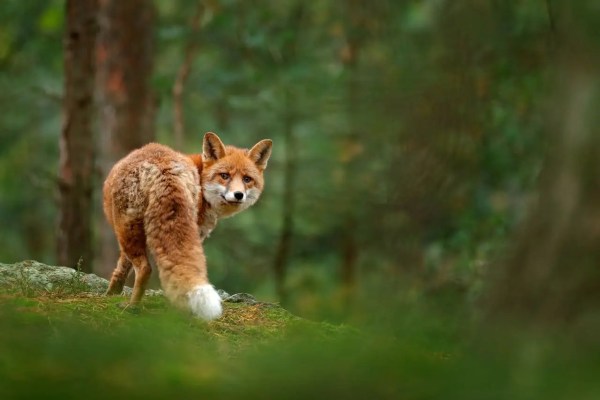
Photo: Zetong Li / Unsplash
“Moderate the Tone”
Four cantonal governments have rejected the fox petition by lawyer Pascal Wolf, without providing scientific evidence for their central claims.
IG Wild beim Wild followed up with all four via open letters: a total of 30 specific questions, each with a clear deadline. By 4 October 2026, no response had arrived. We are therefore now requesting access to the official documents on which the cantons base their statements.
Four letters, no response
| Canton | Official | Starting point | Open letter | Questions | As of 4 October |
|---|---|---|---|---|---|
| Glarus | Landammann Dr Markus Heer | Rejection of the petition, 9 June 2026 | 18 June 2026 | 7 | no response for 108 days |
| Uri | Landesstatthalterin Céline Huber | Response to the petition, 24 August 2026 | 26 August 2026 | 9 | no response for 39 days |
| Appenzell Outer Rhodes | Government Councillor Dölf Biasotto | Response to a citizen, 4 September 2026 | 14 September 2026 | 7 | no response for 20 days |
| Solothurn | Regierungsrätin Sibylle Jeker | Rejection of the petition, 14 September 2026 | 15 September 2026 | 7 | no response for 19 days, deadline of 29 September elapsed |
We have documented the questions themselves in the open letters. They all revolve around the same core issue: what measurable purpose justifies regular fox hunting, and what data does the canton base this on?
In fairness, it should be noted that Regierungsrat Dölf Biasotto had previously responded personally over four and a half pages, and Uri did at least respond to the petition. The silence concerns the follow-up questions. These were specifically aimed at disclosing the data, surveys and technical foundations behind the governments' statements.
Four statements without a disclosed basis
Each of the four responses contains a central claim whose factual basis the cantons have so far failed to disclose. Glarus wrote that there is "no evidence" that hunting contradicts sustainability. Uri stated that fox hunting endangers neither the population nor biodiversity. Appenzell Outer Rhodes relied on "many years of experience" while simultaneously admitting that no scientific survey is carried out. Solothurn described the contribution of fox hunting to conflict resolution as "indisputable" and cited as its only source an unscientific position paper by JagdSchweiz, whose contradictions we have already pointed out.
Anyone who formulates things this way must be asked what the claim is based on. As long as the cantons neither name nor make available their sources, these statements remain publicly unverifiable.
Other cantons show that it can be done differently
The canton of Zug responded to the same petition with a scientific expert report by SWILD and derived measures from it; the details can be found on our Zug campaign page. Basel-Stadt is currently examining whether to withdraw from regular fox hunting. The Lucerne commission responded to seven factual questions with the recommendation to moderate the tone. The four cantons in this article chose a third path: no response at all.
The next step: access to files
An open letter obliges a government to nothing. Freedom of information law, by contrast, grants a right of access to existing official documents, provided no legal exceptions or overriding interests stand in the way. It does not oblige authorities to answer questions, but it does oblige them to make their records accessible. This is precisely where it should become clear what the four governments are basing their claims on.
IG Wild beim Wild has therefore submitted requests for access to files to all four cantons. Among other things, the following is requested:
- the reports, memos and data analyses on which the governments' responses are based,
- the data on foxes killed, broken down by cause of death, month and type of hunt,
- the recorded conflict cases, wildlife damage and disease findings in foxes,
- any templates or model responses from other cantons, the Conference for Forests, Wildlife and Landscape, or hunting organisations,
- documents indicating whether the Zug SWILD report was even taken note of,
- and the documents on how our open letters were handled.
Where no relevant documents exist, we ask for an explicit statement to that effect. That too would be informative: a canton that states it holds no records for an "indisputable" effect is thereby also providing an answer. The deadline for all four requests runs until 4 November 2026.
Four cantons, four legal situations
How far the right of access extends differs considerably from canton to canton.
In Solothurn access is granted under the Information and Data Protection Act without any prerequisites and, in principle, free of charge. If access is refused, mediation can be requested from the cantonal commissioner for information and data protection.
In Glarus the principle of transparency under the IDAG has only applied since 1 January 2023, and only for documents from that date onwards. Records and minutes of non-public meetings, such as those of the Cantonal Government Council, are excluded from access (Art. 12 IDAG). These must be distinguished from administrative data and reports that exist independently of such meetings.
In Uri every person has a right of access under the Freedom of Information Act. The law provides for on-site inspection; copies are issued by the authority "exceptionally and for a fee" pursuant to Art. 6 para. 2. In the event of a dispute, an amicable settlement is first attempted before the cantonal data protection supervisory body.
In Appenzell Outer Rhodes the 1996 Information Act still applies. It grants access only upon proof of a legitimate interest. On 30 November 2025, the electorate did adopt a new cantonal constitution introducing the principle of transparency, as the Federal Council notes in its guarantee dispatch. However, according to the cantonal collection of laws, the previous constitution remains in force until 31 December 2026. Our request therefore sets out the interest in detail.
We have already experienced authorities responding only under legal pressure. The municipality of Spreitenbach left a request for information unanswered for weeks and only replied once the cantonal supervisory body intervened. In the case of the Hunting blinds in the Aare valley too, we held the authorities to account with concrete requests.
What happens next
If the cantons provide the files, we will analyse them and publish the results. If a canton states that no records exist, we will document that as well. If access is refused, we will pursue the available avenues — mediation, formal rulings and, if necessary, appeals.
Anyone living in one of the four cantons can get active themselves. On our campaign pages for Appenzell Outer Rhodes, Solothurn, Uri and Glarus you will find template letters to the cantonal parliaments, the facts, and the contact details. An overview of all the cantons is provided on the page End fox hunting.
More on the subject of recreational hunting: In the dossier Alternatives to recreational hunting we show political and practical alternatives to recreational hunting. What the research says about this is shown by Hunting fact-checked: the state of research.
The position of IG Wild beim Wild: IG Wild beim Wild rejects recreational hunting. Our model is the canton of Geneva, which has managed without recreational hunting since 1974: without hunting seasons, without hunting dogs, without driven hunts, without high seats, without the animal cruelty and crime that go hand in hand with hunting season elsewhere. What has worked there for over fifty years disproves every position paper by JagdSchweiz. An association that bases its policy on claims it refutes in its own documents is not a professional organisation, but a factory for misinformation.

All articles are written by IG Wild beim Wild as well as by external co-authors. Research, structuring and editorial processes may be supported by AI-assisted tools.
Support our work
With your donation you help protect animals and give their voice a hearing.
Donate now →