Hunting pulpits in the Aare valley: the canton waves it off, the questions remain
The canton considers four hunting blinds outside the building zone exempt from permit requirements. Yet its own practice classifies enclosed blinds as subject to building permit approval.

«Confession from the high seat»
In response to an enquiry from IG Wild beim Wild, the Aargau Department for Building Permits stated on 23 July 2026 that neither a building application nor a building permit exists for two high seats in the lower Aare valley, and that none is required.
The information was provided by section head Markus Krause following consultation with the Forestry Department and the municipality of Mettauertal. In the meantime, two further high seats have emerged in the same area, bringing the number of documented structures to four.
Four structures, two municipalities
The high seats stand in the lower Aare valley near the German border, at around 500 metres above sea level, outside the building zone. According to the informant, who is familiar with the area, three of the four structures are located within the municipality of Mettauertal and one within the neighbouring municipality of Schwaderloch. The canton's statement referred only to the first two reported locations in Mettauertal; no official assessment exists for the other two.
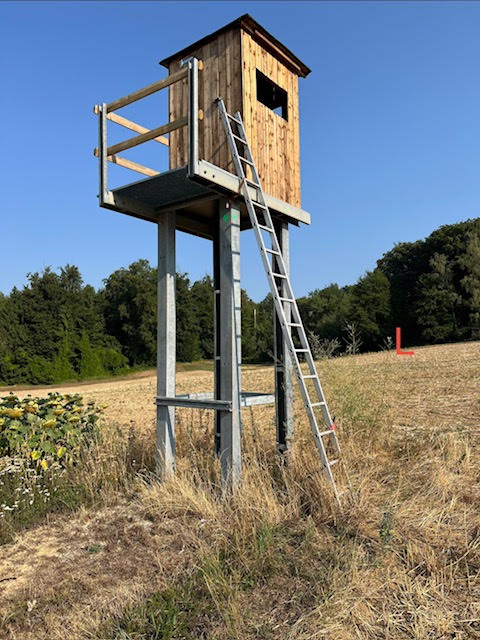
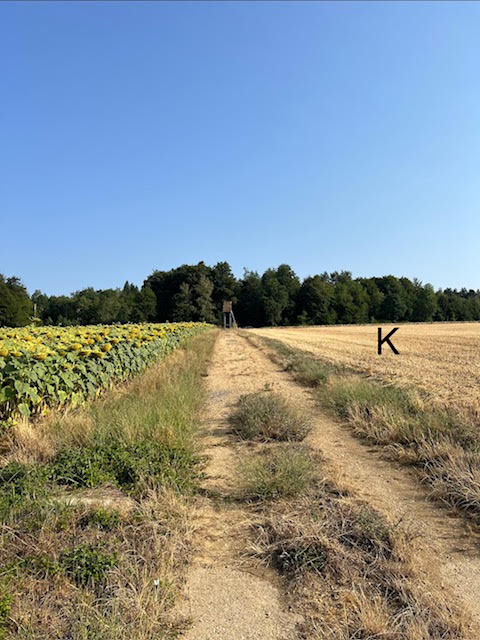
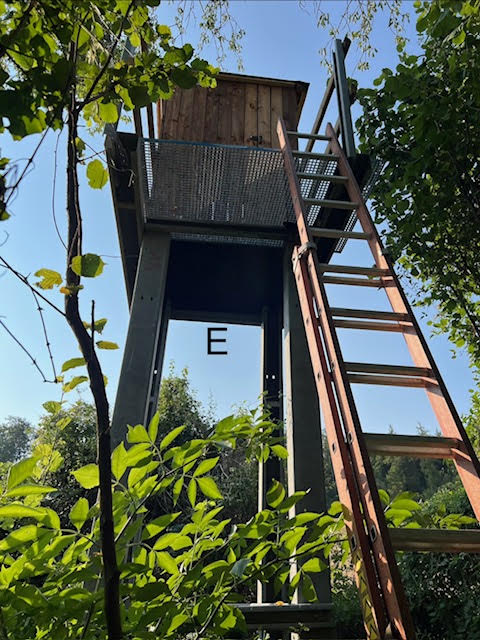
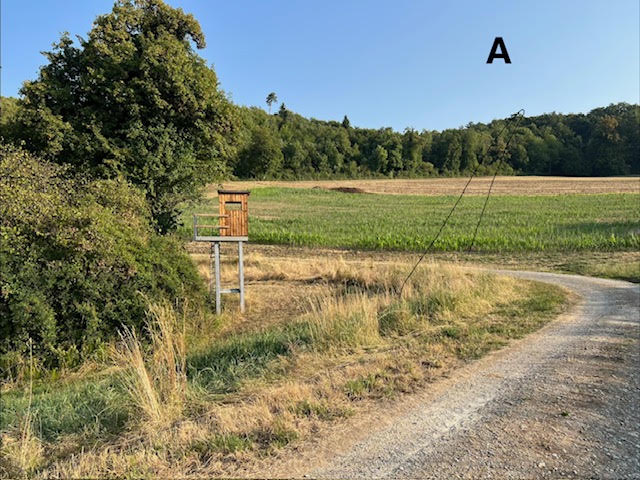
The photos do not show simple ladder stands. These are enclosed wooden cabins with a lean-to roof, a door and window openings, mounted on tall, hot-dip galvanised steel frames. Access is via permanently fixed metal ladders, in some cases supplemented by platforms with railings.



The cantonal practice
The canton names three criteria according to which hunting blinds in Aargau are exempt from the building permit requirement: a floor area, measured at the top, of no more than two square metres, no fully enclosed or glazed construction, and the consent of the landowner. In the assessment of the municipality and the canton, the two structures examined meet these conditions. No assessment has been made of the two blinds that emerged later.
Regarding the construction method, the building permit department states that the posts are merely set into the ground, neither on a foundation nor anchored. This means they fall under the practice mentioned above. If the posts were firmly set in concrete, however, a permit would be required.
The canton explicitly rejects a general site-boundedness for hunting installations under Article 24 of the Spatial Planning Act. This cannot be affirmed or denied as a matter of principle, but only on a case-by-case basis.
Who is responsible for oversight
In Aargau, the municipality is the responsible building police authority. It initiates proceedings when it becomes aware of unauthorised structures. The canton, where applicable, draws the municipality's attention to such structures and supports it with legal and procedural questions.
This means that oversight of hunting infrastructure outside the building zone lies with the municipalities — the level closest to any examination of the specific case, yet also the one with the fewest specialist resources.
What the criteria fail to capture
The cantonal criteria focus on the cabin: its floor area and its enclosure. The overall height of the structure is thus not captured. Both structures rise several metres above the ground on their steel frames and stand at field edges and embankment crests, from where they are visible from afar. A cabin can fall below the two-square-metre threshold and yet, as an overall construction, still dominate the open landscape.
This is not legally insignificant. According to the case law of the Federal Supreme Court, buildings and installations requiring a permit are those permanent structures that have a fixed relationship to the ground and significantly alter the external appearance of the area. What matters is whether an installation has spatial consequences important enough that the public has an interest in prior review. The cantons may interpret this federal concept more broadly, but not more narrowly. Whether a practice that relies solely on cabin floor area meets this standard remains an open question.
The choice of materials also points to permanence. Hot-dip galvanised steel is used because it remains weather-resistant for decades. Anyone building in this way is not preparing for a single season. Incidentally, galvanised components exposed to the elements release zinc into the surrounding soil as they weather – an effect that the canton of Zurich has documented for steel structures such as poles and lamp posts. Compared to the zinc loads from agricultural fertilisation, however, this input is barely significant.
Open questions
The canton's response is based on consultation with the municipality of Mettauertal. The reply does not indicate whether the ground area of the two hunting blinds was measured on site or whether the condition of the post footings was inspected.
It also remains unclear how the criterion of a not fully enclosed construction is applied in practice. The available photographs show cabins with a door, roof and window openings on several sides. Exactly where the boundary lies between an open hunting stand and an enclosed cabin is not evident from the response.
IG Wild beim Wild submitted these questions to Markus Krause, the section head responsible at the building permits department. Krause had answered the initial enquiry in detail within a few days in July; however, the canton did not respond to the follow-up questions concerning the basis for its own classification.
What the case reveals
The response from Aarau is instructive beyond this individual case, as it is the first time the Aargau practice has been explicitly named. The two-square-metre threshold corresponds to the rule also applied in the canton of Zurich.
At the same time, the case shows how far the permit-free zone extends. Structures several metres high, with a cabin, roof and fixed access ladder, can be erected outside the building zone without any procedure taking place, without public notice and without any possibility for third parties to comment. Whether a structure meets the criteria is only assessed once someone raises the question.
Wild beim Wild has long documented that in Swiss forests numerous high seats stand without a permit and that enforcement is patchy. On the legal situation regarding high seats in Switzerland, the case in Aargau adds another facet: here it is not a matter of a missing permit, but of no permit being required in the first place.
Addendum of 28 September 2026: How the canton disregards its own practice
Since the initial publication, the case has developed in several respects. These developments touch on the core of the open questions, and they paint a picture of how the responsible office handled a straightforward request for information.
The chronology
On 18 July 2026, IG Wild beim Wild submitted an enquiry to the Building Permits Division of the Department of Construction, Transport and Environment. Section head Markus Krause answered by email, in detail and within a few days. The channel of communication worked, the address was correct, the reply arrived.
On 31 July 2026, IG Wild beim Wild submitted a follow-up question. It concerned the basis of Krause's own classification: Was the base area of the platforms measured on site? Was the condition of the post feet inspected? How is the criterion of a structure not being enclosed all round to be interpreted? This follow-up question received no reply. Not within days, not within weeks, not by the end of August.
On 29 August 2026, IG Wild beim Wild therefore submitted a request for a mediation procedure under Section 31 of the Act on Public Information (IDAG) to the canton's Commissioner for Public Information and Data Protection.
On 24 September 2026, the data protection commissioner confirmed receipt of the request and invited the building permits department to submit a written statement. Only then did Krause get back in touch.
The reason given for the silence
In his reply, Krause explained that the email of 31 July had been routed directly by Microsoft into the quarantine folder and had never reached the department. It had only been found because of the registered letter. He added that IG Wild beim Wild had chosen this method of communication and had refrained from following up, so it could not count on a timely reply.
This explanation does not hold up. Krause had received and answered the original enquiry of 18 July via exactly the same channel and the same address. A route that demonstrably worked the first time does not turn into a lottery for a second matter sent to the identical address. Moreover, the sender is not responsible for a malfunctioning spam filter at the authority. Responsibility for one's own inbox lies with the authority that received an enquiry, not with the person who wrote it.
Above all, however, Krause's account contradicts the records of his own administration. He claims that IG Wild beim Wild had «waived a follow-up enquiry». The data protection commissioner's letter of 24 September states the opposite: it expressly refers to the «follow-up enquiry of 31 July 2026, to which, according to your information, no reply had been received by 28 August 2026». The follow-up enquiry whose existence Krause denies is recorded in the proceedings of his own data protection office.
The material underpinning the practice
Asked about a fact sheet or a directive, Krause replied that no such document existed. However, there was a presentation that JagdAargau had publicly shown at the 2023 autumn assembly, setting out the previous practice regarding hunting structures in the forest. This presentation, dated 20 September 2023, is available to the editorial team.
It distinguishes between two categories of hunting hides, and it does so precisely along the line whose interpretation had remained unresolved in July.
The presentation lists ladder stands, high seats and drive-hunt platforms as "not subject to building permit requirements". Three conditions apply to them: a footprint measured at the top of up to two square metres, the consent of the landowner and, as the slide literally states, communication "in the circular of 15 December 2015".
The pulpit, by contrast, is presented as its own separate category. The decisive feature is explicitly named on the slide: a pulpit is «in addition to being a high seat, enclosed all round and/or glazed». The conclusion is printed alongside in red text: «subject to building permit». The hunting cabin, too, is presented as requiring a permit, to be assessed under Article 24 of the Spatial Planning Act. A hunting purpose therefore does not exempt a structure from the permit requirement.
The contradiction in the classification
This means the information Krause provided in July stands in contradiction to his own department's classification scheme.
The photos of the reported structures in the Aare valley show enclosed wooden cabins with a door, a pent roof and window openings. According to the canton's own presentation grid, this is precisely the construction method that defines a pulpit, and pulpits are classified there as requiring a permit. Krause nevertheless classified the structures as permit-free elevated pulpits and applied the two-square-metre rule. However, the presentation names this rule for high seats and drive-hunt stands, not for the enclosed pulpit, where enclosure itself is the decisive criterion. He thus transferred the criterion of one category onto a type of structure belonging to the other category.
This becomes especially apparent in the presentation itself. The department illustrates the permit-requiring category, among other things, with the image of an enclosed wooden cabin with a pent roof, mounted on a tall frame at the edge of a field, with open countryside and power pylons in the background. This example resembles the structures documented in the Aare valley right down to the construction method.
The concealed circular letter
Another point concerns the completeness of the information provided. The IG Wild beim Wild had explicitly asked whether a guidance sheet or directive existed. Krause denied this and referred solely to the presentation. The presentation itself, however, cites as the basis for the exemption from permit requirements a «circular letter dated 15.12.2015». A circular letter is an official document, not an association's talk, and thus precisely the kind of written basis that had been asked about. Why it was not mentioned in response to the question about a directive, whether it is still in force, and what it states, remains unclear. The editorial team has requested that the document be released.
Who decides outside the building zone
The classification as exempt from permit requirements has a consequence that extends beyond the individual case. In its ruling 1C_170/2024 of 5 March 2025, the Federal Supreme Court confirmed that Article 25 paragraph 2 of the Spatial Planning Act requires an assessment by the competent cantonal authority for all building projects outside the building zone, regardless of whether the municipality approves or rejects them. This is intended to ensure that spatial planning law is applied uniformly and in accordance with the principle of equal treatment, and to prevent a municipal filter from being applied.
However, this requirement only applies if a building project actually exists. If a structure is classified as exempt from permit requirements, there is by definition no building application that would need to be decided at cantonal level. This is precisely why the classification is the decisive point. It precedes the question of jurisdiction. If an enclosed cabin is wrongly classified as a permit-exempt high seat, the cantonal assessment that would be mandatory for a structure correctly identified as requiring a permit is thereby also omitted. It therefore matters all the more whether the classification is based on an independent cantonal factual review or, as in the present case, on consultation with the municipality.
What the case reveals about enforcement
Krause referred the more in-depth questions to a separate supervisory complaint procedure. At the same time, the course of events so far already shows a great deal about the state of oversight of hunting-related structures outside the building zone.
A statement that assigns an enclosed cabin to the category of an open high seat, even though the department's own division explicitly distinguishes between the two types of structure. An enquiry that remains unanswered for months and whose existence is later disputed, even though it is documented in the data protection authority's proceedings. A written basis from 2015 that is not mentioned when directly asked about it. And a response that only materialises once the data protection commissioner intervenes.
In July, the central open question was where the boundary lies between an open high seat installation and an enclosed cabin. This question is now answered by the canton's own material: it is the enclosed nature that turns a high seat into a pulpit blind, and according to the described practice, a pulpit blind requires a permit. This is therefore no longer solely a matter of patchy enforcement, but the question of whether enclosed structures were classified as permit-free high seats when, according to the scheme used by the responsible department, they should have been treated as permit-requiring pulpit blinds.
Addendum of 29 September 2026: The 2015 circular letter proves the permit requirement
In response to the requested disclosure, the canton provided the «circular letter of 15.12.2015». The document comes from the Department of Forestry, Hunting and Fisheries within the Department of Construction, Transport and Environment and was sent at the time to all hunting associations. It is the basis to which the 2023 presentation refers in support of the permit-free practice. And it answers the central question of this case unambiguously.
Under the heading «High seats and building permit requirement», the circular letter states that the permit requirement was reviewed following enquiries from municipalities. The result, verbatim: «In summary, it can be said that no building permit is required for commercially available, open high seats with an area of a maximum of 2 m². Enclosed hides and larger high seats, however, are subject to the building permit requirement.»
This means that the permit requirement for enclosed hides has been part of the canton's own basis since 2015. Not in an association's slide, but in a circular letter from the canton to the hunting associations, signed by the then head of section and the head of department. According to this wording, the two-square-metre threshold explicitly applies only to open high seats. It does not apply to enclosed hides.
The structures documented in the Aare valley are enclosed wooden cabins with a door, roof and window openings. According to the clear wording of the circular letter, they are therefore subject to a building permit requirement. The classification by the head of the building permits section, who described the same structures as permit-free while applying the two-square-metre rule, contradicts the canton's own basis.
What is more, the circular itself points out that the circulars and the associated documents can be accessed digitally on the cantonal homepage. It is therefore a published, publicly accessible basis. When asked explicitly about an information sheet or guideline, the canton had initially replied that no such document existed. The circular is now in the editorial team's possession.
In his accompanying email delivering the document, the section head states that, in his assessment, the new questions are also part of the ongoing supervisory complaint proceedings. This once again refers the substantive response to a different procedure. It is also notable that this response was again sent by email, via the very channel that the canton had previously blamed for the months-long failure to respond.
As for the core of the case, the situation is clearer than ever following the delivery of the circular. The question is no longer where the boundary lies between a high seat and a hunting blind. The canton itself has drawn this boundary in its own guidance for ten years, namely at the point of enclosure. The question is why enclosed hunting blinds in the Aare Valley were classified as permit-free high seats, even though the canton's own circular explicitly subjects them to a building permit requirement.
More on the subject of recreational hunting: The scientific evidence is presented in the overview Studies on the Effects of Recreational Hunting.
The position of IG Wild beim Wild: IG Wild beim Wild rejects recreational hunting. Our model is the canton of Geneva, which has managed without recreational hunting since 1974: without hunting seasons, without hunting dogs, without driven hunts, without high seats, without the animal cruelty and crime that go hand in hand with hunting season elsewhere. What has worked there for over fifty years disproves every position paper by JagdSchweiz. An association that bases its policy on claims it refutes in its own documents is not a professional organisation, but a factory for misinformation.
Wild animals need a voice
Once a week: research, petitions and background information on recreational hunting. Free of charge and can be unsubscribed from at any time.

All articles are written by IG Wild beim Wild as well as by external co-authors. Research, structuring and editorial processes may be supported by AI-assisted tools.
Support our work
With your donation you help protect animals and give their voice a hearing.
Donate now →