Gansabhauet Sursee: 60 people protest, municipal commission sticks with the dead goose
Eleven sabre blows, 3,500 spectators and a municipal commission that sees no need for action.
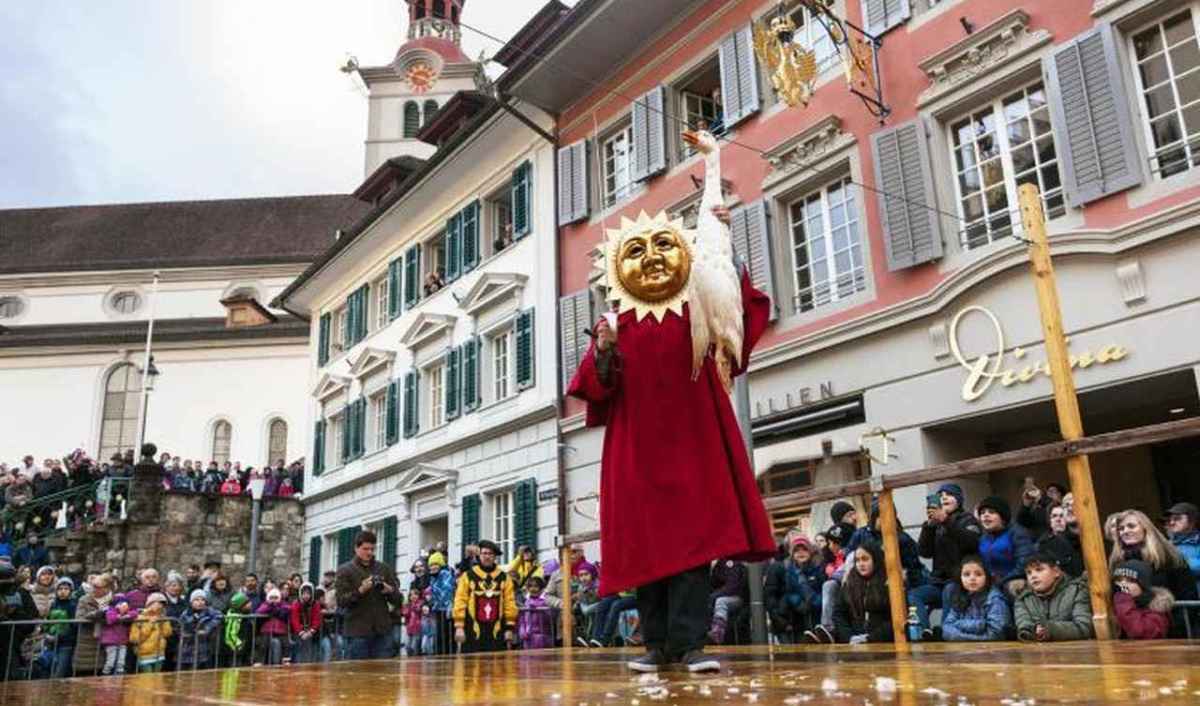
Gansabhauet in Sursee (archive photo). Photo: Bruno Meier, Sursee / Sursee municipal picture gallery
What I Won't Pass On
The Gansabhauet was held again in Sursee (LU) on 11 November 2026. In front of the town hall, masked participants struck two dead geese, hung from a wire rope, with a blunt sabre until the neck was severed. Eleven blows were needed in total: the first goose's neck was severed with the seventh stroke, the second's with the fourth. Each participant had one attempt. This was reported by the news agency Keystone-SDA, citing information from the town. 78 men and eleven women had registered to strike, and an estimated 3,500 people looked on.
On the margins of the public festival, around 60 animal welfare activists protested, according to Tele 1. Their banners read “Shame on you” and “Tradition is no excuse”. Their demand is simple: the geese should be replaced with dummies.
Who is responsible for the Gansabhauet
The Gansabhauet is not a private event. It is organised by the Gansabhauet Commission, a commission of the town of Sursee based at the address of the municipal administration. According to the town, it is responsible for organisation and implementation and is made up of representatives of the town of Sursee, the carnival guild Heini von Uri and the Lucerne police. It is chaired by Sara Steiner. The Sursee town council, led by mayor Sabine Beck-Pflugshaupt, also joins the procession to the town hall each year.
Steiner defended the custom to SRF with the words: «As we understand it, we are not acting against the dignity of the animal. Rather, the event takes place in honour of the goose, because in the past it was a valuable animal.» She rejects any change: «As long as we have spectators and people sign up to do the striking, we will stick with it.» There is, she says, no need for action.
Her predecessor Erich Felber had already stated in 2022 to 20 Minuten that a fake goose had «never been an issue» in Sursee. The Gansabhauet is on the Federal Office of Culture's list of living traditions, which according to Wildlife has been maintained since 2012.
Opposition has lasted for years
Wednesday's protest is not an isolated incident, but the latest stage of a dispute that has been running for years:
- 2022: Together with other activists, the animal rights activist Olivier Bieli launches the petition «Abolish the Gansabhauet» to the Sursee city council on Campax. Meret Schneider, then a member of the National Council, publicly criticises the custom.
- 2025: Bieli files a criminal complaint with the Lucerne public prosecutor against the committee head, for alleged disregard of animal dignity. The public prosecutor confirms receipt to 20 Minuten. According to the newspaper, it was the first complaint in the history of the custom. A decision on it is not mentioned in the reports on this year's Gansabhauet.
- 2026: Bieli organises the on-site demonstration on behalf of several animal welfare associations. He told Tierwelt it was the first protest «of this size» in the history of the event.
Bieli told SRF: «Here animals have to die so that people can have their fun.» And he added: «We also tell our children they must not pull cats by the tail or kick dogs. And then we do something like this to the geese.»
A festival for children, with a day off school
The supporting programme is explicitly aimed at children and young people: pole climbing, sack races, pulling faces, and in the evening the Räbeliechtli lantern parade. According to 20 Minuten, schoolchildren in Sursee have the day off. Bieli points out that, year after year, the footage shows dozens of children standing at the very front of the stage while adults cheer as the head is severed from the body.
Wild beim Wild has examined the questions raised when violence against non-human animals is framed as a festival for children in the article Children, hunting and the socialisation of violence and in the dossier Hunting and children.
Animal dignity: what legal experts say
Switzerland protects the dignity of animals in the Federal Constitution (Art. 120 para. 2) and in the Animal Welfare Act (Art. 1 and Art. 3 lit. a). Whether and to what extent this protection also extends to dead animals has not been settled in law. Gieri Bolliger and Andreas Rüttimann of the Foundation for Animals in Law expressly name the Sursee Gansabhauet, in a specialist article, as a custom that should be "critically examined". The Animal Welfare Act essentially applies to living animals, they write, but it is "not far-fetched" to bring the dignity of dead animals under statutory protection as well.
Animal rights lawyer Antoine F. Goetschel told 20 Minuten in 2022 that the problem with the Gansabhauet is that "the death of an animal is ritually celebrated". A ban cannot, however, be derived without a change in the law. He proposed extending the offence of disturbing the peace of the dead (Art. 262 of the Criminal Code) to vertebrates. "This ritual, even with dead geese, hardly seems in keeping with the times," said Goetschel.
The Foundation for Animals in Law (TIR) has once again commented on this year's Gansabhauet in a social media post. It writes that the violent severing of the head becomes a public spectacle and a competition, with violence against animals staged as entertainment and socially normalised. The fact that the goose is already dead, it says, does not automatically make the handling of its body unproblematic: in the TIR's view, animal dignity must not end with death. That a custom has been practised for generations is not a sufficient argument for exempting it from critical scrutiny. What the Constitution says about animal dignity is shown in the article Animal dignity and hunting. The same open question concerns Wild beim Wild in the case of the trophy photos of recreational hunters: the template motion Protecting animal dignity beyond death sets out proposals for political action on this.
Sursee already knows geese made of wood
When the Gansabhauet was cancelled in 2020 because of the pandemic, a goose that could be used in play stood in front of the town hall, according to the Bote der Urschweiz. In 2021, according to a statement from the city council, the town had wooden geese by the Sursee sculptor Elias Zürcher put up to commemorate the custom. These installations were not a substitute run of the Gansabhauet. They do show, however, that the symbol of the custom can be preserved without a real animal's body. Pole climbing, sack racing, turnip lanterns and the procession need no dead animal anyway.
Commentary: Primitive remains primitive, even with official approval
The event needs to be described once without the folklore. Adults drink a sip of white wine, have their eyes blindfolded and take turns striking with a blunt sabre at the neck of a hanging dead bird until the body falls to the ground. Thousands look on. The schoolchildren of Sursee have the day off. It is organised not by a club in some back room but by a municipal committee led by Sara Steiner, with representatives of the city of Sursee, the Heini von Uri guild and the Lucerne police, and with the city council taking part in the procession.
This is a primitive ritual. It does not become more dignified because it is old, nor more harmless because the goose is already dead. The geese are, in the words of the committee leader, "deliberately selected", as she told 20 Minuten in 2025. Their bodies serve a public beheading ritual. Anyone who wants to "honour" a non-human animal does not hang it from a wire and let an audience watch as blow after blow is struck. The formula "in honour of the goose" is the same reinterpretation known from the Hubertus Mass, where the killed creature is blessed, and against which vigils are again being held in 2026.
Sursee knows the pattern. In February, in the same city, the pelts of killed foxes are traded at the Zentralschweizer Fäälimärt, likewise under the label of tradition. How recreational hunting frames its violence with festival catering, raffles and children's entertainment is shown by the dossier Recreational hunting as an event. The Gansabhauet works on the same logic: anyone who turns the handling of killed animals into a public festival immunises it against criticism. Every objection is then treated as an attack on the homeland.
Tradition is no justification. Bear fights, cockfights and dancing bears were once regarded as tradition too, until society no longer tolerated them. Sara Steiner herself named the yardstick: as long as spectators come and people sign up to strike, everything stays as it is. But the fact that people want to watch does not answer the question of whether real animal bodies are needed for it. The call for dummies is not directed against sack races, Räbeliechtli lantern parades or the shared festival, but against the beheading ritual. The lever lies with everyone who attends, and with the Sursee city council: it should ensure that the municipally run event does without real animal bodies in future.
Further articles on this topic can be found in the section animal rights.
More on the subject of recreational hunting: What the research says about this is shown by Hunting fact-checked: the state of research.
The position of IG Wild beim Wild: IG Wild beim Wild rejects recreational hunting. Our model is the canton of Geneva, which has managed without recreational hunting since 1974: without hunting seasons, without hunting dogs, without driven hunts, without high seats, without the animal cruelty and crime that go hand in hand with hunting season elsewhere. What has worked there for over fifty years disproves every position paper by JagdSchweiz. An association that bases its policy on claims it refutes in its own documents is not a professional organisation, but a factory for misinformation.
Wild animals need a voice
Once a week: research, petitions and background information on recreational hunting. Free of charge and can be unsubscribed from at any time.

All articles are written by IG Wild beim Wild as well as by external co-authors. Research, structuring and editorial processes may be supported by AI-assisted tools.
Support our work
With your donation you help protect animals and give their voice a hearing.
Donate now →