Wolf kills in Ticino: Only 6 of 131 animals were protected
The canton's own statistics prove the scale of the problem, its labels contradict one another, and the appeals court will decide by the end of the year on IG Wild beim Wild's access to the files.

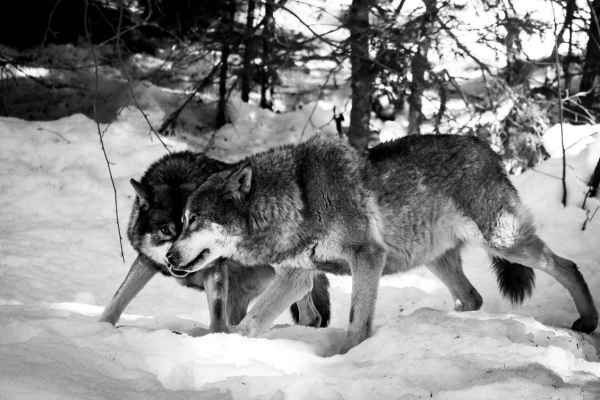
Photo: Kevin Schmid / Unsplash
«No fence, no herder»
Of 131 non-human animals whose deaths the canton of Ticino attributes to the wolf between January and October 2026, barely six were adequately protected. These are not figures from IG Wild beim Wild, but the canton's own. IG Wild beim Wild filed its fourteenth criminal complaint on 2 November 2026, and the Ticino appeals court has announced a decision on access to the files by the end of the year.
What the canton's statistics show
The Ufficio della caccia e della pesca publishes a monthly chart entitled «Lupo – Predazioni 2026». The current version is updated to 30 October 2026. For January to October it records 46 kills attributed to the wolf, involving 131 animals killed or fatally injured.
Broken down by protection status, the picture is as follows:
- 61 animals died in situations where the canton classes protection as “not reasonable”.
- 48 animals died where protection was inadequate (“protezione non adeguata”).
- 13 animals died where protection was inadequate “due to force majeure”.
- 6 animals died despite adequate protection.
- For 3 animals, the canton provides no information.
According to the canton's own statistics, 122 of the 131 animals killed, or 93 per cent, were therefore explicitly not effectively protected. At the end of July, according to the Gruppe Wolf Schweiz tally, Ticino was in second place nationwide with 69 animals killed, behind Valais with 130. In the Grisons the figure at the same point was 29, in Vaud 5. Across Switzerland excluding Ticino, the number of livestock killed fell from 402 to 183 compared with the previous year, mainly thanks to stronger herd protection, as we showed in our mid-season review of the alpine summer. Where protection is in place, the number of kills falls. In Ticino, there is hardly any protection.
Five kills at the same spot
How little the official finding “animals not sufficiently protected” achieves is shown particularly clearly by a single location in the Luganese. At the coordinates 720366 / 101097 in Villa Luganese, a goat died on 29 July 2026 and three more were injured. At exactly the same spot, two sheep had been killed and a goat injured on 5 July. Some 50 metres away, in Cadro, three sheep died on 29 May, and some 90 metres away, six sheep and a goat on 13 March. As early as December 2024, the canton reported three dead sheep and one dead goat in the same square kilometre.
Five kills in the tightest of spaces, each time with the same finding. The IG Wild beim Wild reported this location on 16 March and 10 July 2026. Three of the kills occurred after the first report, one even after the second. Neither the animal keeper nor any authority has visibly drawn any consequences from this. We have previously described how the Ticino veterinary office handles such cases: “Ticino veterinary office looks away, animals die”.
“Force majeure” in the Val Bedretto
On 5 August 2026, three sheep died in the Val Bedretto, and a fourth had to be put down. On 28 August another sheep followed. The canton classifies both cases on its case list with the same formula: “non protetti adeguatamente per cause di forza maggiore”, inadequately protected due to force majeure. The kills of 8 and 9 September in the same valley carry the same formula. It is a contradiction in terms, and the canton uses it routinely.
Force majeure presupposes an unforeseeable event. In the Val Bedretto, the canton has documented wolf kills since 2004. In the immediately adjacent square kilometre, eleven sheep were killed on each of two occasions in July and August 2024, and since August 2025 the area has been regarded as the territory of the 'Bedretto' pack. At the same time, on 15 and 20 August 2026, the canton classified two kills in the same valley as «protetti adeguatamente». So protected flocks do exist there. When one flock is protected and another is not, that is not force majeure but an omission.
The same pasture, two labels
In Brione Verzasca, fourteen sheep died between 6 and 11 August 2026. At location 699904 / 129911, the classification on 9 August was «non proteggibili», not protectable. Two days later, at the identical location, it read «forza maggiore». Both cannot be true at the same time.
The picture is similar in Gordevio in the Maggia Valley: in November 2020, the canton reported five goats killed there, with the note «animali non protetti». Since 2024, the same area has consistently been classed as 'not protectable', most recently on 6 September 2026. Barely three kilometres further on, the canton classified a kill in July 2025 once again as «non protetti adeguatamente». The terrain has not changed, but the label has. How little the classification 'not protectable' means is shown by the Alpe Bri/Ninagn: the canton had classed it as not reasonably protectable, yet the shepherd protects his roughly 360 sheep there all the same, with livestock guardian dogs, fences and a night pen.
The appeals court will decide by the end of the year
How the authorities handle the complaints is the subject of the pending proceedings before the Corte dei reclami penali in Lugano. In June 2026, the Ticino public prosecutor refused the IG Wild beim Wild and its founder party status, and with it access to the files of their own criminal complaints. The IG Wild beim Wild lodged an appeal on 18 June. In its statement of 30 June, the public prosecutor conceded that not even police reports yet existed for the reported cases and that no suspects had been identified, more than eight months after the first complaint.
By letter dated 26 October 2026, the president of the Corte dei reclami penali has now announced that the appeal will be decided by the end of this year. Since the start of the proceedings, IG Wild beim Wild has sent the court a copy of every new criminal complaint. The fourteenth, filed on 2 November 2026, covers ten cases between 29 July and 6 September, involving 25 animals killed. In total, according to its own count, the complaints filed by IG Wild beim Wild since October 2025 now cover 34 incidents with at least 116 animals killed.
Comment: Not protectable does not mean not here
The canton's labels serve a clear purpose. Animals classed as “not protectable” count towards wolf kills as though they had been protected. Anyone who takes their animals to a place where, by their own account, they cannot be protected is not reprimanded but instead supplies the justification for the next kill. In September and October 2026, wolves from the Molare and Camoghè packs were already killed in Ticino. For every kill, the canton pays the recreational hunters a bounty of 500 francs. Our wolf kill counter.
Would it be tolerated with chickens, horses or cattle if keepers left their animals unattended in a place they themselves described as unprotectable? With sheep and goats, apparently, exactly that is accepted. Yet responsibility does not begin with the fence, but with the choice of pasture. A place that cannot be protected is no place for unprotected sheep.
The canton records the kills and classifies them as “not protectable” or “force majeure”, yet no consequences for the animal keepers are discernible. At the end of June, more than eight months after the first complaint, the public prosecutor had still not identified any accused person. The price of unprotected animal husbandry is paid by the animals: the sheep and goats that die without protection, and the wolves that are shot for it. Background on the role of the wolf can be found in our Wolf in Switzerland dossier, with further articles in the section animal rights.
More on the subject of recreational hunting: What the research says about this is shown by Hunting fact-checked: the state of research.
The position of IG Wild beim Wild: IG Wild beim Wild rejects recreational hunting. Our model is the canton of Geneva, which has managed without recreational hunting since 1974: without hunting seasons, without hunting dogs, without driven hunts, without high seats, without the animal cruelty and crime that go hand in hand with hunting season elsewhere. What has worked there for over fifty years disproves every position paper by JagdSchweiz. An association that bases its policy on claims it refutes in its own documents is not a professional organisation, but a factory for misinformation.
Wild animals need a voice
Once a week: research, petitions and background information on recreational hunting. Free of charge and can be unsubscribed from at any time.

All articles are written by IG Wild beim Wild as well as by external co-authors. Research, structuring and editorial processes may be supported by AI-assisted tools.
Support our work
With your donation you help protect animals and give their voice a hearing.
Donate now →