Violence and dead animals: Britain's hidden world of recreational hunter gangs at illegal hare coursing
A BBC investigation reveals how criminal gangs of recreational hunters in England organise illegal coursing of hares, terrorise farmers and leave messages using dead animals.
On a remote farm in the English county of Cambridgeshire, Mathew Latta is startled during his lunch by the loud noise of engines.
More than a dozen off-road vehicles break through his farm gate, over 70 people in military clothing and balaclavas get out, and dogs are let off the leash. The vehicles race across the fields at high speed, destroying crops and grazing the family's garden fence.
Latta describes it as a fully organised coursing event with participants and competition dogs, where spectators watch and place bets. He found it extremely frightening. His daughter, then seven years old, kept asking whether the men would come into the house.
Only after more than three hours does the pack move on. Left behind are four vehicles, one of them burnt out. The convoy had previously moved through an area of the county roughly 32 kilometres long, forcing other vehicles off the road and even robbing a petrol station.
An old “sport” that lives on underground
Hare coursing is an old form of recreational hunting in which greyhounds or lurchers chase hares that have first been flushed from their hiding place. Points are awarded for how often the dogs force the running hare to turn, as well as for the catch itself. In Great Britain this form of recreational hunting was banned in 2005, having reached its peak in the 19th century. Since then it has persisted as an illegal underground business, run by gangs who use intimidation and violence to prevent any oversight.
BBC investigations uncovered what lies behind this facade: a hidden network of highly organised illegal coursing events in rural areas, often at night under floodlights, with trophies, large cash prizes, valuable hunting dogs and, in some cases, even international betting.
Almost 9’000 reports in three years
According to police responses to Freedom of Information Act requests, the BBC recorded almost 9’000 reports of hare coursing across the country over the past three years. There are no official crime statistics for this offence, so the number of unreported cases is likely to be correspondingly high.
In the case of Latta's Farm, the Cambridgeshire police subsequently launched an intensive investigation. Over 40 people were arrested and 25 charged, several of whom have since been convicted. Some of the perpetrators had travelled from far-off regions, such as Lincolnshire, Leicestershire, Berkshire and North Wales. A senior police officer describes it as “a proper operation”.
During a house search, the police eventually secured the trophy that had been competed for: the “Super 8 Cup”, decorated with images of dogs and hares, around 61 centimetres tall, roughly the size of the English FA Cup trophy.
A multi-million business in dogs and betting
The scale of the financial interests behind illegal recreational hunting is considerable. In a video seen by the BBC, eight men can be seen haggling in a pub over a lurcher standing on the table in front of them. The dog was the champion of the 2025 Super 8 Cup and was sold for 55’000 pounds.
The prize pool of the Super 8 Cup is said to have been around 50’000 pounds, with an entry fee of 1’000 pounds per participant. According to the police, this money goes, among other things, into vehicle pools and even into legal costs in the event of a raid.
The head of the UK's national wildlife crime unit also confirms that, in individual cases, money from livestreams for gamblers in China flowed into the illegal business. Foreign betting was not, however, existentially necessary for the British gangs to finance their hobby.
This is not “minimum-wage crime” but rather some of the country's best-organised criminals, according to the investigator. While there continue to be smaller, local events involving a handful of men and dogs, the degree of organisation of larger events has increased tenfold through the influence of organised crime.
Terror against farmers
Of 27 identified prime suspects in the field of hare coursing, all but five have connections to organised crime, according to investigators. They are violent criminals who abuse people, animals and women, carry weapons and issue threats.
A survey of around 50 landowners and businesses, carried out through the industry body Country Land and Business Association, paints an alarming picture. Almost all respondents reported property damage, one business in Essex reported over 100 incidents, and a farm in North Yorkshire as many as 150. 29 of the respondents stated that they had been threatened with violence.
These included threats to abduct dogs, burn down buildings, anonymous calls with death threats, attacks on vehicles with catapults, as well as hints that they knew where the families lived and where the children went to school.
A farmer in Wiltshire tried to secure his roughly 1’200-hectare land with concrete blocks, tree trunks and ditches. In vain — the gangs continue to intrude, and attempts at confrontation end with threats against him personally.
Dead animals as a message
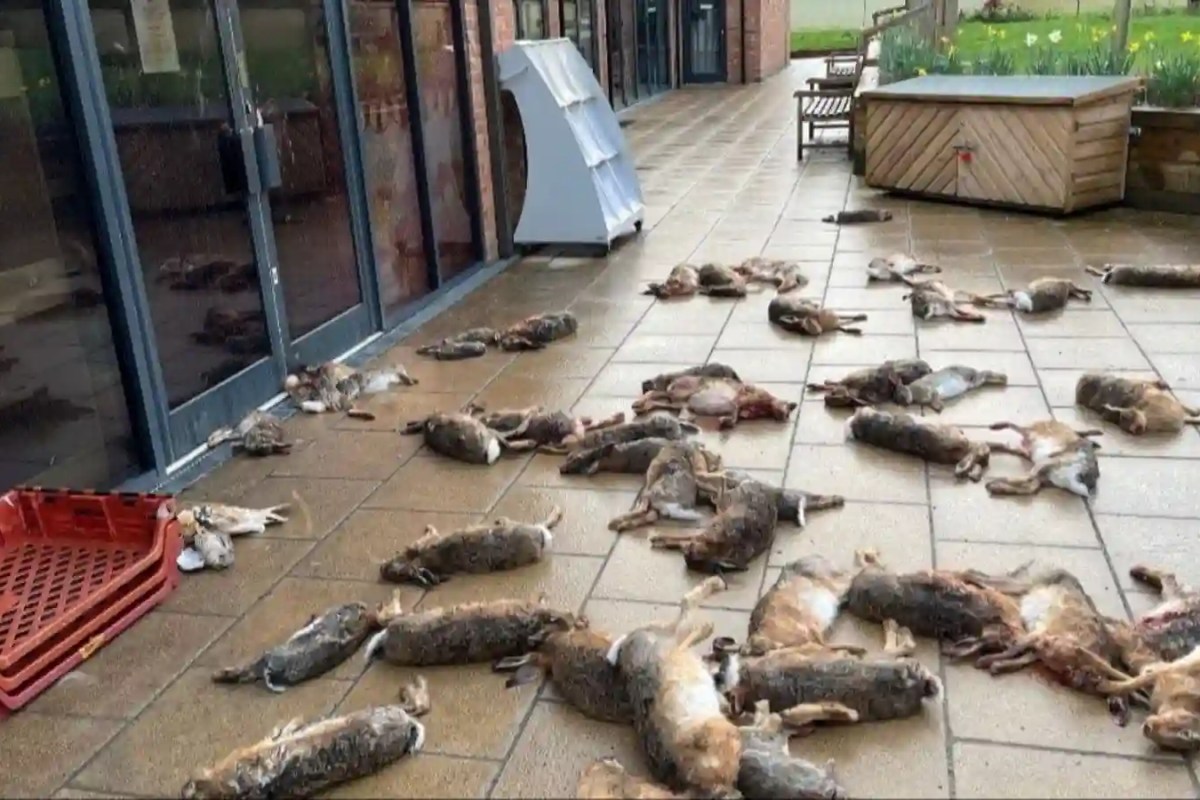
A particularly shocking aspect of the investigation concerns the deliberate dumping of dead animals for intimidation. In the village of Awbridge in Hampshire, more than 20 carcasses, including a headless muntjac deer, were laid out in front of a primary school. In Broughton, around 50 dead hares along with a dead barn owl and a dead kestrel were scattered in front of the village shop.
A former game warden who knows the affected region well interprets such actions as a message: that they had been there, but had not let themselves be caught. In the survey of landowners, 35 respondents stated that dead animals had been deliberately left behind on their land. The message to the local population, they said, is: you can do whatever you want, because no one is checking.
In the Broughton case, following forensic analysis of the dead birds of prey, the police managed to make an arrest. The suspect was convicted of possession of the protected dead birds, but acquitted of the charge of criminal damage for dumping the carcasses, since the image recordings did not allow a clear identification.
One police officer reports on a particularly unmistakable case: animal carcasses were once laid out on a road in such a way that they spelled out the words «catch me».
Assessment: a familiar pattern in Switzerland too
The BBC investigation demonstrates, in exemplary fashion, how organised crime nests itself within forms of recreational hunting as soon as control and enforcement are lacking. In Great Britain this happens entirely outside any licence, through gangs that continue to run an underground bloodsport business that was banned in 2005.
In Switzerland a related, but differently situated, problem appears within the legal system: in our section Crime & Hunting we repeatedly document cases in which licensed recreational hunters with legal access to firearms became perpetrators of violence against people. In the case of Faido and Leontica a man confirmed to be a recreational hunter shot his ex-wife, allegedly using a silencer that is available to recreational hunters through exemption permits under hunting law, and subsequently blew up a house, injuring several police officers.
Both cases, the British one as well as the Swiss one, ultimately raise the same fundamental question: how consistently is access to lethal weapons in the recreational hunting environment actually controlled, whether by organised gangs outside the law or through inadequate aptitude assessments within the legal system?
In the view of the IG Wild beim Wild, for hobby hunters annual medical-psychological aptitude assessments modelled on the Dutch example, as well as a binding upper age limit. The largest age group among recreational hunters today is 65+. In this group, age-related impairments such as declining eyesight, slowed reaction times, reduced concentration and cognitive deficits increase significantly in statistical terms. At the same time, accident analyses show that the number of serious hunting accidents involving injuries and fatalities rises significantly from middle age onwards.
The regular reports of hunting accidents, fatal mishandlings and the misuse of hunting weapons highlight a structural problem. The private ownership and use of lethal firearms for leisure purposes largely escapes any continuous control. In the view of IG Wild beim Wild, this can no longer be justified. A practice based on voluntary killing while at the same time generating considerable risks for humans and animals loses its social legitimacy.
Hobby hunting is also based on speciesism. Speciesism describes the systematic devaluation of non-human animals solely on the basis of their species membership. It is comparable to racism or sexism and can be justified neither culturally nor ethically. Tradition is no substitute for moral scrutiny.
In the field of recreational hunting in particular, critical scrutiny is indispensable. Hardly any other field is so shaped by embellishing narratives, half-truths and targeted disinformation. Where violence is normalised, narratives often serve as justification. Transparency, verifiable facts and an open public debate are therefore indispensable.
More on the subject of recreational hunting: In the dossier The Role and Criticism of Recreational Hunters we shed light on the training, power and self-image of recreational hunters. The scientific evidence is presented in the overview Studies on the Effects of Recreational Hunting.
The position of IG Wild beim Wild: IG Wild beim Wild rejects recreational hunting. Our model is the canton of Geneva, which has managed without recreational hunting since 1974: without hunting seasons, without hunting dogs, without driven hunts, without high seats, without the animal cruelty and crime that go hand in hand with hunting season elsewhere. What has worked there for over fifty years disproves every position paper by JagdSchweiz. An association that bases its policy on claims it refutes in its own documents is not a professional organisation, but a factory for misinformation.
Support our work
With your donation you help protect animals and give their voice a hearing.
Donate now →